Why the herd follows its oldest.
In a drought, the elephant herds that fare best follow their oldest female, who remembers the last one. What that tells us about the elders in our own families.
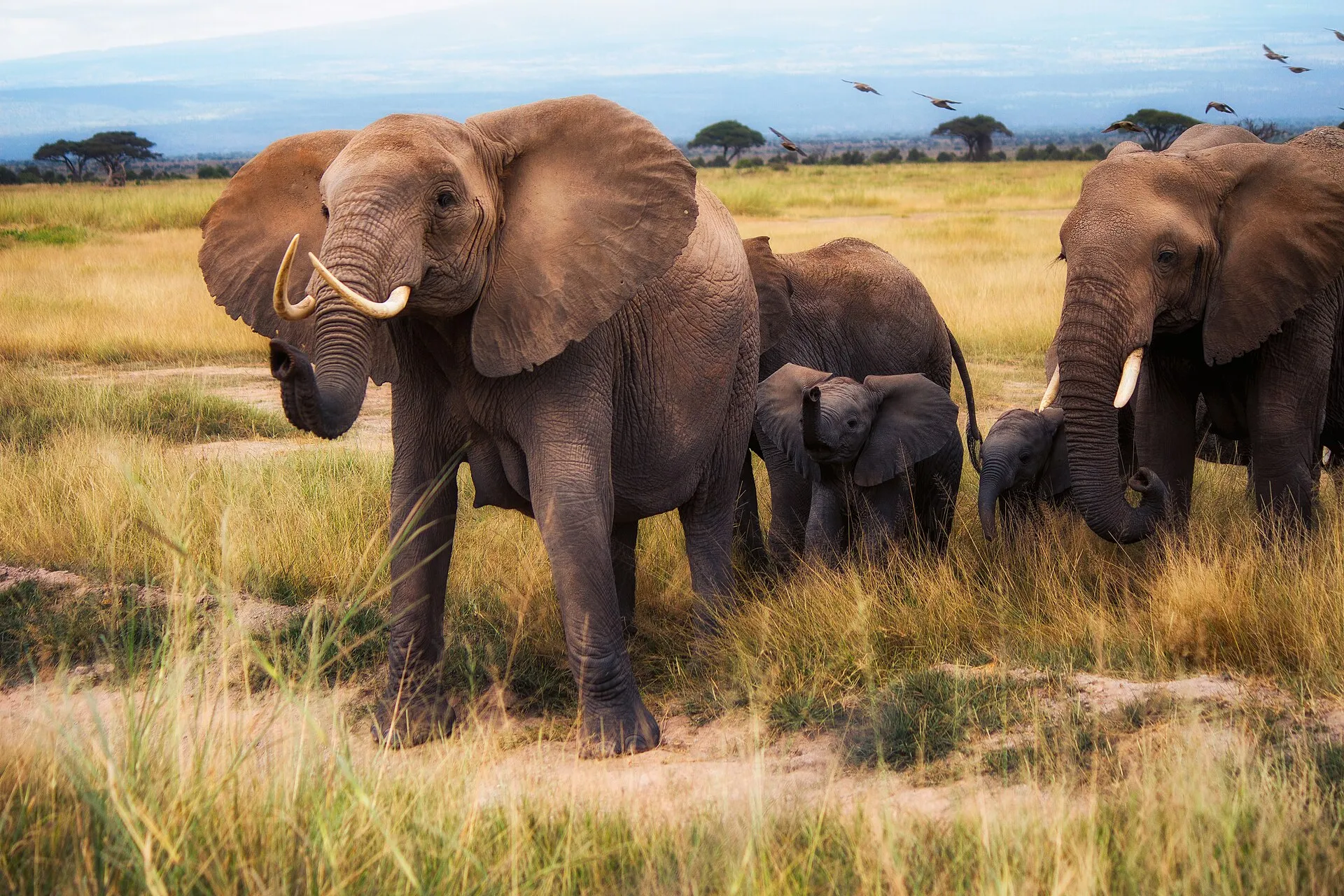
In 1993, Tarangire National Park in northern Tanzania went through the worst drought in decades. Researchers from the Wildlife Conservation Society had been following three elephant family groups there, and what happened to them became one of the clearest illustrations of why the elephant matriarch, the oldest female who leads each family, matters so much.
Two of the families left the park. They were led by matriarchs aged 45 and 38. The third family stayed, and it was led by a younger matriarch, aged 33. Across the three groups, roughly one in five calves died that year. But the losses were not spread evenly. According to the researchers, the family that stayed behind accounted for most of the deaths.
Charles Foley, Nathalie Pettorelli and Lara Foley, who published the study in Biology Letters in 2008, offered a cautious explanation. The last drought of comparable severity had struck the region decades earlier. The older matriarchs were alive then; the family that stayed had no one old enough to remember it. The two families that survived best may have been following a memory of where water could be found the last time the rains failed.
The researchers called this a hypothesis, and it is one. But it fits a larger body of evidence, built up over decades of fieldwork, that points to the same conclusion: in an elephant family, the oldest member is not a passenger. She is the archive.
What does an elephant matriarch actually know?
Elephant families are led by females. Males leave in adolescence; the family that remains is a group of related mothers, daughters, sisters and their calves, usually led by the oldest of them. Wild African elephants can live for sixty years or more, which means a matriarch may carry half a century of experience.
In 2001, Karen McComb and her colleagues at the University of Sussex published a study in Science titled “Matriarchs as Repositories of Social Knowledge in African Elephants.” Working in Amboseli National Park in Kenya, where elephant families have been studied continuously since the 1970s, they played recordings of other elephants’ contact calls to family groups and watched how they responded.
Elephants in Amboseli know the voices of many other families. A call from a familiar family is no cause for alarm; a call from strangers can mean harassment and danger to calves. The researchers found that families led by older matriarchs were much better at telling the two apart. They bunched together defensively at the voices of strangers and ignored the voices of acquaintances. Families with younger matriarchs were less selective, more likely to treat friends as if they were strangers, which in the wild means wasted energy and constant false alarms. The families with older matriarchs also appeared to raise more calves.
A decade later, the same team tested something more dangerous. In a 2011 paper in the Proceedings of the Royal Society B, they played the roars of lions to 39 Amboseli families. Male lions are far more dangerous to elephants than females, because they are big enough to bring down a calf. The older the matriarch, the more strongly her family reacted to a male lion’s roar. Families with younger matriarchs tended to under-react to exactly the sound that should have frightened them most.
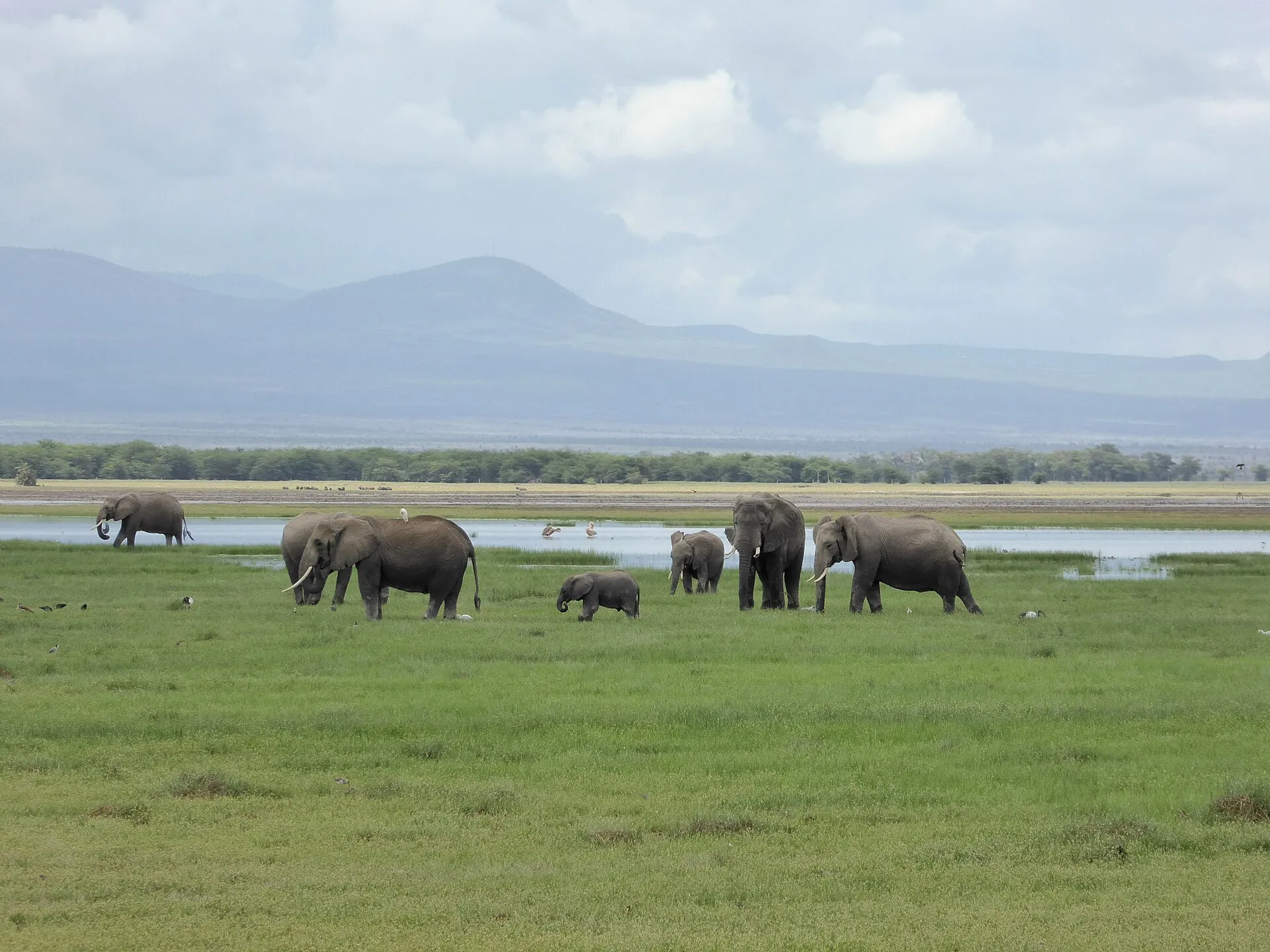 “Elephant family” by Regina Hart, 2016. CC BY 2.0.
What happens when the old ones are gone?
The most striking evidence comes from a natural experiment no one would have chosen to run.
In the 1980s and 1990s, South Africa’s Kruger National Park controlled its elephant population by culling. Whole family groups of adults were killed, and some of the young survivors were moved to other reserves, including Pilanesberg National Park. These orphans grew up in a population with almost no older elephants.
The first sign that something was wrong came from the young males. From 1992, adolescent bulls in Pilanesberg began killing white rhinoceroses, more than 40 of them in about five years. In a 2000 paper in Nature, Rob Slotow and his colleagues reported the likely cause. The young bulls were entering musth, a period of heightened testosterone and aggression, far earlier and for longer than normal. In an intact population, older bulls suppress this. In 1998 the park brought in six adult bulls. The young males’ musth episodes shortened, and over the following 20 months not a single rhino was killed by an elephant.
The female side of the story took longer to see. In 2013, Graeme Shannon, McComb and others repeated the voice-recognition experiments with the Pilanesberg families, by then decades after the culls. The Amboseli elephants responded to calls in an orderly way, according to how familiar or dominant the caller was. The Pilanesberg elephants did not. Their reactions showed no consistent pattern at all. The population had grown and was otherwise doing well, but a kind of social knowledge that elephants normally absorb from their elders had never been passed on.
The lesson is that this knowledge is not instinct. It is learnt, it lives in particular individuals, and if those individuals are removed before it is transmitted, it is gone. McComb’s team pointed out the uncomfortable corollary: hunters and poachers prefer the largest animals, and the largest animals are usually the oldest.
Is it only elephants?
Killer whales tell a similar story, and it may explain one of the oddest facts in biology. Female killer whales stop reproducing in their thirties or forties but can live into their eighties or beyond. Menopause of this kind is found in only a handful of species, humans among them.
In 2015, Lauren Brent and colleagues at the University of Exeter and the Center for Whale Research analysed 35 years of observations of the Southern Resident killer whales, which hunt salmon off the Pacific coast of the United States and Canada. They found that post-reproductive females tended to lead their groups through the salmon foraging grounds, and that they did so most often in years when salmon were scarce. When food was plentiful, anyone could find it. When it was not, the group followed the one who remembered where it had been in other lean years.
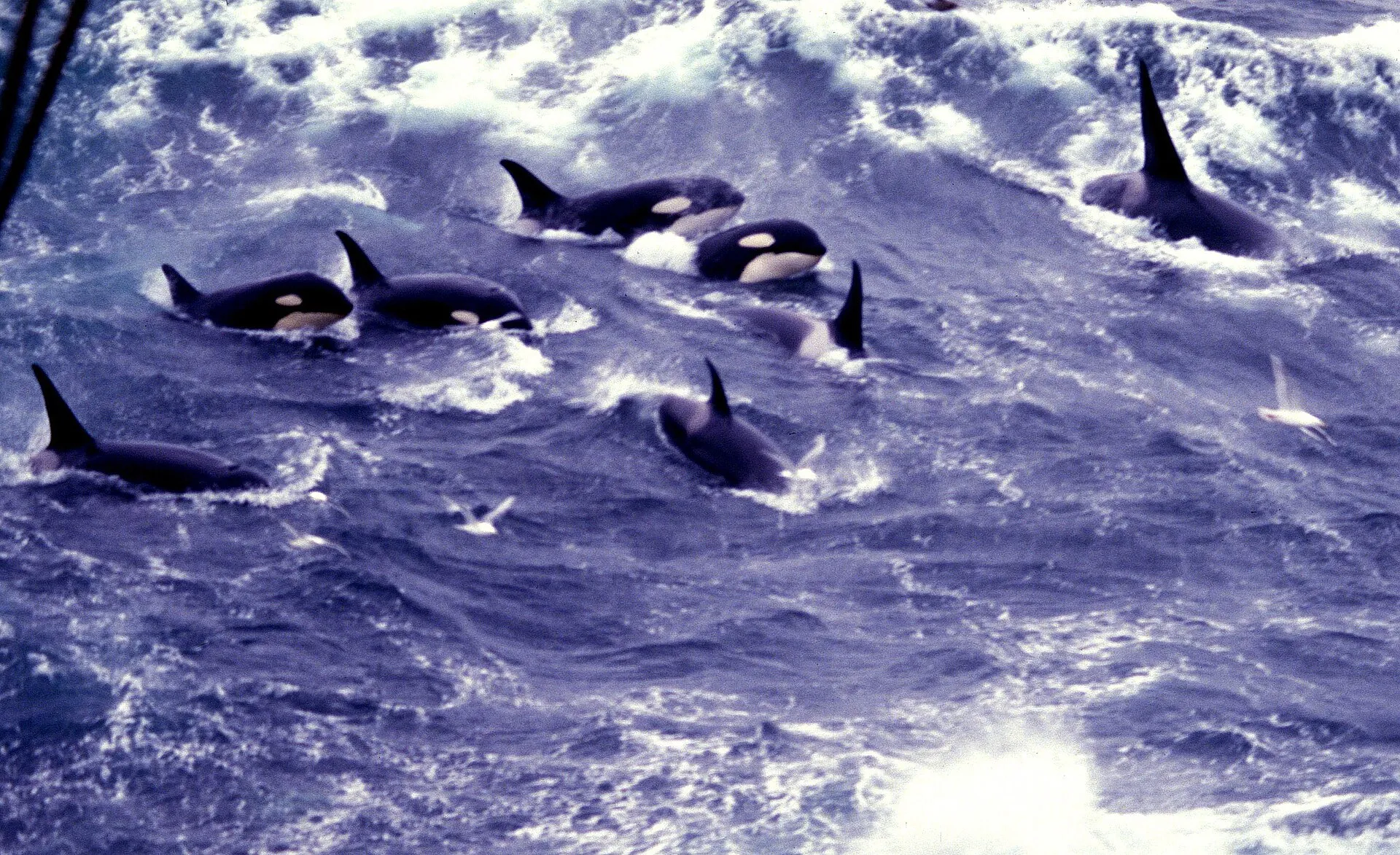 A pod of killer whales in the North Pacific. Photo by Allen Shimada, NOAA. Public domain.
Not every biologist accepts that this explains why menopause evolved; the question is still debated. But the pattern itself is consistent across both species. The value of the old is concentrated in the bad years.
The anthropologist Kristen Hawkes has made a related argument about humans, the so-called grandmother hypothesis, which I described in questions to ask your grandparents before it’s too late. Long post-reproductive lives seem to evolve where grandmothers make a difference to whether grandchildren survive, through food, care and knowledge.
Why is rare knowledge the most fragile?
There is a general principle hidden in the Tarangire drought, and it applies well beyond elephants.
Knowledge that is used every day is passed on by routine. Every calf in a family learns the daily route to water by walking it. Nobody needs to remember it specially, because it is rehearsed constantly.
Knowledge about rare events is different. A drought that comes once every few decades cannot be rehearsed. The only individuals who know what to do are those who lived through the last one, and by the time the next one comes, there may be very few of them left. The rarer the event, the older the knowledge, and the older the knowledge, the more fragile it is. It is held by the fewest individuals, who are closest to death, and it is almost never called on until the moment it is needed, which is the worst possible moment to discover it has gone.
Human families work in much the same way. Everyday knowledge, such as how to get to Grandma’s house or what we eat at Christmas, takes care of itself. What disappears is knowledge of the rare things: how the family survived when the business failed, what it was like to migrate with nothing, how a grandparent coped with the death of a child, what was done the last time someone fell seriously ill. These are the family’s droughts. They happen once a generation, and the people who remember the last one are, almost by definition, the oldest people we know.
In the more than one hundred life stories I have filmed since 2020, including with Holocaust survivors, the most valuable material is nearly always of this kind. It is rarely the everyday detail of a childhood, interesting as that is. It is the account of the worst year, and of what got them through it. My grandmother spent part of the four hours I recorded with her on exactly these stories. Her children and grandchildren had heard fragments of them. Few had heard them whole.
What can people do that elephants cannot?
An elephant family has only one way to preserve what its matriarch knows: the young must live alongside her long enough to absorb it. If she is shot, or if the family is broken up, that knowledge cannot be recovered.
For most of human history, families were in the same position. As the saying I examined in when an old man dies, a library burns puts it, knowledge lived in people, and it died with them unless someone had listened carefully enough to carry it forward.
We are not limited in that way any more. A grandmother’s account of how the family came through its worst year can be recorded on video in an afternoon, in her own words, with her own face and voice, and kept for grandchildren who are not yet born. The young elephants in Pilanesberg never had the chance to learn from their elders. Most of us still do, but only while our elders are here, and the questions that matter most are precisely the ones that are never urgent until it is too late to ask them.
That is the idea behind Everyone, the app we built for filming family life stories one question at a time. But the principle does not depend on any particular tool. Find the oldest person in your family and ask them about the hardest year of their life. One day, someone you love may need to know where the water was.