Questions to ask your grandparents, the oldest library you can visit.
Your grandparents can reach back 150 years of family memory, further than anyone else alive. The questions to ask them, and why the window is short.

In 2004 the anthropologists Rachel Caspari and Sang-Hee Lee published a study of more than 750 fossil teeth. Teeth wear down at a fairly steady rate, so the degree of wear gives a rough guide to age, and Caspari and Lee used it to sort the remains of early humans into younger adults and older adults, the latter defined as old enough to be grandparents. Among Neanderthals, they found roughly four older adults for every ten younger ones. Among the modern humans of the early Upper Palaeolithic in Europe, the ratio had reversed: about twenty older adults for every ten younger ones.
The method has critics, who argue that fossil collections do not reflect the living populations that produced them. But Caspari’s interpretation is worth taking seriously. She suggested that the arrival of grandparents in large numbers may have been one of the things that made modern humans modern, because people who live long enough to know their grandchildren can pass on what they know across three generations instead of two.
That is the real reason to make a list of questions to ask your grandparents. It is not only sentiment. For most of human history, grandparents were the library, and in your family they still are.
Why are grandparents the family’s memory?
A grandparent sits at an unusual point in time. Most people can remember their own grandparents, and many grandparents today knew theirs. A grandmother born in 1945 may well have sat on the knee of a woman born in the 1870s, and heard stories from her about a world of horses, letters and no electric light. When you ask your grandmother about her grandmother, you are reaching back more than 150 years through two living memories. No other conversation you can have will reach that far.
The anthropologist Kristen Hawkes arrived at a related idea from a different direction. Working with the Hadza, hunter-gatherers in Tanzania, in the 1980s, she and her colleagues noticed that older women spent long days digging tubers that fed their grandchildren. The resulting “grandmother hypothesis” proposes that this help was so valuable that it explains why human women live for decades after menopause, which almost no other mammal does. The hypothesis remains contested. But both lines of research point the same way: grandparents are not a pleasant extra in human families. They are part of how human families were built to work, and much of what they contributed was knowledge.
What has changed is that the knowledge used to be passed on by default, around the fire or the kitchen table, because the generations lived together. Today many grandchildren see their grandparents a few times a year, and the conversations are about school and the weather. The transmission that was once automatic now has to be deliberate.
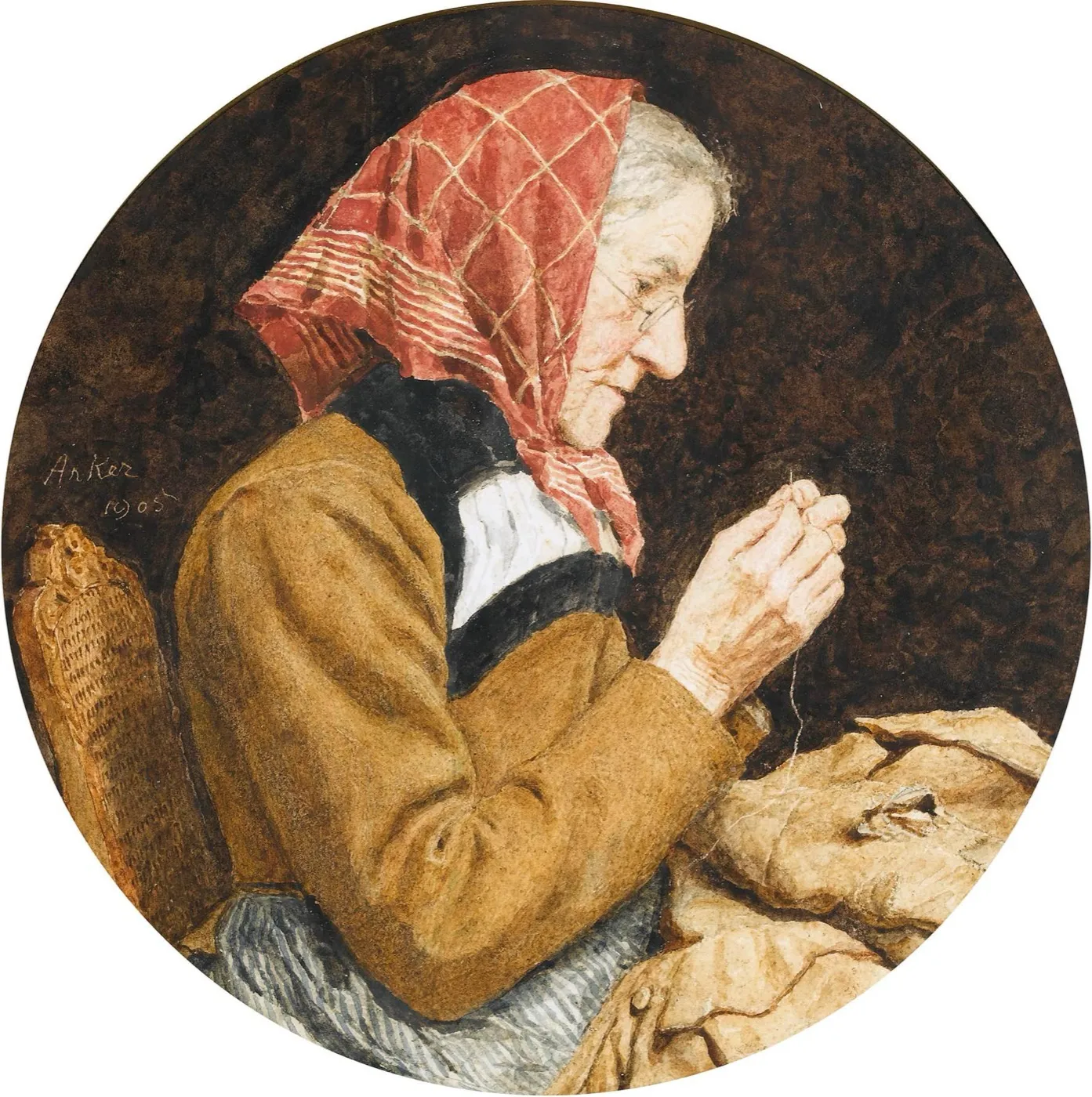 “Seated Grandmother Mending” by Albert Anker, 1905. Watercolour. Public domain.
Why are grandparents easier to interview than parents?
Anyone who has tried to interview a parent knows the difficulty: the relationship is crowded with history, authority and old arguments, and a question about the past can sound like an accusation. (There is a whole post on how to get a parent to talk about their past.)
Grandparents are often different. Anthropologists since A. R. Radcliffe-Brown have observed that in many societies the bond between grandparents and grandchildren is easier and more familiar than the one between parents and children. The grandparent is not responsible for discipline. The grandchild is not trying to establish independence. There is less to defend on either side, and so more room for candour.
In my experience of filming more than a hundred life stories since 2020, this holds. People will tell a grandchild things they never told their own children, partly because enough time has passed, and partly because the grandchild is asking with curiosity instead of grievance.
What questions should you ask your grandparents?
The principle from questions to ask your parents about their life applies here: the smaller and more specific the question, the bigger the story. Ask for scenes, not summaries. The list below is ordered roughly as I would ask it, starting with the easiest ground and saving the most reflective questions for last.
Their childhood world
- Describe the house you grew up in. Which room was the centre of things?
- What did a normal school day look like, from waking up to going to bed?
- What did you eat on an ordinary weeknight, and what did you eat on special occasions?
- What did things cost? What was the first thing you saved up to buy?
- What were you allowed to do as a child that children are not allowed to do now?
The people before them
These are the questions only a grandparent can answer, because they reach a generation no one else alive remembers.
- What were your grandparents like? What did they call you?
- Where did the family come from, and why did they leave?
- Was there a family story everyone knew, or one nobody talked about?
- Are there names, places or photographs that only you can still identify?
History, as they lived it
Your grandparents lived through events you know only from textbooks. What is missing from the textbooks is what it felt like at the time.
- What is the first big news event you remember? Where were you when you heard?
- How did the war, the Depression, migration or the political upheavals of their time touch your family?
- What changed most in your lifetime? What do you miss?
- What did people worry about then that nobody worries about now?
Love and work
- How did you meet my grandmother or grandfather? What was your first impression?
- What was your first job, and what did you learn there?
- What was the hardest decision you ever made?
Your parents, as children
This is the section grandchildren most often forget, and it is one of the most valuable. Your grandparents are the only people who remember your mother or father as a child.
- What was my mum or dad like at five, and at fifteen?
- What did they get into trouble for?
- What were you worried about for them? What were you proud of?
Looking back
- What are you most proud of?
- What would you do differently?
- What do you know now that you wish you had known at my age?
- How would you like to be remembered?
And end, as I do with every interview, by asking whether there is anything they would like to talk about that nobody has asked.
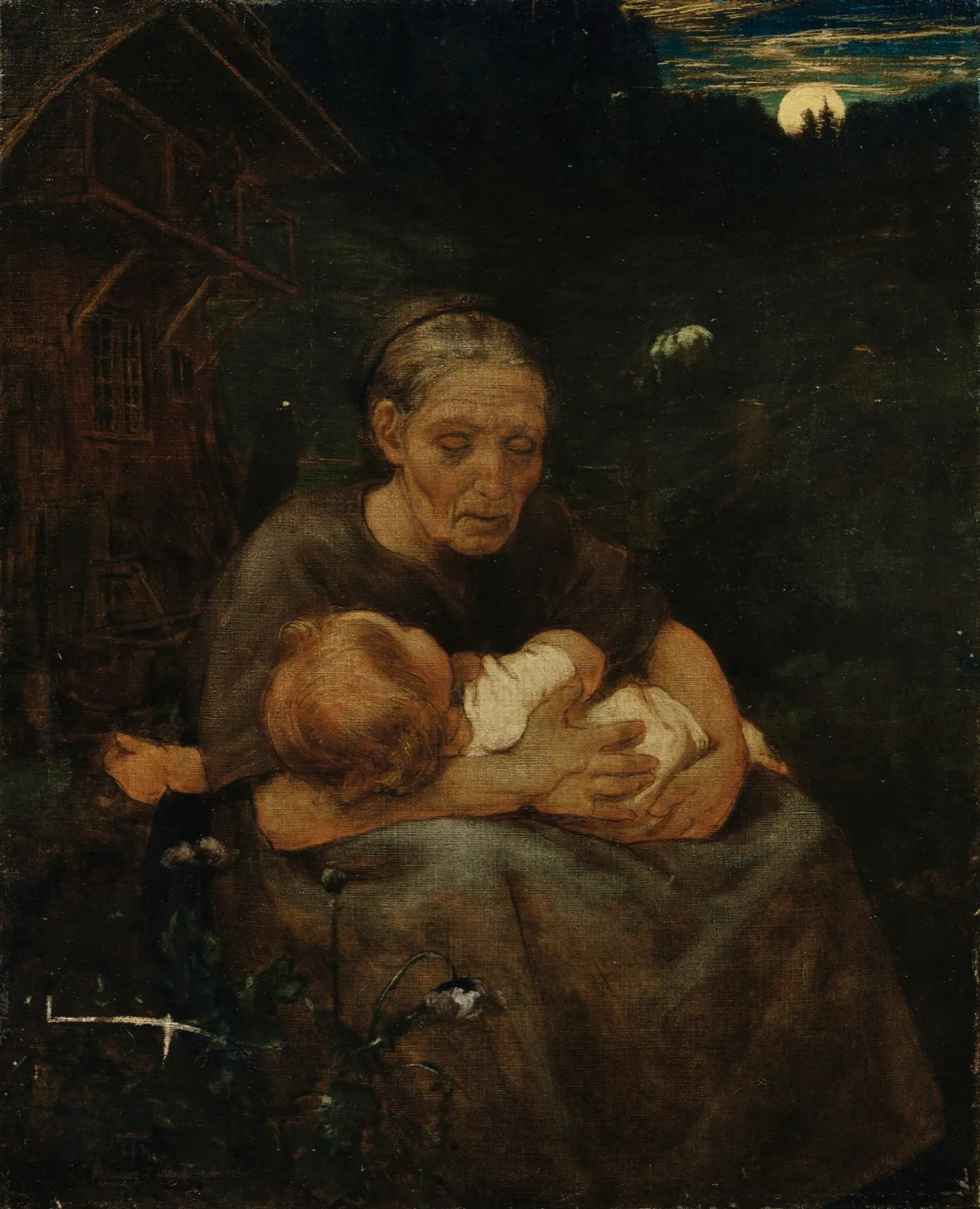 “Grandmother with Grandchild” by Hans Thoma, undated. Public domain.
How do you ask without it feeling morbid?
The phrase “before it’s too late” is accurate, and it is also the main reason people never begin. Asking a grandparent to record their life story can feel like announcing that you expect them to die.
Three things help. First, frame it as interest, not preservation. “I realised I don’t know what your childhood was like” is true and does not mention mortality. Second, start with objects. A photograph album, a medal, a recipe card or an old letter gives both of you something to look at, and memories are tied to cues in a way that general questions cannot match. Third, keep sessions short. Thirty to forty-five minutes is enough for most people, and older people often tire sooner. The practical details, including hearing, pace and the best time of day, are in how to interview older family members.
Most grandparents, in my experience, are not offended by the request. They are surprised by it, and then pleased. Very few people are ever asked about their own lives.
Why film it, not just write it down?
I have four hours of my grandmother telling the story of her life. She has since passed away. When I return to the recording, the facts are not what I go back for. It is the way she laughed before the end of a story, the pause before she spoke about her mother, the expression that crossed her face when she reached a part she had decided to tell me after all. A written account would have kept the events and lost her.
Video also changes who the story is for. A story told once to a grandchild survives as long as that grandchild remembers it correctly, which is not long. Filmed, it can be watched by great-grandchildren who will never meet the person telling it. Most of us cannot name our own great-great-grandparents, let alone hear their voices. The next generations do not have to be in the same position.
What should you do this week?
Choose five questions from the list above, one from each section. Ring your grandparent and arrange a time, ideally somewhere quiet where they are comfortable. Prop up a phone at eye level, sit beside it, and begin with the house they grew up in. If you would like a structure, the Everyone app has a grandparents question pack that presents one question at a time, so you can keep your attention on them instead of on a list.
The fossil record suggests that grandparents may be one of the reasons our species flourished: a third generation that remembered what the second had forgotten. The arrangement still works, but only if someone asks. Every family has a short window in which the oldest memories it possesses are still held by a person who can be asked about them. That window is open now, and it does not reopen.