Questions to ask an immigrant family member, and the chapter nobody asks about.
Questions to ask an immigrant parent or grandparent about leaving, the journey and the first year, and why the hardest chapter is the one we skip.
In May 1970 a park ranger named Alexander Weiss walked into a condemned wooden barracks on Angel Island, in San Francisco Bay, with a flashlight. The building had been part of the immigration station that processed new arrivals, most of them Chinese, between 1910 and 1940, and the state was planning to demolish it. Weiss found Chinese characters carved into most of the walls. They were poems. Detainees waiting for their cases to be decided had cut them into the timber with knives, and in the decades since, more than two hundred have been documented.
The poems matter for a reason that has nothing to do with poetry. Someone had been held in a room, among strangers, in the most uncertain stretch of their life, and felt that it had to be written down. The words stayed on the walls for decades before anyone with a flashlight read them.
Most immigrant families have a version of those walls: a chapter that was felt intensely and never told. This piece offers questions to ask an immigrant family member, and argues that the best ones are not about the country they left or the country they reached. They are about the stretch in between.
Why do immigrant parents and grandparents tell so little?
They tell a great deal, but they tell it in a particular shape.
Ask almost any immigrant to a rich country how they came, and you will hear a short, polished account: the year, the ship or the flight, the amount of money in a pocket, the first job. It has been told at weddings and funerals for forty years. It is true, and it is a headline. Families keep the headline and assume they hold the story.
Three things keep the rest from coming out. The first is protection. Many parents who left a war, a famine or a poor village made a decision that their children would not carry it. The silence is a deliberate gift, and it works so well that the children grow up with no idea there was anything to carry. The second is the language. The memories of the old life are stored in the old language, and if the children no longer speak it, there is no shared vocabulary in which to tell them. The third is the one we do not like to admit: nobody asks. A child of immigrants is busy fitting in. A grandchild is busy being a child. By the time either of them is curious, the person who could answer is old.
The historian Marcus Lee Hansen described the pattern in 1937, noting that what the son wishes to forget, the grandson wishes to remember. I wrote about it in questions to ask about your family heritage. The point to add here is that the timing is unforgiving. The generation that stopped asking is the one that could have heard the answers first-hand.
How many families does this describe?
More than we tend to assume. At the 2021 Census, 27.6 per cent of people in Australia had been born overseas, and 48.2 per cent had at least one parent born overseas.
Almost every one of those crossings was a story in its own right. A person gave up a language, a house, often a profession, and started again where nobody knew what they had been. Researchers call it deskilling: many skilled migrants take work well below their qualifications because their qualifications are not recognised, and some never return to the work they trained for. A grandfather who stacked shelves in a supermarket may have been a surgeon. If nobody asks, the surgeon disappears from the family record, and the grandchildren remember only the shelves.
What are the best questions to ask an immigrant family member?
The most useful organising idea is to follow the journey in order, and to spend the most time where the family knows least. The questions below move from the place left behind, through the leaving and the in-between, to the first year. Choose a handful for each sitting. They suit a parent, a grandparent or any older relative, and they work for a school project as well as for a family archive.
Before leaving
- Where were you born? What was the street, the village or the town like?
- What did your parents do for work? What did you expect to do?
- What were you studying, or training for, before you left?
- When did you first think of leaving? Who did you tell?
The decision
- Why did you go? Was it a choice, or did you have to?
- Who argued against it? Who helped?
- What did you know about the new country before you arrived, and where did that knowledge come from?
- Who did you leave behind? When did you next see them?
The journey
- What did you pack? What did you leave behind that you wish you had brought?
- What do you remember of the journey: the people, the weather, the smells, the food?
- What did you feel when you arrived? What was the first thing you noticed?
- Was there an interview, an inspection or a waiting period? What was it like to wait?
The first year
- Where did you sleep the first night? Who was there?
- What was the hardest thing in the first year? What did you not expect?
- How did you find work? What was the first job, and how did it compare with the work you had done before?
- Who was kind to you? Who was not?
- Did you change your name, or did someone change it for you?
- When did you first dream in the new language?
What was kept and what was lost
- What do you still do the way it was done where you were born?
- What did you decide your children should not have to go through?
- Do you think of the old country as home? Do you think of this one as home?
- If you could tell your great-grandchildren one thing about leaving, what would it be?
The follow-up matters more than the question. “What was the journey like?” will produce a sentence. “What did you see from the window on the first morning?” will produce a scene.
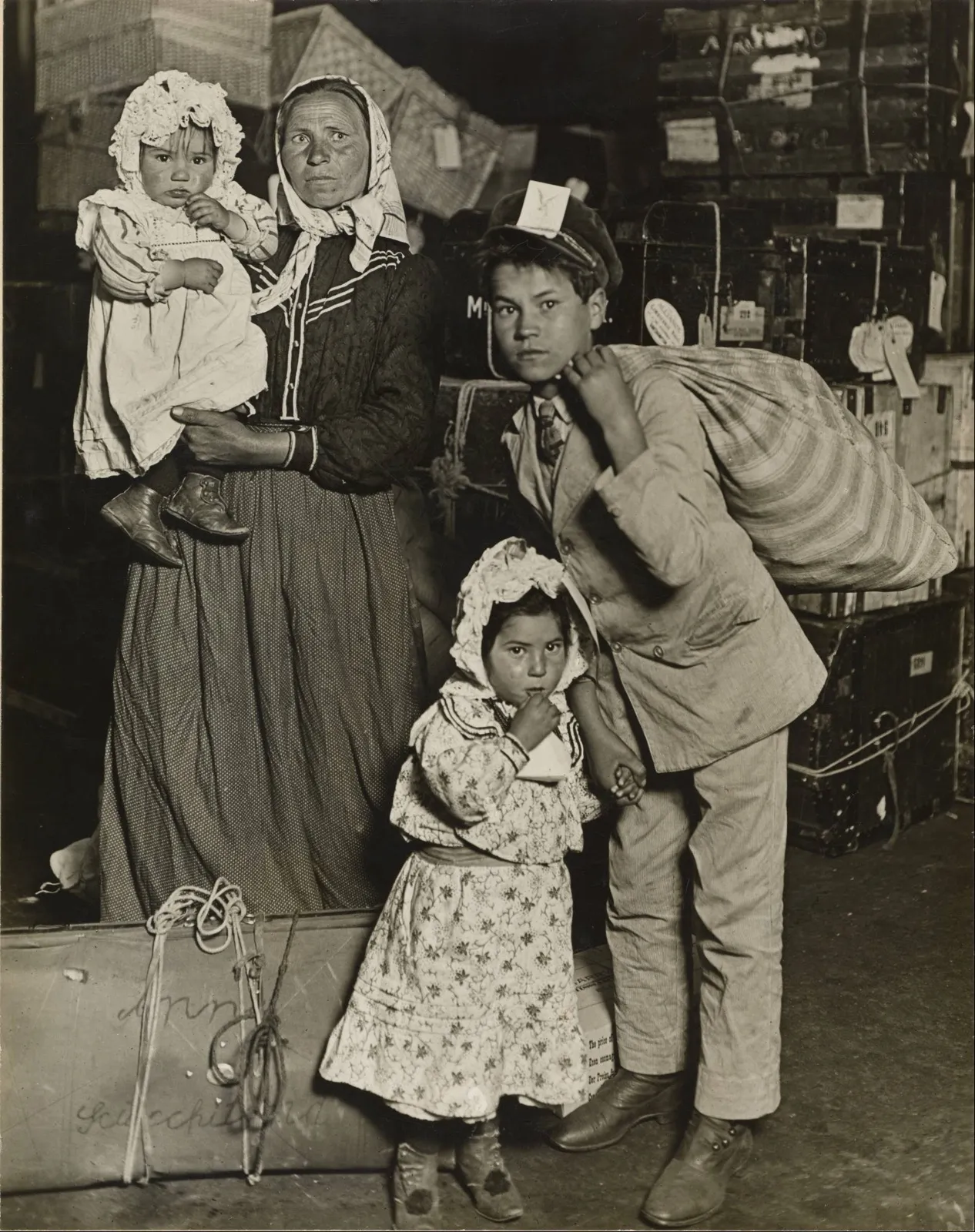
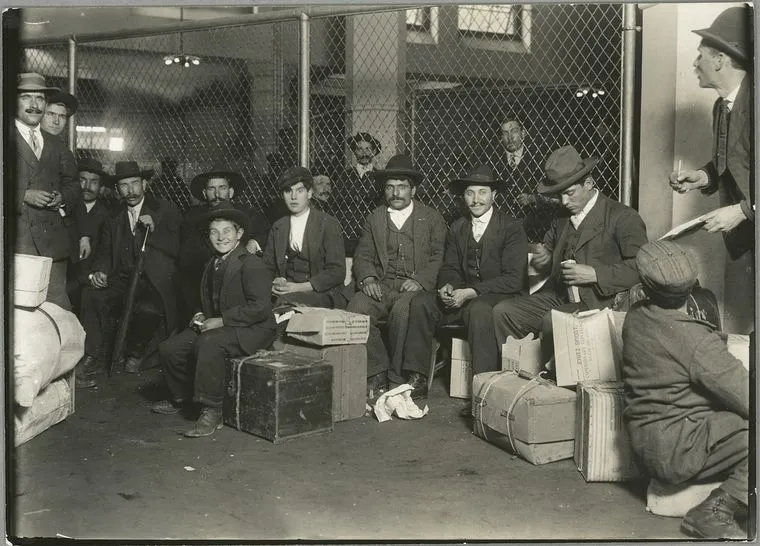 Group of Italian immigrants waiting at Ellis Island, by Lewis Hine, 1908. New York Public Library. Public domain.
How do you ask about a painful journey?
Some immigrants left by choice and some did not. A refugee who fled a war is in a different position from someone who followed a job offer, and the questions that suit one can wound the other. A few principles help.
Let them choose the depth. Offer the question and make clear that “I would rather not say” is a complete answer. People are far more likely to speak when they know they are allowed to stop. If a subject is painful, ask whether they would like to leave it for another day, and then actually leave it.
Do not ask about legal status. How a person arrived, under which visa or by what route, is rarely what you want to know, and in some families it is a source of fear that has lasted decades. Ask about the experience, not the paperwork.
Ask in their language if you can. The psychologists Viorica Marian and Ulric Neisser found in 2000 that bilingual people recalled more memories from the years they had spent in a given language when they were interviewed in that language. If you speak even a little of the first language, use it for the opening questions. If you do not, ask the relative to switch into it for a few minutes, and have someone translate afterwards. The recording of the original is worth more than any translation.
Start with an object. A suitcase, a passport, a photograph or a coin gives the person something to talk about other than themselves. “Where did this come from?” is easier to answer than “what was it like?”.
Why does it matter that someone asks?
The Angel Island poems answer this better than any argument. Many of them are unsigned. The people who carved them did not expect to be identified, but they carved in the hope that someone would read. Someone did, but only after the station had closed and only because the building was about to be demolished.
Most family stories do not have walls. They exist in one copy, in one person’s memory, and the copy ends with the person. I made the same argument in how to preserve family stories, and it applies with particular force to migration, because the usual records of a family history (a passenger list, a naturalisation certificate, a census return) say that a person arrived and almost nothing about what it was like to be them.
There is also a more personal reason. The scholar Marianne Hirsch coined the term postmemory for the relationship that children of Holocaust survivors have to events they did not live through, shaped by the stories, images and silences of the generation before. Her subject was one extreme case, but the idea applies more widely: a silence in a family is not empty, and children fill it with something. It is better that they fill it with the person’s own account.
Why film it rather than write it down?
A transcript preserves the words. It loses the pause before the name of the village, the accent that returns when they mention their mother, the hands that show the size of the suitcase, and the original language, where much of the story lives.
Over the past six years I have filmed more than a hundred life stories through The Archive, including Holocaust survivors, many of whom had made a new life far from where they were born. What I notice on the footage is how often the most important sentence is in the first language, or is not a sentence at all. A video keeps that. It also keeps something the family will want in fifty years: the person, at the age at which they were able to tell it.
A first sitting does not need to be long. Pick four or five questions from the lists above, sit somewhere quiet, prop a phone beside you and press record. If you would like a structure that breaks the interview into one question at a time, the Everyone app does this, so the story can be gathered over several short visits. The method matters less than the asking. Every year that passes without the question makes the answer harder to give.
For a longer guide to the conversation itself, see how to interview older family members, and for the wider set of questions about a family’s past, family history interview questions.