The oldest voice ever recorded, and what it chose to say.
Born in 1800, recorded on wax in 1889: how Helmuth von Moltke became the oldest voice we can still hear, and why his cylinders nearly vanished.
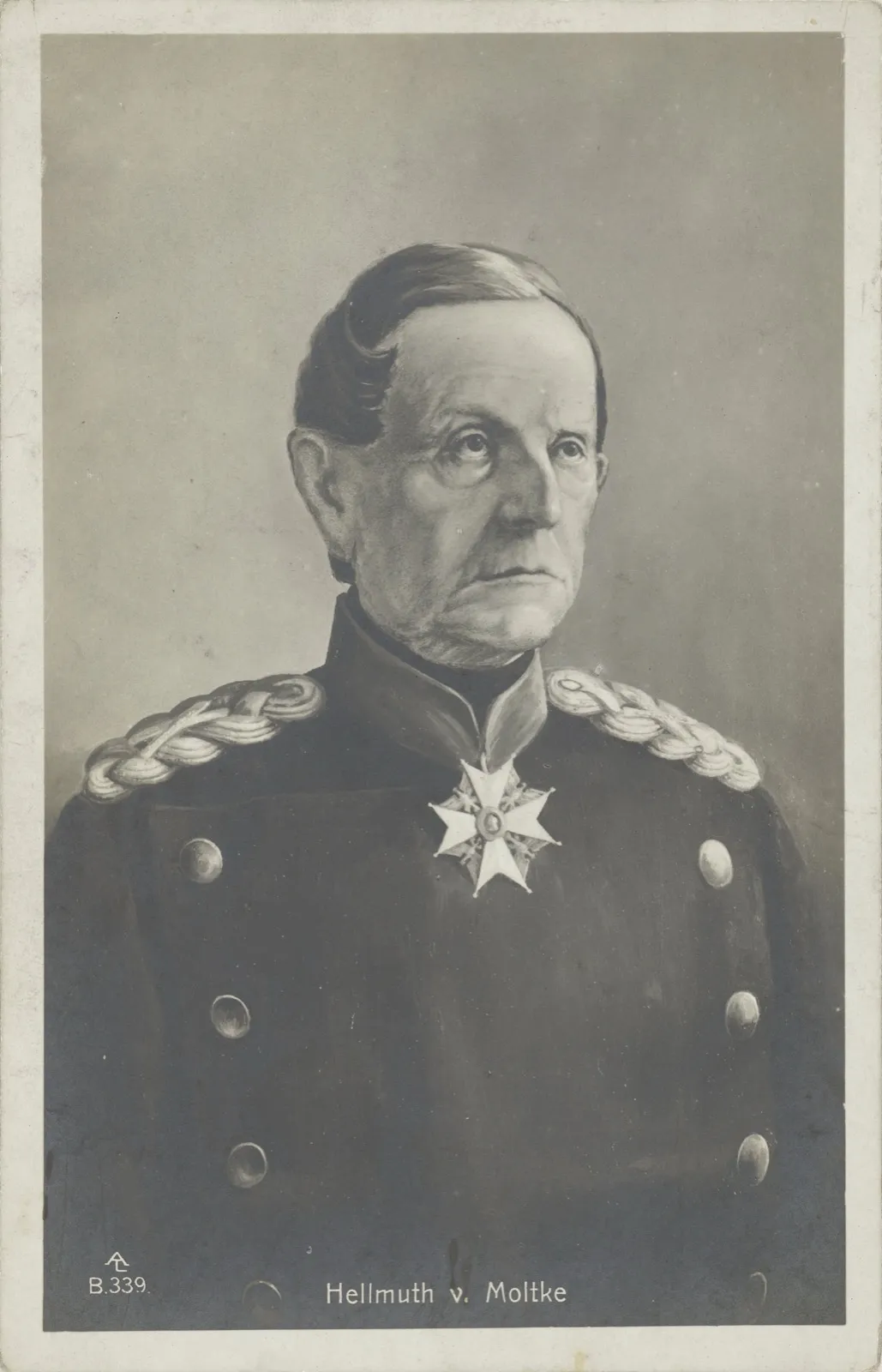
On 21 October 1889, a young German-American technician named Theo Wangemann carried one of Thomas Edison’s new phonographs into a country house at Kreisau, in Prussian Silesia. His host was Field Marshal Helmuth von Moltke, five days short of his eighty-ninth birthday. Moltke leant towards the recording horn and said, in German, that Mr Edison’s newest invention was truly astonishing. “The phonograph,” he went on, “makes it possible for a man who has long rested in the grave to raise his voice once more and greet the present.”
He was describing himself. Moltke was born on 26 October 1800. That makes the wax cylinders made that afternoon the oldest voice recording in the sense that matters most: they carry the voice of the earliest-born human being we can still hear. The US National Park Service, which holds the cylinders, describes them as the only known recordings we can listen to of someone born in the eighteenth century. (Strictly counted, the eighteenth century ran from 1701 to 1800, so Moltke qualifies by a matter of weeks.)
The story of how that voice survived is worth telling in full, because it is a story about how close any voice comes to disappearing, and about what a person chooses to say when they know the future is listening.
Who was Helmuth von Moltke?
When Moltke was born, Napoleon had been First Consul of France for less than a year. There were no railways, no photographs and no electric telegraph. By the time he died, in Berlin on 24 April 1891, he had lived through the arrival of all three, and spoken into the machine that would end the silence of the dead.
In between, he became one of the most celebrated soldiers of the nineteenth century. As chief of the Prussian General Staff from 1857 to 1888, he planned the campaigns against Denmark in 1864, Austria in 1866 and France in 1870–71: the three wars that unified Germany. He was famous in Germany for his reserve. Contemporaries called him der große Schweiger, the great silent one.
There is a quiet irony in that. The man known for saying little is the man whose voice reaches furthest back.
How did Edison’s phonograph reach Kreisau?
The answer usually given, that Edison sent Moltke a cylinder, is close but not quite right. Edison did not go to Kreisau. In 1889 he sent Wangemann, one of his laboratory staff, on a long European tour with an improved wax-cylinder phonograph, partly to show it off and partly to record famous voices and musicians. Over about eight months Wangemann recorded, among others, Otto von Bismarck at Friedrichsruh on 7 October 1889, and, in December in Vienna, Johannes Brahms playing a shortened version of one of his own Hungarian Dances.
The visit to Kreisau was a stop on the way to Vienna. According to the sound historian Stephan Puille, whose research identified the recordings, Wangemann first played Moltke the cylinder he had made of Bismarck two weeks earlier. Moltke recognised his old colleague’s voice only once the playback speed had been corrected. Then Wangemann had the twenty or so relatives in the house speak into the machine one after another, and recorded the Field Marshal at least four times.
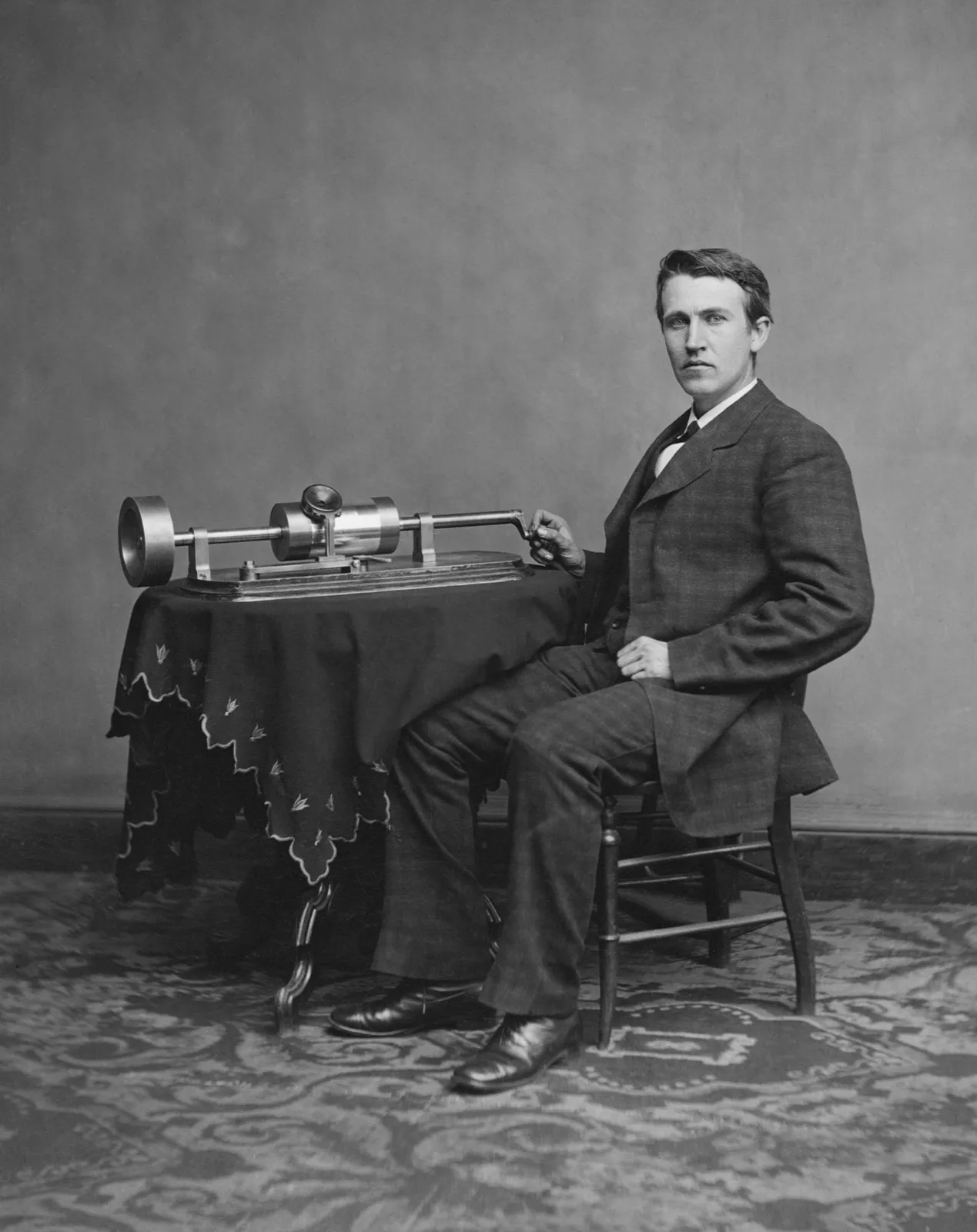 Thomas Edison with his phonograph, probably 1878. Photo by Levin C. Handy, Library of Congress. Public domain. The wax-cylinder machine Wangemann took to Europe in 1889 was a much improved descendant of this one.
What did Moltke say?
Two of the cylinders survive. Each begins with someone announcing the place and the date: Kreisau, den einundzwanzigsten Oktober achtzehnhundertneunundachtzig. Kreisau, 21 October 1889.
On the first, Moltke makes his remark about men speaking from the grave. Partway through he says “the telephone” by mistake, stops, and starts the sentence again with “the phonograph”. Then he recites a few lines from Goethe’s Faust, from the opening scene in which the scholar Faust complains that his scientific instruments mock him, with all their wheels and cogs, because none of them can unlock nature’s secrets. It is a strange choice to make into a brand-new scientific instrument, and possibly a deliberate one.
On the second, he begins with Shakespeare, in German translation: Polonius’s advice to his son in Hamlet, “Give every man thy ear, but few thy voice.” Then he recites another passage from Faust, from the scene outside the town gate, about the longing in every human heart to rise upwards when the lark sings overhead and the crane flies home. The first attempt was recorded too quietly, so he says it twice. He ends by giving the date, the place and his own name.
That is, more or less, all we have. A third cylinder, on which he apparently spoke about Francis Bacon and the dangers of experiment, is lost; its content is known only from a newspaper report the next day. A fourth was recorded while Moltke and three of his generals played cards.
Why did the recordings nearly disappear?
Wangemann’s European cylinders were never copied. The plan had been to duplicate them, but it did not happen. The originals went back to Edison’s laboratory in West Orange, New Jersey, and were forgotten. They were not labelled with the names of the speakers.
In 1957, when Edison’s home and laboratory passed to the US National Park Service, Wangemann’s damaged wooden transport case was found in Edison’s library, holding seventeen cylinders, some of them broken. His European recordings sat in the collection, unidentified, for more than fifty years. In 2011 the Park Service had them played on a specialist cylinder reader and digitised, and two historians of early recording, Patrick Feaster and Stephan Puille, set about working out who was speaking. The announcements helped: a voice saying “Kreisau, 21 October 1889” narrows the field considerably. The results were made public on 30 January 2012.
So the voice of a man born in 1800 spent about seventy years lost and another fifty-odd years anonymous. It survived because wax is reasonably durable, because someone kept a box, and because a technician had the habit of saying where and when he was before each recording.
Was Moltke the only old voice to be recorded?
He was the earliest born, but not alone. Edison’s British agent, George Gouraud, recorded the poet Robert Browning, born in 1812, at a dinner party in London on 7 April 1889. Browning began reciting his poem “How They Brought the Good News from Ghent to Aix”, forgot the words, apologised, and was cheered by the other guests. He died that December. Alfred Tennyson, born in 1809, recorded “The Charge of the Light Brigade” and other poems on wax cylinders around 1890.
What strikes me about all of these recordings is what they share. Each of these men was asked to speak into a machine that could carry his voice past his own death, and each of them recited. Browning reached for his own verse, Tennyson for his, Bismarck for songs and a line of advice to his son, Moltke for Goethe and Shakespeare. None of them told a story about his own life. The great silent one, given the chance to speak to the future, mostly quoted other people.
That is not a criticism. In 1889 nobody had any idea what a recording was for. The model was the parlour recitation, and these men did what an educated person was expected to do in company. But it means that the oldest voice we can hear tells us almost nothing about the man who owned it. We know what the Battle of Königgrätz looked like on his maps. We do not know what he remembered of his childhood in Mecklenburg, or what he thought about in the evenings at Kreisau.
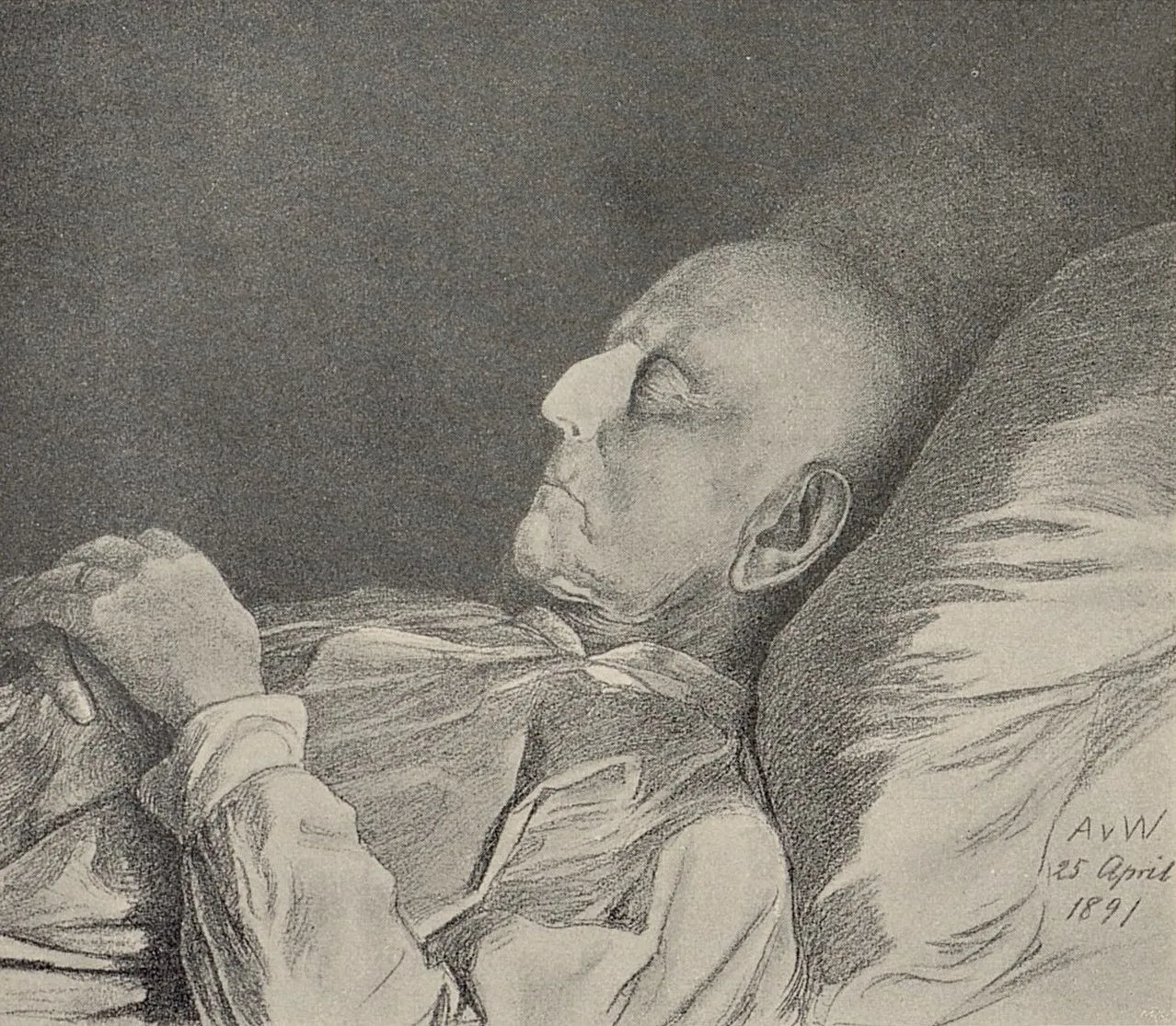 “Moltke on his deathbed”, drawing by Anton von Werner, dated 25 April 1891, the day after Moltke’s death. Public domain.
What does the oldest voice recording teach us?
Moltke died eighteen months after Wangemann’s visit. His prediction came true almost exactly as he phrased it: a man long in the grave, raising his voice to greet the present. Anyone can listen to him now in a few seconds online, 137 years after he spoke.
Three things follow from his story, and they apply to every family, not only to field marshals.
A recording that does not say who and when is half lost. The Moltke cylinders were found in 1957 and identified in 2011. What saved them was a spoken date and place. A family video that never names the speaker, or the year, can become just as anonymous within two generations. (I wrote about this problem in what happens to your photos and videos when you die.)
A voice survives by accident unless someone decides it should. Wangemann’s cylinders were never copied, and two of Moltke’s four are gone. The same fragility applies to a phone that is never backed up or a hard drive in a drawer. The question is not whether a recording exists but whether anyone will be able to find it and play it in fifty years. (On why video is more future-proof than sound alone, see audio vs video recording.)
What you ask for is what you get. Moltke was asked to say something into a machine, and he recited. Had anyone asked him to describe the house he grew up in, or the day he became a soldier, the oldest recording in the world might also be the oldest life story in the world. When I film someone’s life, I ask for stories, not performances, because the stories are what descendants want to hear. (For the reasons a voice matters so much after a death, see hearing a loved one’s voice after they have died.)
In 1889 a recording of a person was so rare that it took a celebrated field marshal and an employee of Thomas Edison to make one. Today anyone with a phone can film a parent or grandparent telling their own story, and the Everyone app exists to make that a little easier. Moltke’s voice reached us across 137 years almost by luck. Ours do not need to rely on luck at all.