Old home movies are fading. So are the people who can explain them.
Old film and tape are decaying, and the machines that play them are gone. How to digitise home movies, and the one step most families forget to take.
In July 2016, a Japanese company called Funai Electric made what was reported to be the last video cassette recorder. It had been the only manufacturer left. At its peak Funai sold around fifteen million VCRs a year; by 2015 it sold about 750,000, and when a supplier stopped making a key part, the company stopped too.
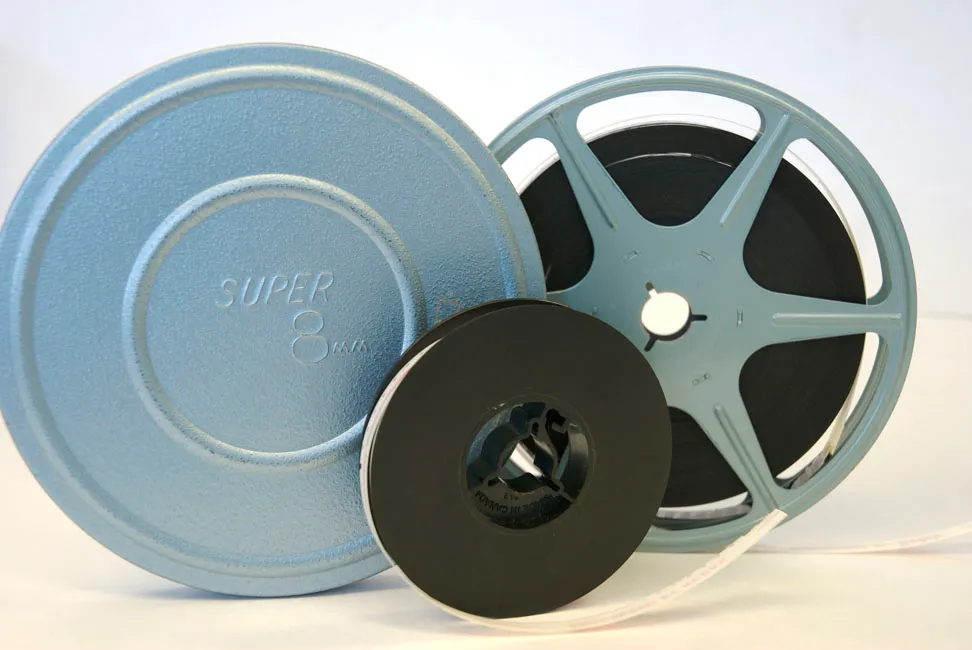
That decision quietly changed the status of millions of family videos. A VHS tape in a cupboard is no longer a recording you can watch whenever you like. It is a recording that depends on a machine nobody makes, and that machine will eventually break. The same is true, one generation further back, of the reels of 8mm and Super 8 film sitting in shoeboxes, waiting for a projector that has not been switched on since the 1980s.
If you want to digitise old home movies, the good news is that it has never been easier. But the most important part of the job is not the one most people think about. The film and tape are running out of time, and so are the people who can tell you what is on them.
How did families start filming themselves?
Home movies are about a century old. In December 1922 the French company Pathé launched the Pathé Baby, a small system built around a new 9.5mm film gauge. Its advertising promised le cinéma chez soi, cinema at home. Kodak followed in 1923 with 16mm film and the Cine-Kodak camera, and in 1932 introduced 8mm, made by splitting 16mm film down the middle to halve the cost.
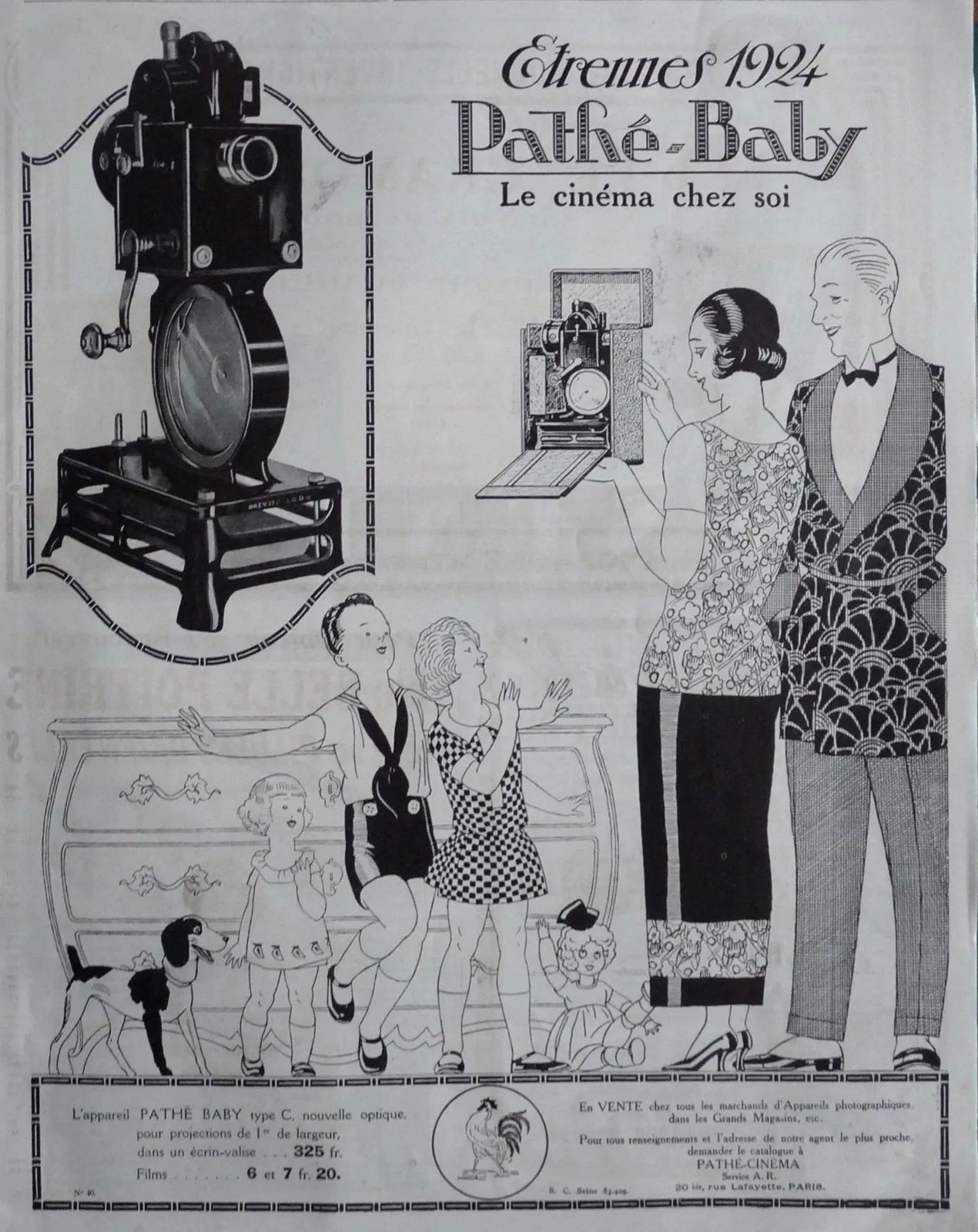 Advertisement for the Pathé Baby, “Le cinéma chez soi”, 1924. Public domain.
For decades, filming your family remained a middle-class hobby. Film was bought by the minute, sent away for processing, and recorded no sound. Super 8, launched by Kodak in 1965, made it simpler with a cartridge that dropped into the camera, and sound versions arrived in the 1970s. Then, through the 1980s, VHS and the camcorder replaced film almost entirely: tape was cheap, reusable, recorded sound, and played straight back on the family television.
So most families now have some mix in a cupboard: a few reels of 8mm from the 1950s or 1960s, a box of Super 8 from the 1970s, and a pile of VHS, VHS-C or Video8 tapes from the 1980s and 1990s.
Why is it urgent to digitise home movies now?
There are two separate problems, and they compound each other.
The first is physical decay. Almost all home movie film was made on cellulose acetate, the so-called safety film that replaced flammable nitrate. Acetate is far safer, but it is not stable. As it ages, particularly in warm and humid conditions, it breaks down and releases acetic acid. Archivists call this vinegar syndrome, because the first sign is the smell. The film then shrinks, curls and becomes brittle. The process feeds on itself, since the acid accelerates further decay, and it can spread to other reels stored nearby. Cool, dry storage slows it down considerably. Nothing reverses it.
Magnetic tape has its own failures. The binder that holds the magnetic particles onto the tape can absorb moisture and turn sticky, the signal weakens, and mould grows in damp cupboards. Audiovisual archives have taken this seriously enough that many adopted a shared warning, sometimes called “Deadline 2025”: the view that the contents of magnetic tape collections would be at grave risk of permanent loss unless they were digitised by about the middle of this decade.
The second problem is obsolescence. Even a perfectly preserved tape is useless without a working machine, and the machines are disappearing faster than the tapes. Mike Casey, who led media preservation work at Indiana University, coined a word for the combination of the two: degralescence, degradation plus obsolescence. Each makes the other worse. As fewer machines survive, the remaining ones are older, harder to repair, and more likely to damage a fragile tape when they play it.
Neither problem announces itself. A box of films can sit in a wardrobe for thirty years and look the same from the outside.
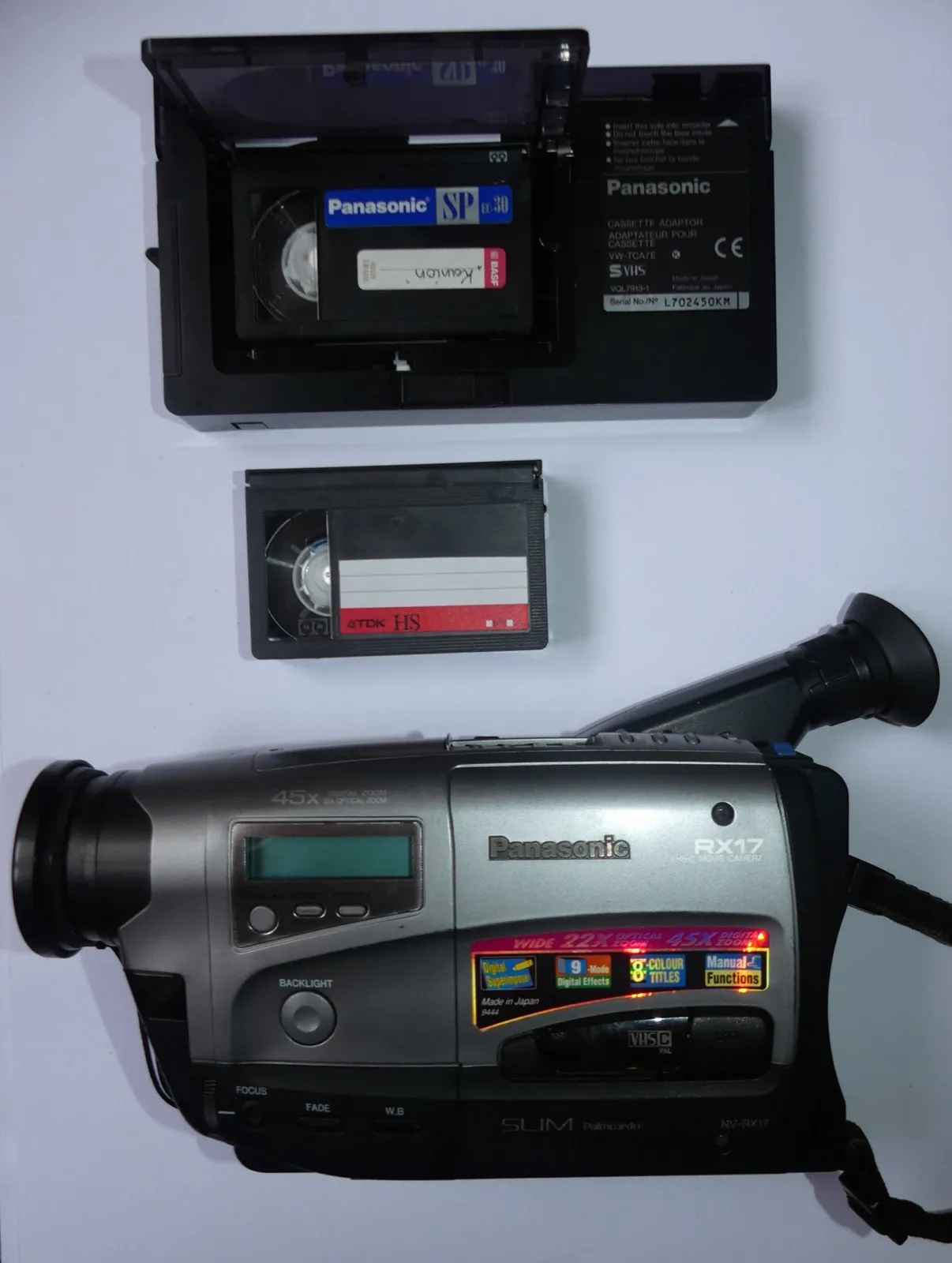 A Panasonic VHS-C camcorder, a VHS-C tape and a cassette adapter. Photo by Zalasem1, 2024. CC BY 4.0.
How to digitise old home movies
The right method depends on the format.
Film (8mm, Super 8, 9.5mm, 16mm). For most families, a professional transfer service is the sensible choice. Look for one that scans each frame individually, rather than projecting the film onto a screen and filming it. Frame-by-frame scanning is gentler on old film and gives a much sharper result. Ask what resolution they scan at and what files you will receive, and request a high-quality master file as well as an everyday copy that plays on a phone. If a reel smells of vinegar, or the film is curled or brittle, tell the service before sending it, and do not try to project it yourself: an old projector can tear or burn fragile film in seconds.
Tape (VHS, VHS-C, Video8, Hi8, MiniDV). These can be done at home if you have a working player and a USB video capture device, which connects the player to a computer. It is slow, because tape plays in real time, but it is not difficult. If the tape is visibly mouldy, damaged or sticky, a specialist is the better option, since a struggling machine can chew a tape and destroy it. MiniDV is already digital, so it can usually be transferred without any loss of quality.
Whichever method you choose:
- Sort and label first. Write down what is on each box or reel before it leaves the house, even if it is only “Grandad, 1970s, beach?”. Labels on originals are often the only date you will ever have.
- Start with the oldest and most fragile. Film from the 1950s and 1960s, and tapes that have been stored somewhere warm, should go first.
- Name the files properly. A file called
Tape_07.mp4will mean nothing to your grandchildren. A file called1984 Christmas at Nan's house, Brunswick.mp4will. - Keep the files in more than one place. At least two copies, in two different places, one of them away from home. A single hard drive in a drawer simply recreates the shoebox problem with a newer box. (What happens to digital files after their owner dies is its own problem; I have written about it in digital legacy.)
- Keep the originals. Store them somewhere cool, dry and dark. Scanning technology will improve, and the original may one day yield a better copy.
What do home movies actually show?
Once the files exist, many families discover something slightly disappointing. Home movies are mostly the same few scenes: birthdays, Christmas mornings, weddings, beaches, a child taking its first steps. People wave at the camera. The footage is precious, and it says remarkably little.
This was not an accident. Film was expensive, so people filmed occasions rather than ordinary days, and for most of the history of home movies there was no sound, so nobody was filmed talking. Even after camcorders arrived, the convention held: you pointed the camera at events, not at people explaining themselves. I have argued elsewhere that this is the central limitation of the twentieth century’s family archive, and that the future of storytelling depends on correcting it: we recorded what families did, and almost never who they were.
That limitation creates a specific risk. A silent reel of a 1962 wedding is only fully meaningful while someone alive can say who the people are. Who is the woman in the hat? Why is everyone at that particular beach? Whose house is that? Which of the children grew up to be your grandmother? Without that knowledge, the film slowly turns into footage of strangers, which is what most old home movies sold at markets and estate sales already are.
What is the step most families miss?
Digitising preserves the images. It does not preserve their meaning. The meaning lives in the memories of the oldest people in the family, and that is the most fragile part of the archive.
So the most valuable thing to do once the films are digitised is to watch them together, with the people who were there, and record what they say.
Sit a parent or grandparent in front of the television, play the footage, and film them watching it. As each scene appears, ask: Who is that? Where was this? What was happening that year? People who struggle with an open question about their childhood will often talk freely when they see their own father walk across a lawn in 1958. A moving image is a powerful memory cue, and the stories it releases are often ones nobody in the family has heard.
A few practical points help:
- Film the person, not the screen. You already have the footage. What you do not have is their face and voice as they react to it.
- Note the time code. When they identify someone, write down the file name and the minute, so the names can later be added to the file or its description.
- Let them go off topic. If a clip of a picnic leads to twenty minutes about the uncle who drove everyone there, that is the point.
- Do it in short sessions. Thirty to forty-five minutes is plenty; it is surprisingly tiring to watch your own past. (There is more on setting up the room in how to film an interview at home.)
Why the people matter more than the footage
I have four hours of my grandmother telling me about her life. She has since died, and of everything my family owns, that recording is the thing I would save from a fire. It is not valuable because it is well shot. It is valuable because it contains her voice explaining her own life, which no photograph or silent film could ever do.
The tapes and reels in the cupboard are worth rescuing, and soon. But they are the easy part. Services can be paid and files copied a hundred times. The knowledge of who is in those films, and why the moment mattered, exists in only a few minds, and it cannot be copied after they are gone.
So digitise the films. Then do the thing the original cameras could not: sit down with the people in them, ask them questions, and film the answers. A phone is enough for that; an app such as Everyone, which gives you one question at a time, can make it easier to start. The old home movies show what your family looked like. What the oldest relatives say while watching them shows who they were.