
What happens to your photos and videos when you die?
We take around two trillion photos a year, yet most will be unreadable, locked away or meaningless within a generation. How a digital legacy actually survives.
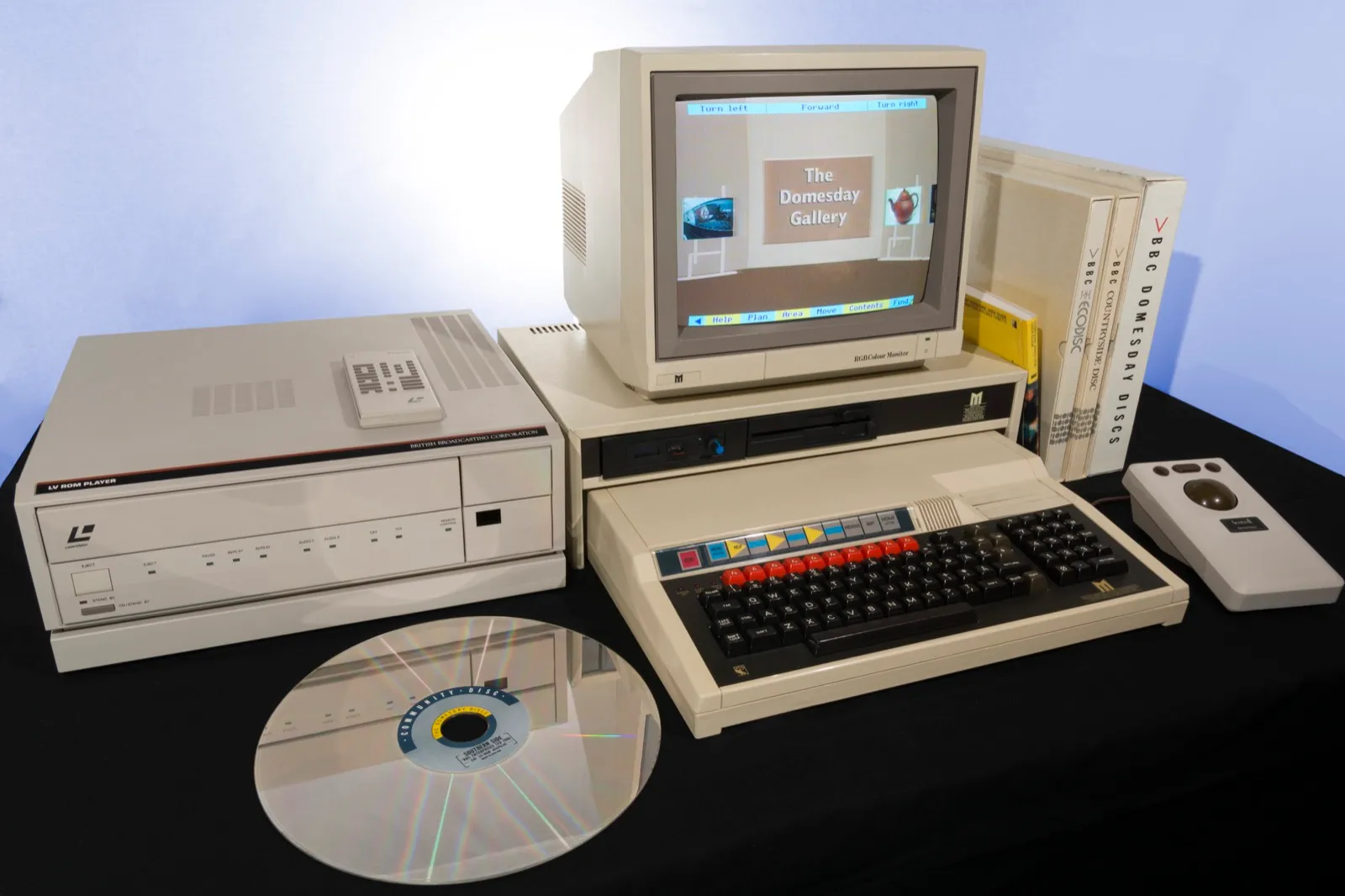
The Domesday Book, William the Conqueror’s survey of England, was written on sheepskin parchment in 1086. It sits in The National Archives at Kew and can still be read by anyone who knows medieval Latin. In 1986, to mark its nine-hundredth anniversary, the BBC built a digital successor. More than a million people, including children from over nine thousand schools, contributed photographs, maps and descriptions of their local area. Everything was stored on two twelve-inch laserdiscs, read by a specially modified BBC Master computer and a Philips player made for the purpose.
By 2002 the project was close to unreadable. The computers were obsolete, the players rarer still, and the data was locked in a format nothing else could open. The Observer summarised the situation in a headline: the digital Domesday Book had lasted fifteen years, not a thousand. It took a rescue team from the universities of Leeds and Michigan, writing software that imitated the dead hardware, to get the discs talking again.
I find it hard to think of a cleaner experiment. Same country, same idea, same name. The version written on animal skin is fine after nine centuries. The version written in bits needed life support after a decade and a half.
That is worth holding in mind when you consider the question in the title. By most estimates, people now take somewhere around two trillion photographs a year, and a growing share of them are videos. It is the most thoroughly documented generation in history. It is also, I will argue, on course to leave less behind than the shoebox generation before it, unless we understand the three distinct ways a digital legacy dies.
Why does parchment outlast a laserdisc?
A page of parchment needs only two things to be read: light and a reader. A digital file needs a stack. There is the physical medium, the drive that reads it, the operating system that talks to the drive, the software that understands the file format, and the hardware that runs all of the above. Every layer in that stack is replaced every few years, and any one of them failing makes the file unreadable, even if the bits are perfectly intact.
Vint Cerf, one of the engineers who designed the internet’s core protocols, warned in 2015 that this could produce what he called a digital dark age. His concern was not that the data would be destroyed, but that it would be preserved without any means of interpreting it: a century of photographs, letters and records that future historians can hold but not open. He called the decay “bit rot”.
The lesson of the Domesday rescue is that digital material survives only through active maintenance. Someone has to copy the files to new media, convert them to current formats and check that they still open, on a cycle of years rather than decades. Paper survives neglect. Bits do not.
Who holds the key to your accounts?
The second way a digital legacy dies is simpler and more common. The files are fine. Nobody can get to them.
In 2015, a British man named Matthew Thompson died without a will. His widow, Rachel, was his sole heir and executor. His iCloud account held around 4,500 family photographs and 900 videos, including those of their daughter. Apple would not open it. Its terms of service at the time contained a section headed, bluntly, “No Right of Survivorship”: the account was not transferable, and on receipt of a death certificate it could be deleted. A grant of probate was not enough; Apple wanted a specific court order. It took nearly three years and a hearing at Central London County Court in 2019 before she got the photographs.
The companies have since built some doors. Google introduced an Inactive Account Manager in 2013, which lets you name people who will be notified, and optionally given your data, after a period of inactivity you choose. Facebook added a legacy contact in 2015, someone who can manage a memorialised profile but cannot log in as you. Apple added a Legacy Contact in December 2021: you can name up to five people, each of whom receives an access key, and after your death they can present that key and a death certificate to retrieve your photos, messages and files. The access lasts three years, after which the account is deleted.
Notice the pattern. Every one of these has to be set up in advance, by you, while you are alive. If you do nothing, the default is still closest to the old clause. Your photographs end up on a server, encrypted, behind a password only you knew, and your family is left arguing with a support form.
The scale of this is becoming strange. Two researchers at the Oxford Internet Institute, Carl Öhman and David Watson, used United Nations mortality data to estimate how many Facebook users will die over the coming decades. In their most conservative scenario, with no new users at all, the dead would outnumber the living on the platform by around 2070. If the network kept growing at its 2018 rate, the number of deceased users could approach five billion by the end of the century. We are building, without any plan, the largest archive of ordinary human lives that has ever existed, and most of it belongs to a handful of companies.
What is a photograph without its caption?
The third death is the one families notice last and feel most.
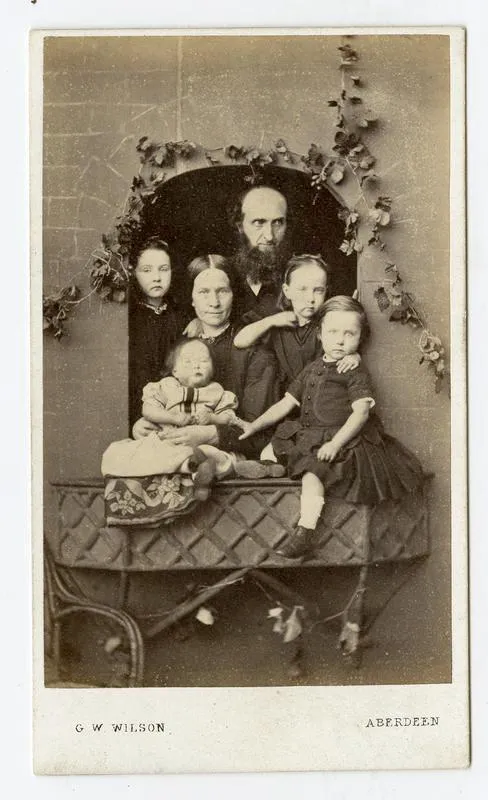 Carte de visite of an unidentified family, photographed by George Washington Wilson in Aberdeen in the 1860s. Aberdeen Archives, Gallery and Museums. Public domain.
This family paid to be photographed in Aberdeen in the 1860s. The image has survived in excellent condition for a century and a half. The archive’s label for it is “unidentified family”. The format outlived its subjects; the meaning did not. Somebody could once have told you who the bearded man was, and why the children were dressed up, and which of them went on to have children of their own. That person died, and the caption died with them.
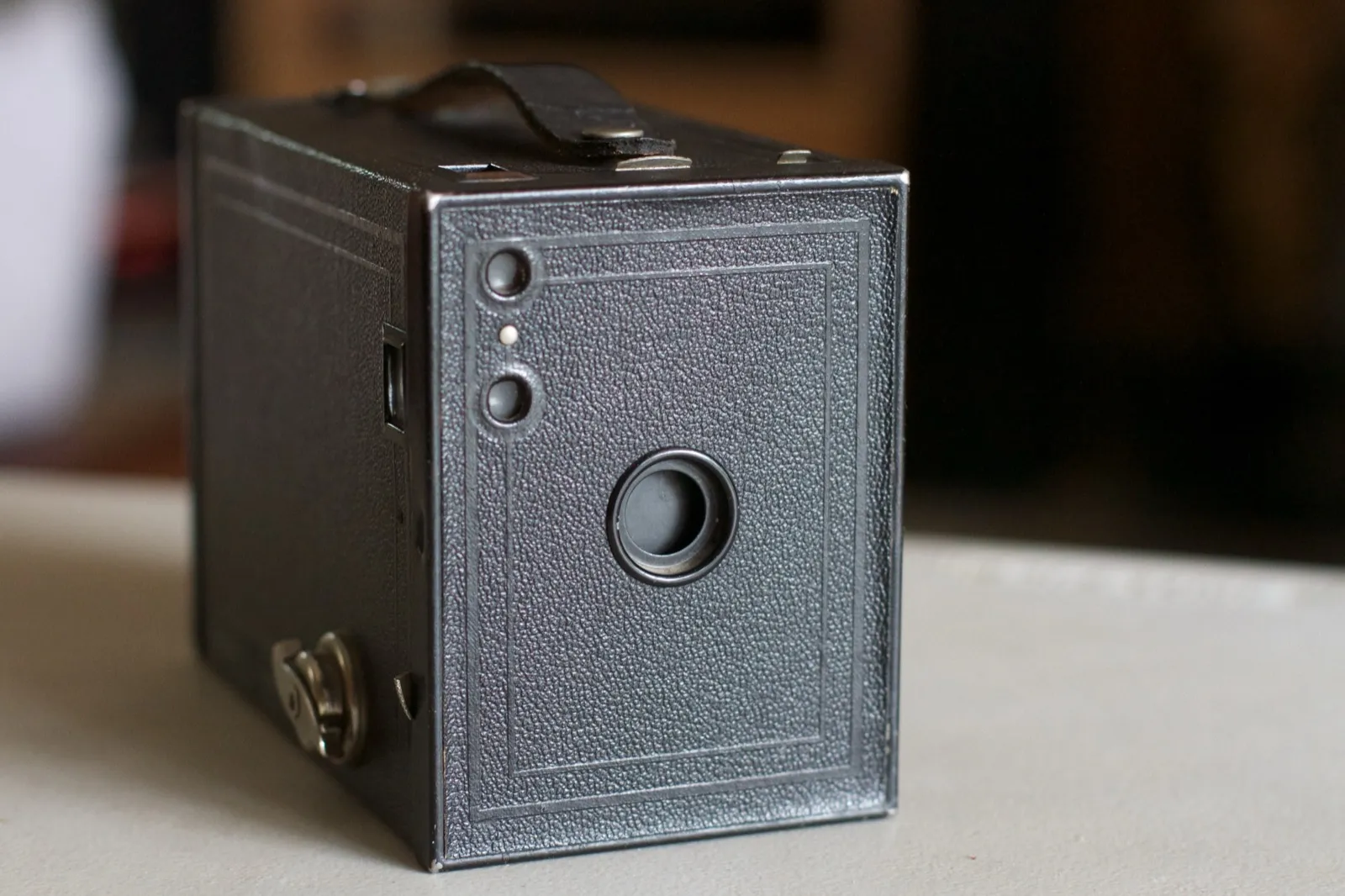 A Kodak Brownie box camera. The original Brownie of 1900 sold for one dollar. Photo by Alan Levine (cogdogblog), 2014. CC0.
When Kodak released the Brownie in 1900 for a dollar, photography stopped being a studio occasion and became a household habit. Within a few generations every family had a shoebox or an album, and every album went through the same life cycle. For a while the people in the pictures were known to everyone who opened it. Then they were known to one elderly relative. Then the album passed to someone who kept it out of respect and could not name a single face in it.
The phone has not changed that cycle. It has multiplied it by a thousand. A camera roll of twenty thousand images, with no captions, no dates anyone will remember, and no one to ask, is not a richer inheritance than the shoebox. It is a bigger shoebox. A photograph records that a moment happened. It does not record what the moment meant, and the meaning is the only part your descendants will want.
What actually survives?
Put the three failures together and the shape of a durable digital legacy becomes clear. It has to survive the format, the lock and the loss of context. Each has a known answer.
Copies, kept moving. The digital preservation community has a slogan for the first problem: lots of copies keep stuff safe. Keep your important photographs and videos in at least two places, one of them not in your house, and every five years or so move them onto whatever is current. Use the most ordinary formats you can.
Access shared in life. Set the legacy options on your Apple, Google and Facebook accounts this week; it takes a few minutes each. Then write a single page that says where things are, who has the keys, and what you would like done, and keep it with your will. Not the passwords: the map.
Context attached to the object. This is the part no setting can do for you. The caption has to be put back while the person who knows it is still here. The cheapest way to do that for a whole lifetime is to film the person talking. Hand your mother the album and record her turning the pages. Her face, her voice and her explanation are the caption, and a four-minute video of her saying “that was the summer we nearly lost the farm” is worth more to her great-grandchildren than every unlabelled image in the box. The same logic explains why self-published memoirs so often end up unread.
 “Young Girls Looking at an Album” by Pierre-Auguste Renoir, c. 1892. Virginia Museum of Fine Arts. Public domain.
The caption is the person
I filmed my grandmother for four hours before she died. The videos sit in several places and are in a format every phone can play, so the first two problems are handled. But what makes them valuable is the third. Watching them, you do not just see the photographs of her life; you hear her decide which stories to tell and watch her face as she tells them. She is the context. Nothing else in the house can do what those four hours do.
There is a gravestone in the old cemetery at Whroo, in central Victoria, for a man named John Welch. Its inscription reads, “Remember me as you pass by.” Stone solves the format problem handsomely; it will be legible long after every cloud service in existence has closed. What it cannot do is tell you who he was. He asked to be remembered and left a name.
You can leave much more than that, and it costs almost nothing. The failure mode of the digital age is not that we record too little. It is that we record everything except the one thing that gives it meaning, and leave it behind a password. Everyone is built around that gap: a person answers one question at a time, on video, and the stories are kept for the people they were meant for, including in a time capsule that opens on a date you choose. Make the copies, hand over the keys, and get the stories while there is still someone to tell them. Your descendants will have no shortage of pictures of you. What they will be short of is the people in them.


