
How the Egyptians saw life and death.
The ancient Egyptians believed a person could die twice, and that the second death, being forgotten, was the one that mattered. They were onto something.
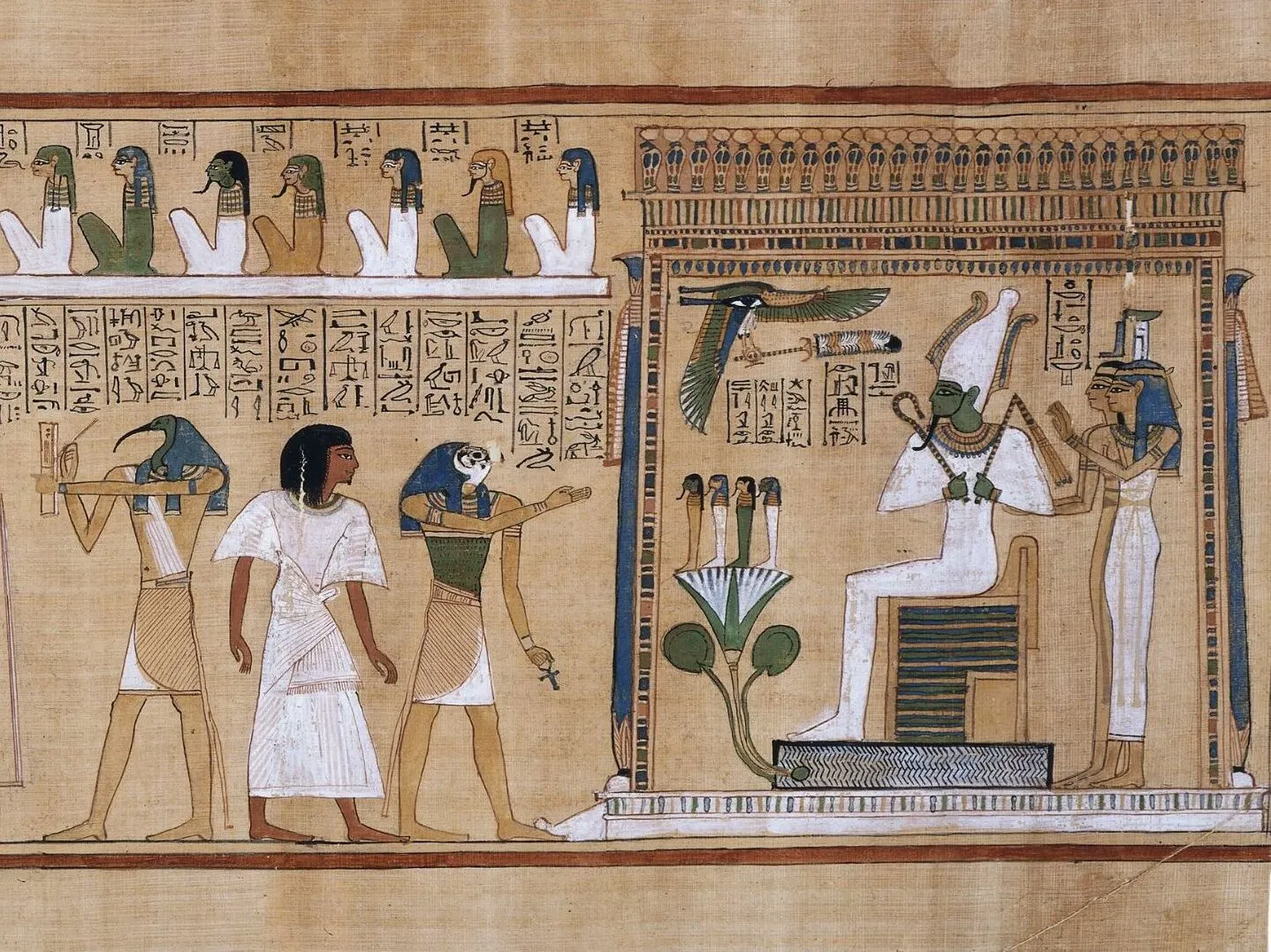
Around 1275 BCE, a royal scribe named Hunefer died in Thebes. We know almost nothing about his life. We don’t know what he looked like, what he sounded like, or what he thought about anything.
But we know his name. It is written on a papyrus scroll in the British Museum, and roughly three thousand years later, people are still saying it. By his own culture’s standards, that means Hunefer is still alive.
To understand why, you have to understand what the Egyptians believed a person actually was.
What is a person made of?
We tend to think of a person as a body with a mind inside it. The Egyptians had a more elaborate model. A person was made of several distinct parts, and each one had to survive death separately:
- The body (khat): the physical vessel, which is why preserving it mattered so much.
- The ka: the life force, which remained near the tomb and needed to be sustained with offerings of food and drink.
- The ba: the personality, often depicted as a bird with a human head, free to leave the tomb by day and return at night.
- The heart (ib): the seat of thought, emotion and memory, and the record of how a person had lived.
- The name (ren): not a label attached to a person, but a part of the person.
The last item is the most unusual, and the most interesting. It implies that a portion of who you are does not live inside your body at all. It lives in other people: in their mouths, their inscriptions and their memories.
That is a surprisingly modern idea. Identity is not purely private. Part of it is held by everyone who knows you.
How do you survive death?
The Egyptians’ answer was engineering. If a person was a collection of parts, then surviving death meant preserving each part.
The body was preserved through mummification. According to Herodotus, who visited Egypt around 450 BCE, the full process took seventy days. The organs were removed and the body dried with natron, a naturally occurring salt. The brain, considered unimportant, was discarded. The heart was deliberately left in place, because it would be needed later.
The ka was sustained by offerings, left by family members and funded, among the wealthy, by endowments meant to last forever.
The heart had to pass judgement.
The weighing of the heart
The guide to this judgement is what we now call the Book of the Dead. The Egyptians gave it a more hopeful title: the Spells for Coming Forth by Day. It was a collection of spells written on papyrus and buried with the dead, a set of instructions for what came next.
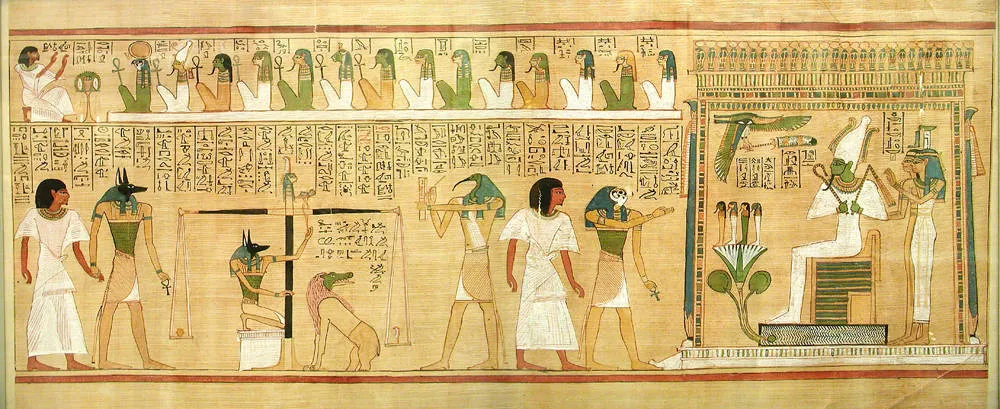 The weighing of the heart, from the Papyrus of Hunefer. Ammit waits beside the scales. Public domain.
In its most famous scene, Anubis leads the dead person into the Hall of Two Truths. Their heart is placed on one side of a scale. On the other is a single feather, the symbol of Ma’at: truth, balance and cosmic order.
The dead person then recites what historians call the “negative confession”, a list of wrongs they claim never to have committed. I have not stolen. I have not lied. I have not caused anyone to weep. Thoth, the god of writing, records the result. A heart weighed down by wrongdoing is devoured by Ammit, a creature that is part crocodile, part lion and part hippopotamus. That is annihilation.
A heart that balances with the feather earns its owner entry into the Field of Reeds.
It is worth noticing what the Field of Reeds was. It was not a realm of clouds or abstract bliss. It was Egypt: fertile fields, abundant harvests, the river, one’s family. The Egyptian vision of paradise was not an escape from life but a continuation of it. People who wanted to leave this world behind would not have imagined heaven as a better copy of it.
The popular image of the Egyptians as a civilisation obsessed with death has it backwards. Their elaborate funerary culture was the product of a civilisation that valued life so highly it could not accept that life should end.
The second death
Passing judgement was still not enough. The Egyptians believed a person could die a second time, and this death was permanent. It happened when you were forgotten.
This is why names were carved everywhere: on coffins, statues, stelae and tomb walls. Many tombs carried what Egyptologists call an “appeal to the living”, an inscription addressed directly to passers-by, asking them to stop, recite an offering prayer, and speak the name of the deceased. Every visitor who read the name aloud helped keep its owner alive.
The clearest evidence of how seriously this was taken comes from its inverse. When the Egyptians wanted to destroy someone completely, they erased the name. After the female pharaoh Hatshepsut died, many of her images and inscriptions were systematically removed. After the reign of Akhenaten, the pharaoh who had tried to overturn Egypt’s religion, his name was struck from monuments and omitted from official lists of kings. This was not vandalism. It was an attempt at execution after death.
Who got to be remembered?
There is an uncomfortable implication here. If survival depended on preservation, then survival was expensive.
Mummification, a decorated tomb, a personalised copy of the Book of the Dead, a stone inscription and perpetual offerings were available to a small elite. Most estimates suggest that only a few per cent of ancient Egyptians could read and write. The overwhelming majority were buried simply, and their names were never recorded anywhere that would last.
By the Egyptians’ own logic, almost everyone who lived in ancient Egypt has now died the second death. Hunefer survived because he was a royal scribe who could afford a beautifully illustrated papyrus. The farmers who grew his grain did not.
This pattern held for most of human history. Being remembered was a luxury good. Pharaohs had pyramids, aristocrats had portraits, and the famous had biographies. Everyone else had, at best, a name on a headstone.
What we have that they didn’t
When I was a teenager, I came across a grave in Whroo, an abandoned gold-mining town in country Victoria. It belonged to a man named John Welch, and the poem on it began: “Remember me as you pass by.”
It is the same request made by Egyptian tombs three thousand years earlier: an appeal to the living, asking a stranger to stop and remember. And it met with the same partial success. I know John Welch’s name. I know nothing else about him.
That is the limit of a name. It preserves the fact that someone existed, but not who they were. The Egyptians tried to solve this with every technology available to them, and the best they could manage for most people was nothing at all.
We are in a fundamentally different position. For the first time in history, preserving a person, not just their name but their face, their voice, their manner of speaking and the stories they tell, costs almost nothing. It requires a phone and an afternoon.
The Egyptians spent fortunes trying to avoid the second death, and most still failed. We can avoid it far more easily. The only remaining obstacle is that someone has to ask. If you are not sure where to begin, here is how to capture someone’s life story, step by step.


