
How to capture someone’s life story.
Lessons from filming more than a hundred life stories: how to prepare, what to ask, and why the most important part of an interview is the pause.
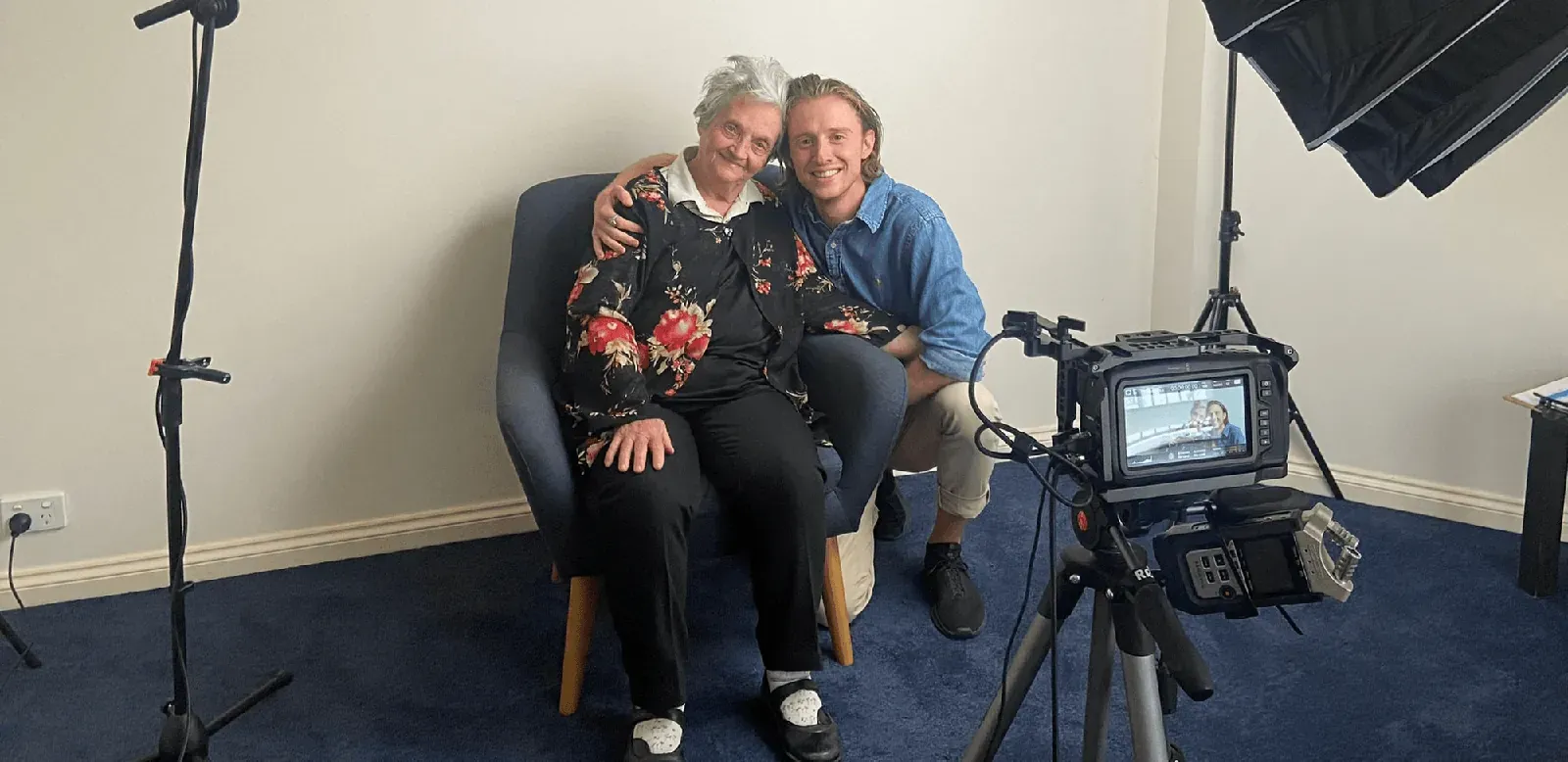
My grandmother has since passed away, but I have four hours of her telling me about her life. I can watch the way she laughed at her own jokes, the way her hands moved when she spoke about her mother, and the moments when she paused, looked away, and decided whether to tell me the next part.
Most families have nothing like this. That is rarely because they don’t care. It is because recording a life story feels like a project for later, and later has a way of running out.
Since 2020 I have filmed more than a hundred life stories, from Holocaust survivors to members of my own family. What follows is what I have learnt about doing it well. None of it requires professional equipment. All of it can be done with the phone you already own.
Why video, rather than writing?
A written family history records what happened. A video records who it happened to.
The difference matters more than it first appears. Most of what we know about a person is not contained in their words. It is in their tone, their timing, their expressions, the things they hesitate over and the things they rush past. A transcript of my grandmother’s interview would tell you about her life. The video lets you meet her.
There is also a practical argument. Very few people will sit down and write a memoir. Almost anyone will talk for an hour if someone they love asks them good questions and listens properly. Video lowers the barrier from authorship to conversation.
Step 1: Choose a person and a reason
Start with one person. Often it is a parent or grandparent, but some of the best interviews I have filmed were with an aunt, a family friend or a neighbour of fifty years.
A reason helps, because a request to “interview” someone can feel strangely formal. A birthday, an anniversary, a reunion or a trip back to someone’s hometown all work. So does the simple truth: I realised I don’t really know your story, and I would like to.
Most people are rarely asked about their own lives. The request is usually received as a compliment.
Step 2: Plan the questions in the order a life was lived
Write down fifteen to thirty questions before you begin, and arrange them roughly chronologically. This is not just tidiness. Memory is associative: recalling one period of life brings neighbouring memories within reach. Moving through a life in order lets each story prompt the next.
A reliable structure:
- Origins: full name, where and when they were born, who their parents were
- Childhood: earliest memories, the house they grew up in, school, friends
- Coming of age: first jobs, first love, leaving home
- Adulthood: work, marriage, children, migration, the decisions that changed everything
- Hardship: loss, regret, what sustained them
- Reflection: what they are proud of, what they would tell their younger self, how they want to be remembered
Spend the most time on adolescence and early adulthood. Psychologists have long observed what they call the reminiscence bump: older adults recall a disproportionate number of vivid memories from roughly their teens to their late twenties. It is the period when first experiences are concentrated and identity is formed, and it is usually where the richest stories are.
Save the difficult questions for later in the conversation. Trust takes time to build, even with family. (For a full list, see these questions to ask your parents about their life.)
The Everyone app includes ready-made question packs, such as Grandparents, Mum and Travel, if you would rather not start from a blank page.
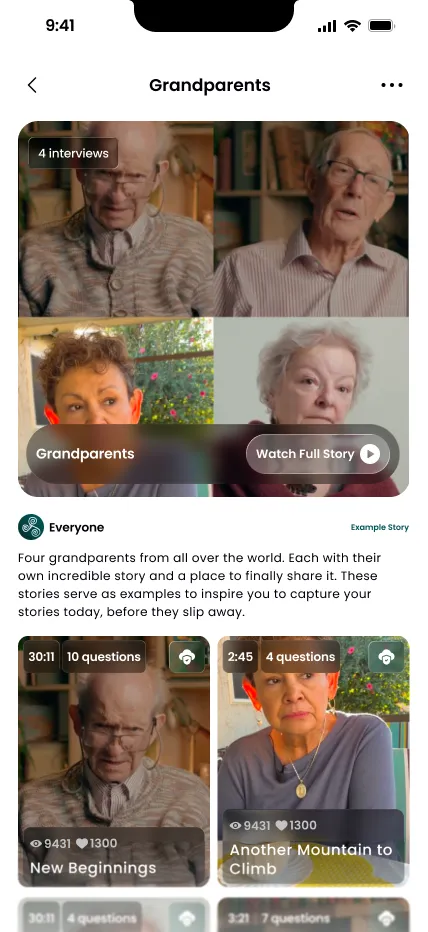 Question packs in the Everyone app, with example stories.
Step 3: Set up the shot
The technical requirements are modest, but a few details make a significant difference:
- Light from the front. Seat the person facing a window. Light from behind turns them into a silhouette.
- Camera at eye level. Prop the phone on books or a small tripod. Filming from below is unflattering; filming from above feels like an interrogation.
- Silence the room. Turn off the television, radio and appliances, and put both phones on Do Not Disturb. Background noise is the most common reason home recordings become unwatchable.
- Choose a meaningful background. A bookshelf, a garden or a favourite chair says something about the person. A blank wall says nothing.
- Frame from the chest up. The face is the point.
Sit beside the camera, so that when they look at you they are looking close to the lens. (For why each of these rules works, and how to get the sound right, see how to film an interview at home.)
Step 4: Ask for stories, and then wait
This is the part that determines whether an interview is merely complete or genuinely good.
Ask for scenes, not summaries. “Where did you grow up?” produces an address. “Describe the house you grew up in” produces a kitchen, a smell, a family argument, a neighbour. Specific questions retrieve specific memories; general questions retrieve general answers. (There is good research on why: see open vs closed questions.)
Follow up. In my experience, the best material almost never comes from the first question. It comes from the second and third: What happened next? What did that feel like? Why do you think you made that choice?
Tolerate silence. When someone stops speaking, the natural instinct is to fill the gap with the next question. Resist it. Wait five seconds. People often say the most honest thing in an interview immediately after a pause, once they are convinced you genuinely want to hear it.
Don’t correct the record. If your grandfather says it was 1962 and you know it was 1963, let it stand. You are not compiling a history. You are capturing how he remembers his own life, which is a different and more valuable thing.
Use objects. Photographs, letters, a wedding ring, a school report. Memories are tied to cues, and a physical object can unlock recollections that no question will reach. Hand it over and ask, “Tell me about this.”
Step 5: Record in chapters
Do not attempt an entire life in one sitting. Both of you will tire after thirty to forty-five minutes, and the quality of the answers declines with fatigue. (If the person is elderly, hearing and memory change the job in other ways too; see how to interview older family members.)
Break the story into sessions: childhood one weekend, work and family the next, reflection another time. Shorter sessions also give the person time to remember. It is common to receive a call a few days later that begins, “I thought of something else.”
This is the logic behind how Everyone works. It presents one question at a time, so a life story is built as a collection of short videos rather than one long, intimidating recording.
Step 6: Decide where the story will live
A video left on a camera roll is not safe. Phones are lost, storage fills, and in twenty years no one will know where to look (see what happens to your photos and videos when you die).
Before you begin, decide who each story is for. Professional oral historians settle this before the first question, and families can borrow much of their method (see how to conduct an oral history interview). Some are private. Most belong to the family. Some are best kept for the future, to be opened on a grandchild’s eighteenth birthday or years after the storyteller has died. Everyone allows you to seal a video in a time capsule that remains locked until a date you choose.
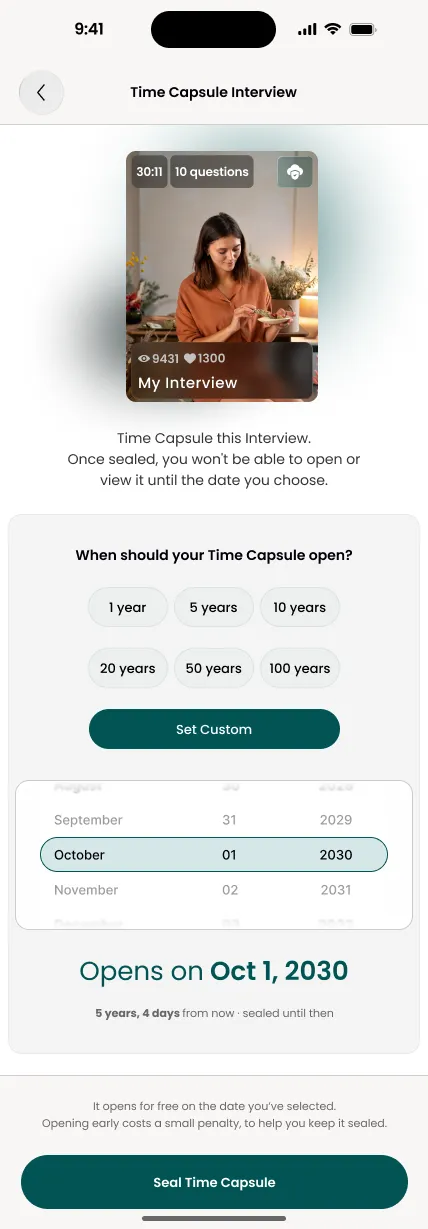 A time capsule in Everyone, sealed until a chosen date.
The most common mistake
The most common mistake is not a technical one. It is delay.
I frequently hear some version of, “I always meant to record my father’s stories.” It is almost always said in the past tense. Regret research suggests why this one lingers: as the regrets of the dying show, it is the things we never did, not the things we did, that grow heavier with time. Families often feel it first when someone has to write a eulogy and finds the first half of the life missing.
The ancient Egyptians believed a person could die twice: once when the body fails, and again when the last person who remembers them is gone. The first death cannot be prevented. The second can, and the cost of preventing it has never been lower.


