Questions to ask a Holocaust survivor, and the ones to leave unasked.
How to talk to a Holocaust survivor: the questions that work, the ones to avoid, and the method the big testimony archives use, while the witnesses remain.
In If This Is a Man, Primo Levi describes a dream he had in Auschwitz, and which he learnt was shared by other prisoners. He is at home, among family and friends, and he is telling them what has happened to him. They are not listening. They talk among themselves, and in his account his sister gets up and leaves the room without a word. Levi’s fellow prisoner Alberto tells him that everyone has the same dream.
That dream is the best guide I know to what to ask a Holocaust survivor, and how. The fear it records was not that nobody would believe the story. It was that nobody would stay in the room long enough to hear it. Anyone looking for questions to ask a Holocaust survivor is really being asked to do one thing: to stay in the room.
The people who can still answer are now very old. In January 2024 the Claims Conference estimated that about 245,000 Jewish Holocaust survivors were alive worldwide, with a median age of 86, and that 96 per cent of them were child survivors born after 1928. That is the window, and it is closing.
Why is it different to ask a Holocaust survivor?
Because the ordinary rules of asking an elderly relative about their life assume that remembering is pleasant. For most families, a question about a first job or a wedding is a gift. For a survivor, an open question about the war may reach something that has been carefully kept shut for decades, and the person asking has to decide in advance whether they can bear to hear the answer.
There is also an asymmetry that does not exist in other interviews. A survivor may well have been asked the wrong kind of question before, by people who wanted a lesson, a verdict or a dramatic scene. The USC Shoah Foundation’s interviewer guidelines make a related point: interviewers should remember that they may be the first person with whom the interviewee has ever shared their experiences, and should take extra care accordingly.
This is not a reason to stay away. When the Shoah Foundation began filming survivors in 1994, many who sat down had never told their own families what happened to them. The silence was rarely a lack of willingness. It was the absence of someone who asked well.
What should you not ask a Holocaust survivor?
The professional guidelines are more useful here than any list of etiquette, because they explain the reasons. Three habits cause most of the damage.
- Questions that demand a defence. “Why didn’t you leave earlier?” or “Why didn’t people fight back?” treat the survivor as someone who must justify what was done to them. The Shoah Foundation advises against phrasing even clarifying questions as “Why?” because the interviewee may hear a challenge rather than curiosity. Ask “What did your family decide to do, and how did you hear about it?” instead.
- Questions that treat survival as a puzzle to be solved. “How did you survive?” implies that there was a technique, and that those who died lacked it. Survival often turned on luck as much as on anything a person did. Ask about particular days and people and let them draw their own conclusions.
- Interrupting, steering or correcting. The Shoah Foundation’s guidelines tell interviewers to keep their comments to a minimum, to avoid the small verbal acknowledgements of ordinary conversation that wreck a recording, and not to debate. If a date or a place seems wrong, write it down and check it afterwards. A memory that is out of step with the archive is still a memory worth keeping.
One rule sits above these. If the person declines a question, accept the refusal. The Shoah Foundation requires its own interviewers to respect it, and a family member should hold themselves to the same standard.
How do you prepare to talk to a Holocaust survivor?
Professional interviewers spend much of their effort before the camera is on. The Shoah Foundation’s process includes a pre-interview conversation and a written questionnaire, completed in the week before filming, covering family members, places and dates. Interviewers are expected to spend at least thirty minutes preparing questions and to read about the places the person lived. A survivor who was eight years old when the war began saw it very differently from one who was twenty, and the guidelines say plainly that the age matters.
You can do a version of this at home.
- Learn the outline first. Find out where they were born, where they lived, and roughly when. If they have already given testimony to an archive or a museum, watch it before you meet, and ask about what it left out rather than repeating it.
- Meet once without the camera. Explain what you want to do and why, who will see it, and that they can stop at any time. Agree a length. The Shoah Foundation’s interviews average between two and two and a half hours, whereas Yad Vashem, which collects testimony within families as well as formally, suggests about one to two hours for a recording made in the family circle.
- Choose a place they know. The Shoah Foundation films survivors in their own homes. People speak more freely in their own chair and in their own language.
- Keep the room small. The Foundation asks relatives to leave the room during filming unless the survivor invites them in, so that nobody interrupts.
What are the best questions to ask a Holocaust survivor?
The Shoah Foundation follows the shape of a life in three parts: before, during and after. I would do the same. The war is the reason you are asking, but it is not the whole person, and the stretch before it is often what the family has least.
Before the war
- Where were you born, and what is the first thing you remember about your home?
- Who lived in your house? What did your parents do?
- What was a normal Friday night, or a normal Sunday, like?
- What did you want to be when you grew up?
- Who were your friends? Do you remember their names?
After a catastrophe, a family tends to remember a person only by how they died. A grandmother who describes her mother’s kitchen is putting the person back.
During the war
Let them lead here, and do not hurry towards the worst of it. Prompts that tend to work:
- When did you first realise that things were changing?
- What do you remember about the day you left your home?
- Is there an object, a photograph or a name that you kept with you?
- Who helped you? Who do you think of when you remember that time?
- Is there a day you would like me to know about?
The last question gives the survivor control over how much to tell.
After the war
The Shoah Foundation’s guidelines say that an interview should not end at liberation, and I agree. It is often the least asked, and the least told, part of the story.
- Where did you go afterwards, and who was waiting for you? Who was not?
- How did you build a life? Did you feel able to talk about it?
- When did you first tell your story, and to whom?
- What did you choose not to tell your children, and why?
- What would you like your great-grandchildren to know about you?
How do you handle the silences?
Badly, if you are like most people. The instinct is to fill a pause with a prompt, a sympathetic noise or a change of subject. The Shoah Foundation’s advice runs the other way: do not be afraid of silence, and count to ten in your head, because the interviewee will often add something, and that is frequently when “the most illuminating information is revealed”.
Primo Levi’s dream explains why this is hard and why it matters. The listener who gets up and leaves is the one who could not bear the pause. Staying put, with a steady expression, is the whole of the skill. If the person becomes distressed, offer a break, a glass of water or the chance to stop for the day. They can return to it, and so can you.
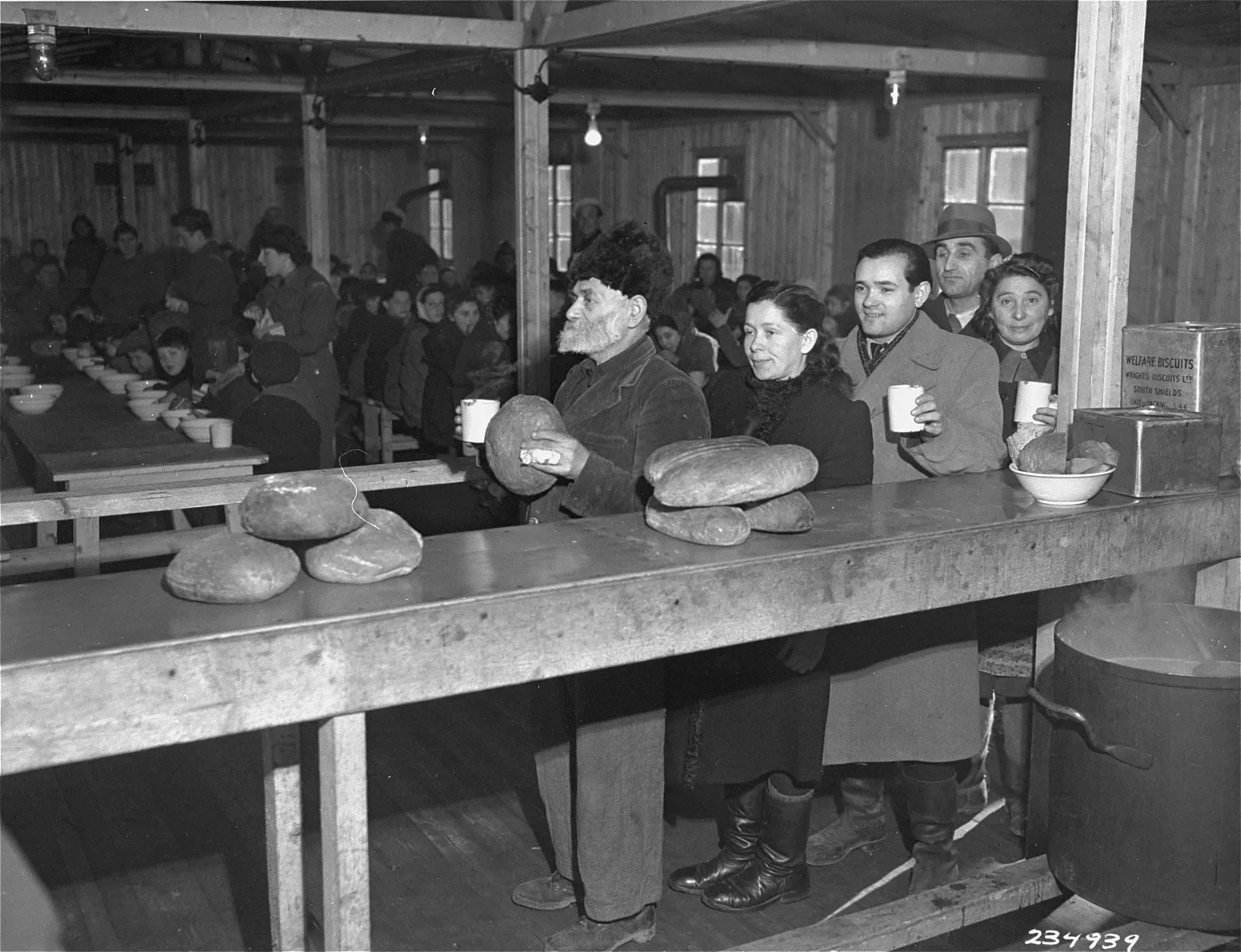 Jewish displaced persons receive bread rations at the Bindermichl camp in Linz, Austria, around 1946. United States Holocaust Memorial Museum. Public domain.
Why should the camera be on?
Because what a survivor’s face does while answering is part of the testimony. The case for filming rather than writing or recording sound alone is made at length in why 55,000 Holocaust survivors were filmed, but the short version is that a transcript preserves what was said and video preserves what it cost to say it.
It also gives the family something no memoir can. Most of the great testimony archives end the same way: the survivor is invited to hold up photographs and documents to the camera and to introduce the children and grandchildren who are present. That moment turns a record of events into a record of a family that continued. Do the same. Ask them to name the people in each photograph, and ask who is sitting beside them.
If you are new to this, the practical groundwork in how to interview older family members and how to conduct an oral history interview applies in full. Ask permission before filming, explain who will see the recording, and give them a copy.
Where should you start?
With the first question in the list, and with the person rather than the war. Ask where they were born. Ask what the house looked like. Allow the answer to go where it goes, and leave a few seconds after it ends.
Since 2020 I have filmed more than a hundred life stories through The Archive, and I have been privileged to film Holocaust survivors among them. What I took from it is that the survivor is very rarely reluctant to be asked. They have often been waiting a long time for a listener who would stay. The Everyone app, which presents one question at a time and records each answer on video, can give you the prompts, though a phone propped on a stack of books and an unhurried afternoon do the real work.
Levi’s sister left the room in the dream. In the room you are about to sit in, you can be the one who does not.