
How to interview older family members, and why it is a different job.
Most interview advice assumes a listener in their prime. What hearing, memory and the life review change when the person across the table is eighty.
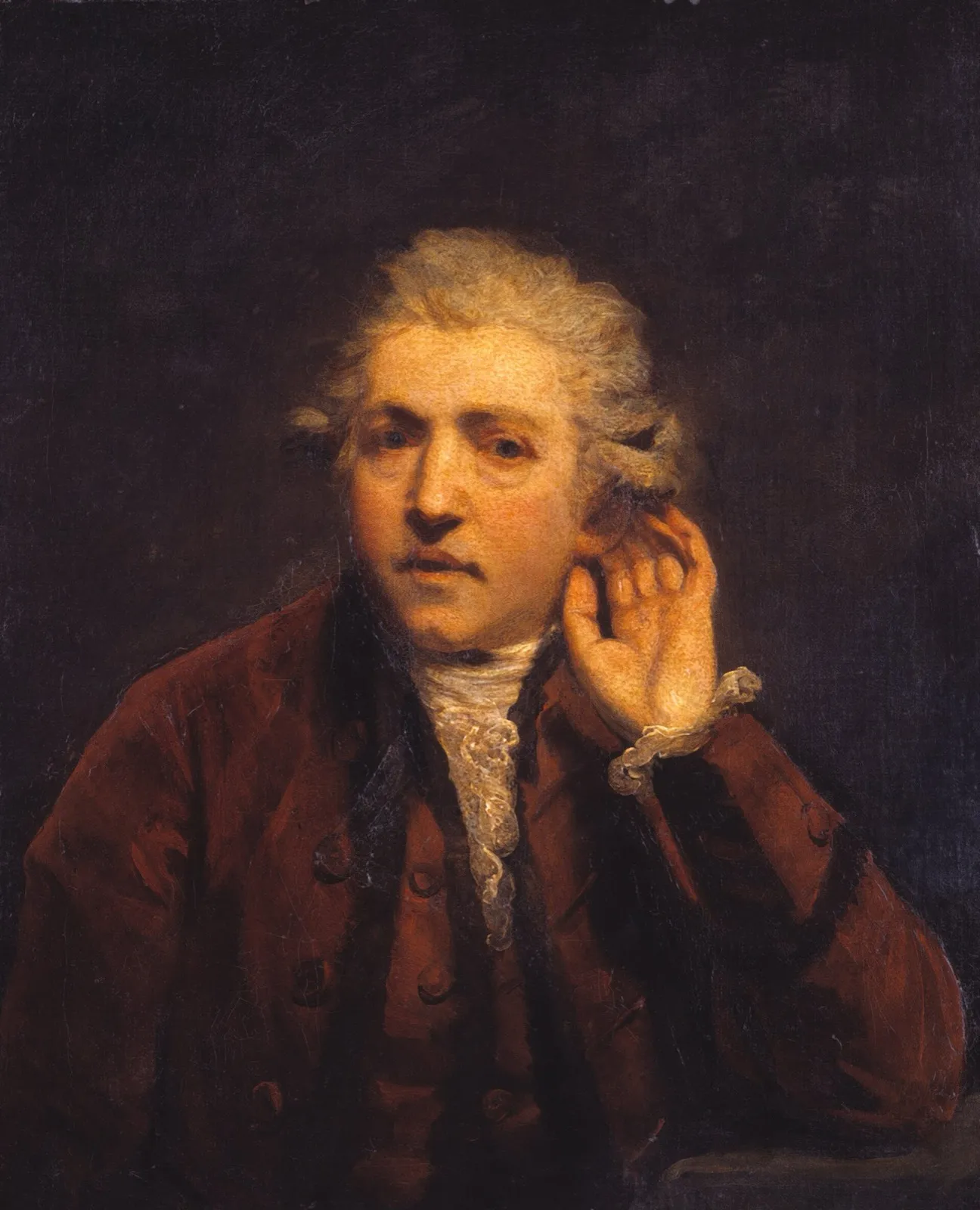
Around 1775, at the height of his fame, Sir Joshua Reynolds painted himself with one hand cupped behind his ear. He was the first president of the Royal Academy and the most sought-after portraitist in Britain, and he could have shown himself any way he liked. He chose to show himself straining to hear. His deafness is usually traced to a severe cold caught in Rome as a young man, and he carried an ear trumpet for the rest of his life. The painting is a small, honest admission: the man who looked at people for a living could no longer easily hear them.
I think of it whenever someone asks how to interview older family members, because almost everything written about interviewing assumes a listener in their prime: quick to hear, quick to retrieve, able to sit for two hours. A grandparent of eighty-five is not that listener, and treating them as one is the most common reason family interviews disappoint. (For what to ask once you are sitting down, see these questions to ask your grandparents.)
The differences, however, are predictable. Ageing changes hearing, memory, stamina and a person’s relationship to their own past in ways that are well documented, and each change implies something concrete about how to ask. What follows is what I have learnt filming more than a hundred life stories since 2020, many with people in their eighties and nineties, and what the research says about why it works.
Why do they not seem to hear the question?
Start with the ear, because it is the problem interviewers most often misdiagnose. The World Health Organization’s 2021 World Report on Hearing estimates that more than a quarter of people over sixty have disabling hearing loss, and the proportion rises steeply with age.
Age-related hearing loss is not simply a matter of volume. It takes the high frequencies first, and the high frequencies are where consonants live: the s, f, t and th that distinguish one word from another. Vowels, which sit lower, usually come through. The result is a person who hears that you are talking, hears roughly the shape of the sentence, and cannot reliably tell fifty from sixty or when from where. Studies of older listeners consistently find that background noise makes this far worse, out of proportion to the loss shown on a hearing test, and that older adults compensate by leaning hard on context and on watching the speaker’s face.
Each of these facts has a practical consequence:
- Film indoors, in a quiet room. Gardens and cafés are pleasant and nearly useless. A clock, a fridge, a television in the next room or traffic through an open window will cost you answers, not just sound quality. (The room itself is covered in how to film an interview at home.)
- Sit where they can see your face, close and in good light. Lip-reading is doing more work than either of you realises.
- Speak lower and clearer rather than louder. Raising your voice mostly raises the vowels, which they could already hear, and distorts the consonants, which they could not.
- Ask one short question at a time. A two-part question is a guessing game for someone catching two words in three.
- Do not take a blank look for a lack of memory. Very often the question simply did not arrive. Repeat it, differently and more slowly, before concluding there is nothing there.
Why is 1950 clearer than last Tuesday?
The second difference is the shape of memory. In 1881 the French psychologist Théodule Ribot observed that when memory fails, it tends to fail in reverse order: recent memories go first, and the oldest and most often revisited survive longest. The pattern is now called Ribot’s law. It has exceptions, and how often a memory has been retold seems to matter at least as much as its age, but the broad tendency is familiar to anyone who has sat with an elderly relative. The names of this year’s great-grandchildren slip; the name of the horse on the farm in 1938 does not.
A second pattern reinforces the first. When psychologists ask older adults to recall memories from across their lives, the memories cluster disproportionately between roughly the ages of ten and thirty, a pattern that David Rubin and his colleagues identified in 1986 and called the reminiscence bump. First jobs, first loves, war service, migration and marriage are told with a vividness that later decades rarely match.
For the interviewer, this reverses the usual instinct. Many people begin with the recent past because it feels safe and easy. For an older person it is often the hardest ground, and an early stumble there can convince them that they have “a terrible memory” and shut the interview down. Begin instead where the memory is strongest: the house they grew up in, the first day of school, the first job, the week they met their husband or wife. The questions I use are in questions to ask your parents about their life, and they lean deliberately towards the early decades.
 “Arrangement in Grey and Black No. 1”, usually called Whistler’s Mother, by James McNeill Whistler, 1871. Musée d’Orsay, Paris. Public domain.
Two further rules follow. Do not test. “Do you remember what year that was?” is a memory exam, and failing it in front of a grandchild is humiliating. If a date matters, you can find it later. Do not correct. You are recording how a person remembers their life, which is the only version of it that was ever theirs. Even where memory is seriously impaired, the long-rehearsed stories of early life are often the last to go.
Why do they repeat themselves, and wander?
Here the research is more generous than our instincts. In 1963 the American psychiatrist Robert Butler published a paper in the journal Psychiatry called “The Life Review”. Until then, an old person’s tendency to dwell on the past was widely read as a symptom: a withdrawal from the present, a prelude to senility. Butler argued the opposite. He described reminiscence in old age as a natural and universal process, prompted by the awareness that life is ending, in which a person returns to old experiences and unresolved conflicts in order to make sense of them. It was, in his account, closer to therapy than to decline.
That reframing changes what an interviewer is doing. You are not extracting data from a failing archive. You are joining a process that is already under way. When your grandfather tells the story of the boat for the fourth time, it is not that he has forgotten telling it. The boat is where his life turned, and he is still working on it. Repetition is a map of what matters. Film the fourth telling. It is often the best one.
Wandering is a related case. Psychologists have found that a minority of older adults show what is called off-topic verbosity: answers that begin on the subject and drift, through a chain of loosely connected recollections, somewhere else entirely. In a life story interview this is frequently the point. The drift goes where the associations are strong, and the associations are the person. The journalist’s reflex, to steer back to the question, is the wrong reflex here. Let it run, and return later with “You mentioned your sister’s wedding. Tell me about that day.”
Why is the version you hear so sunny?
There is one more pattern that interviewers mistake for evasion. The psychologist Laura Carstensen and her colleagues at Stanford have shown over several decades that as people age, their attention and memory tilt towards the positive, a finding known as the positivity effect. Older adults attend to, and later recall, more positive than negative material, and the effect appears to be motivational rather than a symptom of decline: with less time ahead, people invest in what feels meaningful and let go of what does not.
So when your mother describes a childhood of real poverty as “a wonderful time”, she is not necessarily hiding anything. She may be reporting what her memory now offers her. You can still ask about the hard parts, and you should, gently and with explicit permission not to answer, because the hardest stories are usually the ones a family most needs. But accept that the account you get is the one the person has chosen to keep. It is a record of how a life looks from its final chapter, which is something no document can give you.
How long should a session be?
Shorter than you think. Attention, hearing and voice all tire faster at eighty-five than at forty, and the quality of the answers drops before anyone admits to being tired. Oral historians who work with older narrators generally keep sessions to forty-five minutes or less. I rarely go past that, and I stop early at the first sign of flagging: shorter answers, more “I don’t know”, a hand going to the eyes.
 “An Old Woman Dozing over a Book” by Nicolaes Maes, about 1655. National Gallery of Art, Washington. CC0.
Three practical consequences:
- Film in the morning, or whenever that person is at their best. Late afternoon is the worst time for many older people.
- Plan for several sessions, each on one period of life, rather than one long one.
- Use objects. A photograph, a medal, a ring, a letter. For a tiring mind, a thing in the hand is a far cheaper cue than a question, and it bypasses the hearing problem entirely.
My grandmother’s four hours were filmed in sittings of under an hour, over several visits. She has since died. I have never once wished the sittings had been longer. I have often been glad there were more of them.
A short checklist
- Quiet room, indoors, facing a window, their face lit and yours visible.
- Camera at eye level, you beside it, close enough to be lip-read.
- One short question at a time; repeat it before you assume a blank.
- Start in childhood and the twenties; leave the recent past alone.
- Never test, never correct.
- Let repetition and tangents run; they are the content.
- Ask about the hard years gently, with permission to decline.
- Forty-five minutes, in the morning, over several visits.
- Hand them something to hold.
What the painting is really about
Whatever Reynolds meant by it, the hand behind the ear is the posture of someone who badly wants to hear what is being said. That, in the end, is the whole technique. Interviewing an older family member is not a matter of better questions, although better questions help. It is a matter of removing, one by one, the obstacles between a person and the telling: the noise, the fatigue, the fear of failing a test, the sense that nobody is really listening.
The window for doing this is narrower than it feels, which is why so many people search for the questions they wish they had asked only after the chance has passed (I wrote about that in questions I wish I had asked my parents). Everything above works with a phone propped on a stack of books. Everyone was designed around the same constraints: one question at a time, short recordings, a clear decision about who each video is for. The tool matters less than the sitting down. For the filming itself, see how to capture someone’s life story on video.


