Why 55,000 Holocaust survivors were filmed.
The largest archive of Holocaust survivor testimonies is on video, not paper. The reasons behind that choice apply to every family with a story to keep.
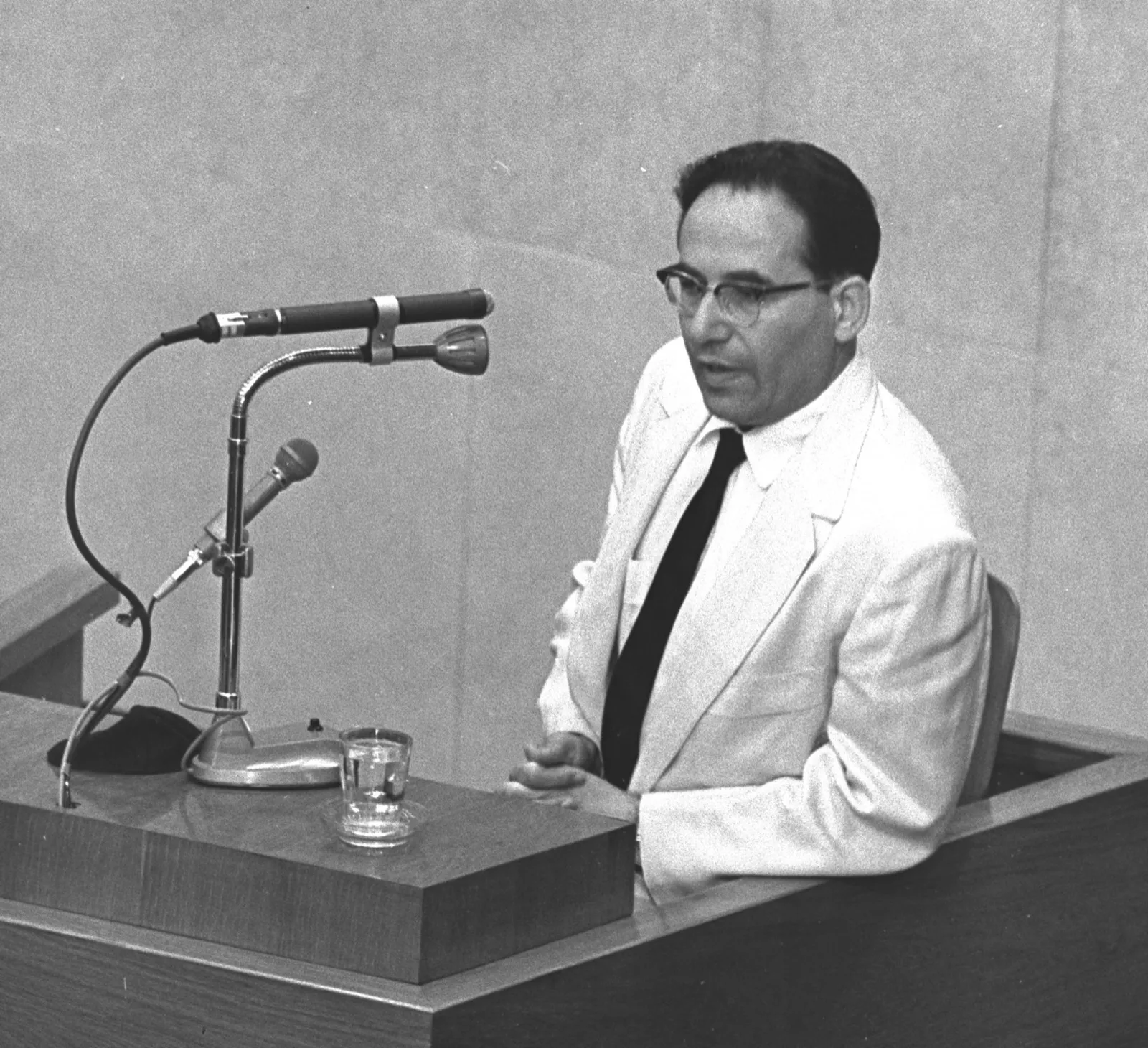
On 7 June 1961, a writer named Yehiel De-Nur took the witness stand at the trial of Adolf Eichmann in Jerusalem. He had survived Auschwitz and written about it under the pen name Ka-Tzetnik, from the German abbreviation for a concentration camp prisoner. A few minutes into his testimony, while trying to describe Auschwitz as another planet with its own laws of time, he collapsed in the witness box and was carried from the courtroom.
The written trial record notes, in a line, that the witness fainted. The footage shows a man in a white jacket speaking, faltering and falling. Anyone who has seen both knows that they do not record the same event. The transcript tells you what happened. The film shows you what it cost.
That gap between the record and the person is the reason the largest collection of Holocaust survivor testimonies in the world is a video archive. The USC Shoah Foundation holds more than 55,000 filmed testimonies, the great majority recorded with survivors and other witnesses of the Holocaust. Understanding why it was built that way, and how the interviews were conducted, says a good deal about how any life story should be kept.
Who first recorded Holocaust survivor testimonies?
The impulse came early. In the summer of 1946, David Boder, a psychologist from the Illinois Institute of Technology, travelled to displaced persons camps in France, Switzerland, Italy and Germany carrying a wire recorder, one of the few portable recording machines of its day. Over about nine weeks he recorded roughly 130 interviews in nine languages, though sources give different totals. His book of selected interviews, published in 1949, has a title that still lands hard: I Did Not Interview the Dead.
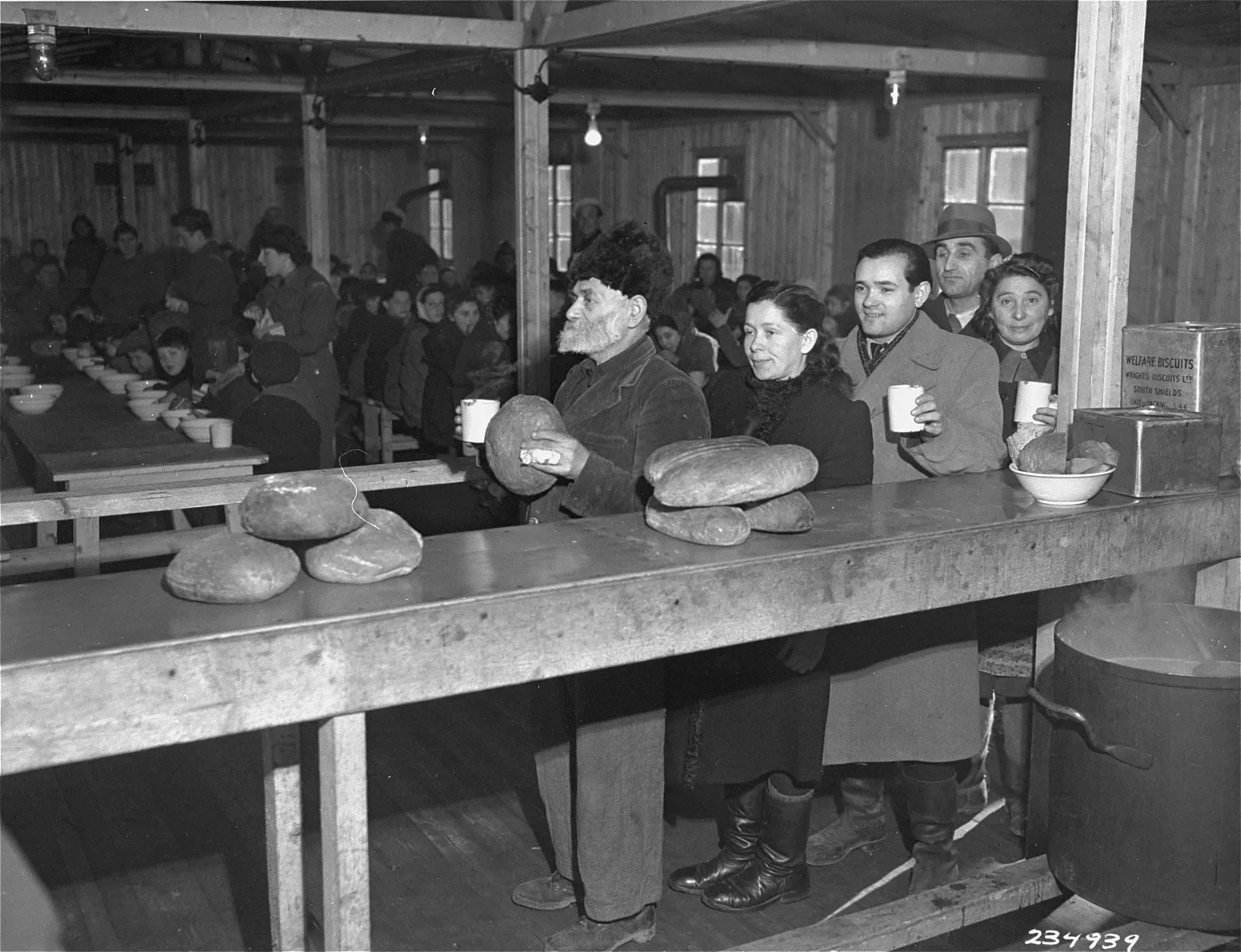 Jewish displaced persons receive bread rations at the Bindermichl camp in Linz, Austria, around 1946. United States Holocaust Memorial Museum. Public domain.
Boder’s recordings are extraordinary, and they are also only voices. We can hear the hesitation and the switching between languages, but we cannot see the faces of the people speaking a year after liberation. For decades afterwards, most testimony existed as written memoirs, court documents and depositions.
The Eichmann trial changed that. The proceedings were filmed for television under the direction of the documentary maker Leo Hurwitz and sent around the world on videotape. More than a hundred witnesses testified, many of them survivors, and for the first time a mass audience watched people describe the camps and ghettos in their own words. It is hard to overstate how new this was. Many viewers had read about the Holocaust. Few had looked at someone who had lived through it while they spoke.
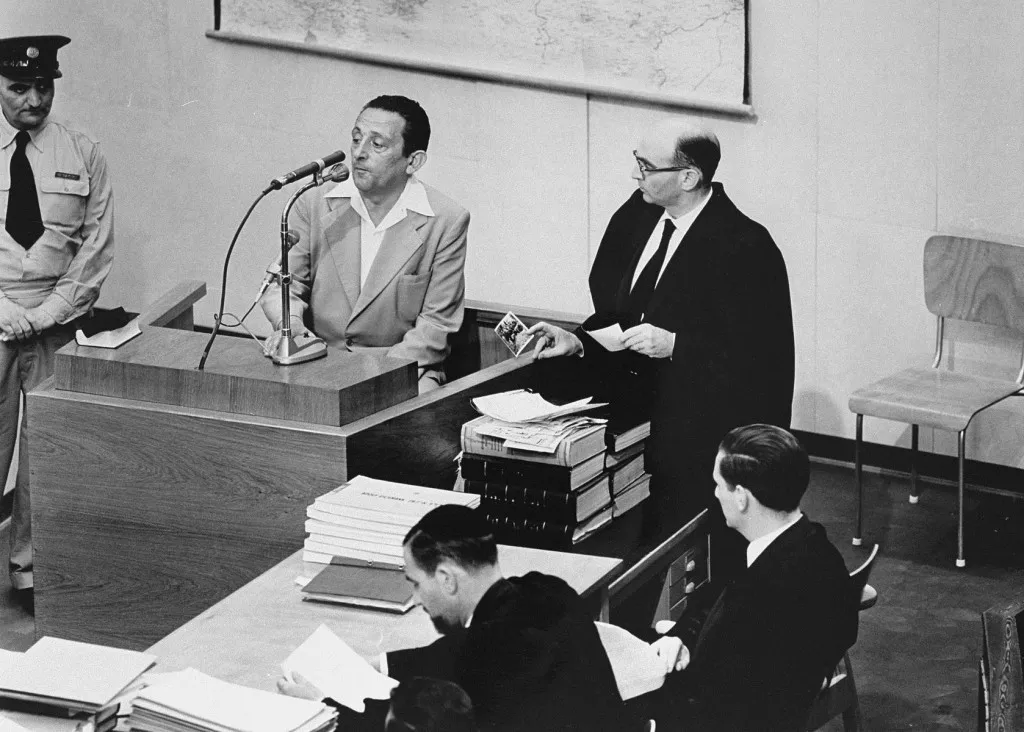 Chief prosecutor Gideon Hausner questions Henryk Ross, a photographer from the Łódź ghetto, at the Eichmann trial, 2 May 1961. Israeli Government Press Office, via the United States Holocaust Memorial Museum. Public domain.
The deliberate filming of survivors’ life stories began in 1979 in New Haven, Connecticut. Laurel Vlock, a television journalist, and Dori Laub, a psychiatrist who had himself survived the Holocaust as a child, arranged for a video crew to film four survivors on 2 May 1979. Their Holocaust Survivors Film Project recorded nearly 200 testimonies before the tapes were given to Yale University in 1981, where they became the core of what is now the Fortunoff Video Archive for Holocaust Testimonies.
Why did Steven Spielberg film 55,000 survivors?
The scale came from Hollywood. While making Schindler’s List, released in 1993, Steven Spielberg met survivors who visited the set and told him their stories. Many had never told them to their own families. In 1994 he founded the Survivors of the Shoah Visual History Foundation with a simple aim: to film as many survivors as possible while they were still alive.
It worked at a speed no archive had attempted. By the end of the decade the foundation had recorded more than 50,000 interviews. The United States Holocaust Memorial Museum puts the total for the main collecting period, from 1994 to the early 2000s, at nearly 52,000 testimonies from 56 countries. The foundation moved to the University of Southern California in 2006, and its Visual History Archive has since grown to include testimonies from other genocides, among them Rwanda, Armenia and Nanjing. By one estimate, the whole collection runs to more than 110,000 hours of video. Watching it end to end would take more than twelve years without sleep.
The reasoning behind the urgency was arithmetic. In 1994, a survivor who had been a young adult in 1942 was already in their seventies. Every year the number of first-hand witnesses fell, and nothing would bring it back up.
Why video rather than written testimony?
There were already shelves of Holocaust memoirs, some of them among the most important books of the twentieth century. So why film?
The literary scholar Lawrence Langer gave one answer in Holocaust Testimonies: The Ruins of Memory (1991), a book built on the Fortunoff videotapes. He argued that written memoirs, even great ones, impose a shape on experience: a narrative arc, a moral, a style. Oral testimony resists that shaping. Witnesses contradict themselves, stop mid-sentence, return to a moment they cannot get past, and refuse the consoling conclusions a reader might want. Langer’s view was that this less filtered record is closer to the truth of what survivors carried.
Video adds a further layer that neither writing nor audio can. A transcript records words. A sound recording adds tone and pauses. Video adds the face that a pause happens on, the glance away, the hand that moves to the mouth. Much of what a listener understands about another person’s experience comes from those signals, and they are precisely what disappears when testimony is reduced to text. A future reader of the Eichmann transcript learns that De-Nur fainted. A future viewer of the footage understands why. (The same reasoning applies at the scale of one family; see why recording a life story on video beats writing.)
How were the testimonies recorded?
The Shoah Foundation’s method was designed for interviewers who would have one chance with each person, often several hours long. Much of it translates directly to a family recording a grandparent.
- Preparation before the camera. About a week before each interview, the interviewer met the survivor to complete a detailed pre-interview questionnaire: family background, places, dates, names. This did two jobs. It gave the interviewer a map of the life, and it built a relationship before anyone pressed record.
- The whole life, in order. The questionnaire, and the interview, were divided into prewar life, the war years and postwar life. The war was the reason for the archive, but the survivors were not reduced to it. Their childhoods, parents, schools, marriages and careers were recorded too.
- At home, in their own language. Interviews were usually filmed in the survivor’s own home, and always in the language they chose. People speak differently in their own living room, and in their first language.
- Photographs and family at the end. Near the close of most interviews, survivors were invited to show photographs, documents and objects to the camera, and to introduce members of their family.
That last step is worth dwelling on. After hours about loss, the testimony ends with a survivor holding up a photograph of a mother or sister who did not survive, and then with children and grandchildren sitting beside them on the sofa. It turns the recording from evidence into a family document. Professional oral historians use much the same structure, which is set out in more detail in how to conduct an oral history interview.
The method has its critics. Some scholars have worried about a smoothing of memory into a redemptive story, and the quality of interviews varies with the skill of thousands of different interviewers. But the alternative to an imperfect interview was not a perfect one. It was nothing.
What happens when the last witnesses are gone?
In January 2024, the Claims Conference estimated that about 245,000 Jewish Holocaust survivors were still alive, with a median age of 86. Ninety-six per cent were child survivors, born after 1928. Within a decade or two there will be no one left who can say, in the first person, I was there.
When that happens, the archives will carry the testimony. That is the bet the Shoah Foundation and the Fortunoff Archive made, and it is why the foundation later began experimenting with interactive testimony that lets visitors ask a filmed survivor questions (a project described in the future of storytelling). Whether recorded testimony can do the work that a living witness does is an open question. It is certain that it can do more than no testimony at all.
What does this mean for an ordinary family?
The Holocaust is not a template for family history, and the experiences these archives hold are unlike anything most families will have to record. But the logic behind them applies everywhere. Every family has a group of witnesses, usually the oldest generation, who are the only people able to describe a world that has gone. That group only ever gets smaller. And the way to keep what they know is the same: prepare, ask about the whole life, film them at home in their own words, and end with the photographs and the people they love.
Since 2020 I have filmed more than a hundred life stories through The Archive, including Holocaust survivors, and four hours of my grandmother’s story before she passed away. What the great testimony archives understood in the 1990s still holds: the window is real, and the only remedy is to film people while they can still speak for themselves.
In 1994, recording 50,000 testimonies needed a foundation, camera crews in dozens of countries and a very large budget. Today the camera is already in your pocket. Everyone, the free app we built for this, presents one question at a time and records each answer as a short video, which makes the Shoah Foundation’s approach of preparation, chronology and patience possible over a few afternoons at a kitchen table. (Why so much of this work is urgent is the subject of why capturing life stories matters.)