Remembrance Day, and why a name is not enough.
Remembrance Day keeps more than 100,000 Australian names. The Australian War Memorial says telling each of their stories will take nearly 300 years.
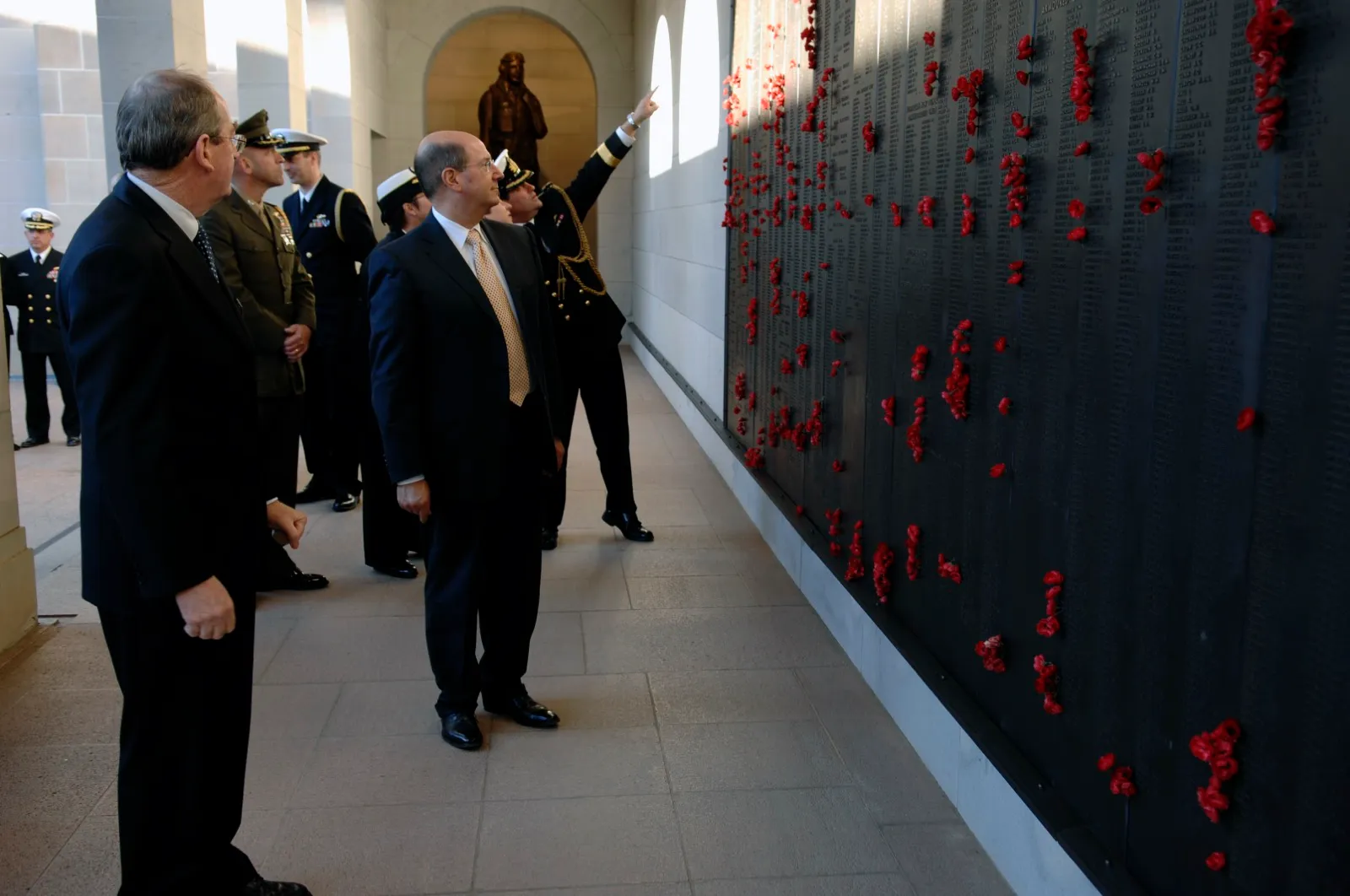
Every afternoon at the Australian War Memorial in Canberra, a member of the Defence Force stands beside the Pool of Reflection and reads the story of one person whose name is on the Roll of Honour. The ceremony began on 17 April 2013. More than 103,000 names are cast in bronze on that wall, and the Memorial has said that, at one story a day, it will take nearly three hundred years to tell them all.
That figure is the most honest thing I know about Remembrance Day. It measures the gap between remembering that people died and remembering who they were. The names were recorded carefully, at great expense, a century ago. The stories were mostly not, and an institution with historians, archives and a national budget now needs three centuries to recover even a short version of each.
Remembrance Day is tomorrow, 11 November. It is a good day to ask what remembering actually consists of, and why the part we are best at is the part that matters least.
Why do we have Remembrance Day?
The fighting on the Western Front stopped at 11am on 11 November 1918, under the armistice signed that morning. A year later, the question was how to mark the date.
The answer came partly from an Australian. In May 1919, Edward Honey, a Melbourne-born journalist living in London, wrote a letter to the Evening News under the pen name Warren Foster, proposing five minutes of national silence on the anniversary. The South African politician Sir Percy FitzPatrick made a similar proposal later that year, and it is not clear whether either man influenced the other. After a trial with the Grenadier Guards, the silence was set at two minutes, and on 7 November 1919 King George V asked the Empire to observe it. It was first kept, in Australia and elsewhere, four days later.
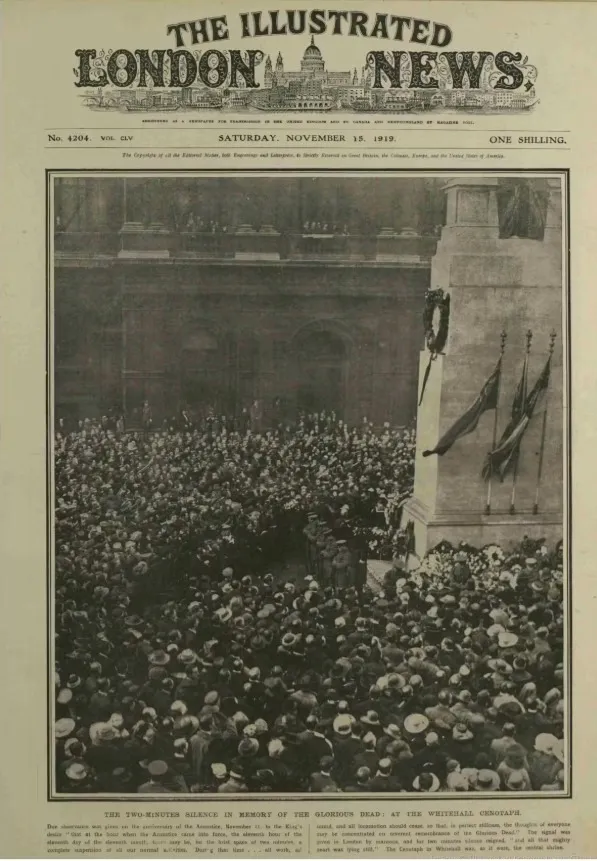 “The two-minutes silence in memory of the glorious dead: at the Whitehall Cenotaph.” The Illustrated London News, 15 November 1919. Public domain.
The two minutes were not designed to tell anyone anything. They were designed to make room. Every person standing in that crowd in Whitehall was thinking of someone in particular, a son, a brother, a husband, a friend from the street, and the silence let each of them do so at once. The ritual worked because the stories were already in the room, carried in the heads of the people standing there.
That is the assumption buried in almost every form of remembrance we inherited from the First World War. The state would keep the names. The families would keep the stories.
What did the Unknown Soldier stand for?
On 11 November 1920, Britain buried an unidentified soldier, brought back from the battlefields of France and Flanders, in Westminster Abbey. France honoured its own unknown soldier at the Arc de Triomphe the same day. Australia did the same, much later: on 11 November 1993, the 75th anniversary of the armistice, the remains of an unknown Australian soldier from the Western Front were entombed in the Hall of Memory in Canberra.
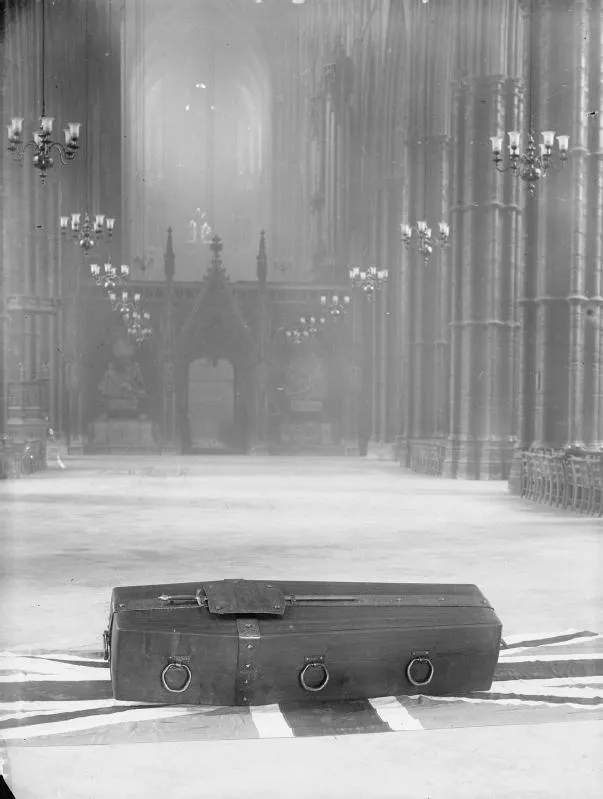 The coffin of the Unknown Warrior in Westminster Abbey, November 1920. Photograph by Horace Nicholls, Imperial War Museum Q31518. Public domain.
In his eulogy that day, Prime Minister Paul Keating described the soldier in the line now carved on the tomb: “He is all of them. And he is one of us.”
The idea is clever, and it explains why these tombs move people. The unknown soldier has no story precisely so that every family can lend him theirs. Of the roughly 60,000 Australians who died in the First World War, many thousands have no known grave. For their mothers, the man in the tomb could be him. Anonymity was the point.
But that only works while there are people who remember someone to lend. A blank space invites a story; it cannot supply one. When the last person who knew a particular soldier dies, the unknown soldier stops being anybody’s son and becomes a symbol of a general loss. A symbol is still worth keeping. It is just not the same thing as a person.
Why do stories move us more than names?
There is a well-studied reason why the Last Post Ceremony tells one story a day instead of reading out a hundred names.
In a 2007 study, the psychologists Deborah Small, George Loewenstein and Paul Slovic asked people to donate to a famine appeal. Some were shown statistics about millions of hungry children in Africa. Others were shown a photograph and a short description of a single seven-year-old girl from Mali named Rokia. People gave far more to Rokia. Adding the statistics to her story actually reduced donations. Slovic has called the broader pattern “psychic numbing”: as the number of victims rises, our feeling for them does not rise with it, and can fall.
Remembrance runs into the same wall. A list of 103,000 names is, emotionally, a statistic. A single story read aloud, with a photograph, a hometown, a letter home and the name of the person who received the telegram, turns one of those names back into a person. The ceremony is essentially a slow-motion attempt to undo psychic numbing, one name at a time, and the arithmetic of three hundred years shows how slow that is when the stories have to be reconstructed from service records after everyone who knew the person has gone.
What happens when the last witness dies?
For the First World War, that moment has already passed. Harry Patch, the last British soldier to have fought in the trenches, died in July 2009 at the age of 111. He had been at Passchendaele in 1917, and by most accounts he hardly spoke about the war until he was around a hundred. Claude Choules, the last man known to have served in combat in that war, died in Perth in May 2011, aged 110. Florence Green, who served as a waitress with the Women’s Royal Air Force, died in February 2012 and was the last known veteran of the war in any capacity.
Patch is the more telling example. For roughly eighty years, one of the most important witnesses of the century said almost nothing, and then, in a short window at the very end, he talked, was interviewed and filmed, and co-wrote a book. Most of the men who stood beside him at Passchendaele never had that window, or never had anyone ask. Their names are on memorials. What they saw is gone.
Every war goes through the same sequence. First the names are recorded, because the state needs them. Then, for a few decades, the stories live in families, half-told at Christmas, sometimes not told at all. Then the witnesses age, and the window closes. I have written about how this played out for Holocaust survivors, whose testimonies were filmed in large numbers only because people realised, in the 1990s, that the window was closing. I have filmed some of those survivors myself through The Archive, and the urgency was the same each time: these were people in their eighties and nineties, and there was no second chance.
Are we at that point with the Second World War?
Very nearly. Anyone who served in the Second World War and is still alive is now around a hundred years old. The window for soldiers’ stories is almost closed. But a much larger group is still here: the people who were children during the war, who remember rationing, evacuations, a father who came home changed or did not come home at all, a migration afterwards. They are in their eighties and nineties, and in most families nobody has asked them anything in detail.
This is where Remembrance Day’s old division of labour breaks down. The state kept the names, and it still does. The families were supposed to keep the stories, and mostly they kept them the way families keep everything, in memory, which is to say for one or two generations. A grandchild knows that Grandpa was in New Guinea. A great-grandchild knows that someone in the family was in a war.
The Lysenko brothers, ten sons from one Ukrainian village who all came home from the Second World War, are remembered today with statues and museum displays. Even so, what survives of their mother, the centre of the story, is a handful of remembered details. Most families have no statue, and the details are all there will ever be.
What would it mean to remember properly?
The two minutes’ silence still works, in a way, for anyone whose family stories are alive. It gives you a moment to think of someone in particular. The question is what you will have to think about in fifty years, or what your grandchildren will.
If there is someone in your family who remembers a war, as a soldier, a nurse, a child, a refugee or a wife waiting for letters, the most useful thing you can do this Remembrance Day is not to stand in silence but to ask them to talk. Ask for scenes, not summaries: the day the telegram came, the first meal after rationing ended, what their father was like before he left and after he came back. I have gathered some starting points in questions to ask grandparents about WW2, and most of them work for any war.
And record it on video, not just in notes. A name on a bronze wall tells your descendants that someone lived and died. A story told in that person’s own voice, with their face as they pause before the difficult part, tells them who it was. Recording that used to take a professional crew. Now it takes a phone and an afternoon, and apps such as Everyone are built to make it easy, one question at a time.
The Australian War Memorial will spend nearly three centuries telling the stories it can recover. For your own family, the work is smaller and the deadline is closer. It is worth starting before the only thing left to remember is a name.