
How to film an interview at home, and why a window beats a studio.
Why a window beats any lamp, why sound matters more than picture, and how the objects in a room unlock memories: a guide to filming a life story at home.
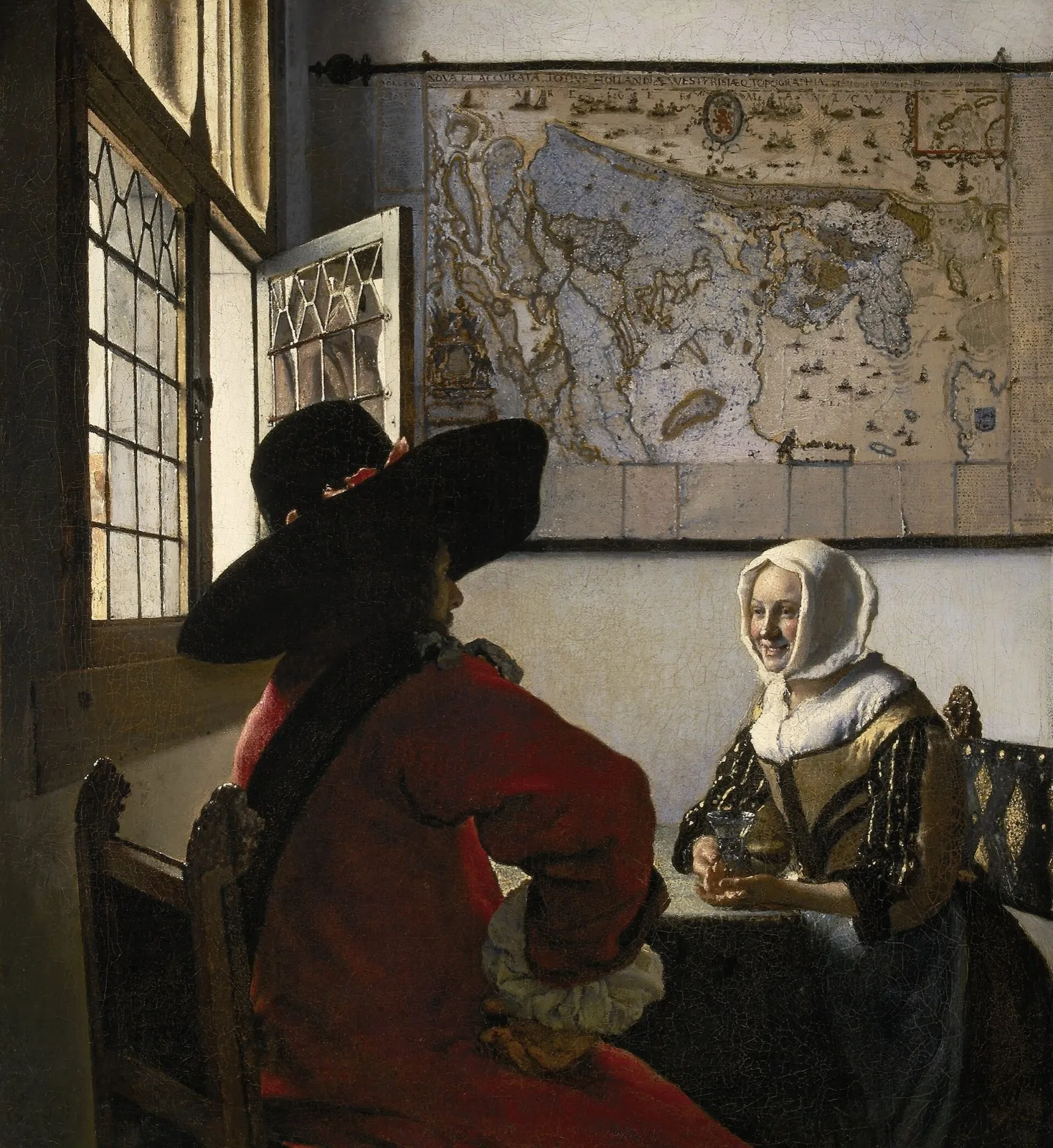
Johannes Vermeer left roughly three dozen paintings, and nearly all of them are set indoors. In almost every one, the light comes from a window on the left. Scholars think most were painted in a single room of his house in Delft. He had no lamps worth the name. He had a window, and he understood exactly what it did to a face: the girl in the painting above is lit from the side so that her smile has shape, while the officer, with his back to the light, is a shadow in a hat.
I think of that room whenever someone asks how to film an interview at home, because the problem has not changed in three and a half centuries. A person, a chair, a window. What has changed is that we now also have to capture the voice, and that the person in the chair is being asked to remember. So a good home set-up is really three problems: light, which Vermeer solved; sound, which he never had to think about; and memory, which depends on the room more than most people realise.
Since 2020 I have filmed more than a hundred life stories. What follows is what I have learnt about the room itself. None of it costs money.
Why does a window beat a lamp?
The quality of light on a face is governed almost entirely by the size of the light source relative to the person. A small source makes hard light: sharp-edged shadows, deep eye sockets, every line exaggerated. A large source makes soft light, which wraps around the features and fills its own shadows. The sun, for all its power, is a small source. An overcast sky is an enormous one, which is why photographers love cloudy days.
A window is a large source. The sky behind it, and any cloud or sheer curtain in front of it, turn it into a soft panel of light a metre or two across, close to the face. It is what every studio softbox is built to imitate. Painters knew this long before cameras: the classic European artist’s studio has a north-facing window, because in the northern hemisphere a north window never receives direct sun, only steady, even light all day. In Australia the equivalent is a south-facing window. If your house has one, that is your studio.
Three rules follow:
- Face the window, at an angle. Seat the person so the window is in front of them and a little to one side, roughly where it is in Vermeer’s room. Light from one side gives a face shape. Never seat someone with the window behind them: the phone will expose for the bright glass and turn them into the officer, a silhouette.
- Keep direct sun out. A shaft of sunlight through the glass is hard, it makes people squint, and it moves. Over a forty-five-minute session it will travel across the room and across the person. Draw a sheer curtain, or choose a time when the sun is on the other side of the house.
- Turn the ceiling lights off. Downlights come from above and put shadows in the eye sockets, and they are usually a different colour from daylight, so the phone cannot decide whether the room is orange or blue. One source is better than two.
Why does sound matter more than picture?
A rule from film production that surprises people: an audience will forgive a soft, dim or slightly wobbly image for an hour, and will not forgive thirty seconds of sound they have to strain to hear. The picture is what we notice. The sound is what we actually use to follow a story.
Phones make this harder than it looks, because the microphone is in the phone and the phone is usually across the room. As a microphone moves away from a voice, the direct sound falls quickly: each time the distance doubles, the voice reaching it drops by roughly six decibels. The echo of the room does not fall at all, because it arrives from every surface. So the further away the phone sits, the more the recording is made of room and the less of person, which is why home interviews so often sound as if they were recorded in a bathroom. The fix is distance: a phone within about a metre of the person, or a cheap clip-on microphone that moves the problem to their collar.
The room matters for the same reason. Hard surfaces reflect sound and soft ones absorb it. Tiles, floorboards, bare walls and, ironically, large windows all ring; carpet, curtains, a sofa, cushions and full bookshelves soak sound up. The best-sounding room in most houses is not the kitchen but a carpeted bedroom or living room. There is a simple test: clap once and listen for how long the sound hangs in the air. If it rings, find more soft things.
Then there is noise, the most common reason a home recording becomes unwatchable. Before you press record, stand still and listen for a full minute. You will hear things the person stopped hearing years ago: the fridge, a clock, air conditioning, a television in another room. Turn off everything you can, close the doors, and put both phones on Do Not Disturb. What you cannot control, wait out: a plane passes in thirty seconds, and a story told over it is lost for good.
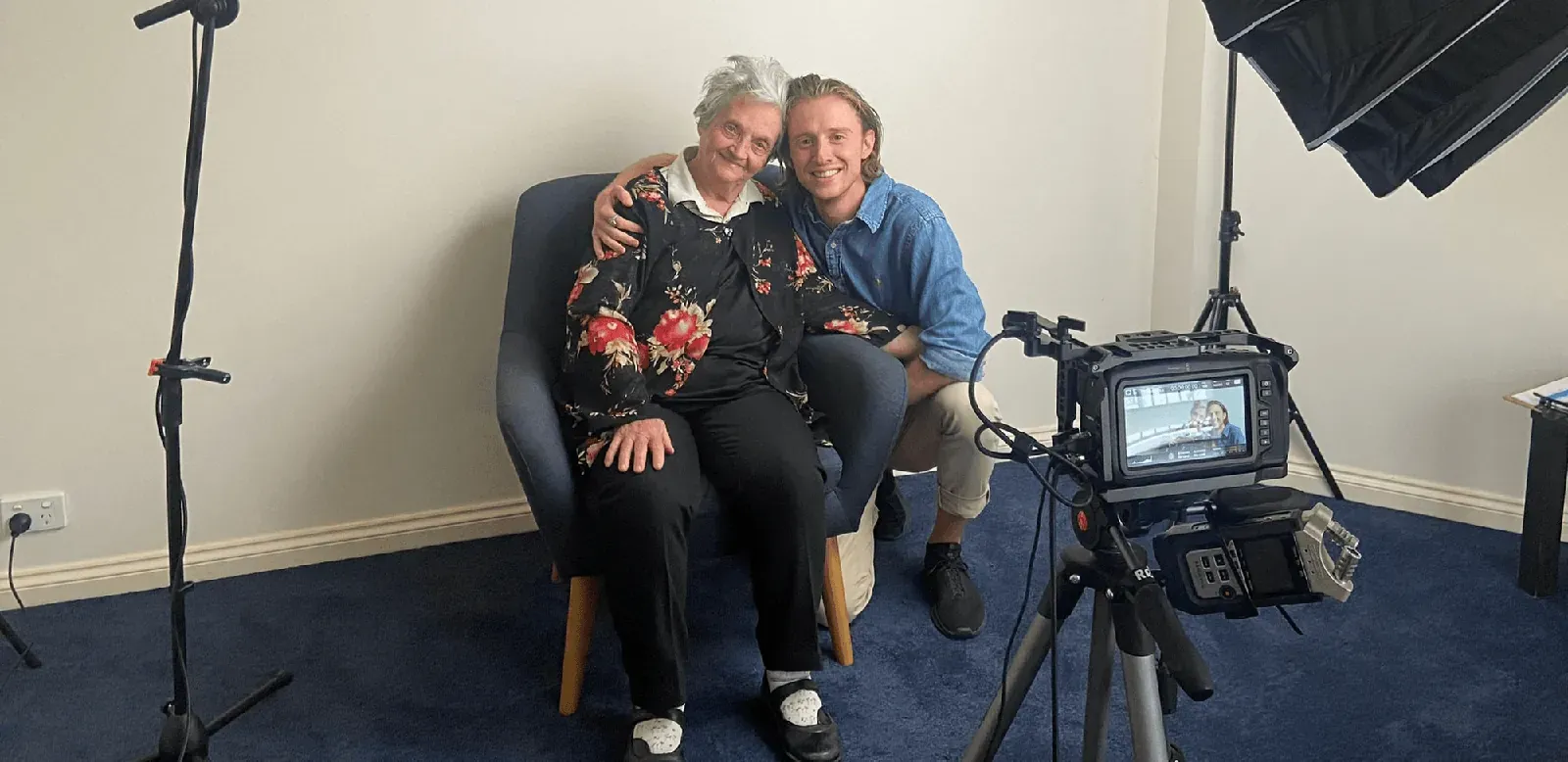 Filming my grandmother: a softbox standing in for a window, a microphone on a stand, carpet underfoot and the camera at the height of her eyes. All of it can be replaced by a window, a phone and a stack of books.
Indoors or outdoors?
The garden is tempting. The light is lovely and it feels less like an interview. It fails for four reasons. The first is wind: a breeze too light to feel will produce a low roar on a phone microphone that no editing removes. The second is everything else that makes noise outside, none of it under your control. The third is light that will not hold still: a cloud crosses the sun, the exposure jumps, and a story told over ten minutes looks as if it was filmed on three different days.
The fourth reason has nothing to do with equipment. People say different things in their own living room than they do in a park. When the USC Shoah Foundation began filming the testimonies of Holocaust survivors in 1994, it did not bring them to a studio. Its archive now holds more than 55,000 testimonies, and most were filmed in the interviewees’ own homes. A person telling their life story is doing something private and effortful, and they do it best in the place where they feel most themselves. Film indoors, with the garden visible through the window if you like it.
What should be in the room?
This is the part interviewers most often neglect, because it does not look like a filming decision. It is a memory decision.
In 1975 the psychologists Duncan Godden and Alan Baddeley had divers learn lists of words, some on the shore and some underwater, and then tested them in either place. Words learnt underwater were recalled better underwater, and words learnt on land were recalled better on land. Later replications have found the effect smaller than the original study suggested, but it is one example of a broader principle Endel Tulving set out in 1973: a memory is easier to retrieve in the presence of the cues that were there when it was formed. The things around us become part of the memory, and bringing them back brings the memory with them.
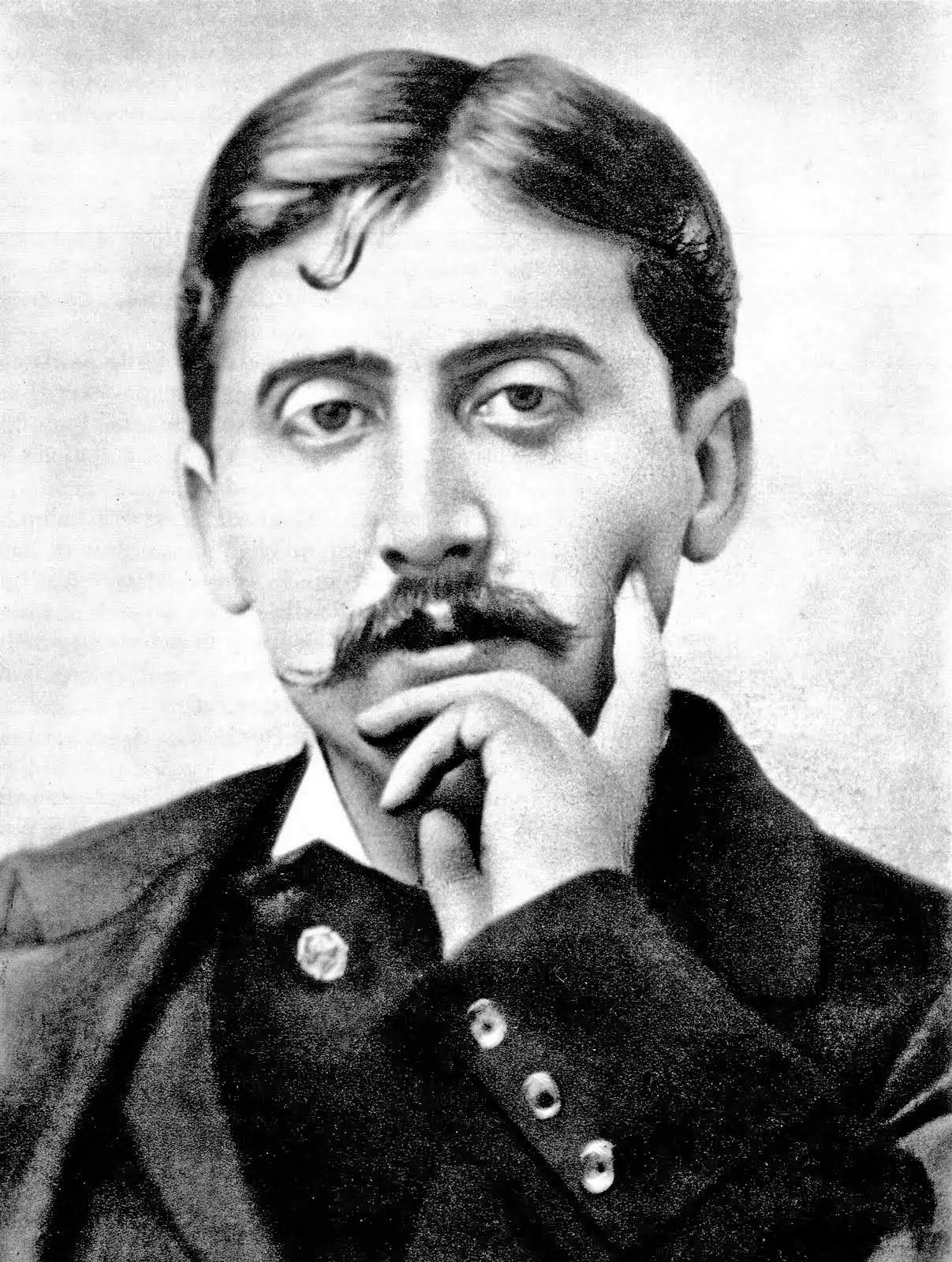 Marcel Proust, photographed by Otto Wegener in 1895. The madeleine in Swann’s Way is the most famous description of a memory unlocked by a cue. Public domain.
Marcel Proust made the same observation without a laboratory. In Swann’s Way (1913), a mouthful of madeleine dipped in tea brings back, unbidden and whole, the narrator’s childhood in Combray. The point of the scene is not the cake. It is that the memory had been there all along, inaccessible to any amount of deliberate effort, until the right cue arrived.
For a life story interview this has two consequences. The first is that a person’s own home is the best possible place to ask them about their life, because it is full of cues: the chair they have sat in for thirty years, the photographs on the dresser, the view from the kitchen window. A studio has none of these. The second is that you should bring more cues into the room deliberately. Ask the person, a few days before, to gather a box: photographs, letters, a wedding ring, a medal, a tool, a recipe book, a school report. Put it on a table beside their chair, within reach. When a question stalls, hand them something and say, “Tell me about this.”
The same logic applies to what is behind them. Film the person in front of their own things, a bookshelf, a dresser, a wall of family pictures, rather than a blank wall. In forty years the background will be the only record anyone has of what that room looked like.
Where does the camera go, and where do you sit?
In the 1990s the documentary maker Errol Morris built a device he called the Interrotron: two teleprompters wired together, so that his subject sees Morris’s face projected over the camera lens and looks him in the eye and into the camera at the same time. He went to that trouble because of what eye contact does to an interview. A person talking to a human face speaks differently from a person talking to a lens.
You do not need the machine. Sit directly beside the camera, your head level with it and as close as you can manage, so that when they look at you they are looking a few degrees off the lens. The remaining rules are small:
- Eye level, chest up. A camera below the face looms; a camera above it diminishes. Prop the phone on books until the lens is at the height of their eyes.
- Lock focus and exposure. On most phones, pressing and holding on the person’s face locks both, so the picture does not pulse every time they move their hands.
- Clean the lens. A fingerprint is the most common cause of a hazy, glowing image, and the easiest to fix.
- Plug the phone in. The best story of the afternoon will arrive at nine per cent battery.
How to film an interview at home: the checklist
- A quiet, carpeted room with soft furnishings and the doors closed.
- The person facing a window, at an angle, with no direct sun on them and the ceiling lights off.
- Camera at eye level, chest up, within a metre of them, you seated beside it.
- Fridge, clock, television and air conditioning off; both phones on Do Not Disturb.
- A box of photographs and objects on a table within their reach.
- Their own things behind them, not a blank wall.
- Focus and exposure locked, lens cleaned, phone plugged in.
- Sessions of forty-five minutes or less, in the morning if they are elderly.
What Vermeer knew
Vermeer did not have good light because he was rich. He had it because he noticed what one window in one room of his house did, and he put people in front of it, over and over, for twenty years. I would trade the equipment in the photograph of my grandmother for a south-facing window and a quiet afternoon. What made those four hours what they are was not the lights. It was her chair, the box of photographs beside it, and the fact that nobody was in a hurry.
The questions to ask once the room is ready are in how to capture someone’s life story on video, and the adjustments to make when the person is in their eighties are in how to interview older family members. Everyone was built for exactly this room: a phone, a window, one question at a time, and someone who wanted to listen.


