Questions to ask about your family heritage.
Family heritage questions to ask parents and grandparents about language, food, migration and why they left, and why the third generation always asks too late.
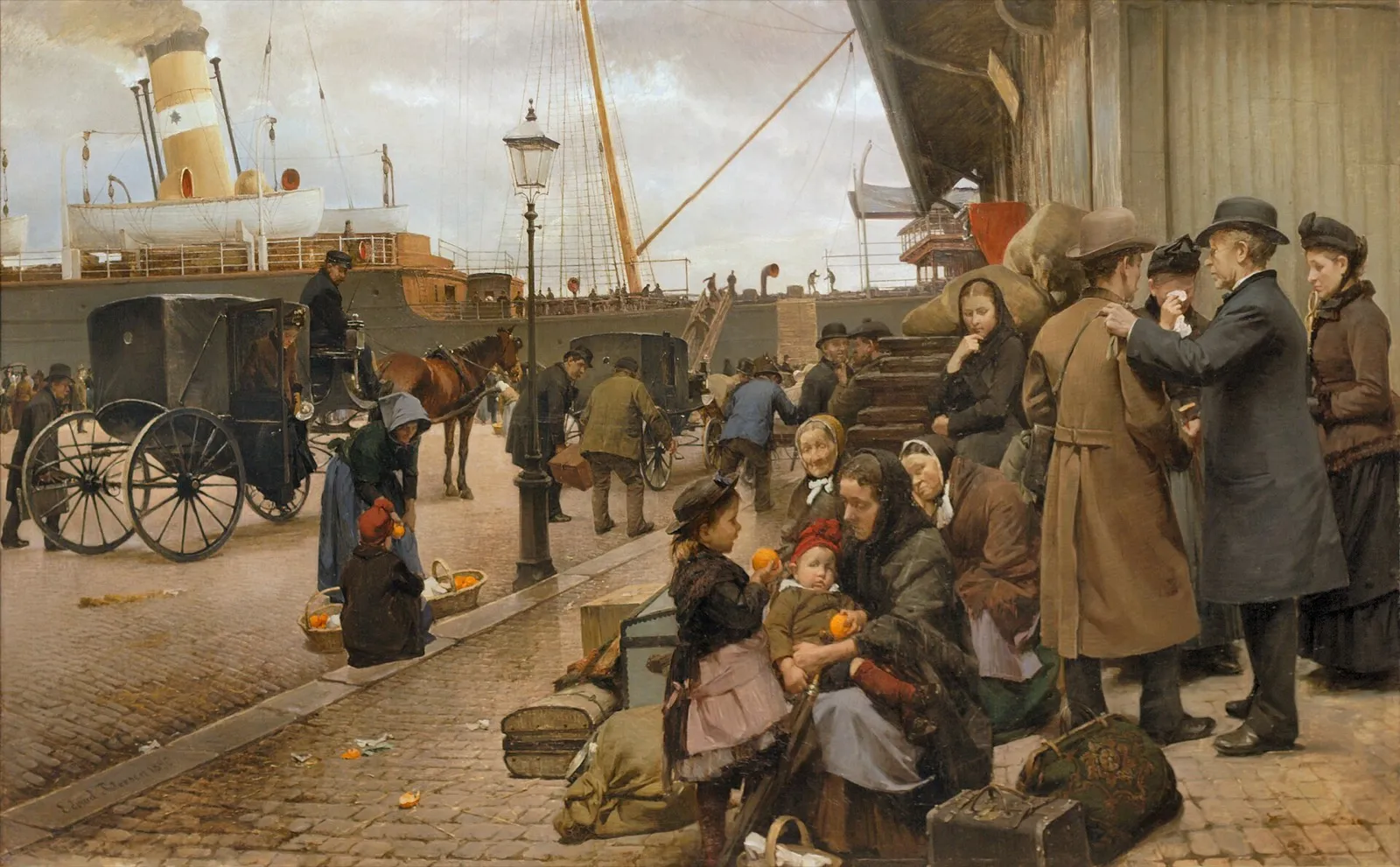
In May 1937 the historian Marcus Lee Hansen gave a lecture to the Augustana Historical Society, a body devoted to the history of Swedish immigrants in the American Midwest. He had noticed a pattern in the families he studied. The immigrants themselves held on to their old language and customs. Their children, raised in America, often wanted nothing to do with them, and spent their youth trying to sound and look like everyone else. Then the grandchildren, comfortable and secure, came back looking for everything their parents had discarded. Hansen put it in one sentence that historians still quote: “What the son wishes to forget, the grandson wishes to remember.”
The trouble with Hansen’s law is the timing. By the time the grandson wants to remember, the people who could tell him are old, or gone. This piece offers questions to ask about your family heritage, and argues that the most valuable answers are the ones no record will ever hold.
Why does heritage skip a generation?
Hansen’s explanation was psychological. The second generation is caught between two worlds, and the easiest way out is to choose the new one. Speaking the old language at school marks you as foreign; eating the old food at lunch invites comments. The third generation carries no such burden. It is secure enough to find the old country interesting rather than embarrassing.
Whatever the cause, the pattern shows up clearly in language. In 2006 the sociologists Rubén Rumbaut, Douglas Massey and Frank Bean published a study of immigrant families in Southern California with a memorable title: “Linguistic Life Expectancies”. They treated a language the way an actuary treats a person, and calculated how many generations it was likely to survive in a family. Spanish lasted longer than any other immigrant language they measured. Even so, according to Princeton’s summary of the study, only about 17 per cent of third-generation Mexican-Americans still spoke it fluently. For most other languages, the decline was faster. The authors concluded that the immigrant’s mother tongue was close to dead by the third generation.
This matters well beyond America. At the 2021 Census, 27.6 per cent of people in Australia had been born overseas, and 48.2 per cent had at least one parent born overseas. Millions of Australian families are somewhere in Hansen’s cycle right now. Many of the grandchildren who will one day want to know have grandparents who are still alive.
What do records keep, and what do they lose?
If you trace a family through archives, you can often find a great deal. Shipping lists give names, ages and ports. Naturalisation papers give dates. Census returns give addresses and occupations. A DNA test will add a percentage breakdown of regions, though less precisely than the marketing suggests.
All of these record what happened. Almost none of them record why. A passenger list will tell you that your great-grandmother sailed from Hamburg in 1923 at the age of nineteen. It will not tell you whether she left for love, for work, out of fear, or because a cousin had written to say there was a job. It will not tell you what she cooked on the first night in her new country, which words she refused to stop using, or what she never told her children about the people she left behind.
Heritage, in the sense that a family actually lives it, is made almost entirely of this second kind of knowledge: the reasons, the recipes, the songs, the jokes that only work in the old language, the superstitions, the way you set a table on a holiday. It is held in people, not paper, and it is lost in exactly the pattern Hansen described. The first generation has it but often does not talk about it. The second generation hears fragments and lets them go. The third generation asks, sometimes in time and sometimes not.
Questions to ask about your family heritage
These are grouped by theme. Ask them of whoever is closest to the source: the person who migrated if they are alive, otherwise the oldest relative who knew them. The follow-up questions matter more than the first ones: Who told you that? What was it like? Why do you think they did that?
Where we come from
- Where was your family from, as far back as you know? Which town or village, not just which country?
- What was the place like? What did people do for work there?
- Did anyone in the family ever go back? What did they find?
- Who is the earliest ancestor whose name you know? What is known about them?
Leaving
- Who was the first in our family to leave, and why did they go?
- Was it a choice, or did they have to leave?
- Who stayed behind? Did the family stay in touch with them?
- What did they bring with them? Is any of it still in the family?
- What was the journey like? How long did it take?
Arriving
- What was hardest about the first years in the new country?
- Where did they live first, and who helped them?
- Did anyone change their name, or have it changed for them?
- Was there a moment when they felt they belonged here?
Language
- What language did your parents speak at home? What language did they speak to you?
- Did you ever stop speaking it? Why?
- Are there words or sayings from the old language we still use?
- Can you say something to me in it, and tell me what it means?
Food, music and celebrations
- What dishes did your mother or grandmother make that came from the old country?
- Which ones did nobody ever write down?
- What songs did your family sing? Can you sing one?
- Which holidays mattered most, and how were they celebrated?
What it means now
- What do you think our family kept from the old country, and what did we lose?
- Is there anything you wish you had asked your own parents about where we come from?
- What would you want your great-grandchildren to know about our heritage?
The questions about leaving are the heart of the list. (If the person you are asking made the journey themselves, there is a longer set in questions to ask an immigrant family member.) The reasons people migrate are rarely simple, and the version a family tells is often softer than what happened. Asking “who told you that?” is the best protection against a family legend hardening into fact. (For more on that problem, and on questions about the generations before, see family history interview questions.)
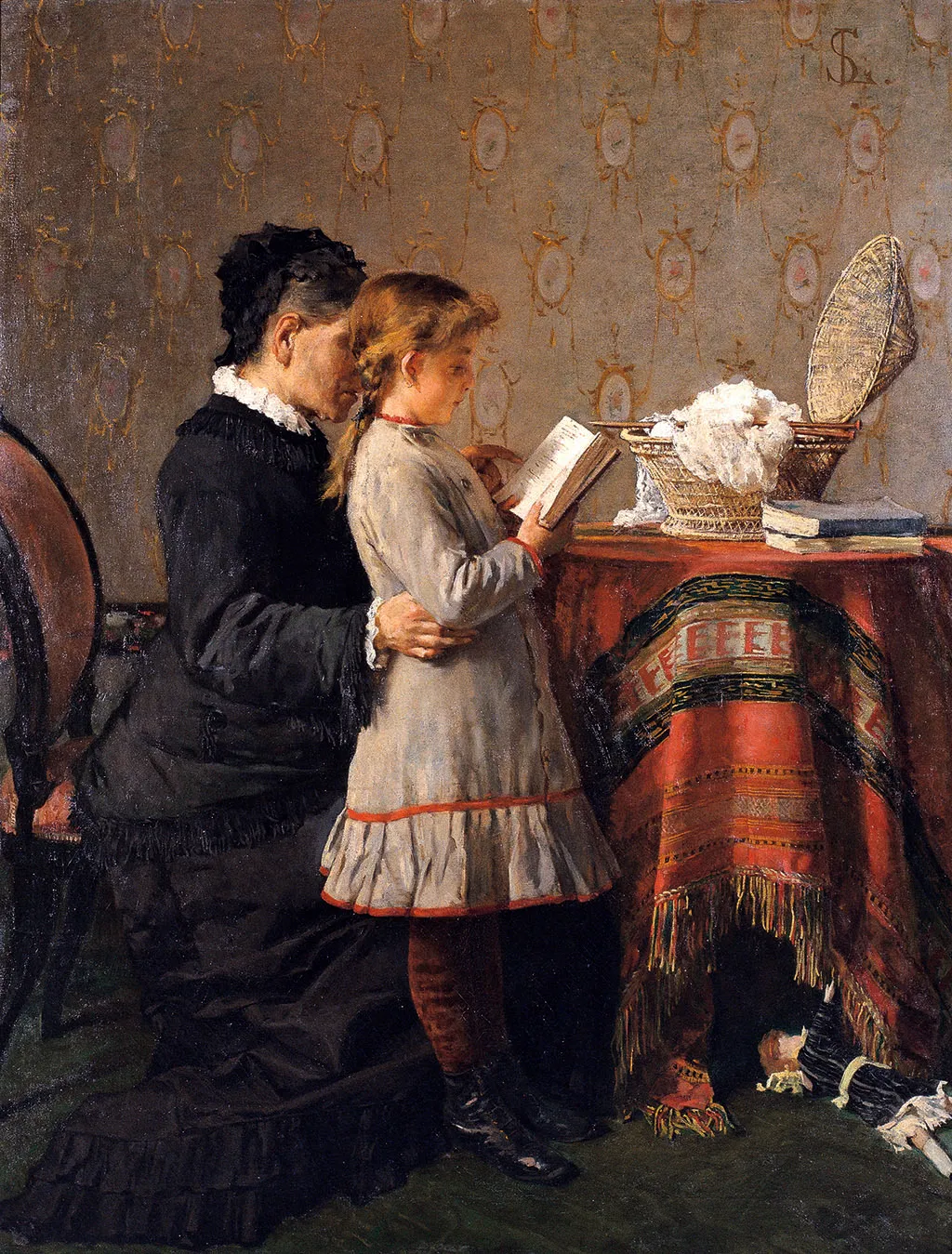 “The Grandmother’s Lesson” by Silvestro Lega, 1880–81. Public domain.
Why do the answers matter to the people asking?
There is some evidence that knowing your family’s history is good for you, not just interesting. In the early 2000s the Emory University psychologists Marshall Duke and Robyn Fivush developed a twenty-item “Do You Know?” scale, with questions such as whether a child knew where their grandparents grew up. Children who knew more of the answers tended to score higher on measures of self-esteem and a sense of control over their lives. The finding is a correlation, and it may partly reflect families who talk more in general. But Duke and Fivush suggested a mechanism worth taking seriously: children who know their family’s story, including its hardships, see themselves as part of something that has survived difficulty before.
Heritage stories are, very often, stories of exactly that kind. Someone left everything, arrived with very little, and built a life. That story is worth more to a teenager than a percentage on a DNA report.
How should you ask about heritage?
Ask them to show you, not just tell you. The most fragile parts of a heritage are practices. A recipe written as a list of ingredients loses the way your grandmother judged when the dough was ready. A song described in a sentence is not the song. Ask them to cook the dish, sing the verse, or say the prayer, and film it. (The same idea applies to preserving family recipes.)
Use the old language, even badly. Asking a question in the language your grandparent grew up with, however clumsily, often changes the answers. In a 2000 study, the psychologists Viorica Marian and Ulric Neisser found that Russian-English bilinguals recalled more memories from their Russian-speaking years when interviewed in Russian, and more from their English-speaking years when interviewed in English. Memories seem to be stored partly in the language in which they were lived.
Bring objects. A passport, a photograph from before the migration, a piece of embroidery or a candlestick that made the journey will open stories that a direct question will not.
Ask each relative separately. Siblings and cousins often hold different pieces of the same story, and the differences are themselves revealing.
Why record heritage on video?
Over the past six years I have filmed more than a hundred life stories, including Holocaust survivors who were among the last witnesses to worlds that no longer exist. What I notice, watching the footage back, is how much of a person’s heritage lives outside their words: the accent that softens when they talk about their mother, the phrase they can only say in their first language, the way they hum a tune while trying to remember the words. My grandmother has since passed away, but I have four hours of her telling me about her life, and none of it could have been captured on a form.
A transcript keeps the facts of a migration. A video keeps the person who made it. If you want a simple structure for recording these conversations, the Everyone app lets you film one question at a time on your phone, so a heritage can be gathered over many short visits rather than one long interview.
Hansen’s law describes a cycle that has repeated in millions of families. The second generation forgets and the third tries to remember. You can break the cycle, but only by asking while there is still someone to answer.