What a DNA test can't tell you.
A DNA test can say where your ancestors lived and who you are related to. It cannot say who they were. Why the most valuable family record isn't genetic.
In 2016 the writer Dani Shapiro, then in her fifties, sent a saliva sample to Ancestry more or less on a whim. Her half-sister had already tested. When the results came back, the two women were not related through their father in the way they should have been. Soon afterwards Shapiro established that Paul Shapiro, the man who raised her and who had died decades earlier, was not her biological father. She had been conceived with donor sperm at a fertility clinic, and nobody had ever told her. She wrote about it in her 2019 memoir Inheritance.
Stories like hers are the reason DNA tests feel so powerful. A tube of saliva can overturn a family’s understanding of itself. But Shapiro’s book is not really about genetics. It is about the questions the test raised and could not answer: what her parents knew, what they intended, why they never said. The DNA told her that something had happened. Only people could tell her why, and the people who knew were gone.
That gap is the subject of this piece. Consumer DNA tests are remarkable, and tens of millions of people have taken one. Yet there is a great deal about your family that a DNA test can’t tell you, and the most important parts are exactly the ones it was never designed to find.
What does a DNA test actually tell you?
A consumer test reads several hundred thousand positions in your genome and does two quite different things with them.
The first is matching. Your results are compared with everyone else in the company’s database, and anyone who shares long stretches of DNA with you is listed as a relative, with an estimate of how close. This is the part that is genuinely precise. If you and a stranger share around a quarter of your DNA, you are almost certainly half-siblings, grandparent and grandchild, or uncle and niece. Ancestry’s own 2025 figures put its network at more than 29 million people, which is why so many family secrets have surfaced in the past decade: if you have not tested, your cousins probably have.
The second is the ethnicity estimate, the pie chart that says you are 38 per cent Irish and 12 per cent Scandinavian. This is the part most people buy the test for, and it is far less precise than it looks.
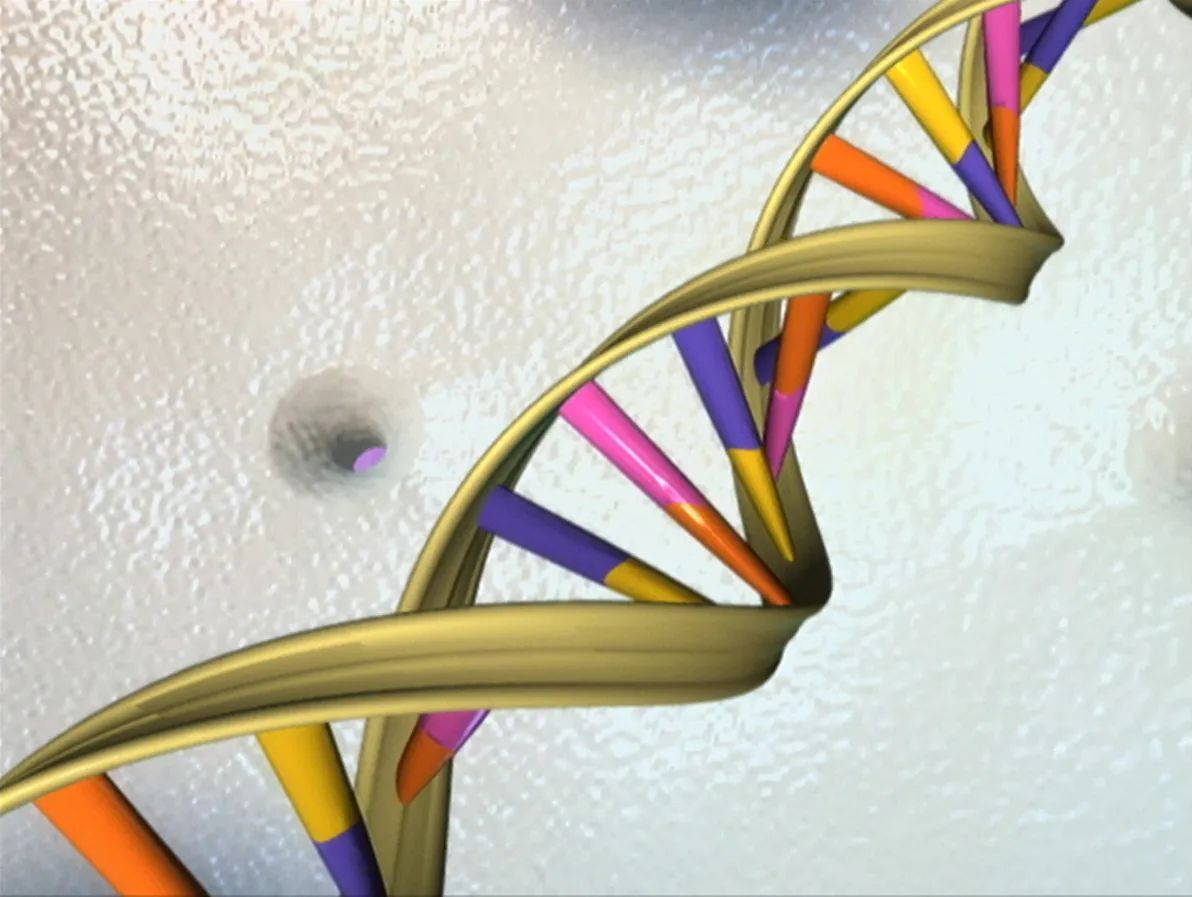 DNA double helix. Illustration by the National Human Genome Research Institute. Public domain.
Why are ethnicity estimates so unreliable?
An ethnicity estimate does not detect anything ancient in your cells. It compares your DNA with “reference panels”: samples from living people whose families are thought to have lived in one region for several generations. When the result says “Irish”, it means that parts of your genome resemble the DNA of people living in Ireland today more than they resemble the other reference groups.
That has two consequences.
First, the answer depends on who is in the panel. When Ancestry updated its estimates in September 2018, it said it had expanded its reference panel from about 3,000 samples to about 16,000. Many customers found that their percentages moved sharply overnight, particularly between closely related regions such as Ireland, Scotland and England. Their ancestors had not changed. The comparison group had.
Second, different companies use different panels and different regional boundaries, so they give different answers. In January 2019 the CBC consumer programme Marketplace sent DNA from the presenter Charlsie Agro and her identical twin, Carly, to five testing companies. Identical twins have, for these purposes, the same DNA, and independent analysis of the raw data confirmed it. The twins still received different ethnicity breakdowns from the same company, and the five companies disagreed with one another. The pie chart is best read as a rough geographic sketch, not a list of nationalities.
None of this makes the tests useless. It makes the ethnicity estimate the least informative part of the result, which is unfortunate, because it is the part most people remember.
How many of your ancestors are actually in your DNA?
Here the numbers become genuinely surprising.
You receive half your DNA from each parent. But you do not receive exactly a quarter from each grandparent, because chromosomes are shuffled and cut each generation before being passed on. On average it is a quarter; in practice it varies noticeably. Each generation back, the shares become smaller and more uneven, until some ancestors’ contributions disappear altogether.
The geneticist Graham Coop has calculated that nine generations back, there is roughly a 30 per cent chance that any particular ancestor passed on no detectable DNA to you at all. Twelve generations back, the chance is over 80 per cent. (I covered this in more detail in a piece about your sixteen great-great-grandparents.)
So your family tree and your genetic tree are not the same thing. Go back three or four centuries and you have hundreds of genealogical ancestors who are fully your ancestors in every historical sense: without any one of them, you would not exist. Most of them left no physical trace in your body. A DNA test cannot find them, because there is nothing of them left to find.
What can’t a DNA test tell you?
Even for close relatives, the people whose DNA you certainly carry, the test is silent on almost everything you would want to know.
It cannot tell you:
- Their names. A match can point you to a living cousin. It cannot tell you what your great-grandmother was called.
- Why they moved. It can suggest a family came from somewhere in central Europe. It cannot say whether they left for work, love, war or fear.
- What they did. Occupation, faith, politics, talents, failures: none of it is written in the genome in any form a test can read.
- What they were like. Whether your grandfather was funny, whether your great-aunt was kind, how your mother sounded when she sang.
- What they knew. The recipes, the family jokes, the reasons behind decisions, the warnings passed down.
- Why things happened. Shapiro’s test revealed a fact. Her parents’ reasons, the part that mattered most to her, existed only in their memories.
A genome is a record of descent. It tells you that a line of people existed and connects you to them. It is closer to a gravestone than to a biography: proof that someone lived, with almost nothing about who they were.
Why does this matter more than it seems?
Because the two kinds of information decay at completely different rates.
DNA is extraordinarily durable as a record. It is copied into every descendant, preserved in databases, and will still be readable by any future technology. If anything, genetic genealogy will become more powerful over time as databases grow. The genetic facts about your family are, for practical purposes, safe.
Stories are the opposite. They exist in one place, the memory of a living person, and they disappear entirely when that person dies, unless someone has asked and recorded them first. The historian of a family has roughly one lifetime to collect them, and usually much less, because the window closes with the oldest generation.
There is a further irony. Genetic data held by a company is not the same as an archive held by a family. When 23andMe filed for bankruptcy in March 2025, its customers’ genetic data became an asset in a court sale; the company was eventually bought by a nonprofit led by its co-founder, Anne Wojcicki, for $305 million. In the meantime, the company’s interim chief executive told a US congressional committee that about 1.9 million customers had asked for their data to be deleted. Whatever one thinks of the outcome, it was a reminder that even the “permanent” record depends on someone else’s business.
So the instinct to take a DNA test is a good one: it comes from wanting to know where you come from. The mistake is to treat the test as the end of the search, when it answers the easiest questions and leaves the most important ones untouched.
What should you do instead, or as well?
If you have taken a test, or are about to, a few things will make it far more meaningful.
- Start with the living. The best source for your great-grandparents is usually your grandparents. Before you build a tree from records, ask the oldest people in your family what they remember. (There is a fuller method in how to start a family tree.)
- Bring the results to them. A list of matches or a surprising percentage is a good prompt. “The test says we have Lithuanian ancestry. Did anyone ever talk about that?” often unlocks stories no direct question would reach.
- Ask about people, not places. Not “where did we come from?” but “what was your grandmother like?”, “what did your father do for work?”, “why did they leave?”
- Record the answers on video. A test result is a number; your grandmother explaining what her own grandmother was like is a person. Film it, so that her face and voice survive along with the facts.
- Treat DNA as confirmation, not explanation. It can prove that you are related to someone. It cannot tell you who your ancestor was.
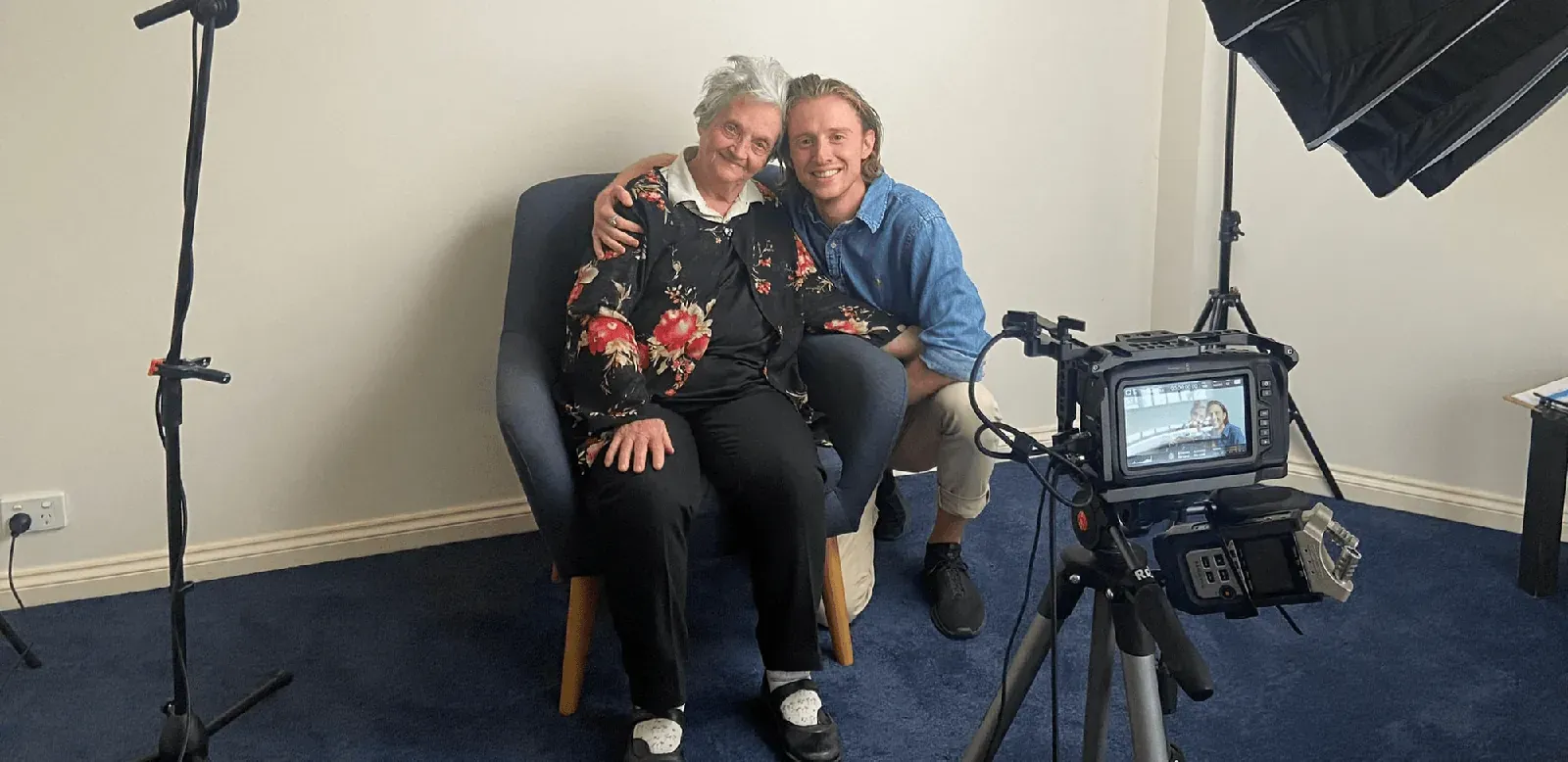 With my grandmother, after filming her life story.
The record that only you can make
I have filmed more than a hundred life stories since 2020, including four hours with my own grandmother, who has since died. In none of those recordings does anyone talk about haplogroups. They talk about the house they grew up in, the parent they never understood, the reason they emigrated, the moment they knew they would marry. That is the material families actually want once the person is gone, and it is the one kind of inheritance that is never passed on automatically.
Your DNA will reach your great-great-grandchildren without any effort from you. Your stories, and your parents’ and grandparents’ stories, will reach them only if someone records them. The Everyone app was built for that second kind of inheritance: one question at a time, on video, kept for the family. A saliva sample takes two minutes. So does the first question.
For a list of where to begin, see these questions to ask your grandparents before it’s too late, or, for where the family came from and why it left, these questions to ask about your family heritage.