Famous last words, and why we wait for them.
Socrates’ rooster, Goethe’s “more light”, Wittgenstein’s “wonderful life”. Famous last words are seldom reliable, and the deathbed is the worst time to ask.
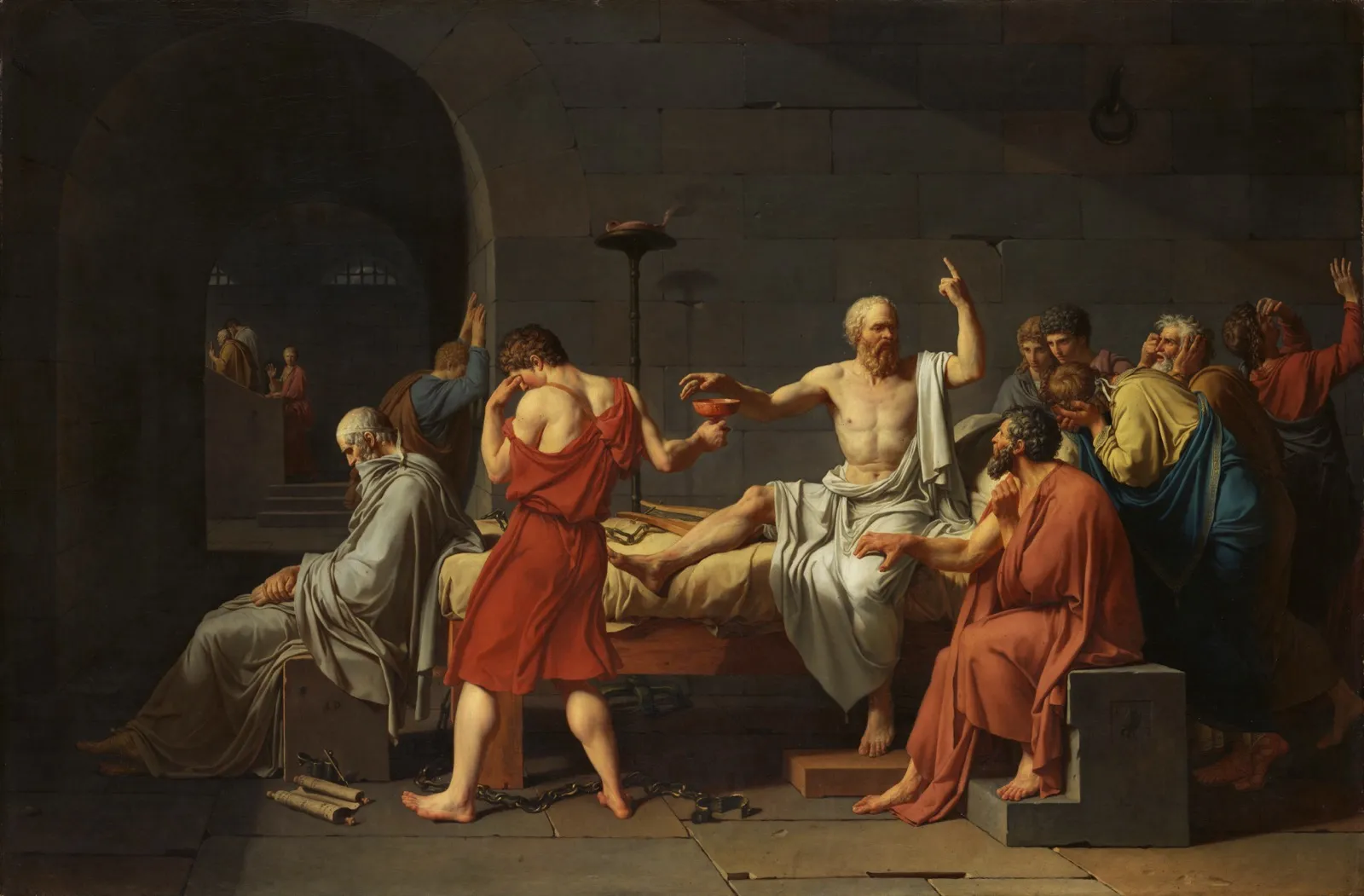
The most famous death scene in Western philosophy ends with a debt. In Plato’s Phaedo, Socrates has drunk the hemlock, walked about the cell until his legs grow heavy, and lain down with his face covered. Then he uncovers it and says to his friend: “Crito, we owe a cock to Asclepius. Pay it and do not neglect it.” Crito asks if there is anything else. There is no answer.
Scholars have argued about that sentence for more than two thousand years. Was it a joke, a reference to death as a cure, or simply a man remembering an unpaid sacrifice? What gets less attention is a line near the start of the dialogue, where the narrator lists who was in the room and adds: “Plato, I believe, was ill.” The most quoted last words in philosophy were written down by a man who says he was not there.
That is a useful place to begin thinking about famous last words, because it holds the whole problem in miniature. We treat the final sentence of a life as uniquely revealing, a kind of summary. Yet the famous examples are often reported second-hand, tidied up or invented, and the real conditions of dying make meaningful last words far rarer than the anthologies suggest. The deathbed is where we expect the truth to come out. It is the worst place to wait for it.
Why do famous last words fascinate us?
The fascination is old and partly religious. In the fifteenth century, two Latin texts known as the Ars moriendi, “the art of dying”, became some of the most widely copied guides in Europe. The shorter version, from around 1450, circulated as a picture book of woodcuts. It showed the dying person in bed, surrounded by angels and demons, resisting five temptations in turn: loss of faith, despair, impatience, pride and attachment to worldly things. The final hours were treated as the moment when a soul was won or lost, so what a person said and did in them mattered more than at any other time.
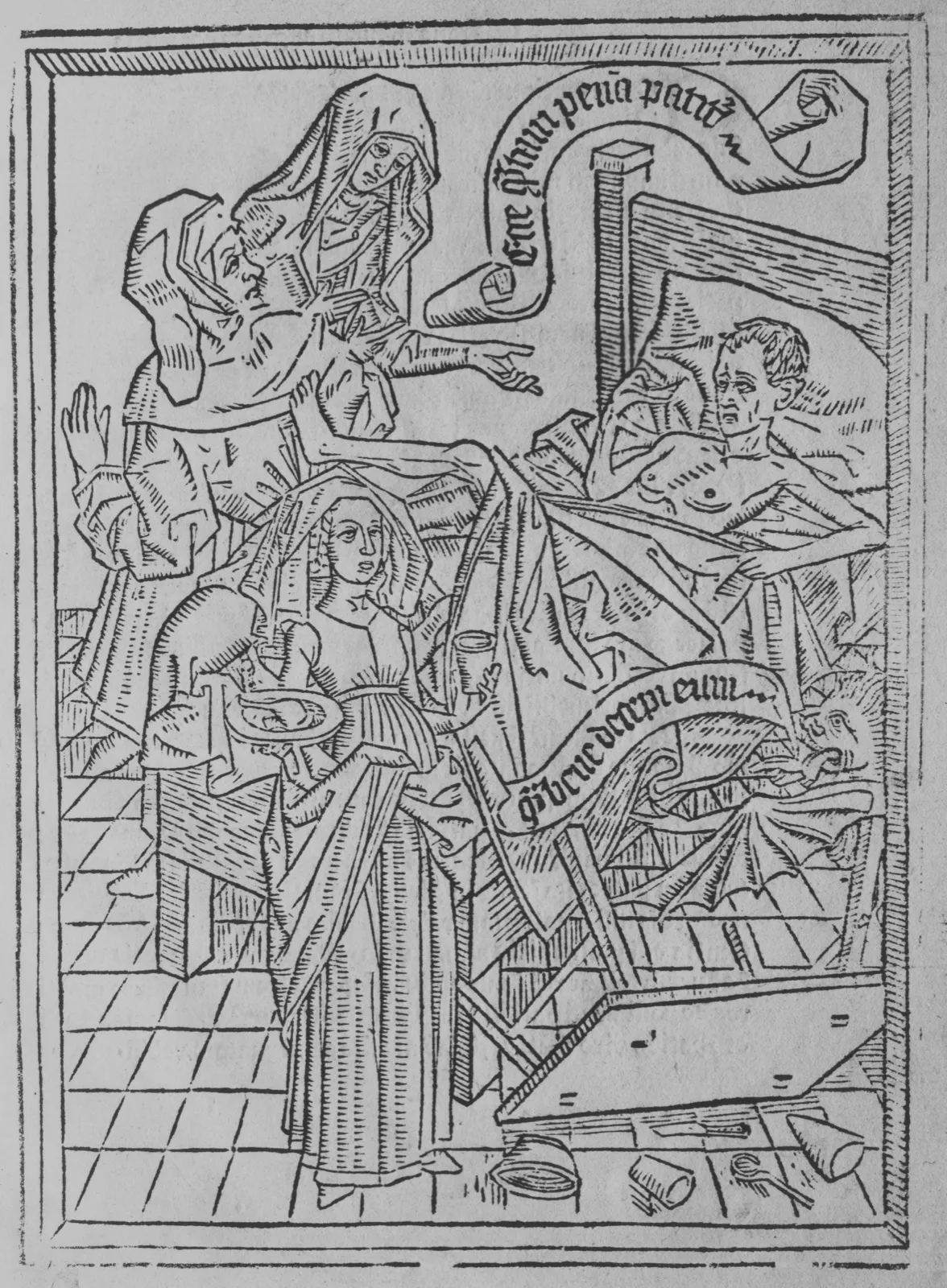 A deathbed scene from an illustrated Ars moriendi, printed around 1475 and attributed to Nicolaus Götz. Metropolitan Museum of Art. CC0.
The idea outlived the theology. The historian Pat Jalland, in Death in the Victorian Family (1996), describes how nineteenth-century British families gathered at the bedside and wrote down the dying person’s final words in diaries and letters, as evidence that the death had been a “good” one. Collections of famous last words became a popular genre. Even Thomas Edison, listing uses for his new phonograph in 1878, suggested recording “the last words of dying persons”, an idea I have written about in the future of storytelling.
There is also a simpler reason. A last sentence feels like a conclusion, and we want lives to have them. A story without an ending is unsettling. The last words offer to close the book.
Are famous last words real?
Some are, and the reliable ones tend to be modest. Others dissolve on inspection.
Johann Wolfgang von Goethe died in Weimar on 22 March 1832. His last words are usually given as Mehr Licht!, “More light!”, and they have been read for two centuries as the dying cry of the Enlightenment. The phrase was first printed by his physician, Carl Vogel, who does not appear to have been in the room at the end. Other accounts from the household suggest something more domestic: a request to open a second shutter and let more light in. Only one version became famous, because only one of them sounded like a conclusion.
The pattern repeats. Famous last words are selected by the people who outlive the speaker, and they select for what sounds right. A sentence that fits the life gets remembered and retold; a request for water or a complaint about the pillow does not. Over time the record fills with lines that are suspiciously good, because that is the only kind that survives the filtering.
The better-attested examples are revealing for a different reason. The philosopher Ludwig Wittgenstein died at his doctor’s house in Cambridge on 29 April 1951. Before losing consciousness he said to Joan Bevan, the doctor’s wife, who had sat up with him: “Tell them I’ve had a wonderful life.” His friend Norman Malcolm, who recorded the words, found them puzzling, because Wittgenstein had so often seemed unhappy. Philosophers are still writing papers about what he meant. A real last sentence, in other words, tends to raise questions rather than settle them.
Steve Jobs’ last words are known because his sister, the novelist Mona Simpson, described them in a eulogy published in The New York Times in October 2011. Before he died, she wrote, he looked at his family and then past them, and said “Oh wow” three times. Its power lies precisely in the fact that it explains nothing.
What are people actually able to say at the end?
The anthologies give the impression that dying people are lucid to the last breath. The medical evidence suggests otherwise.
Delirium, a state of confusion in which attention and awareness fluctuate, is extremely common in the final days of life. Reviews of the clinical evidence put it at up to 88 per cent of people with a terminal illness in their last days, and some hospital studies report higher figures, depending on how it is defined and measured. Add the effects of pain relief, sedation, exhaustion and simple weakness, and the picture becomes clear. For most people, the last days are not an occasion for speeches. Many cannot speak at all, and many who can are not fully themselves.
This has a consequence that many families discover too late. The conversation everyone was waiting for never happens, because by the time it feels appropriate, the person is no longer able to have it. (I have written about the regrets people carry from the other side, in the top regrets of the dying.)
This is not a reason for despair, and it is not to say that final moments do not matter. A hand held, a name recognised, a few words of love: these matter enormously to the people present. But they are not the same thing as a life explained. The deathbed is a place for goodbye. It was never a good place for the story.
Why do we wait for the deathbed?
If last words are unreliable and often impossible, why does the idea of them have such a hold?
One reason is that the deathbed is the first moment when the conversation feels permitted. For most of a life, asking someone to sum up their life seems morbid, presumptuous, or premature. Imminent death removes the awkwardness. It gives everyone licence to ask the large questions: what mattered, what would you do differently, what do you want us to know? The cruelty is that the licence arrives at the same moment as the confusion, the drugs and the fatigue.
A second reason is a quiet assumption that wisdom accumulates and is released at the end, like an inheritance read out with the will. In practice, people say the most interesting things about their lives when they are well enough to think, to remember in detail and to tell a story at their own pace. That usually means years before the end, not hours.
The third reason is plain procrastination, which I have written about in questions I wish I had asked my parents. There is always next Christmas, or next visit. The deathbed then becomes the deadline by default, and deadlines set by illness are rarely met.
What would better “last words” look like?
The most useful reframe is to stop thinking of last words as the final sentence and start thinking of them as the final record: whatever a person leaves behind that explains who they were. On that definition, almost everyone has the chance to leave something far better than Goethe’s disputed sentence, and they can do it on a good day.
In the life stories I have filmed through The Archive since 2020, more than a hundred of them, the most valuable moments rarely came from asking people to sum up. They came from ordinary questions asked while the person was well: where they grew up, what their parents were like, what frightened them, what they were proud of. My grandmother recorded four hours of her story on video. She has since passed. Nothing she said in those hours was framed as a last word. All of it now functions as one.
A few principles follow:
- Ask while the person is well. Lucidity, energy and memory are the raw materials of a good story. They are most plentiful long before the end.
- Ask for stories, not summaries. “What was the happiest year of your life?” produces more than “What have you learnt?” The meaning tends to emerge from the detail, as it does in the stories older people repeat.
- Keep the face and voice. A written line is easily edited by the people who pass it on, as Goethe’s was. A recording of someone telling their own story in their own words cannot be tidied up into something they never said.
- Treat it as a series, not an event. One long session is daunting for everyone. Several short ones are easier, and each adds something the others missed.
The end is not where the meaning is
The Ars moriendi taught that a life was decided in its final hours. Most of us no longer believe that, yet we still behave as if the important conversation belongs at the end. The famous examples point the other way. Socrates’ last words are remembered because Plato spent a whole dialogue recording what he said in the hours before them. Wittgenstein’s are moving because of a life’s work we already know. A last sentence only means something when the rest of the story is there to give it meaning.
The rest of the story is what families usually lose. It is also the part that can be recorded now, cheaply, on a phone, with a face and a voice attached. Apps like Everyone exist to make that easier, with one question at a time. But the tool is secondary to the decision. The words worth keeping are rarely the last ones. They are the ones someone says on an ordinary afternoon, when they are well, and someone has thought to ask.