The first villages had a strange feature. The dead lived there too.
The first human settlements kept their dead beneath the floor. Jericho and Çatalhöyük suggest settling down was also about staying close to family.
In 1953, digging at Tell es-Sultan, the ancient mound of Jericho, the British archaeologist Kathleen Kenyon found seven human skulls. They had been removed from their bodies some time after death, and the faces had been rebuilt in plaster: cheeks, noses, chins and lips modelled over the bone, with pieces of shell pressed into the eye sockets. The British Museum, which holds one of them, dates its skull to between 8200 and 7500 BCE. Someone, more than nine thousand years ago, took the trouble to give a dead relative their face back and keep it in the settlement.
The usual story of the first human settlements is about food. People learnt to farm, farming tied them to fields, and fields tied them to houses. That story is broadly true, but it leaves out something the archaeology keeps returning to. In many of the earliest villages, the dead were not taken away. They were buried beneath the floors where the living slept, cooked and raised children. The first permanent homes were also the first family archives, and that has something to teach us about how memory works and what happens when we stop living on top of it.
What were the first human settlements?
For almost all of the roughly 300,000 years that Homo sapiens has existed, people lived in small mobile groups, moving with the seasons and the animals. Permanent settlement is recent, and it appears first, as far as we know, in the Levant and south-eastern Anatolia at the end of the last Ice Age.
The pioneers were the people archaeologists call the Natufians, who lived in the region from roughly 15,000 to 11,500 years ago. At ʿAin Mallaha, in the Hula Valley north of the Sea of Galilee, they built round houses partly sunk into the ground, with dry-stone walls. They were still largely hunters and gatherers, harvesting wild cereals rather than farming them. Yet they stayed, and they buried their dead within the settlement, often beneath or inside the houses themselves. One grave at ʿAin Mallaha, around twelve thousand years old, holds an elderly woman with her hand resting on a puppy, one of the oldest known burials of a person with a dog.
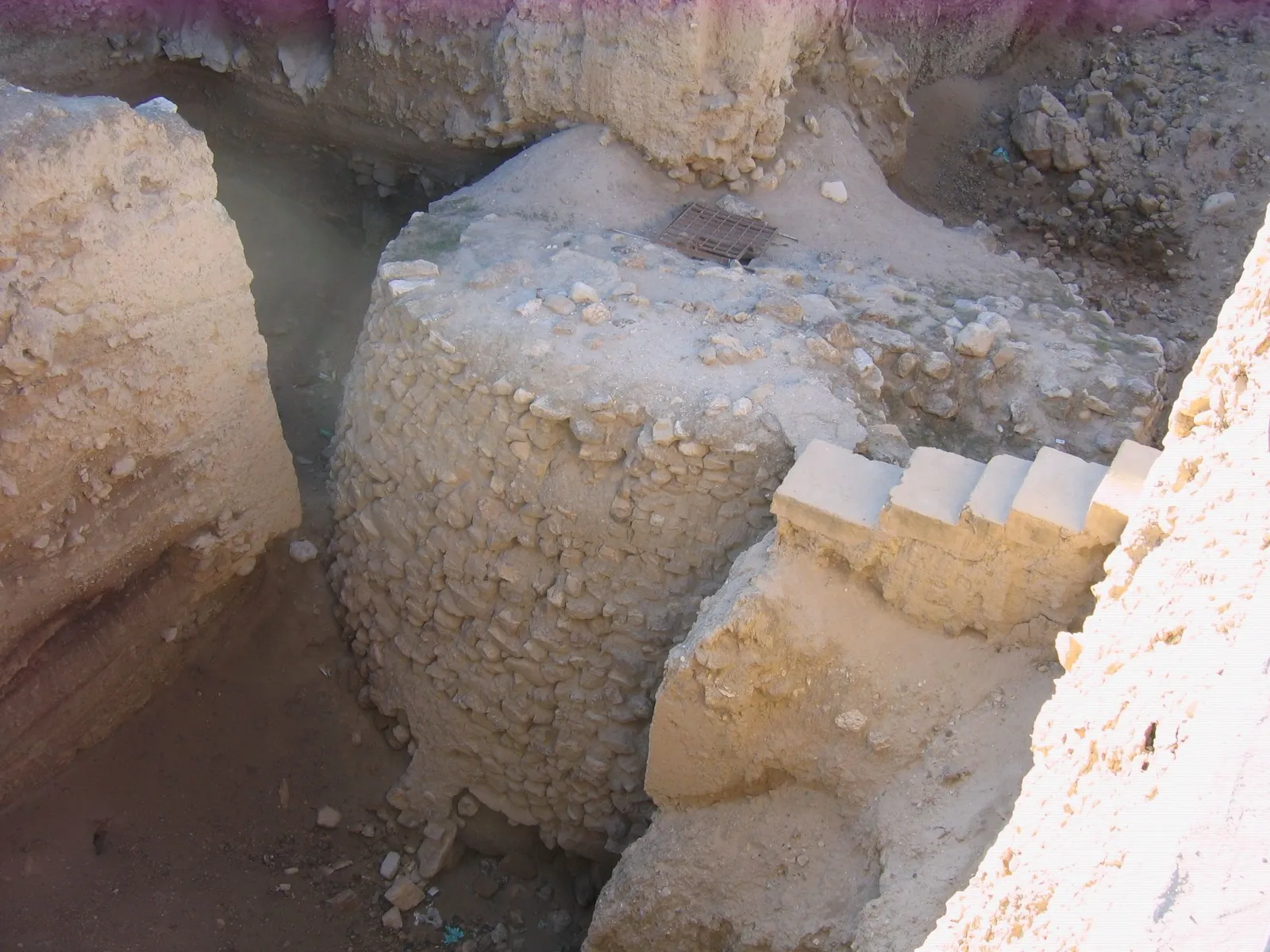
Later sites grew far larger. Jericho had a stone wall and an 8.5-metre stone tower by around 8000 BCE, long before anyone there was writing anything down. Further north, in central Anatolia, Çatalhöyük was occupied from about 7100 to 5950 BCE, and estimates of its population at its peak range from a few thousand to around eight thousand people.
Why did people settle down before farming?
The most unsettling site for the food-first story is Göbekli Tepe, near Şanlıurfa in south-eastern Turkey. From about 9500 BCE, people there quarried and raised huge T-shaped limestone pillars, some more than five metres tall, carved with foxes, snakes, boars and vultures, and arranged them in round enclosures. The German archaeologist Klaus Schmidt, who excavated the site from 1995 until his death in 2014, believed it was built by hunter-gatherers before farming took hold in the region. His summary was blunt: “First came the temple, then the city.”
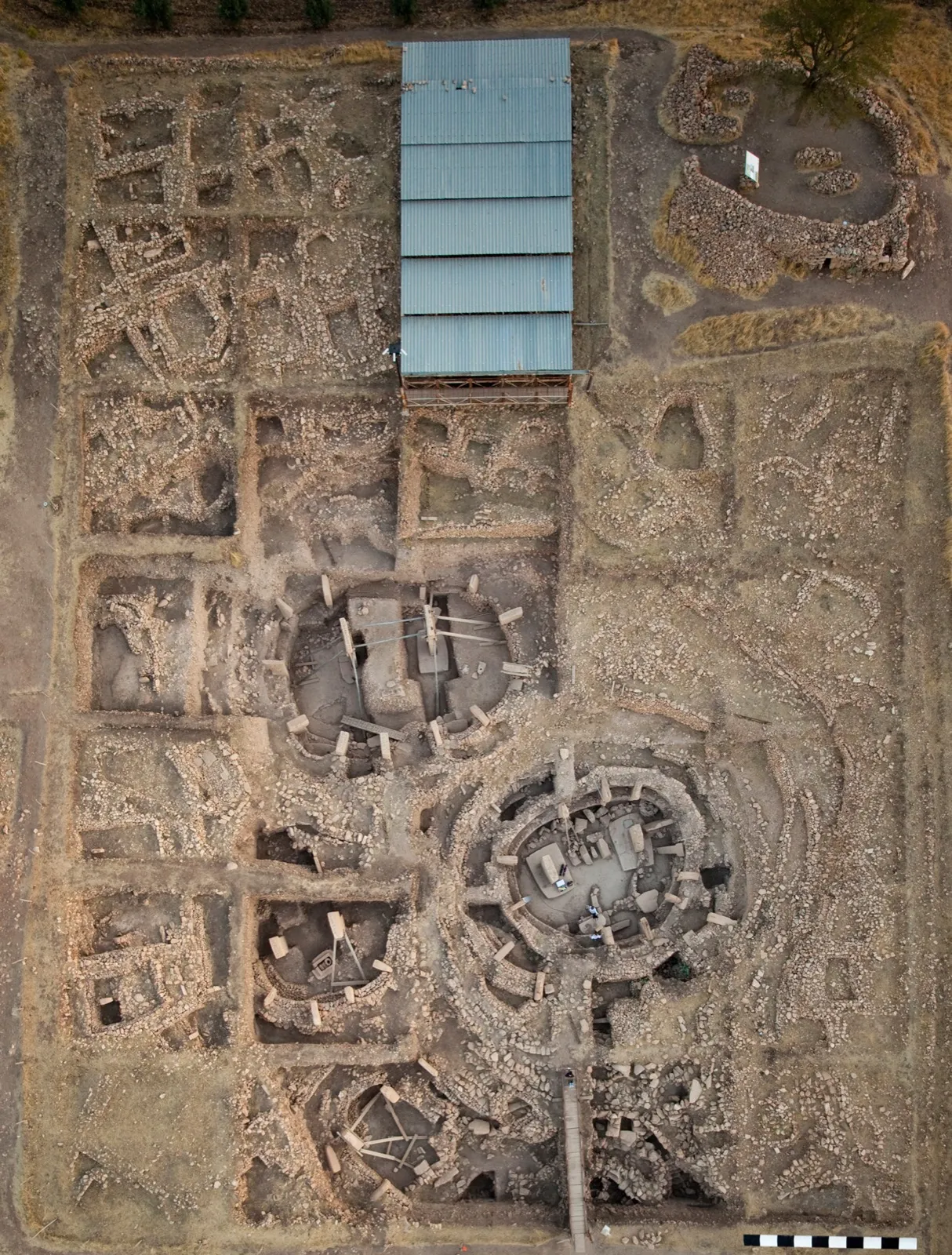 The main excavation area at Göbekli Tepe, from above. German Archaeological Institute, photo by E. Kücük. CC BY 4.0.
More recent excavations have complicated that picture, finding evidence that people also lived at Göbekli Tepe rather than only gathering there. But the broader point has held up. Gathering in one place, building something permanent and returning to it seem to have come before, or alongside, the full dependence on crops. People did not only settle because the fields required it. They also settled because some places mattered to them, and among the things that made a place matter were the people buried there.
Why did they bury the dead under the floor?
It is easy to assume this was a matter of convenience or a lack of alternatives. The evidence points the other way. Burial under the floor was deliberate and laborious, and in many cases it was only the beginning of a longer relationship with the dead.
At Jericho, in the period that produced the plastered skulls, bodies were buried and, after the flesh had gone, the skull was often retrieved, sometimes remodelled, and kept. Similar plastered skulls have been found at other sites in the Levant, including ʿAin Ghazal in Jordan and Tell Aswad in Syria. Archaeologists debate exactly what they meant, and it would be unwise to claim more certainty than the evidence allows. The most common interpretation is that they were a form of ancestor veneration: a way of keeping particular dead people present, recognisable and part of household life.
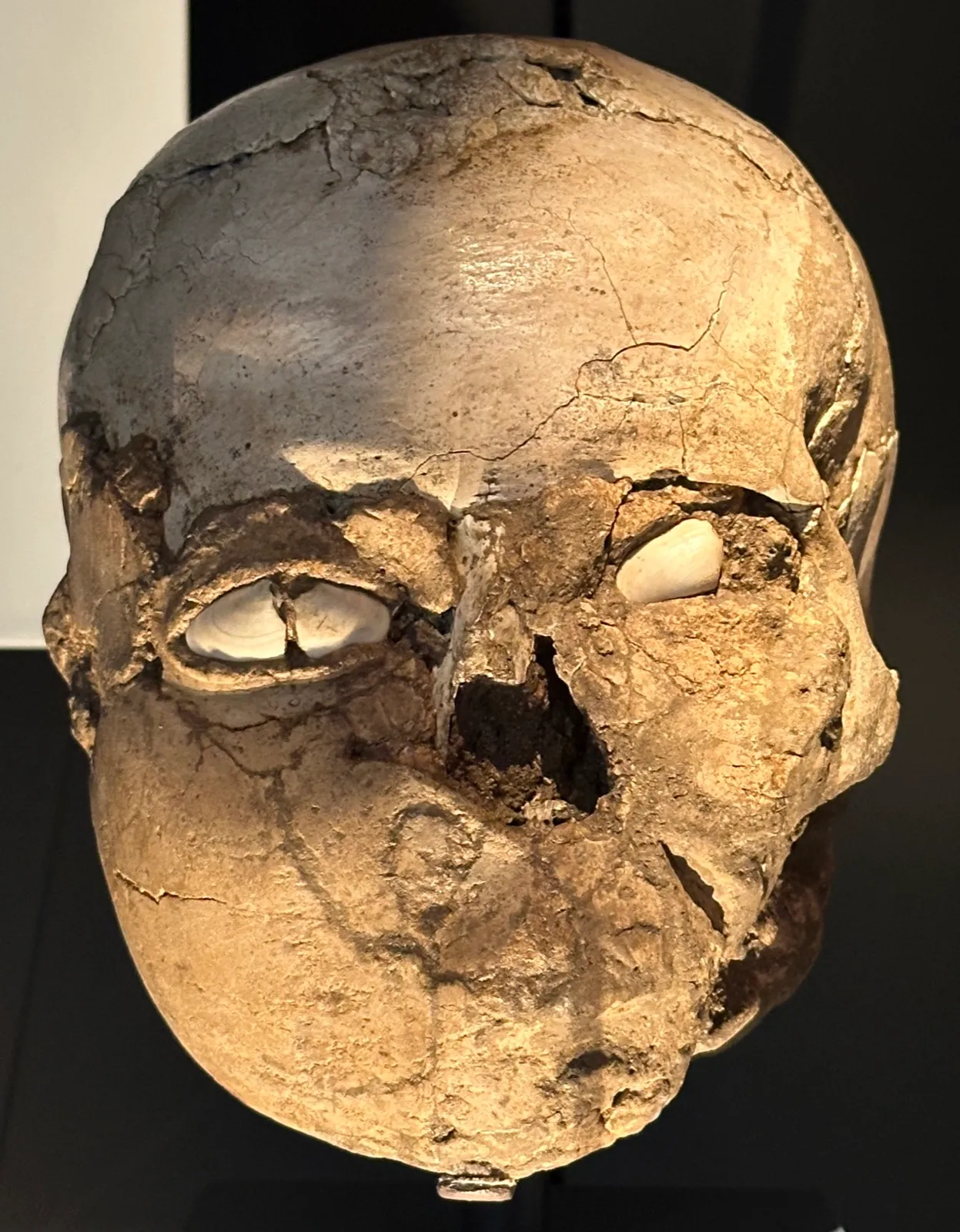 The Jericho Skull, a plastered human skull from Tell es-Sultan, about 8200–7500 BCE. British Museum. Photo by APK. CC BY 4.0.
There is a striking detail in the faces. They are not identical masks. Many of the plastered skulls have individual features, as if the people who made them wanted to preserve a particular person rather than a generic ancestor. In a world without writing, portraits or names on stone, a modelled face was perhaps the most complete record of an individual that anyone could make.
What did Çatalhöyük reveal about home and memory?
Çatalhöyük offers the clearest picture of what living with the dead looked like day to day. Its mud-brick houses were packed so tightly together that there were few streets; people walked across the roofs and climbed down into their homes by ladder. Inside, the dead were buried beneath raised platforms in the main room, the same platforms people sat and slept on. The archaeologist Ian Hodder, who led excavations there from 1993, reports that one house, known as Building 1, had 62 burials beneath its floors. Some houses had dozens; others had a few or none.
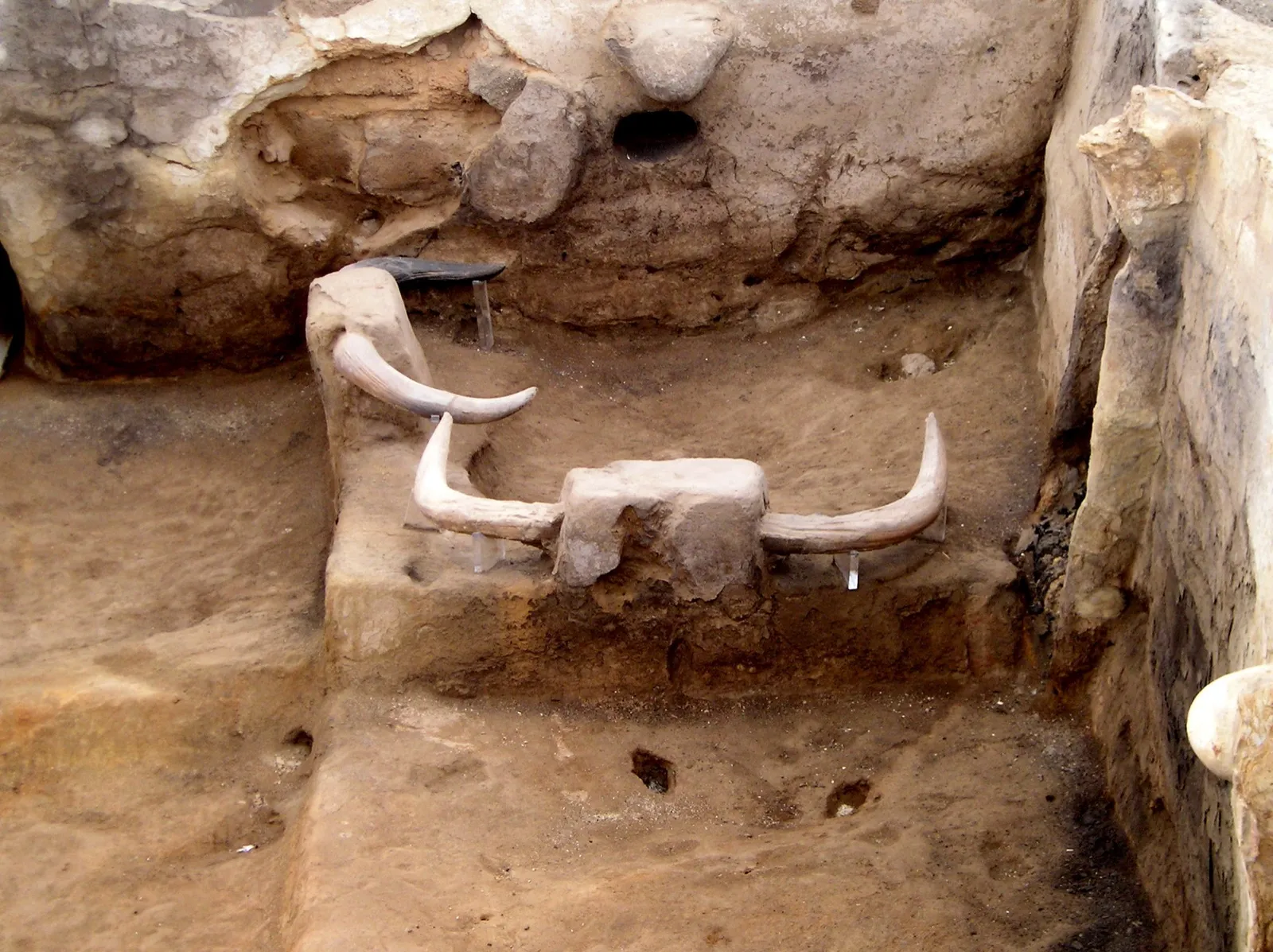 An excavated building at Çatalhöyük, with cattle horns set into a bench. Photo by Verity Cridland, 2008. CC BY 2.0.
Houses at Çatalhöyük were not simply abandoned when they wore out. They were carefully filled in and rebuilt on the same spot, often following the same floor plan, generation after generation. Hodder and his colleagues called the houses that were rebuilt most often and held the most burials “history houses”. They appear to have acted as a kind of memory for the community: a place where the past was physically underfoot, layer upon layer.
One of the most interesting findings concerns who was buried together. Genetic studies of the burials suggest that the people placed beneath a single house were often not close biological relatives. If that is right, the house did not simply contain a family. In an important sense it made one. To belong to a household was to share a floor with its dead.
What happens to memory when people stop staying put?
For most of the ten thousand years since Çatalhöyük, some version of this arrangement persisted. The dead were buried near the living, in the house, the churchyard or the family plot, and families stayed close to them for generations. Memory was attached to a place. The grave, the house and the village held the stories, and the people who lived there kept retelling them. The rituals that survived from this world, such as tending graves or bringing the dead home once a year, are described in more detail in my piece on how different cultures remember the dead.
That system depended on staying put, and most of us no longer do. At the 2021 Census, only about 53 per cent of Australians lived at the same address as five years earlier. Families scatter across cities and countries. The family home is sold; the graves are in a town nobody visits. The physical anchors that held memory for a hundred centuries have come loose, and nothing has automatically taken their place.
The result is a quiet kind of loss. A child at Çatalhöyük grew up literally on top of the household’s dead, surrounded by their remains, their rebuilt walls and presumably their stories. Many children today could not tell you where their great-grandparents are buried, let alone who they were. As I wrote about Kushim, the first name in writing, even when records survive they often preserve the least interesting thing about a person.
What is the modern equivalent of the plastered skull?
The people of Jericho wanted to keep a face. They did it with the materials they had: bone, plaster and shell. It was a remarkable effort, and it preserved the shape of a person while losing everything else: the voice, the manner, the stories, the jokes.
We can now keep all of those things, and we no longer need a house to keep them in. A video recording does what the buried ancestor under the platform once did, except that it travels. It can sit with a grandchild in another city, or with a descendant who will never visit the town where the family began. When I filmed four hours of my grandmother telling her life story, I was not thinking about Neolithic Anatolia. But the impulse was the same one that led someone at Jericho to rebuild a face in plaster: to keep a particular person present for the people who come after.
Through The Archive I have filmed more than a hundred life stories since 2020, and the families who value them most are often the ones who have moved furthest from where their story began. The recording becomes the place. The Everyone app was built with that in mind: to film a parent or grandparent answering one question at a time, and keep their face and voice somewhere the whole family can reach.
The first human settlements were built by people who did not want to leave their dead behind. We have left our places behind, mostly for good reasons. The question is whether we take the people with us.