For forty years he preached. Then he left behind what he really thought.
Jean Meslier preached for forty years and believed almost none of it. He left his real thoughts in a manuscript, and others rewrote them. What it teaches us.
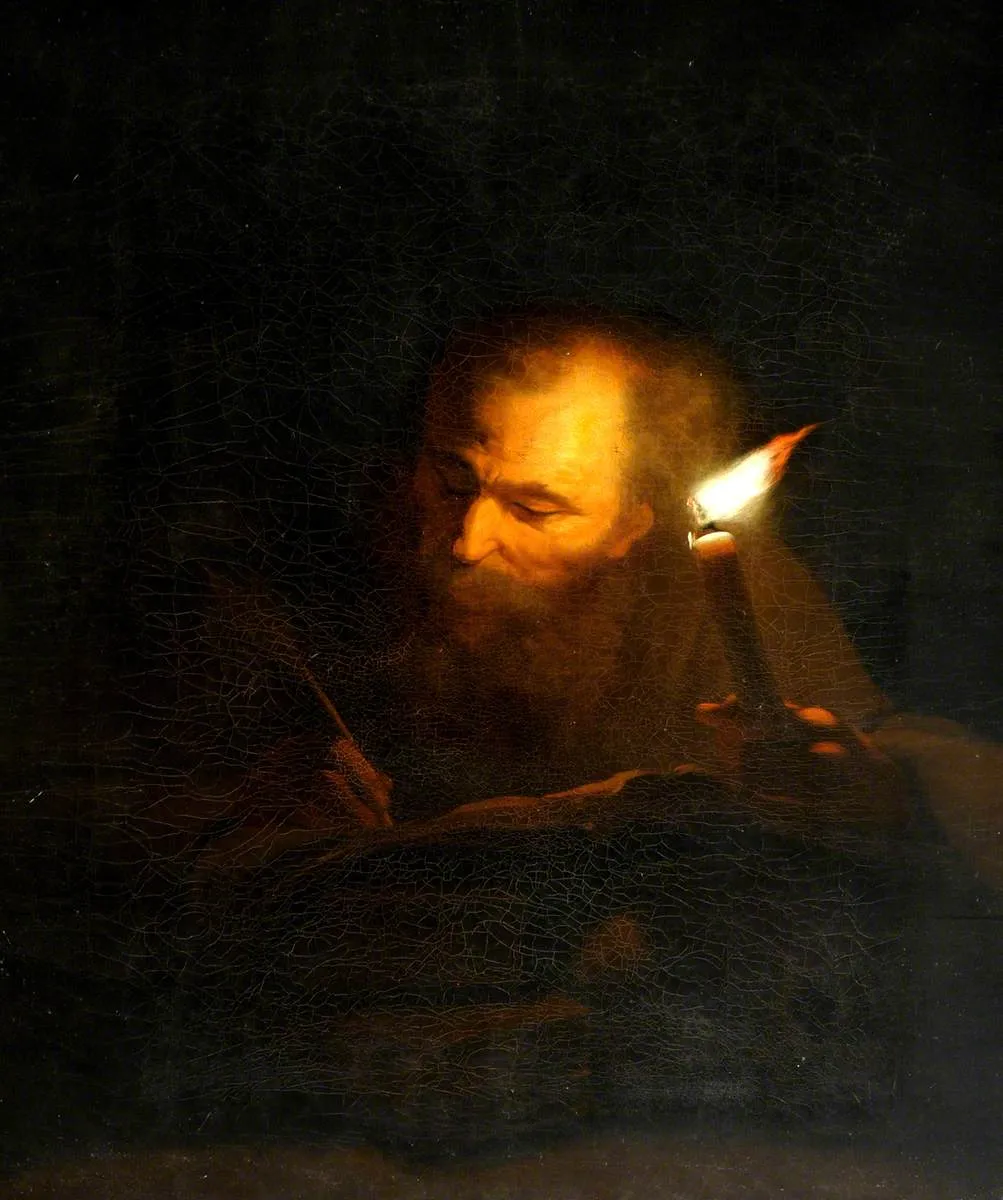
In 1729 a parish priest died in Étrépigny, a village in the Ardennes in north-eastern France. His name was Jean Meslier, and he had served the same two small parishes for forty years. By most outward measures he was unremarkable. He said Mass, heard confessions, baptised children and buried their grandparents.
In his house, three copies of a manuscript were found, each running to more than six hundred pages. In it, the priest explained to his parishioners that he had not believed what he taught them. He rejected the Church, the Christian God, the immortality of the soul and the right of kings and nobles to rule over the poor. It is often described as the first book-length argument for atheism in modern Europe, and it was written by a village curé who had kept his own counsel for his entire working life.
Jean Meslier’s story is usually told as a chapter in the history of unbelief. I think it is more interesting as a story about something nearly everyone does: keeping our real thoughts to ourselves, and assuming that, one day, we will find a way to leave them behind.
Who was Jean Meslier?
He was born on 15 June 1664 in Mazerny, a village not far from Étrépigny, to a family that worked in textiles. He trained for the priesthood, and on 7 January 1689 he became curé of Étrépigny and the neighbouring parish of Balaives. He stayed until he died.
Almost everything we know about his life before his death comes from a handful of church records. He was reproved more than once by his superiors, including over his employment of young female servants. The most revealing incident was a dispute with the local nobleman, Antoine de Touilly, over the treatment of the peasants. Meslier criticised the lord from the pulpit, accusing him in effect of robbing the poor, and was reprimanded by his archbishop.
That episode tells us two things. Meslier cared intensely about injustice, and he had learnt exactly what it cost to say so in public. He kept his deeper views out of his sermons for the rest of his life. According to the French historical record, when he died two fellow priests buried him in the garden of the presbytery, and no entry was made in the parish register.
Why did he wait until he was dead?
The manuscript opens with an address to his parishioners, whom he calls mes chers amis, my dear friends. He explains that it would not have been permitted, and would have been too dangerous, to tell them openly during his life what he thought about how people were governed, about religion and about morals. So he would tell them after his death.
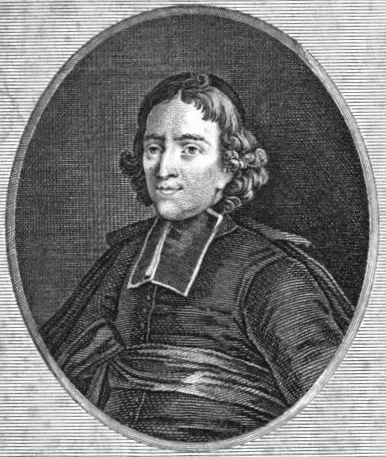 “J. Meslier”, an engraving published in Paris in 1802, in an edition of a book he did not write. No portrait made in his lifetime is known, so this may be imagined. Public domain.
The reasoning was sound. In the France of Louis XIV and Louis XV, a priest who published an attack on the Church and the monarchy risked his living, his liberty and possibly his life. Meslier made three copies, which suggests he understood a second risk too: a single manuscript could easily be destroyed by whoever found it.
But consider what the delay cost. For forty years, the people he was writing to sat in front of him every Sunday. Instead of being questioned by them, he wrote a long, dense, repetitive treatise designed to be read after he could no longer answer for it. There is little sign that his parishioners ever read it. The manuscript found a very different audience.
What happened to his words?
The copies did not go to the people of Étrépigny. They passed into official hands and then, in secret, into circulation. By the 1730s handwritten copies were being passed around among freethinkers in Paris. In a letter of November 1735, the writer Nicolas-Claude Thieriot told Voltaire about the manuscript.
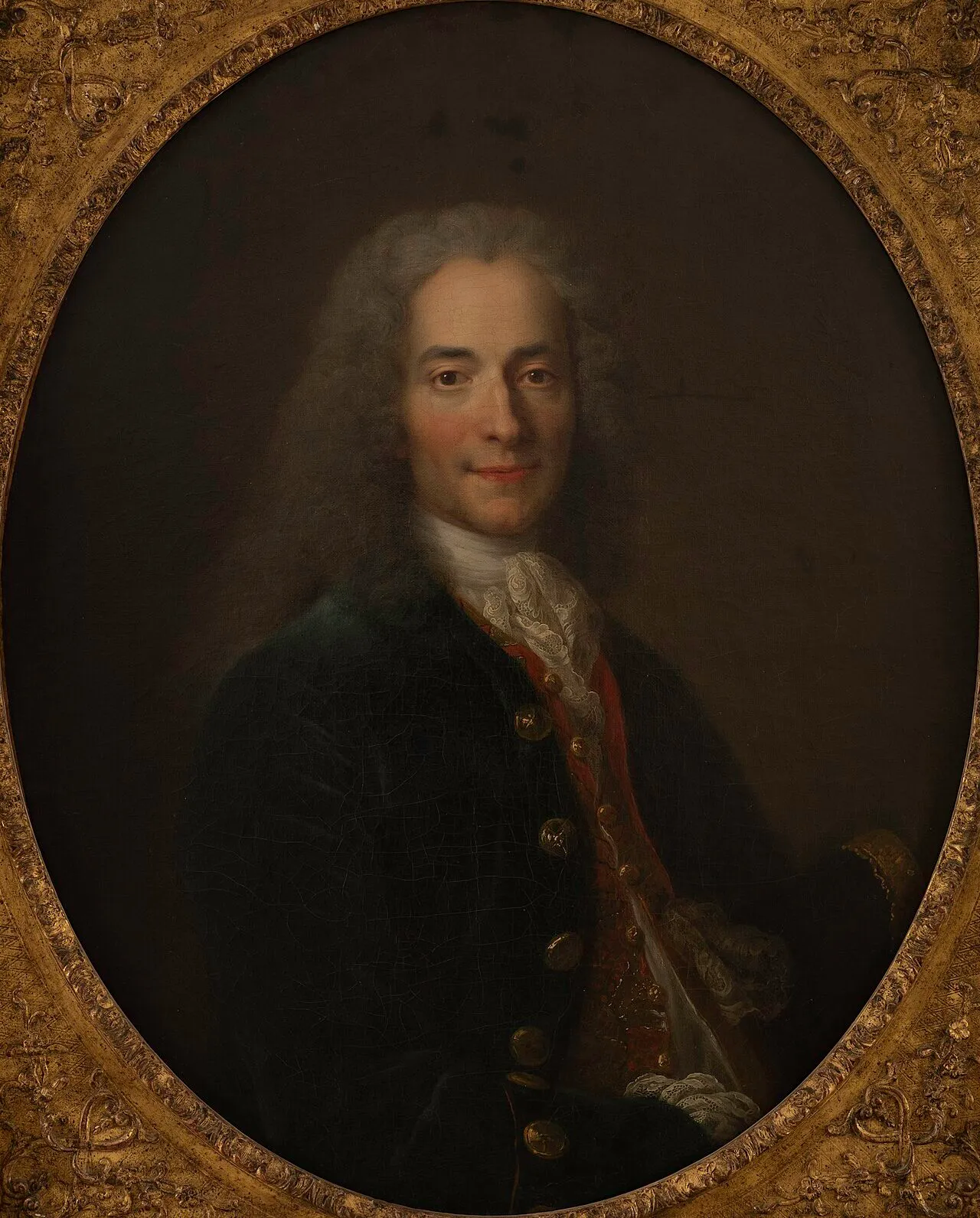 Portrait of Voltaire by Nicolas de Largillière, painted around 1718. Musée Carnavalet, Paris. CC0.
Voltaire saw the value of a priest’s deathbed rejection of the Church, and in 1762 he published Extrait des sentiments de Jean Meslier, a short selection from the testament. It was enormously effective propaganda. It was also not quite Meslier. Voltaire was a deist, who believed in a creator God while rejecting organised religion, and his extract presents Meslier as something similar. Meslier’s outright atheism was softened, and his attacks on the monarchy and his ideas about common ownership of property were largely cut. The most quoted line of Voltaire’s version, in which Meslier says he dies more full of wishes than of hopes, does not appear in the full text at all. In private, Voltaire was dismissive of the original, writing to Helvétius in 1763 that it was written in the style of a carriage horse.
Other people borrowed the name too. In 1772 Baron d’Holbach published an anonymous book called Le Bon Sens; later editions were sold as Le Bon Sens du curé Meslier, and for a long time readers took it to be his. The engraved portrait above comes from one of those editions. The most famous sentence associated with him, that humanity will not be free until the last king is strangled with the guts of the last priest, is not his either. In the testament, Meslier reports the wish of an uneducated man he had heard of. Diderot later reworked it into a line of verse, and the popular version grew from there.
The full text was not printed until 1864, in three volumes published in Amsterdam under the editorship of Rudolf Charles, more than 130 years after Meslier died. Even that edition got basic facts wrong: its title page gives his year of death as 1733.
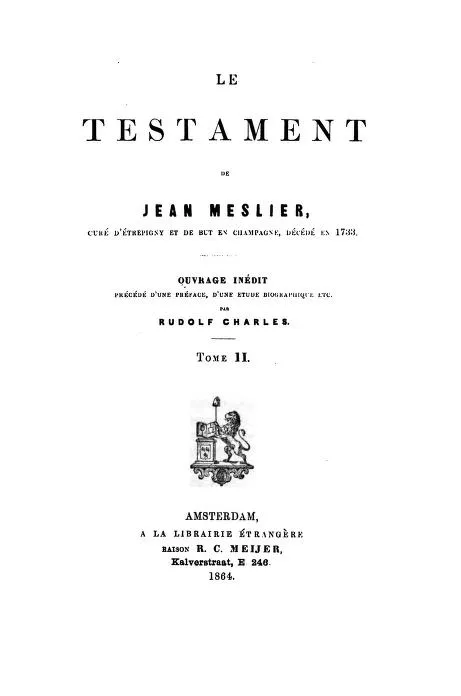 Title page of the second volume of the first complete edition, Amsterdam, 1864. Note the death year. Public domain.
So Meslier’s ideas outlived him. But for more than a century, the Meslier people knew was a figure assembled by others: abridged by Voltaire, ghost-written by d’Holbach, misquoted via Diderot.
Why do our real thoughts usually die with us?
Few people hide anything as dangerous as Meslier did. But almost everyone keeps a version of the arrangement he lived with: a public self, which is what our families and communities see, and a private self, which holds what we actually believe, doubt, regret and hope.
The gap is usually innocent. We spare people’s feelings and play the roles that families need: the steady parent, the uncle who never talks about the war. The trouble comes at the end. What a family remembers, and what is said in a eulogy, is overwhelmingly the public self. The private self tends to go unrecorded, because nobody asked for it and the person never found the right moment to offer it.
Meslier at least had a plan. Most people simply intend to say something one day. In the more than a hundred life stories I have filmed since 2020, the moments that families value most are rarely the polished summaries. They are the points where someone stops performing the role they have played for decades and says what they really think: about their marriage, their faith, a decision they still question, a parent they never forgave. Those moments are also the hardest to get, because they only come when someone asks directly and is prepared to listen to the answer.
Is a manuscript the safest place for the real you?
Meslier’s story suggests two lessons about how to leave your thoughts behind, and both cut against his method.
The first is about timing. A testament read after your death cannot be clarified, defended or discussed. Meslier’s ideas were taken up by people with their own agendas, and he could not object. Had he said even a little of it to the people it was meant for while he was alive, the record would at least contain his answers to their questions.
The second is about form. Written words are easy to separate from their author. They can be abridged, reordered, translated loosely, attributed to the wrong person or put into someone else’s book, and all of this happened to Meslier within a few decades. A recording of a person speaking in their own voice, with their own face and their own hesitations, carries a great deal of its context with it. It can still be cut or quoted out of context, but it is much harder to turn an atheist into a deist when the viewer can watch him say what he means. (I have made the broader case for recording a life story on video rather than writing it elsewhere.)
What does it look like to leave your real thoughts behind?
It does not require a 600-page treatise, and for most people it does not involve anything shocking. It involves answering questions that the people who love you would ask if they felt they could. For example:
- What do you believe that most people around you do not?
- What have you changed your mind about, and what changed it?
- What did you pretend to feel, for someone else’s sake?
- Is there a decision you made that you still are not sure was right?
- What did you never say to your parents that you wish you had?
- What would you want your grandchildren to know about who you really were, as opposed to who you seemed to be?
These are harder than the questions people usually ask in a legacy video, which tend to drift towards advice. The person answering should decide what is kept private and for how long. Some answers belong to the family now; some are better sealed and opened later.
That last option is the closest modern equivalent to what Meslier wanted. The Everyone app lets you film answers like these one question at a time and lock a video in a time capsule until a date you choose. The difference from Meslier’s position is that you can do it while you are still here to explain yourself, in your own voice, without anyone else’s hand on the text.
Meslier spent forty years preparing to tell the truth, and the world heard a version edited by strangers. Most of us will not hide anything so large. But nearly all of us are carrying some version of his manuscript, and it is worth asking who we are waiting for.