Kushim and the history of memory: the first name in writing.
The oldest name in writing may belong to Kushim, a barley accountant in Uruk. What his tablet reveals about who history remembers, and who it forgets.
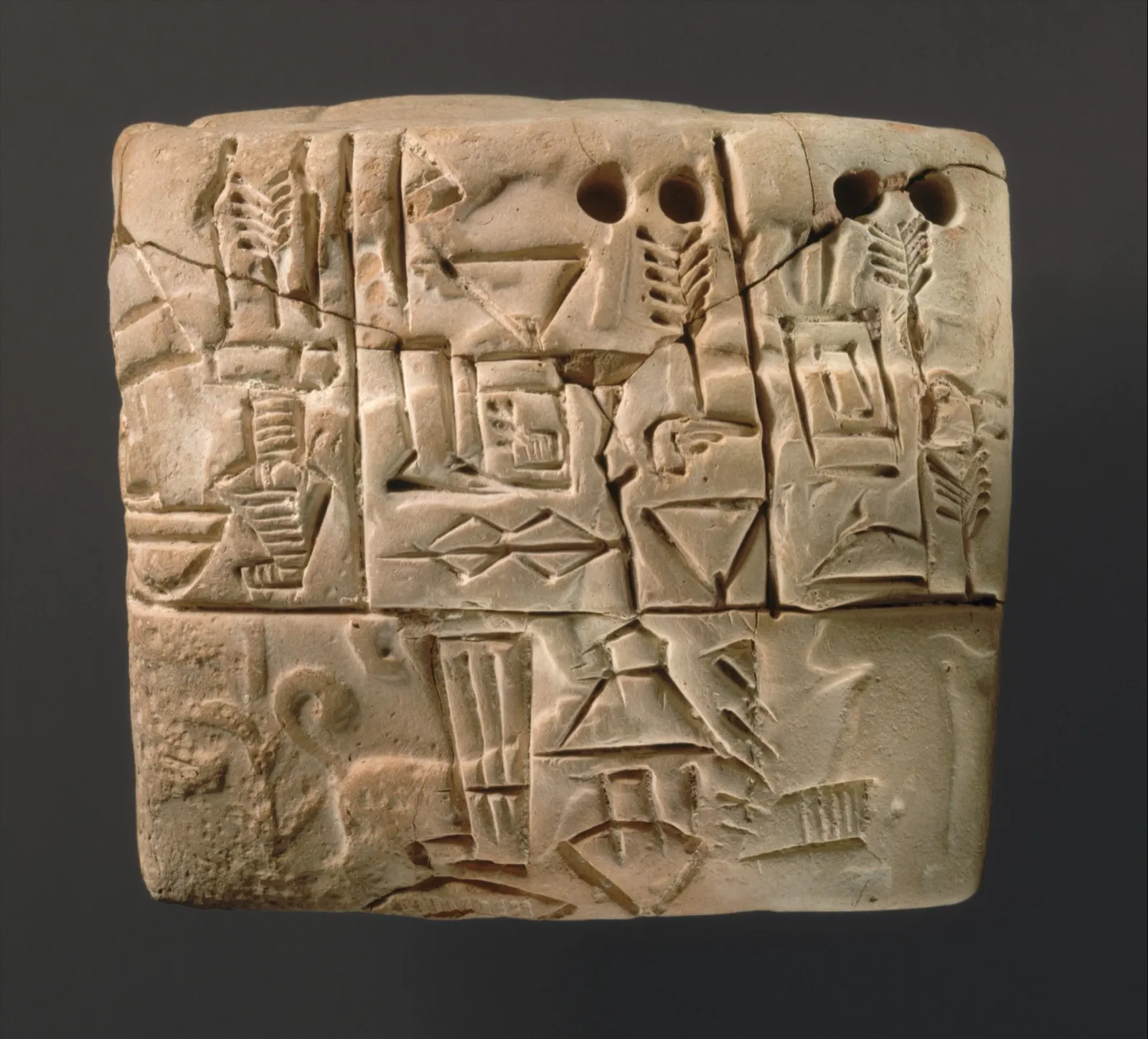
Around five thousand years ago, in the city of Uruk in what is now southern Iraq, someone pressed a few signs into a lump of wet clay the size of a palm. Translated, the record says roughly this: 29,086 measures of barley, 37 months, Kushim.
That last word is, as far as we can tell, one of the earliest names of a person ever written down. If Kushim was a person, he is among the first human beings in history whom we can call by name. And everything we know about him is contained in that one line. We do not know his age, his family, his face, or a single thing he said. We know that he was responsible for a large quantity of barley over about three years.
The historian Yuval Noah Harari made Kushim briefly famous in Sapiens, where he pointed out the irony: the first name in history belongs not to a king, a poet or a prophet, but to an accountant. It is a good joke. It is also the opening line of a much longer story about the history of memory, and about who gets remembered at all.
Who was Kushim?
The honest answer is that we do not know, and possibly never will.
The tablet, now catalogued as MS 1717 in the Schøyen Collection, dates to the late Uruk period, somewhere between about 3400 and 3000 BCE. It is written in proto-cuneiform, the earliest stage of the Mesopotamian script, which did not yet record full sentences. It recorded numbers, objects and a handful of other signs. Even the figure is uncertain: the reading Harari popularised is 29,086 measures of barley, while some scholars read 28,086. Either way, it is a large amount, probably well over a hundred thousand litres.
The two signs that make up “Kushim” (read as KU and ŠIM) appear on more than a dozen other tablets from the same period, sometimes alongside a sign meaning a temple administrator. That has led some specialists to suggest Kushim may not be a personal name at all, but a job title, or even the name of an office or institution. The earliest “name in history” might be the equivalent of “Accounts Department”.
If that sounds disappointing, it is worth noticing what the ambiguity itself tells us. The record was not made to remember anyone. It was made so that an institution could keep track of a debt. Whether Kushim was a man, a role or a storeroom was irrelevant to its purpose.
Why was the first writing about barley?
Because writing was not invented to tell stories. It was invented to count.
Archaeologists working at Uruk recovered several thousand proto-cuneiform tablets, most of them from the precinct of the temple of Inanna known as Eanna. The overwhelming majority are administrative: ration lists, records of grain, livestock, textiles and labour. Most of the rest are lexical lists, standardised word lists used to train scribes in the bookkeeping system. There are no poems, no letters, no prayers in the earliest layers, and no life stories.
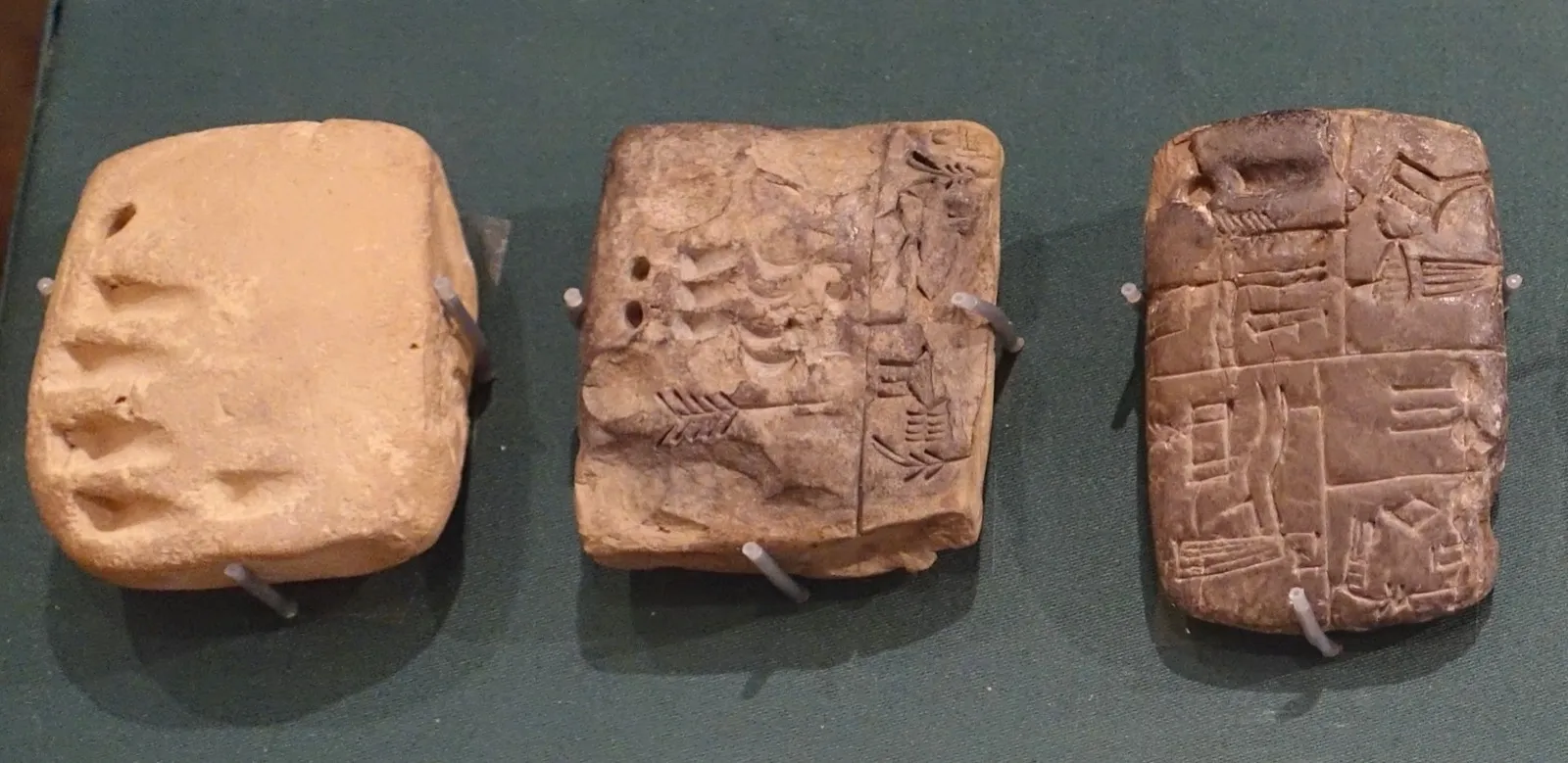 A numerical tablet, a numerical tablet with signs, and a proto-cuneiform tablet, late Uruk period. Oriental Institute Museum, Chicago. Photo by Daderot, derivative by Zunkir. CC0.
The reason is practical. Uruk was one of the first true cities, with tens of thousands of inhabitants, temple estates, workers who were paid in rations, and goods moving in quantities no individual could hold in their head. Human memory evolved for a life in small groups, where you know everyone and can remember who owes what. It breaks down when the numbers run into thousands and the transactions stretch across years. A city needs an external memory, one that does not forget, does not die, and cannot easily be disputed.
Clay tablets were that memory. They were built for the institution, not for the individual. When a name appears in them, it is because a person was useful to the ledger: as a debtor, a recipient of rations, a supervisor. One of the other early names we have, from a tablet made perhaps a generation or two after Kushim’s, belongs to a man called Gal-Sal, recorded together with two people he owned as slaves, En-pap X and Sukkalgir. They are remembered as property.
How did people remember before writing?
It would be a mistake to conclude that nothing was remembered before Uruk. For most of human existence, memory was carried by people: in stories, songs, genealogies and place names, repeated across generations.
Oral memory could be astonishingly durable. In Australia, the researchers Patrick Nunn and Nicholas Reid have argued that Aboriginal stories from around the coast describe a time when the sea was much lower and land now underwater could be walked on, which would mean some of those stories have been passed down for more than seven thousand years. The argument is debated, but it shows what oral cultures can preserve when stories are told deliberately and often.
The limitation of oral memory was not durability. It was selection. A community could carry only so much, and what it carried was what mattered to the group: origins, laws, heroes, the land. The ordinary person’s life was held by the people who knew them, and it lasted about as long as they did. (I have written more about this in a short history of storytelling.)
Writing changed the capacity of memory, but at first it did not change the selection. It simply gave institutions a far better tool for remembering what institutions care about.
How long did it take writing to remember people?
A long time. Literary texts, the first writing that recorded stories, hymns and proverbs rather than transactions, appear in Mesopotamia only around 2600 BCE, roughly half a millennium after the earliest accounts. The first author we know by name, the priestess Enheduanna, daughter of Sargon of Akkad, composed her hymns around 2300 BCE, perhaps eight or nine hundred years after Kushim’s barley was counted.
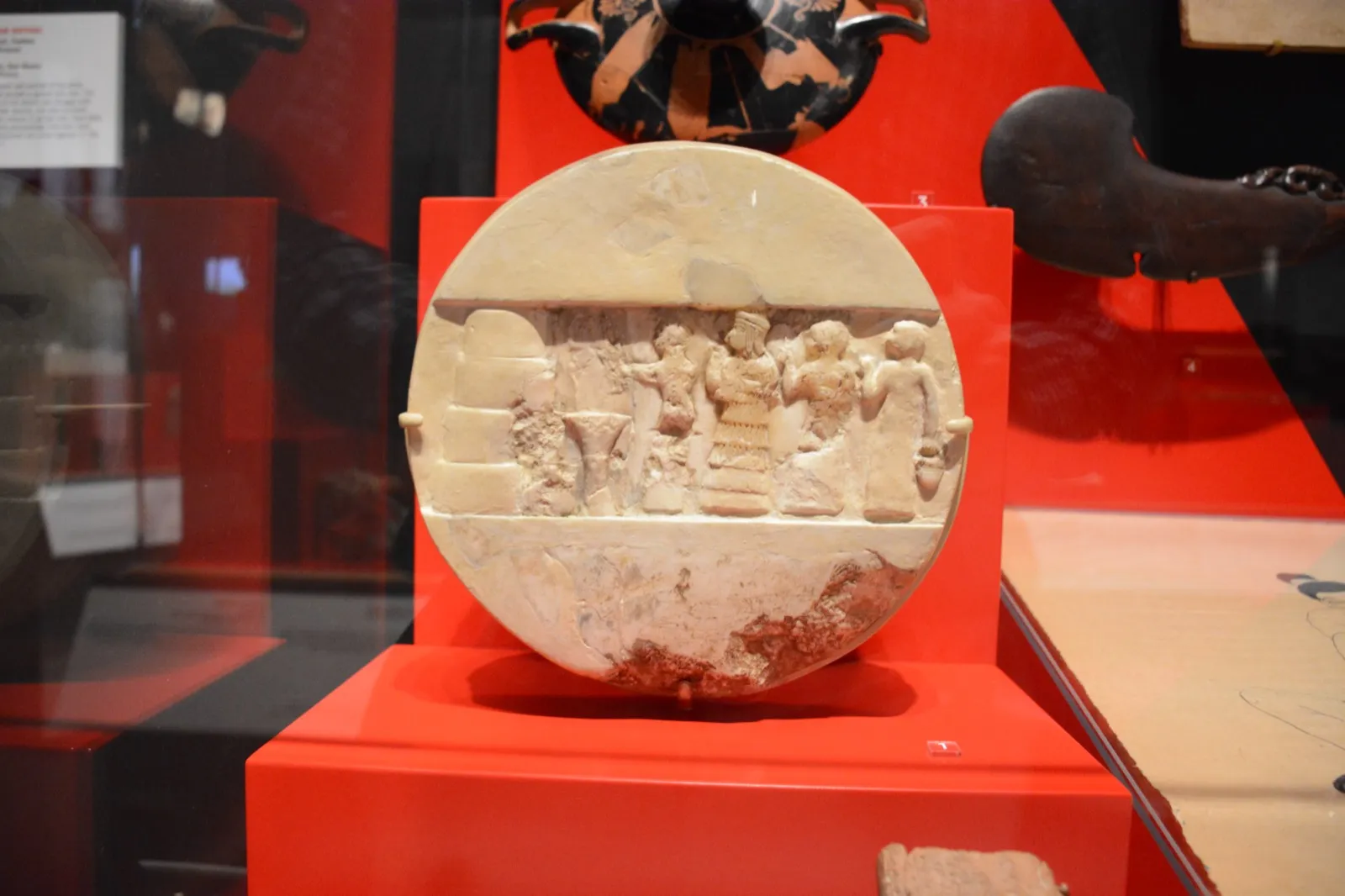 The Disk of Enheduanna, about 2300 BCE. Penn Museum, Philadelphia. CC0.
Even then, the people who were remembered in their own words were a tiny elite: kings, priests, scribes and their patrons. The oldest stories in the world are about gods and kings, not farmers. For thousands of years afterwards, the most common way an ordinary person entered the written record was much the same as Kushim: a tax roll, a census, a parish register, a bill of sale. Historians who try to recover the lives of ordinary people in history often have to reconstruct them from exactly these sources, reading between the lines of documents that were never meant to describe a life.
There is an old complaint about this. In Plato’s Phaedrus, written in the fourth century BCE, Socrates tells a story in which the Egyptian king Thamus is offered the gift of writing and declines to praise it. Writing, he says, will not improve memory but weaken it, because people will rely on marks outside themselves instead of remembering. Thamus was worried that external memory would hollow out the internal kind. The history of Kushim suggests a different problem: external memory was very good at remembering the wrong things.
What does the record say about us?
Here is where the story of Kushim stops being ancient history.
Consider what the institutions of the twenty-first century remember about any one of us. Banks hold every transaction. Tax offices hold every income. Phone companies hold where we were and whom we called. Supermarkets know what we buy each week. If an archaeologist in the year 7000 recovered the data that exists about a typical person today, they would be able to reconstruct their spending in extraordinary detail, much as we can reconstruct Kushim’s barley.
What they would very likely not find is the person. Their voice. How they told a story. What they believed and why, what frightened them, what they found funny, what they would have wanted a descendant to know. In other words, the ledger has grown enormously, but the default record of a human life is still a receipt.
This is not a moral failing of institutions. They remember what they need. The point is that personal memory has never been the default. It has always required someone to decide that a life was worth recording, and then to do it.
Is the history of memory finally changing?
In one important respect, yes. For the first time, the tools for recording a person are as cheap and widespread as the tools for recording a transaction. Almost everyone carries a camera that films in high definition and records clear sound. A person can be captured not as a name on a list, but as a face and a voice, telling their own story.
I have seen what this preserves. Since 2020 I have filmed more than a hundred life stories through The Archive, including Holocaust survivors whose testimony now exists on video in their own words. I also have four hours of my grandmother telling me about her life. She has since passed away. Had I not asked, the record of her would look much like everyone else’s: some official documents, some photographs, a gravestone. Instead, her great-grandchildren will be able to hear her laugh.
The barrier is no longer technology. It is the same barrier that existed in Uruk: someone has to decide that this person is worth remembering, sit them down, and ask. Most families never do it, not because they do not care, but because it always seems like something for later. (If you are wondering where to start, these questions to ask your grandparents are a good place.)
What Kushim leaves us
Five thousand years on, Kushim is remembered because a temple needed to know where its barley had gone. That is a strange kind of immortality: a name, a number and nothing else. It is also the kind most people in history received, if they received anything at all.
We are the first generation with a real choice about this. The institutions will keep recording our transactions whatever we do. Whether anything more than that survives, whether our great-great-grandchildren meet a person or read a ledger, depends on whether we record the rest ourselves. That is why we built Everyone: a free app that guides you through filming a life story one question at a time, so that what is left behind is a person, not a receipt.