
How to interview someone, and why the question decides the answer.
Police detectives once interrupted witnesses every 7.5 seconds. What that research reveals about how to interview someone, and why open-ended questions work.
In the mid-1980s, the psychologists Ronald Fisher and Edward Geiselman listened to recordings of real police detectives interviewing witnesses to crimes. These were experienced professionals, and the interviews mattered: a missed detail could mean an unsolved case. What the researchers found was striking. The detectives asked mostly short, direct, closed questions, and they interrupted. On average, a witness who began to give an open answer was cut off after about seven and a half seconds.
It was less a technique than a habit, and it is what most people do when they want information quickly. They decide what they need to know, ask for it, and move on. The result was interviews that were efficient, tidy and much less informative than they could have been.
Almost everyone who interviews a parent or grandparent about their life makes the same mistake. Learning how to interview someone well is mostly a matter of unlearning it: understanding why open-ended questions retrieve so much more, and when a closed question is still the right tool.
What is the difference between open and closed questions?
A closed question can be answered with a single word or a fact: yes, no, a date, a name. Were you happy at school? Did you like your father? When did you get married?
An open question cannot be answered that way. It asks the person to describe, explain or tell: What was a normal school day like? Tell me about your father. How did you two decide to get married?
The distinction sounds trivial, but it determines who is doing the remembering. A closed question contains most of its own answer. “Were you happy at school?” has already chosen the topic, the frame and the options. The interviewer has done the thinking; the interviewee fills in a blank.
An open question hands the thinking over. The person has to search their own memory and decide what matters. That is harder, which is why it works: the searching brings up material neither of you knew was there.
Why did the most famous questioner in history ask closed questions?
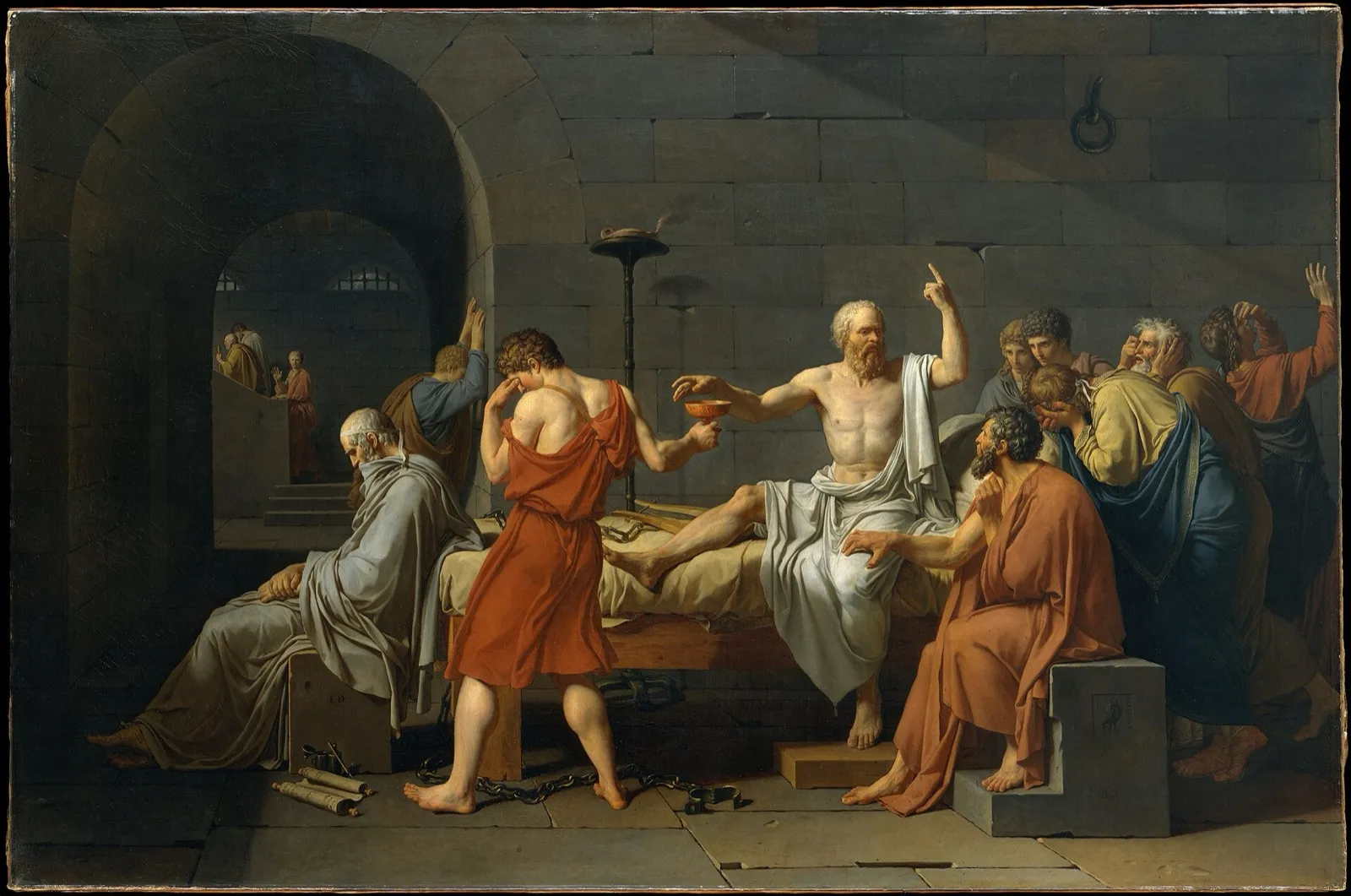
The painting at the top of this page shows Socrates in 399 BCE, on the day he was executed, still talking. He is remembered as the great questioner of Western philosophy, and the method of teaching through questions still carries his name.
Yet anyone who reads Plato’s dialogues will notice something about how Socrates actually asks. Much of the time, his questions are closed, and often leading. He proposes a statement and asks whether his companion agrees, and the companion, page after page, replies with some version of “Certainly” or “That is true.”
This is not a flaw in the method. It is the method. Socrates was walking his companions, one agreed step at a time, to a conclusion he had already reached. Closed questions are how you lead someone somewhere.
A life story interview has the opposite goal. You do not know where the story goes, and you should not be steering it. If you find yourself asking a long series of questions that get “yes”, “no” and “I suppose so” in reply, you are conducting a Socratic dialogue with your grandmother, and the only story being told is yours.
What happened when police started asking open questions?
Fisher and Geiselman’s response to what they heard was to design a different kind of interview, which they called the cognitive interview. Its principles came from memory research rather than police habit. Ask the witness to mentally return to the scene: the room, the weather, how they felt. Ask them to report everything, including details that seem unimportant. Do not interrupt. Let them talk in their own order, and then ask them to go back through events in a different order.
The results were consistent. In laboratory and field studies, witnesses interviewed this way recalled substantially more correct information than witnesses given a standard interview, without a matching rise in errors. A 1999 meta-analysis by Günter Köhnken and colleagues, pooling dozens of studies, found the cognitive interview produced considerably more correct details while accuracy stayed at a similar level, around 85 per cent compared with 82 per cent. The technique has since been taught to police and investigators in many countries.
The mechanism applies just as much at a kitchen table. Memories are not stored as a list of facts. They are tied to context: places, people, sensations, feelings. A closed question goes straight for one fact and skips the context that would have brought neighbouring memories with it. An open question, especially one that asks for a scene, rebuilds the context first. Once someone is mentally back in the house they grew up in, the stories arrive on their own.
The same pattern appears far outside policing. A 2019 study led by Naykky Singh Ospina, analysing recorded consultations in the United States, found that patients who began explaining why they had come were usually interrupted, typically within about eleven seconds. Wherever people are busy and think they know what they are looking for, open questions are the first casualty.
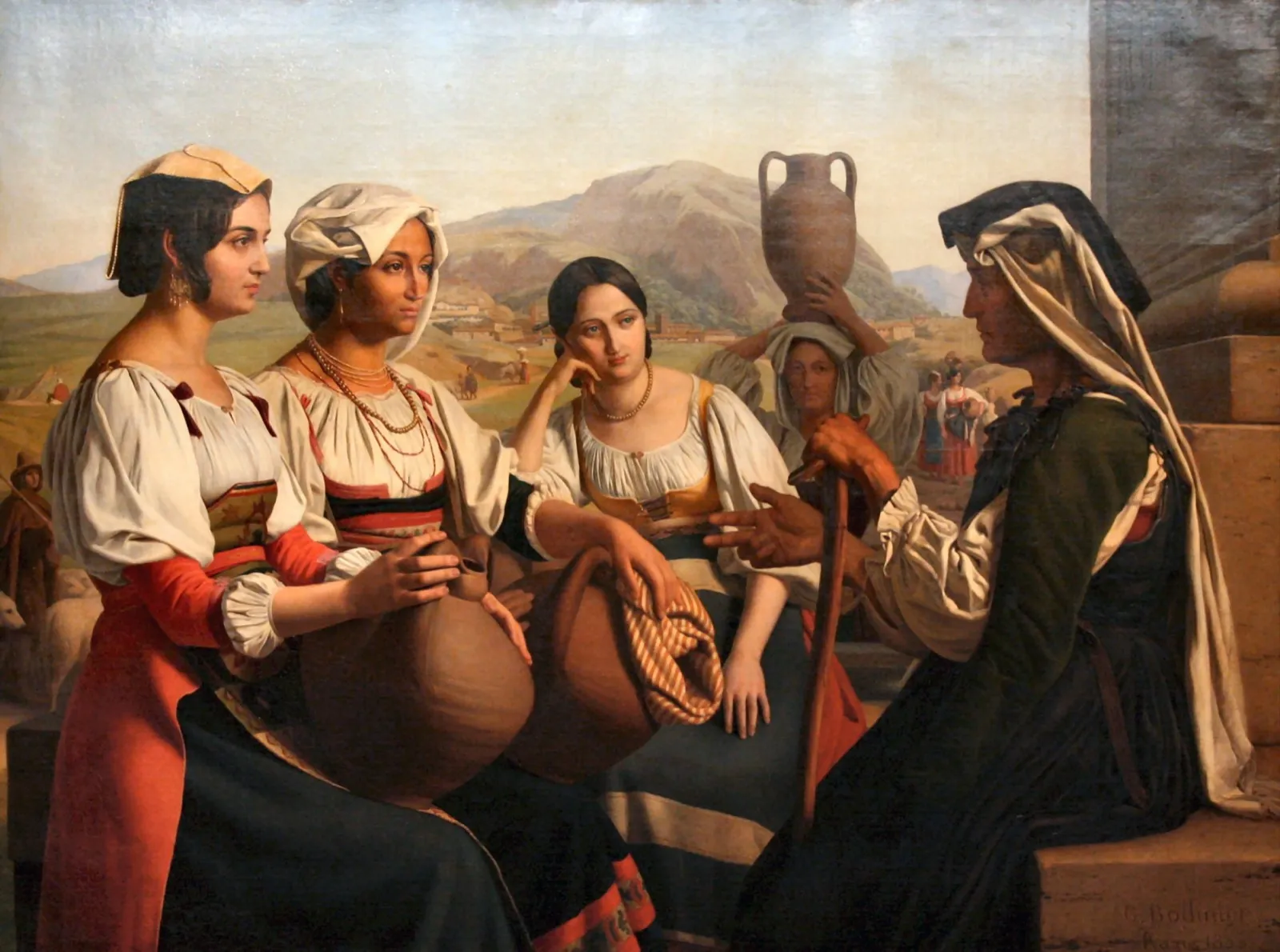 “Three Women at the Fountain Listening to an Old Woman” by Guillaume Bodinier, 1832. Public domain.
Can a question change what someone remembers?
It can, and this is the strongest argument for being careful.
In 1974, Elizabeth Loftus and John Palmer showed people films of car accidents and then asked them how fast the cars were going. The only thing that varied was one verb. People asked how fast the cars were going when they “smashed” into each other gave higher estimates, on average around nine miles per hour higher, than people asked about cars that “contacted” each other. In a follow-up experiment, people who had heard “smashed” were asked a week later whether they had seen any broken glass. They were more than twice as likely to say yes as people who had heard “hit”. There was no broken glass in the film.
A leading question does not merely bias the answer. It can quietly become part of the memory. “Your father was very strict, wasn’t he?” invites a person to remember a strict father, whether or not that is the father they would have described if you had asked, “What was your father like?”
In families, leading questions usually come from affection. We want to hear the good story again, so we prompt it: Tell me about the time Dad stood on your foot at the dance. That gets the familiar version, polished by retelling. Ask instead, “How did you meet Dad?”, and you leave room for the details that never made it into the family repertoire.
How to turn closed questions into open-ended questions
Most closed questions can be rewritten in a few words. A useful test is to begin with one of three verbs, a pattern taught in police interview training under the mnemonic TED: tell, explain, describe.
| Closed | Open |
|---|---|
| Did you like school? | What was a normal school day like for you? |
| Were your parents strict? | What did you get in trouble for as a child? |
| Was it hard to leave home? | Describe the day you left home. |
| Did you want to be a teacher? | How did you end up becoming a teacher? |
| Were you scared during the war? | What do you remember about the day it began? |
| Do you have any regrets? | If you could go back and change one decision, which would it be? |
Notice that the open versions are also more specific. That is deliberate. “Tell me about your childhood” is open but so broad that it tends to produce a summary: It was a happy childhood; we did not have much. The best open questions point at a scene, a moment or a person, and then let the speaker decide what to say about it. For a full set of these, organised by stage of life, see questions to ask your parents about their life.
Three more habits matter as much as the wording:
- Ask one question at a time. “What was your first job, and did you like it, and how much were you paid?” will get an answer to the last part only.
- Do not interrupt. If seven and a half seconds was too short for a detective, it is too short for your father. When he stops, wait. The pause is often where the second, truer version of the answer begins.
- Follow up with more open questions. What happened next? What was that like? Why do you think you did that? The first answer is a doorway; the follow-up is the room.
When should you ask a closed question?
Closed questions are not wrong. They are a different tool, and a good interview uses both.
They are useful for facts that need to be precise: full names, the year someone emigrated, the name of the ship, the street they lived on. They are useful at the very start, because easy questions with clear answers put a nervous person at ease. And they are useful at the end of a story, to confirm something you might otherwise get wrong: So that was in Melbourne, not Sydney?
Interviewers sometimes describe this as a funnel: start wide with an open question, narrow with open follow-ups, and only when the story has been told, use a closed question to pin down a detail. Opening with the closed question ends the story before it starts.
What does this look like in practice?
Since 2020 I have filmed more than a hundred life stories, including Holocaust survivors and my own grandmother, who gave me four hours of her life before she died. The interviews I am proudest of are not the ones where I asked the cleverest questions. They are the ones where I asked short, open questions and then said very little.
The hardest part is resisting the urge to be helpful: to finish a sentence, to supply the date someone is searching for, to move on when there is silence. Each of those is the interviewer’s voice replacing the storyteller’s.
This matters more on video than on paper. A transcript records the answer; a video records the person searching for it, the look away, the half-smile before a story they have not told in decades. Those moments only happen when there is room for them. (For setting up the camera, light and sound, see how to capture someone’s life story on video.)
The Everyone app is built around this idea: it asks one open question at a time and records the answer as a short video, so the storyteller can take as long as they need. But the principle does not depend on any app. Ask questions that hand the memory over, and then let the person you love do the remembering.


