How to start a family tree: begin with the living.
Archives will still be there in fifty years. The people who can name the faces in your old photos will not. Why a family tree should start with interviews.
On the afternoon of 10 January 1921, a fire broke out in the basement of the Commerce Building in Washington, D.C. Stored there were the original schedules of the 1890 United States census, the handwritten record of almost 63 million people. According to the National Archives, about a quarter of the schedules burned and around half were damaged by smoke and water. In 1933 Congress authorised the destruction of what remained. Today the population records for fewer than one per cent of those people survive, roughly six thousand names.
For American genealogists, the loss is still felt every day. Anyone trying to trace an ancestor between 1880 and 1900 runs into a twenty-year hole.
I start with this story because it is the most famous example of a problem every family historian eventually meets: records disappear. But there is a larger and less obvious point hidden in it. If you want to know how to start a family tree, most guides will send you straight to the archives. I think that is the wrong place to begin. The archives are the part of your family history that is, for the most part, already safe. The part that is disappearing is sitting at the dinner table.
What is a family tree actually made of?
A family tree looks like a diagram of people. It is really a diagram of documents.
Every name on it rests on a record: a birth certificate, a marriage register, a census entry, a ship’s passenger list, a gravestone. The genealogist’s discipline is to link each person to the next generation through evidence, one step at a time, and to note where every fact came from. This is the right discipline, and anyone serious about it should follow it.
But it has a consequence that is easy to miss. A tree built only from records can contain only what institutions chose to write down. Governments recorded people when they were born, married, died, paid tax, enlisted, migrated or were counted. They did not record what anyone was like.
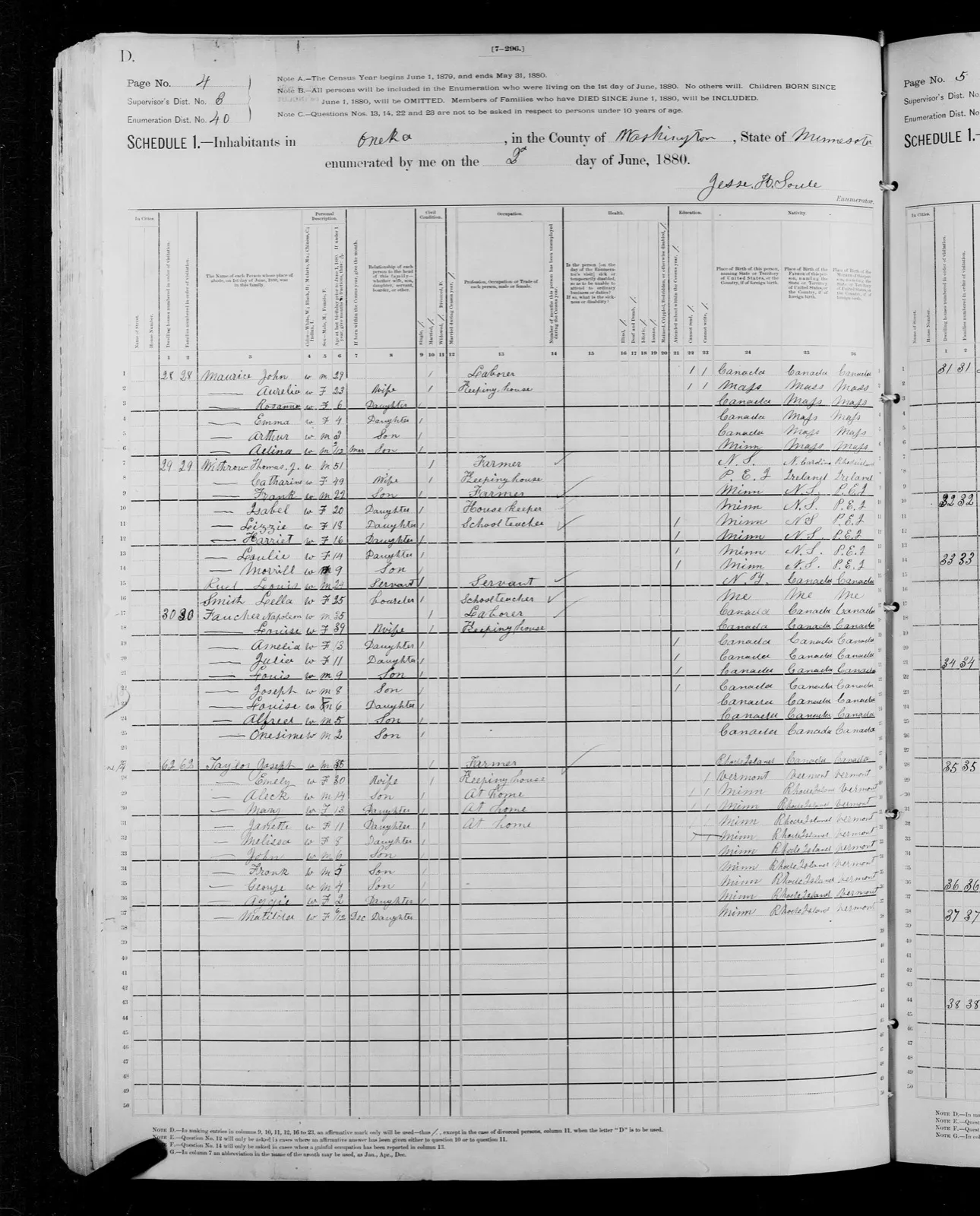 A page from the 1880 United States census, Oneka, Washington County, Minnesota. U.S. Census Bureau, National Archives. Public domain.
Look at the census page above. Line 7 records Thomas Withrow, aged 51, a farmer born in Nova Scotia. His wife Catharine was born on Prince Edward Island to Irish parents. Their daughter Lizzie, eighteen, is listed as a schoolteacher. It is a remarkably rich record by the standards of the time, and it tells you almost nothing about who these people were. Did Lizzie like teaching? Why did Thomas leave Nova Scotia? What was Catharine’s laugh like? The census was never designed to ask.
Why are the records the safer half?
Here is the counterintuitive part. Official records, for all their losses, are built to last.
Most countries keep census returns and register births, deaths and marriages precisely so that they can be consulted later. The United States releases individual census records 72 years after they are taken; the 1950 census was opened in April 2022. England and Wales wait a hundred years; the 1921 census was released in January 2022. These documents sit in climate-controlled archives, are microfilmed, digitised and indexed. Much of the hard work is now done by organisations such as FamilySearch, which is free, and by national libraries. In Australia, the National Library’s Trove service has digitised millions of pages of historical newspapers, where birth notices, obituaries and local gossip about your ancestors may be waiting.
Some records will not be there, of course. The 1890 census is one example. Australia offers another: for most of the twentieth century, the Australian Bureau of Statistics destroyed census forms once the statistics had been processed, so they have never been available to family historians. Since 2001, people have been able to opt in to having their form kept in a Census Time Capsule at the National Archives, to be opened after 99 years. The first one will be released in 2100.
But whatever exists in an archive today will, in all likelihood, still exist in thirty years. You can do that research next year, or after you retire, or your grandchildren can do it. The archive will wait.
What will not wait?
Living memory has no such protection.
Your parents and grandparents carry information that appears in no register: the maiden name of a great-grandmother, the name of the village the family came from before it changed countries, who the people in the unlabelled photographs are, which cousin fell out with whom and why. They also carry the thing no record holds at all, which is what the people on the tree were like. Your grandmother may be the last living person who remembers her own grandmother’s voice.
This knowledge is held by a single, ageing copy, and it is lost whenever that person dies. The Malian scholar Amadou Hampâté Bâ put it memorably at UNESCO in 1960: when an old man dies, a library burns. The 1890 census fire destroyed one set of records once. A similar loss happens, quietly, in every family, every generation.
Living relatives are also the best research tool you have for the archives themselves. A record search with a surname and a rough date often returns hundreds of possible matches. A grandmother who remembers that her father came from a particular town, worked on the railways and had a brother called Albert can reduce those hundreds to one. In my experience, the details that unlock a stuck branch of a tree are very often the ones someone remembered offhand in conversation.
How to start a family tree, in order
If the argument above is right, the order of work follows from it. Do the perishable part first.
- Start with yourself. Write down your own full name, date and place of birth, and the same for your parents and siblings. Genealogists work backwards from the known to the unknown, one generation at a time.
- List every living relative over sixty. Parents, grandparents, great-aunts and uncles, and old family friends. These are your most valuable and least replaceable sources. Put the oldest first.
- Interview them before you open an archive. Ask for names, dates and places, but do not stop there. Ask for the stories. Tell me about your grandparents. What do you remember about the house they lived in? Why did the family move? Open questions retrieve far more than closed ones, for reasons explained in this piece on open vs closed questions.
- Bring the photographs. Hand over the shoebox and ask who each person is. Write the answers on the back in pencil, or on a separate sheet. Unlabelled photographs are among the most common dead ends in family history.
- Gather the paper the family already holds. Certificates, letters, passports, military papers, a family Bible. Photograph everything.
- Then go to the records. Use what you have learnt to search birth, death and marriage indexes, census returns, immigration records and newspapers. Note the source of every fact so that someone after you can check it.
- Keep the tree and the stories together. A tree with names and dates is a skeleton. The interviews are what make it a family.
Why film the interviews rather than take notes?
Notes record the facts. Video records the person giving them.
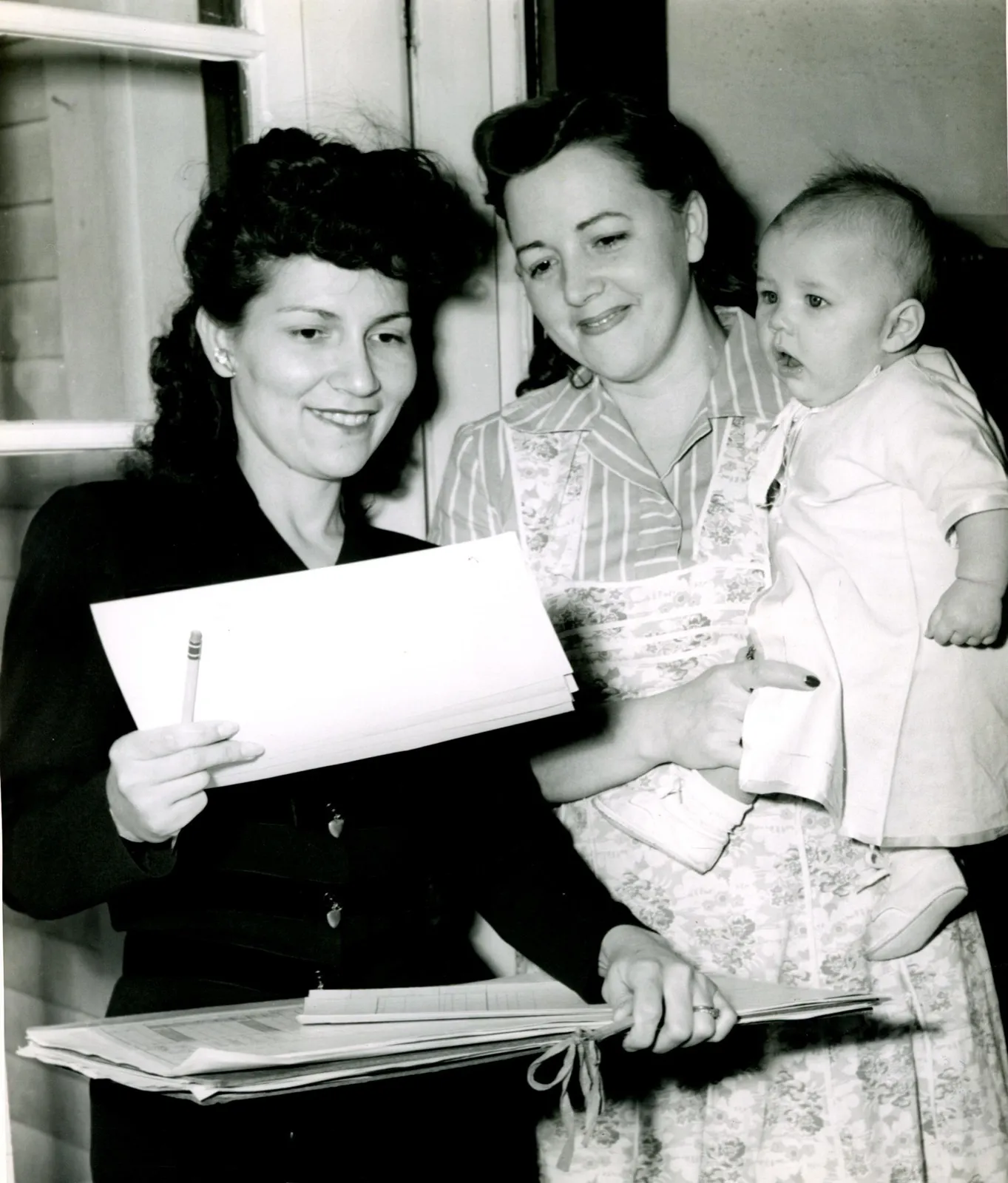 A family takes part in the 1950 United States census. U.S. Census Bureau, April 1950. Public domain.
When I began filming life stories in 2020, I assumed the value would lie mainly in the information. Since then I have filmed more than a hundred of them, including Holocaust survivors and my own grandmother, who has since passed away. I have four hours of her telling me about her life. The facts in that recording would fit on a few pages. What would not fit on any page is the way she told them: her pauses, her laugh, the way her face changed when she talked about her mother.
A future descendant who finds your tree will see names and dates, as you see the Withrows on that census page. If the tree comes with recordings, they can also see and hear the people who knew those names personally. That is the difference between knowing that you had sixteen great-great-grandparents and knowing anything at all about them. It is also, for most of history, a difference no family could bridge. Even a few minutes of film of an ancestor from the 1880s would be among the most treasured things a family could own.
What if your relatives do not want to talk?
Some will hesitate. Many older people assume their lives are ordinary and that no one could be interested. Framing helps: you are building the family tree and need their help, which is true, and it is usually easier to agree to than “I would like to interview you about your life”. Start with factual questions about other people, such as their parents and grandparents, and the personal stories tend to follow on their own. There is more on this in how to get a parent to talk about their past.
Keep the sessions short, half an hour or so, and come back. Memory works by association, and one conversation often brings back material for the next.
The tree you leave behind
Every family tree eventually becomes a document about its maker as well. The person who builds it today will, in a few generations, be one of the names on it.
So the last step in starting a family tree is to add yourself properly: not just a name and a date, but some account of who you were, ideally in your own face and voice. We built Everyone, a free app for filming family stories on video one question at a time, partly with this in mind. It works as well for interviewing a grandparent this weekend as for recording your own answers for the people who will one day look you up.
The archives will wait for you. Your oldest relatives will not. Begin with them.