
How to get a parent to talk about their past, when they say there is nothing to tell.
Why reluctant parents refuse to be interviewed, and the ways of asking that actually work: asking for a favour, starting small, and leaving the hard years alone.

In 1771, staying at the country house of a friend in Hampshire, Benjamin Franklin sat down to write a letter to his son William. He was sixty-five, one of the most famous men in the English-speaking world, and he began, with some modesty, by saying that he had always enjoyed hearing small stories about his ancestors, and that he supposed his son might feel the same about him. The letter grew into the book we now call his Autobiography, one of the most widely read memoirs ever written.
Franklin is a useful figure for anyone wondering how to get a parent to talk about their past, because he was not reluctant, and almost everyone else is. Most people who sit down to record a parent, or hope to, meet the same sentence: there is nothing to tell. Franklin needed no persuading. He had an audience in mind, a reason to write, and a belief that his life was worth the trouble. Take away any one of the three and you have the ordinary parent, who says no to the camera and means it.
This essay is about those three missing pieces, and why supplying them works better than argument.
Why do parents say there is nothing to tell?
It is tempting to read the refusal as shyness or stubbornness. In my experience it is neither. It is a mistaken calculation, and a quite reasonable one.
A life you have lived is the opposite of a story. From the inside it is a long run of days, most of them unremarkable, each one explained by the one before. Nothing in it announces itself as unusual, because you were there for all of it, and what you were present for tends to look inevitable. The man who grew up without electricity, walked to a school four miles away and left home at fifteen to find work does not think of this as a tale. He thinks of it as Tuesday. The strangeness is visible only from a distance, and the distance belongs to the people who come after him.
That is the first thing to understand. When a parent says their life was ordinary, they are accurately reporting how it feels. What they cannot feel is how it will look to a granddaughter in 2060, for whom the details they find tedious (the price of bread, the sound of the machine in the factory, what a first date involved) will be as foreign as ancient Egypt.
Two other reasons are common, and they are different in kind:
- The role is uncomfortable. Being interviewed puts a person on display. They are the subject, being watched, with every answer open to judgement. Many people, especially of older generations, were taught that talking about yourself at length is vanity.
- Some of it hurt. A parent who lived through war, migration, poverty or loss may have good reasons to leave it alone. Many survivors of the twentieth century’s catastrophes said little for decades, and some never spoke at all.
Each reason calls for a different response, which is why a single script (“please, it would mean so much”) fails so often.
Why does asking for a favour work?
Franklin left us a small piece of psychology that fits this problem. In his Autobiography he describes a rival in the Pennsylvania legislature who had taken a dislike to him. Rather than flatter the man, Franklin wrote to ask whether he might borrow a rare book from his library. The man lent it. Franklin returned it a week later with a note of thanks, and they became friends for life. He drew the lesson in a maxim: a person who has once done you a kindness will be readier to do you another than someone you have yourself obliged.
Whether the mechanism is what Franklin thought it was, the practical lesson holds. People tend to like those they have helped, and they find it easier to help than to be the centre of attention. Compare two requests:
- “I would like to interview you about your life.”
- “I need your help. I want the kids to know what this family was like, and you are the only one who can tell them.”
The first makes the parent the subject. The second makes them the expert and the interviewer the beneficiary. Nothing about the sitting has changed, but the role has flipped from being examined to doing something useful, and for a modest, unassuming person that is the difference between refusing and agreeing.
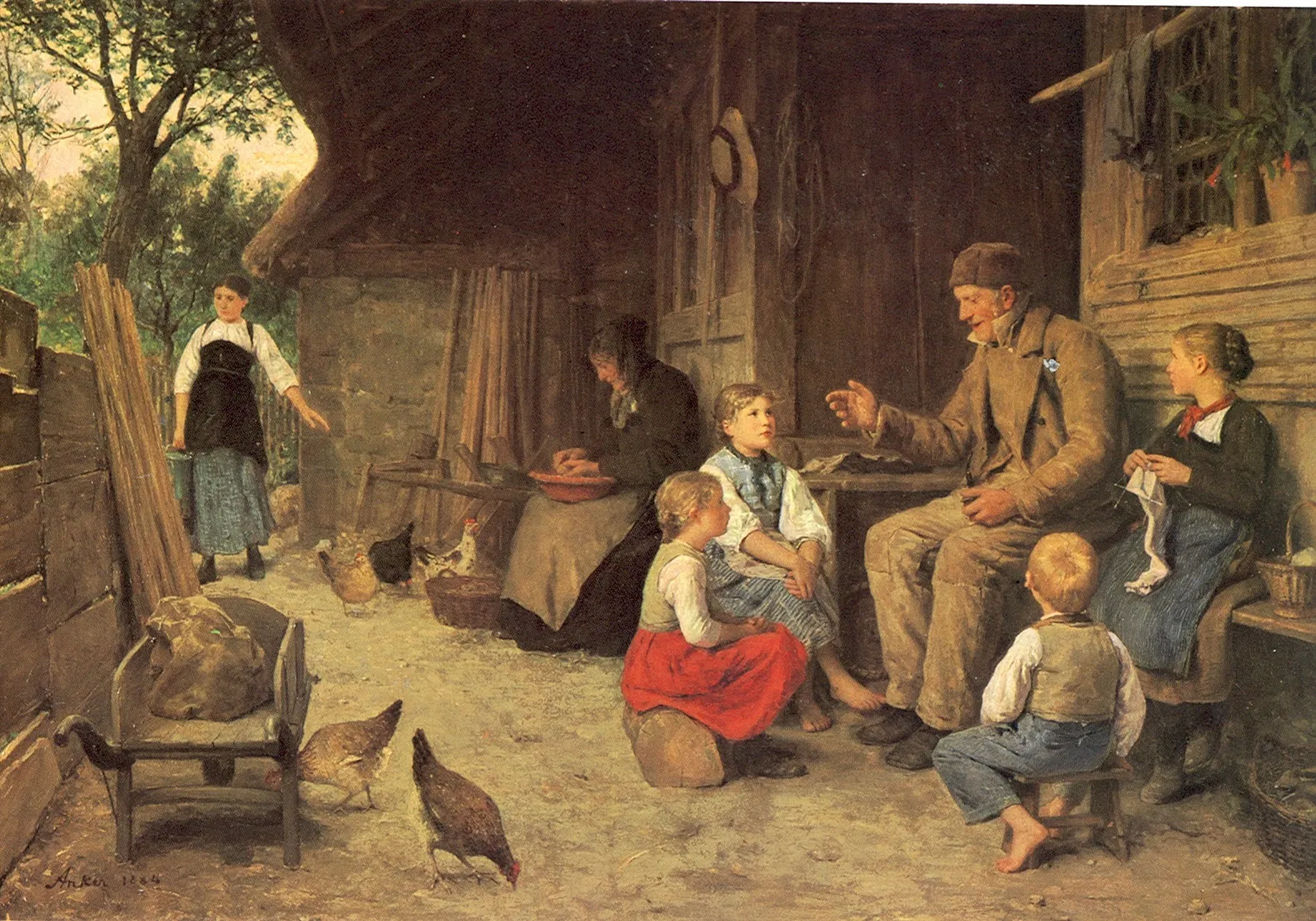 “Grandfather Tells a Story” by Albert Anker, 1884. Public domain.
It helps to name a particular audience. “For the family” is vague. “For Mia, who is six and will never meet your mother” is something a person can picture. The most persuasive thing you can offer a reluctant parent is a specific descendant who is waiting.
How do you make the first yes small?
The second mechanism is older than any family. In 1966 the psychologists Jonathan Freedman and Scott Fraser reported an experiment in which householders were asked to put a large, ugly “Drive Carefully” sign on their front lawn. Very few agreed. But among those who had first been asked to display a small sticker or sign in a window, and had said yes, roughly three-quarters later agreed to the huge one. The finding, now called the foot-in-the-door effect, has been replicated in many forms. A small commitment changes how people see themselves: they become the sort of person who helps.
Applied to a family interview, this means never asking for the whole thing. A parent who hears “a full life story on camera” hears hours of exposure and imagines a formal occasion. A parent who hears “ten minutes, one photograph, and you can stop whenever you like” is being asked to do something they can manage.
A workable ladder looks like this:
- Ask about an object. Put a photograph, a medal or an old recipe card on the table and ask only about that.
- Ask for one story. “Tell me how you and Dad met” is a single, bounded request.
- Film it only if they are comfortable. Many people say yes to talking and no to a lens. Begin with the conversation, and raise the camera once it is a habit.
- End on time. If you said ten minutes, stop at ten, even when they are in full flow. A person who has been trusted to stop is a person who agrees to start again.
The second session is usually easier than the first, and the third is often a pleasure. By then the parent has noticed that the sky did not fall, and that someone found the details interesting.
What if the reluctance is about something painful?
Persuasion has a limit, and it is worth being clear where it lies. If a parent’s silence protects a real wound, the right response is not a cleverer approach but a different question.
Offer them control. Say plainly that there are subjects off the table, and that they decide which. Ask first about the parts of life they enjoy telling: food, work, the street they grew up on, the songs they knew. The hard years often arrive on their own, later, once trust is established, or they never do. Either is acceptable. A recorded account of a kitchen, a trade and a marriage is not a lesser record because the war is missing from it. And do not ask for the painful material in the first sitting, or on camera before they have agreed to be filmed at all.
It also helps to have someone other than a child do the asking. Many older people find it easier to tell a grandchild than a son or daughter, perhaps because a grandchild asks out of curiosity and carries no history of disagreement. A cousin, a niece or a friend of the family can do the same job. If you are the obvious interviewer and it is not working, the best thing you can do is hand the questions to someone else.
When is the right time to ask?
Soon, and then again later if the answer is no. A refusal today is not a refusal permanently. Circumstances change: a birth in the family, a birthday, a funeral, a house being sold and a lifetime of objects being sorted. These are the moments when people become aware of their own history, and when a request that was brushed aside in March may be welcomed in October. I wrote about the other side of the equation in questions I wish I had asked my parents: the people who regret most are usually those who waited for a perfect moment, not those who asked clumsily.
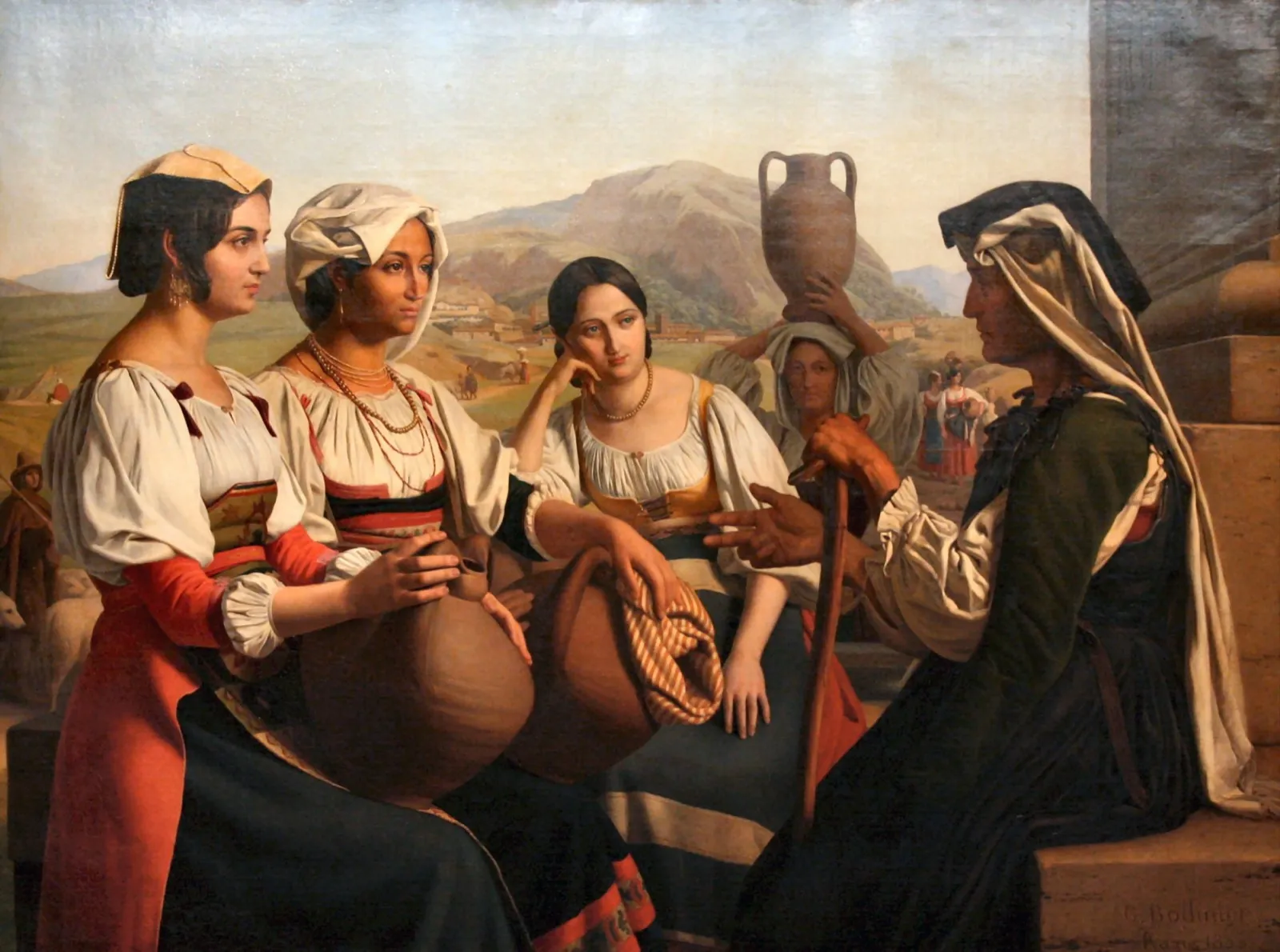 “Three Women at the Fountain Listening to an Old Woman” by Guillaume Bodinier, 1832. Public domain.
What are you really asking for?
Underneath all of this is a simple observation. Parents who refuse to be interviewed are rarely refusing to be remembered. Most of us want it quietly, and the evidence is everywhere, from the graffiti at Pompeii to the line on a gravestone in the Victorian goldfields town of Whroo, which asks the passer-by to “Remember me as you pass by”. What a reluctant parent is refusing is the performance: the lights, the questions, the sense of being judged. Take the performance away, and the wish underneath is usually still there.
So the job is not to talk them round. It is to make the telling feel like something they are giving rather than something being taken, in sittings small enough to be easy, on subjects of their choosing, for a listener they can picture. The practical side, from the room to the questions, is covered in how to interview older family members and how to film an interview at home.
Franklin wrote his story because he trusted that his son would want it, and he wrote it with a particular reader in mind. Most of our parents will do the same if we can show them the reader. A short video, filmed on a phone and kept somewhere safe, is enough, and Everyone was built around that idea: small recordings, each one made for a particular person. The telling matters more than the tool. The only part that cannot be postponed is the asking.


