
You have 16 great-great-grandparents. Can you name them?
Most people cannot name a single great-grandparent. Why your great-great-grandparents were forgotten so quickly, how to find them, and what it means for you.
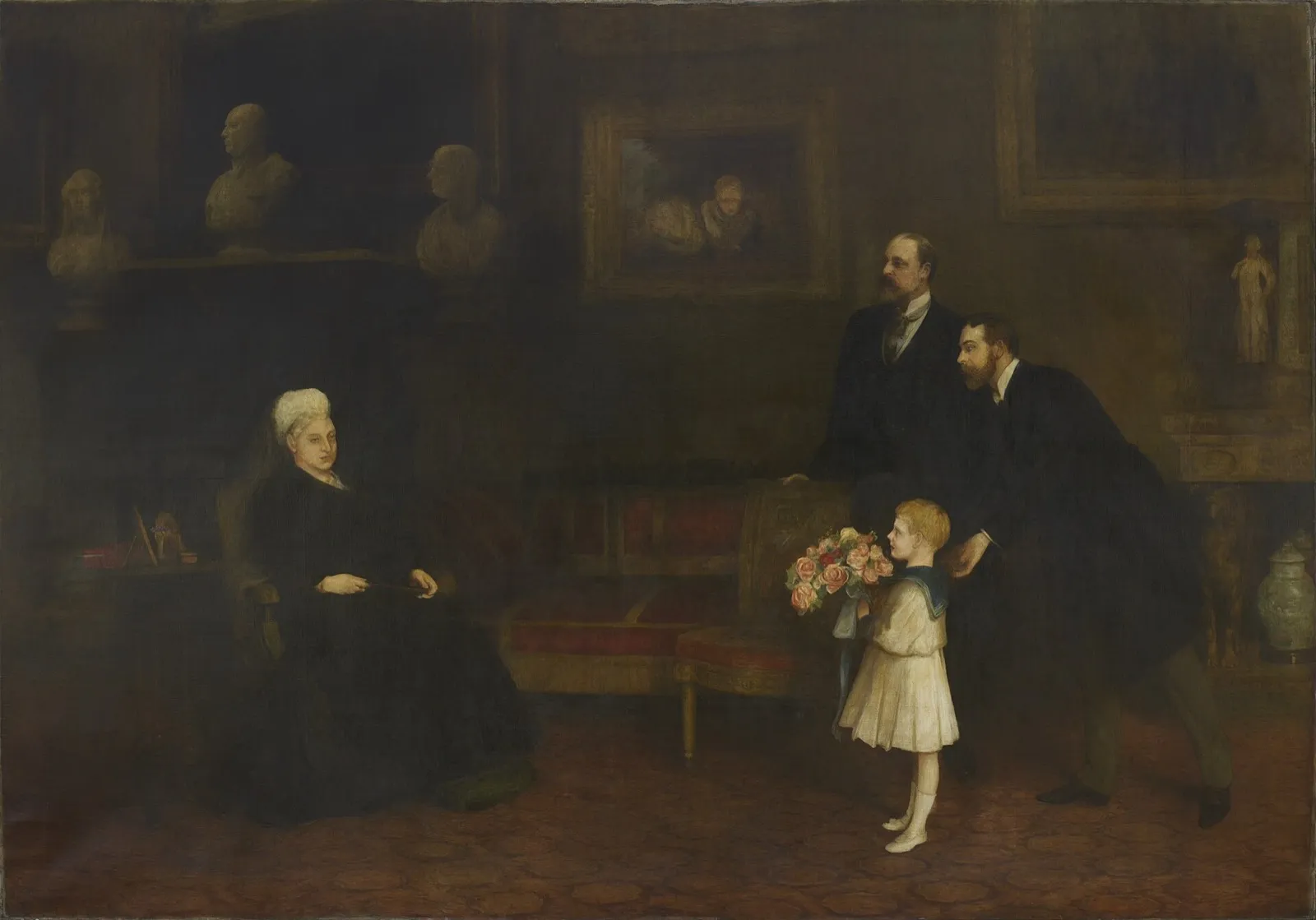
In 2007 the National Trust asked almost two thousand people in Britain to name their great-grandparents. More than half, 57 per cent, could not name a single one. Another 14 per cent could name only one. A later survey of Americans for Ancestry found that fewer than half could name all four of their grandparents, and only 4 per cent could name all eight great-grandparents.
Go back one more generation and the picture is starker still. Everyone alive has sixteen great-great-grandparents. Each of them was as real as you are: they had a favourite food, a laugh people recognised across a room, opinions about their neighbours, and some private fear they rarely mentioned. Most of us could not name one of the sixteen, let alone say anything about them.
This is usually treated as a gap in general knowledge, the kind of thing a genealogy website can fix. I think it says something more interesting about how memory works in families, why it fails so reliably after about a century, and what has changed that would let the next generation do better.
How many great-great-grandparents do you have?
The arithmetic is simple and quickly becomes strange. You have two parents, four grandparents, eight great-grandparents and sixteen great-great-grandparents. Each generation back, the number doubles.
Ten generations back, roughly three centuries, you have 1,024 ancestor positions to fill. Twenty generations back, more than a million. Thirty generations back, around the time of the Norman conquest, the number passes a billion, which is more people than were alive on Earth at the time.
The resolution is that the same people fill many slots. Distant cousins married, often without knowing it, so a single person can appear in your family tree hundreds of times. Genealogists call this pedigree collapse. Pushed far enough, it produces a startling result. A 2004 study in Nature by Douglas Rohde, Steve Olson and Joseph Chang modelled human ancestry and concluded that the most recent common ancestor of everyone alive today may have lived only a few thousand years ago. Go back somewhat further and, on their model, every person then alive was either an ancestor of everyone living now or of no one.
For great-great-grandparents, there is usually no collapse. Sixteen slots, sixteen different people.
How much of you comes from them?
Genetically, each great-great-grandparent contributed on average about one-sixteenth of your DNA, a little over 6 per cent. The real share varies, because chromosomes are shuffled and split each generation, but at this distance you almost certainly carry something from all sixteen.
That stops being true surprisingly soon. The geneticist Graham Coop has calculated that nine generations back, there is roughly a 30 per cent chance that any particular ancestor passed on no detectable DNA to you at all. Twelve generations back, the chance is over 80 per cent. You are their descendant in every genealogical sense, and they left no physical trace in you.
So it is not only stories that fade; biology forgets too, just more slowly. Your great-great-grandparents sit at an interesting point: close enough that you still carry part of each of them, far enough that nobody remembers who they were.
When were your great-great-grandparents born?
The anthropologist Jeffrey Fenner estimated in 2005 that the average generation in developed countries is about 31 years for men and 27 years for women. Four generations back therefore lands somewhere around 110 to 125 years before your own birth.
If you were born in 1990, your great-great-grandparents were most likely born somewhere between the 1850s and the 1880s. Several of them may have been photographed. Cheap card portraits called cartes de visite became a craze in the 1860s, and many families still have a few in a shoebox or album.
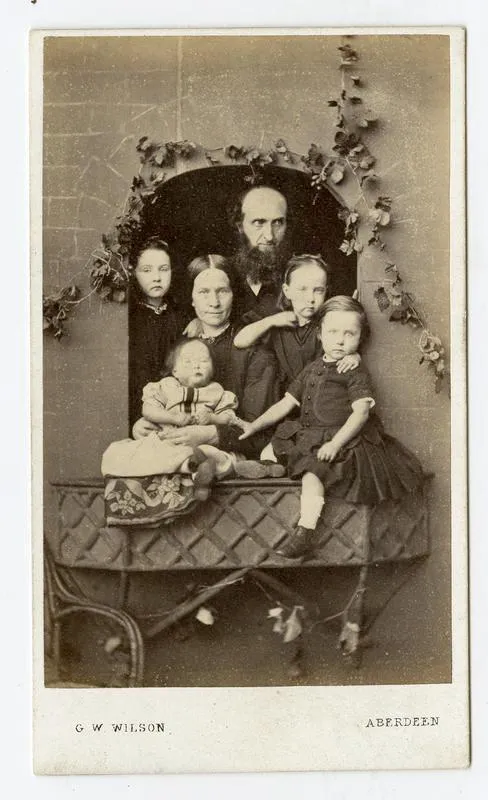 Carte de visite of an unidentified family, photographed by George Washington Wilson in Aberdeen in the 1860s. Aberdeen Archives, Gallery and Museums. Public domain.
The photograph above is typical, and so is its label: unidentified family. Someone paid for this portrait so that the moment would last. The image survived. The names did not. These children are almost certainly somebody’s great-great-grandparents, and their descendants have no idea.
That is the paradox of the generation just beyond living memory. We often have their faces. We almost never have their voices, and rarely their stories.
Why are great-great-grandparents forgotten so quickly?
The Egyptologist Jan Assmann drew a useful distinction between two kinds of memory. Cultural memory is formal and deliberate: monuments, scripture, archives, history books. Communicative memory is everyday and informal: what people remember because someone they knew told them. Assmann estimated that communicative memory reaches back roughly 80 to 100 years, or three to four generations, before it fades.
Family memory is almost entirely communicative. It travels by overlap. You knew your grandparents; with luck, your grandparents knew theirs. Each link is a conversation, and every conversation passes on only a fraction of what the teller knew.
Your great-great-grandparents usually sit just past the end of that chain. Most were dead before you were born, often before your parents were born. Nobody alive has heard their voice.
There is also a problem of division. A family story tends to follow one line: the surname, the side that kept the photographs, the branch with a talker in it. With sixteen great-great-grandparents, the attention of a family is split sixteen ways, and most lines receive none of it. It is common to know a great deal about one ancestor and literally nothing about the other fifteen.
Who used to remember their ancestors?
For most of history, remembering several generations back was a privilege of the powerful. Aristocratic families commissioned genealogical trees like the one below, painted for the Velluti, a patrician family of Florence. A fourteenth-century member of the family, Donato Velluti, wrote a Cronica domestica (household chronicle) recording his relatives’ marriages, quarrels and deaths; a descendant was still adding to it two centuries later.
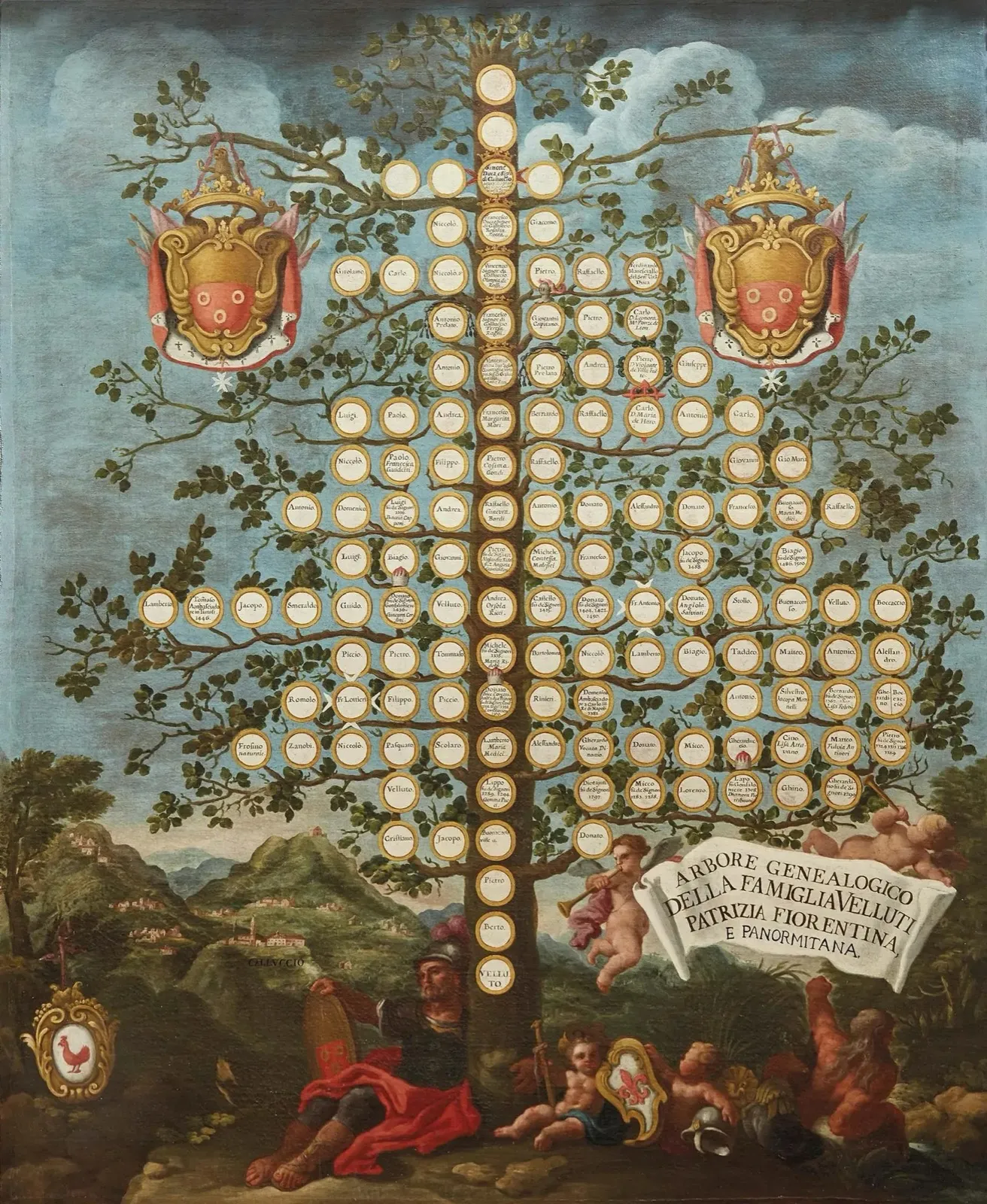 Genealogical tree of the Velluti family of Florence, Tuscan school, 17th–18th century. Public domain.
Such families remembered their ancestors because they had property, titles and the money to pay painters and scribes. Ordinary families had a parish register, perhaps a family Bible, and whatever the grandparents chose to tell. A name entered in a register at a baptism, a marriage and a burial was, for most people, the entire written record of a life.
It is the same pattern I described in the history of storytelling: until very recently, being remembered beyond your grandchildren required wealth or fame. For everyone else, it required luck.
How do you find the names of your great-great-grandparents?
The names, at least, can usually be recovered. A practical sequence:
- Ask your oldest living relatives first. They are the last link in the communicative chain, and they often know names, places and nicknames that no record will give you. Write everything down, and better still, film the conversation.
- Gather what is already in the house. Certificates, letters, family Bibles, funeral cards, and photographs with writing on the back.
- Work backwards through birth, death and marriage records. Each certificate tends to name parents, which gives you the next generation. In Australia these are held by state registries, and many historical indexes can be searched online.
- Use census returns where they survive. In England and Wales, censuses from 1841 onwards list everyone in each household by name, up to 1921, which was released in 2022. Australia is less fortunate: most of its historical census forms were deliberately destroyed, and a fire in 1882 destroyed the household returns from the 1861, 1871 and 1881 censuses of New South Wales.
- Search old newspapers. Obituaries, funeral notices and family announcements often fill gaps. In Australia, the National Library’s Trove database has digitised millions of newspaper pages.
- Treat DNA tests as confirmation, not explanation. They can show that you are related to someone. They cannot tell you who your ancestor was.
With patience, most people can name all sixteen, and it is worth doing. But the result will be sixteen names, sixteen sets of dates, perhaps an occupation and an address. That is a family tree, not a family.
What does a name not tell you?
Records were designed for administration: who was born, who married, who owed tax. They were never meant to capture what a person was like.
The research on family stories points the same way. Marshall Duke and Robyn Fivush at Emory University found that children who knew more about their family’s history tended to be more resilient and have higher self-esteem. What their questions measured was not the ability to recite names. It was stories: how the parents met, where the grandparents grew up, what went wrong and how the family got through it. (I wrote about their work in questions to ask your parents about their life.)
I have four hours of my grandmother telling me her life story. She has since passed away. When I watch it, the information is the least of it. What matters is the way she paused before certain answers and laughed at her own jokes. No certificate could have given me that, and none of my great-great-grandparents left anything like it.
Who will be able to name you?
There is a symmetry here that is easy to miss. In roughly a century, someone will be born for whom you are one of sixteen great-great-grandparents. By default, you will be to them what your own great-great-grandparents are to you: a name in a database, if they look, and perhaps a face in a photograph whose caption has been lost. (Digital photographs fare no better, as I argue in what happens to your photos when you die.)
The reason that happens is not that families stop caring. It is that family memory has always depended on a chain of people retelling stories, and the chain breaks after three or four links. Every previous generation was subject to that limit. We are the first that is not, because a story recorded on video does not need anyone to retell it. It does not fade by a fraction with each telling, and it carries the voice and face along with the facts.
The practical step is modest. Ask your oldest relatives the questions that their great-great-grandchildren would want answered, and film the answers. Then record some of your own. If it helps to have the questions laid out one at a time, that is what Everyone was built for; this guide to capturing a life story covers the rest. Your descendants will have sixteen great-great-grandparents too. There is no reason you need to be one of the ones they cannot name.


