
The oldest stories in the world, and how they survived.
The first stories humans wrote down were about death, friendship and a parent’s advice to a child. How they survived 4,000 years is a story in itself.
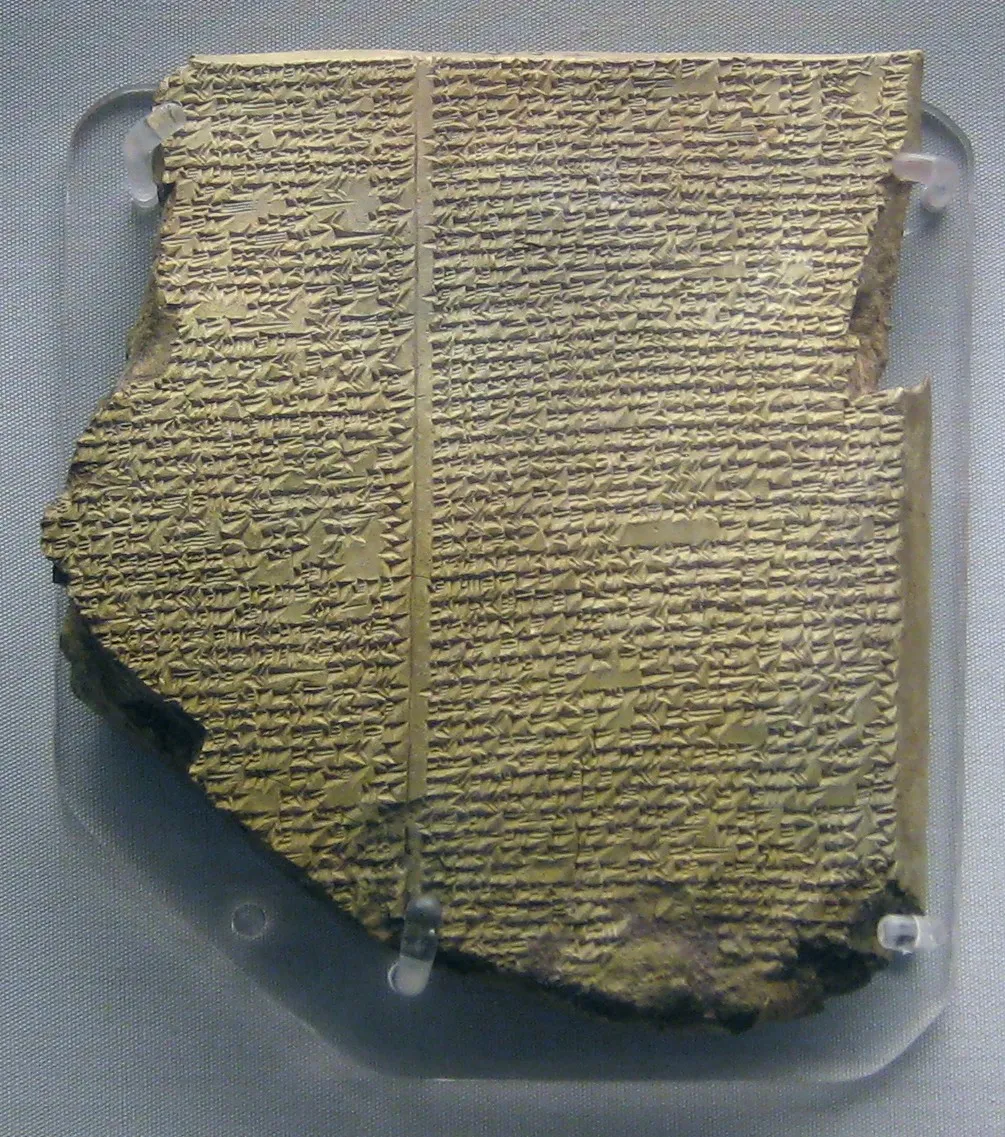
In 1872, a young assistant at the British Museum named George Smith was sorting through fragments of clay tablets that had been shipped to London from the ruins of Nineveh, in what is now northern Iraq. Smith had taught himself to read cuneiform, the wedge-shaped script of ancient Mesopotamia, and he was one of very few people alive who could.
On one fragment he found a story about a man warned by a god of a coming flood. The man builds a boat, loads it with his family and animals, and survives the deluge. When the rain stops, he releases a dove, then a swallow, then a raven, to see whether the waters have receded.
Smith realised he was reading a flood story that predated the written Book of Genesis. According to an account by a colleague, he was so overcome that he jumped up and began pacing the room in great excitement, and started to remove his clothes.
The fragment was part of the Epic of Gilgamesh, one of the oldest stories ever written down. It had been lost for nearly two thousand years. Its survival, and that of the handful of stories as old as it, depended on a remarkable chain of luck, durability and repetition.
What are the oldest stories we know?
The oldest stories are certainly older than writing. They were spoken and sung for tens of thousands of years before anyone recorded them, and almost all of them are gone.
Some oral traditions appear to have lasted extraordinarily long. Researchers have argued that certain Aboriginal Australian stories describe coastlines flooded by rising seas more than 7,000 years ago. A 2016 study that traced the family tree of European and Asian folktales suggested that one, known as The Smith and the Devil, may be around 6,000 years old.
The oldest stories that were actually written come from Sumer, in southern Mesopotamia, where writing developed around 5,000 years ago. Among the earliest:
- The Instructions of Shuruppak, from roughly 2500 BCE, in which a father gives advice to his son. It is one of the oldest surviving pieces of literature in the world.
- The hymns of Enheduanna, a high priestess in the city of Ur around 2300 BCE and the daughter of the king Sargon of Akkad. She is the earliest author in history whom we can identify by name.
- The Gilgamesh poems, Sumerian stories about a king of Uruk, first written down around 2100 BCE and later woven by Babylonian scribes into a single epic.
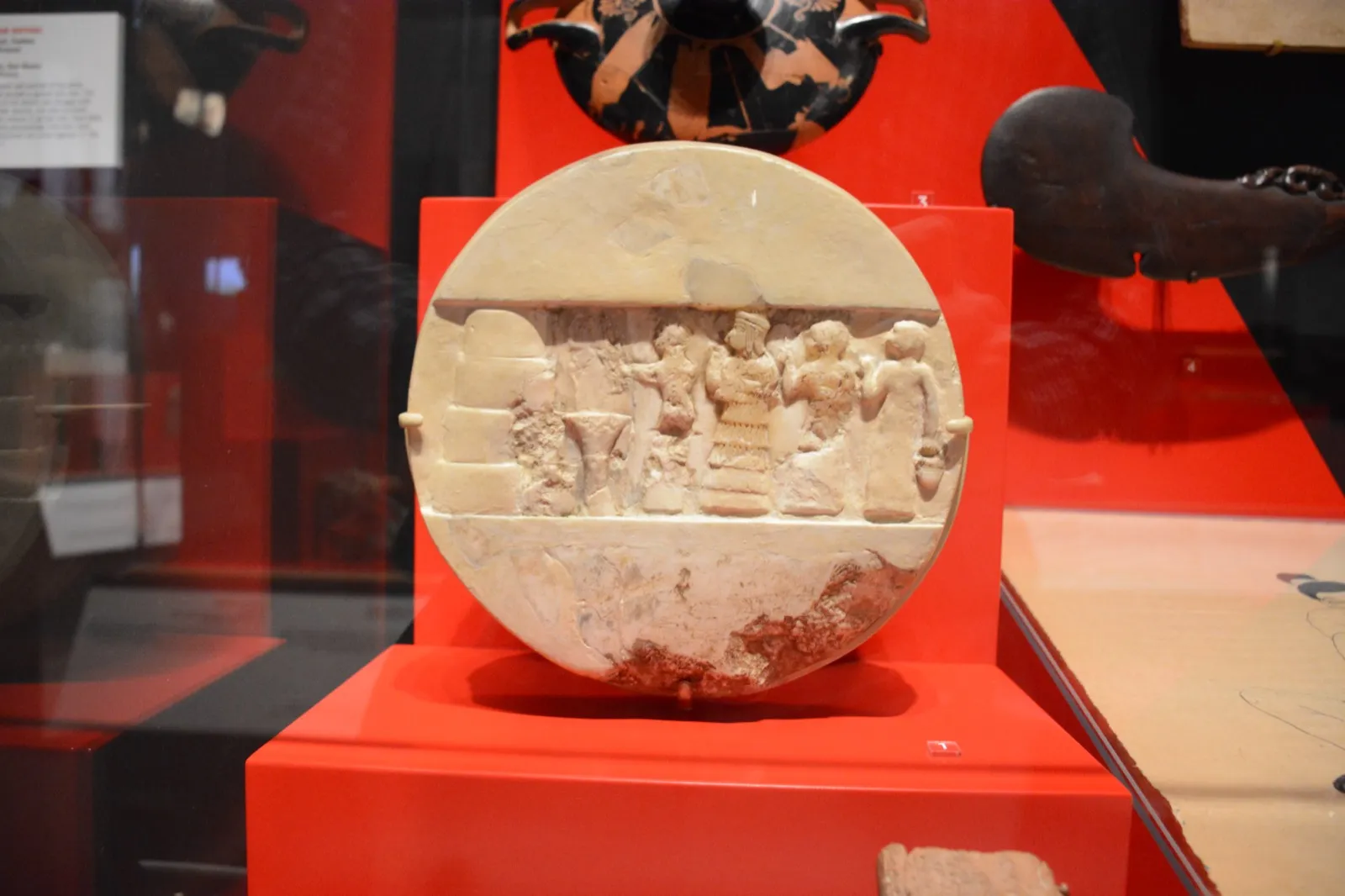 The Disk of Enheduanna, about 2300 BCE. Penn Museum, Philadelphia. CC0.
What are these stories about?
It would be reasonable to expect the oldest literature to be alien to us: concerned with rituals, gods and political legitimacy that have no modern equivalent. Some of it is. But the central themes are disconcertingly familiar.
The Epic of Gilgamesh is, at its core, a story about friendship and grief. Gilgamesh is an arrogant king who meets his equal, the wild man Enkidu. They become inseparable and go on adventures together. Then Enkidu dies, and Gilgamesh is devastated. He refuses to let his friend be buried until he sees a worm fall from Enkidu’s nose. Confronted with the physical reality of death, he becomes terrified of his own, and sets out across the world to find the secret of eternal life.
He fails. He finds a plant that can restore youth, and a snake steals it while he bathes. He returns home with nothing. The epic ends with Gilgamesh showing a companion the great walls of his city, Uruk, inviting him to admire the brickwork. The implication is that the only immortality available to a person is what they leave behind.
In one older version of the epic, Gilgamesh meets a tavern keeper named Siduri, who tells him that eternal life is reserved for the gods. Her advice, roughly paraphrased, is to eat well, celebrate, wear clean clothes, cherish the child who holds your hand, and delight in the embrace of your partner. Four thousand years ago, the answer to the fear of death was already: pay attention to the people you love.
The Instructions of Shuruppak are more practical. A father tells his son not to buy a donkey that brays, not to place a field beside a road, not to make rash promises and not to speak arrogantly. It reads, in places, like advice from a grandparent at the kitchen table. That is worth dwelling on. One of the oldest pieces of literature humanity possesses is an older generation passing what it has learnt to a younger one.
How did they survive?
Most ancient writing did not survive. The stories that did share several characteristics.
A durable medium
Mesopotamian scribes wrote on clay, pressing a reed stylus into wet tablets. Clay is cheap, heavy and unglamorous, and it is also nearly indestructible once it has been fired.
This produced one of history’s great ironies. The largest collection of Gilgamesh tablets comes from the library of the Assyrian king Ashurbanipal at Nineveh. In 612 BCE, an alliance of Babylonians and Medes sacked the city and burned it. The fire that destroyed the palace baked the unfired tablets inside it, hardening them. The destruction of the library is a large part of the reason it survived.
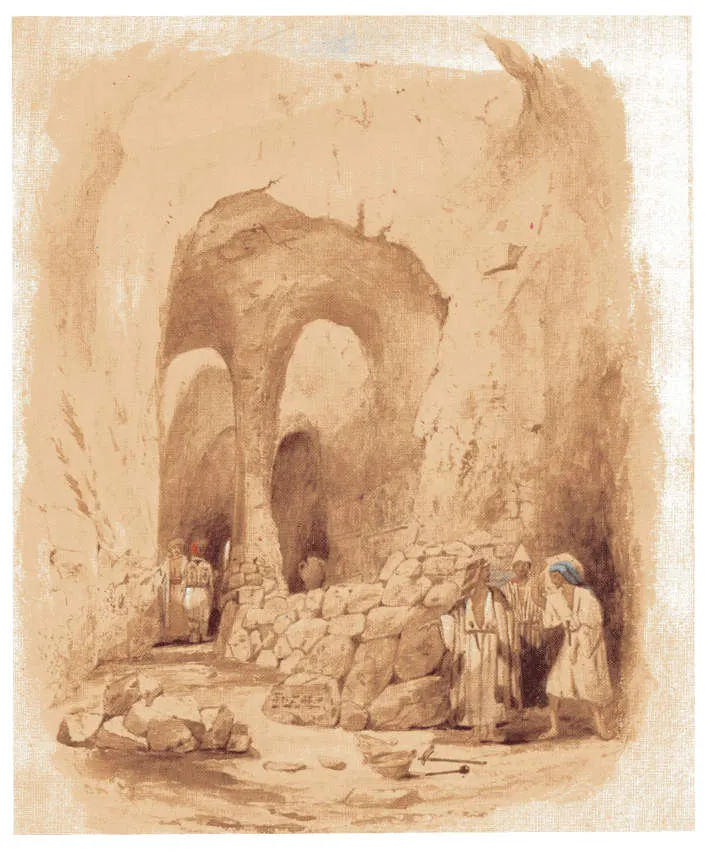 Excavating the South-West Palace of Nineveh. Watercolour by Frederick Charles Cooper, 1849. Public domain.
Compare this with writing on papyrus or parchment, which rots, burns and crumbles unless it is constantly recopied. Of the nine books of poetry by Sappho, perhaps the most admired poet of ancient Greece, only one complete poem survives. The rest exists in fragments and quotations.
Many copies
The second factor was redundancy. Mesopotamian scribes were trained by copying classic texts, and literature such as Gilgamesh was copied again and again in scribal schools across centuries. Many surviving fragments are students’ exercises. A story that exists in a hundred copies has a hundred chances to survive; a story in one copy has one.
Burial, then rediscovery
Cuneiform eventually fell out of use. The last datable tablets were written in the first century CE, and after that no one could read the script. The stories were not destroyed so much as buried and forgotten, preserved underground in the ruins of cities until European and local excavators began digging at sites like Nineveh in the 1840s and 1850s. Scholars then had to decipher the script before the texts could be read at all. George Smith’s discovery came only after that work was done.
Luck, which is still running
The process is not finished. In 2015, a museum in Sulaymaniyah, in Iraqi Kurdistan, published a newly acquired tablet that added around twenty previously unknown lines to the epic, including a description of the forest where Gilgamesh and Enkidu travel, full of birdsong, cicadas and monkeys. A story written down four thousand years ago is still, slowly, being recovered.
Why do they matter now?
The oldest stories matter for two reasons.
The first is what they say. They are the earliest direct evidence of what human beings cared about, and the answer is consistent across four millennia: love, friendship, loss, the fear of death, and the desire to pass something on to the next generation. Reading Gilgamesh mourn Enkidu is a reminder that the emotional core of human life has changed far less than its circumstances.
The second is how they survived, because the same rules apply to us. A story survives if it is recorded on a durable medium, if copies exist in more than one place, and if someone in the future cares enough to look for it.
On those criteria, much of what we create today is surprisingly fragile. A Sumerian clay tablet has outlasted the empires that produced it. A video on a phone can be lost with the phone. The computer scientist Vint Cerf, one of the architects of the internet, has warned that our era risks becoming a “digital dark age”, with vast amounts of material lost to obsolete formats, closed accounts and forgotten passwords.
The people who wrote these stories could not have imagined how far they would travel. The earliest literature we have is, in large part, a father’s advice to his son and a man’s grief for his friend. The stories of your own family belong to the same tradition. They are worth recording, and worth keeping somewhere they can last. (For the longer arc, from campfire to camera, see a short history of storytelling.) If you are wondering where to begin, here is how to capture someone’s life story.


