Questions to ask grandparents with dementia.
What to ask a grandparent or parent with dementia, what never to ask, and why music, photos and old skills reach memories that direct questions cannot.
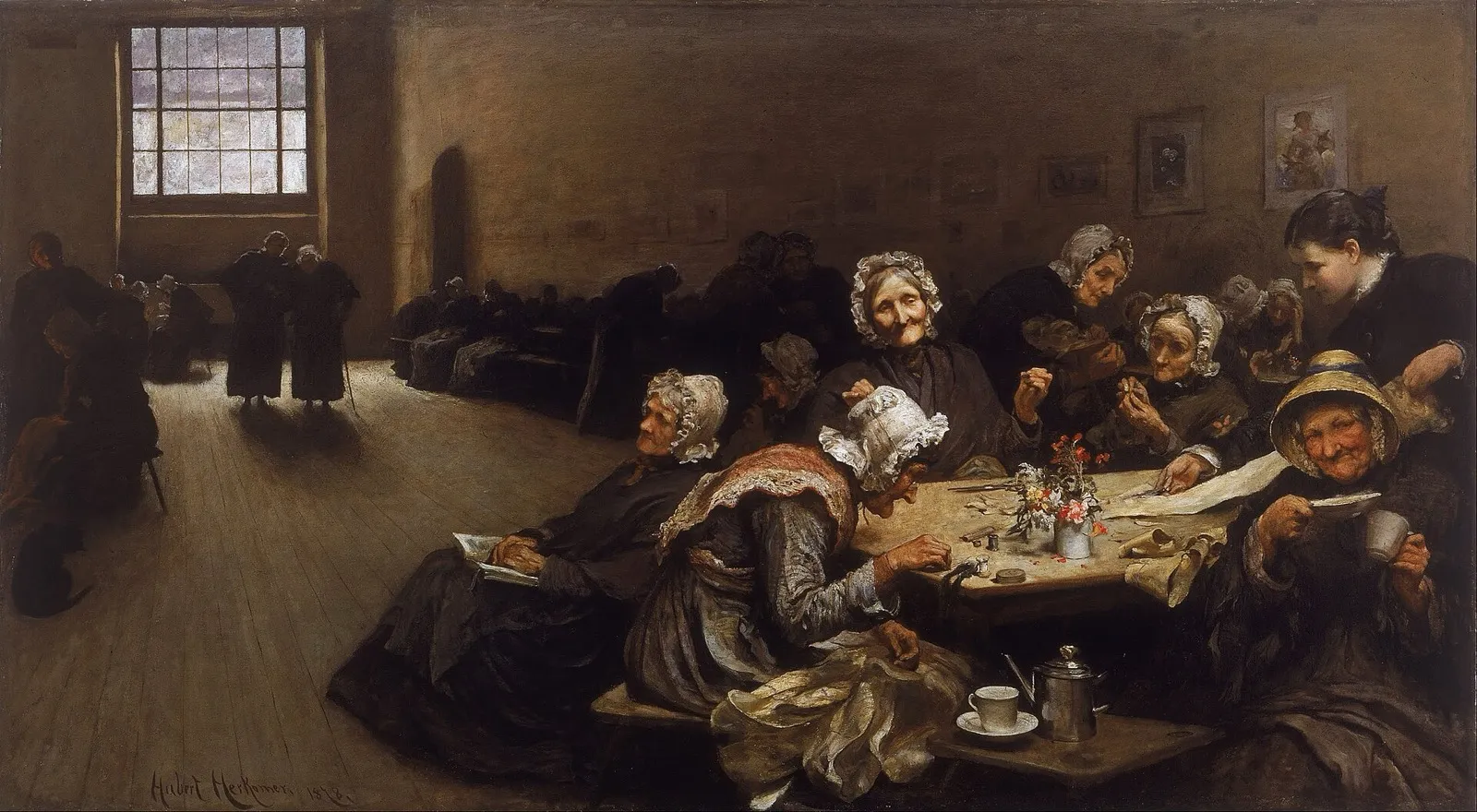
In 1881 the French psychologist Théodule Ribot published a book called Les maladies de la mémoire, translated into English the following year as Diseases of Memory. In it he described a pattern he had noticed in patients whose memory was failing. The losses were not random. The most recent memories went first. Older personal memories lasted longer, general knowledge longer still, and habits and feelings longest of all. The pattern is now known as Ribot’s law. It has exceptions, and neuroscientists still argue about the mechanism, but anyone who has sat with a grandparent with dementia will recognise it: a woman who cannot say what she ate for lunch can describe the kitchen she grew up in.
This has a practical consequence that most families discover by accident. The past is often the last place a person with dementia feels at home. The right questions can take them there. The wrong ones make them feel they have failed a test. This piece is about questions to ask grandparents with dementia, or a parent with dementia, and about the difference between a question that tests and a question that invites.
Why does the past last longer than the present?
The World Health Organization estimates that more than 55 million people are living with dementia worldwide. Alzheimer’s disease, the most common cause, typically begins in and around the hippocampus, the structure the brain uses to lay down new memories. Memories formed decades ago have had years to be rehearsed, retold and woven into many parts of the brain. New ones depend on the very structure that is failing.
Different kinds of memory also fail at different speeds. Recalling a fact on demand, such as a name or a year, is usually among the first abilities to go. Recognising something placed in front of you is easier. Knowing how to do something, such as kneading dough, is stored differently again and often survives long after the person can no longer explain it. Emotional memory, the sense that a song or a person matters, can persist when the details have gone.
The questions that work follow this order. They ask for recognition rather than recall, for feelings rather than facts, and for the distant past rather than the recent one.
What should you never ask?
Most of the mistakes are made with good intentions. They share a structure: they ask the person to retrieve a specific fact and leave them exposed when they cannot.
- “Do you remember…?” Alzheimer’s Society in the UK lists “Remember when…?” among the phrases to avoid, and the Alzheimer’s Association in the United States advises against quizzing. If the answer is no, the question has only demonstrated the loss. Say “I remember when…” instead, and tell the story yourself. They can join in, or simply enjoy hearing it.
- “Who am I?” or “Do you know my name?” This is the same test in its most painful form. Introduce yourself naturally: “Hi Nan, it’s Sarah, your granddaughter.”
- Corrections. If your grandfather says he met your grandmother in 1952 and you know it was 1954, let it stand. You are not compiling a record. You are keeping him company in his own life.
- Too many open questions in a row. “Tell me about your life” is a good question for most people. For someone with dementia it can be overwhelming, because it offers no foothold. Narrow it: one house, one job, one photograph.
Questions to ask grandparents with dementia
The questions below are grouped by the kind of memory they reach. None needs to be asked in order, and one good answer is worth more than ten attempts. Pair each with something they can see, hear or hold.
Questions that start with a photograph or object
- (Holding a wedding photo) Tell me about this day. What was the weather like?
- (Holding an old tool, brooch or recipe card) This was yours. What did you use it for?
- Who is this in the picture? She looks like she was fun.
- (Showing a map or a picture of their hometown) What was this street like when you lived there?
The British gerontologist Tom Kitwood argued in Dementia Reconsidered (1997) that care should protect a person’s “personhood”, their sense of being someone with a history and a place among others. Objects do this better than questions, because the object carries the context the memory can no longer supply.
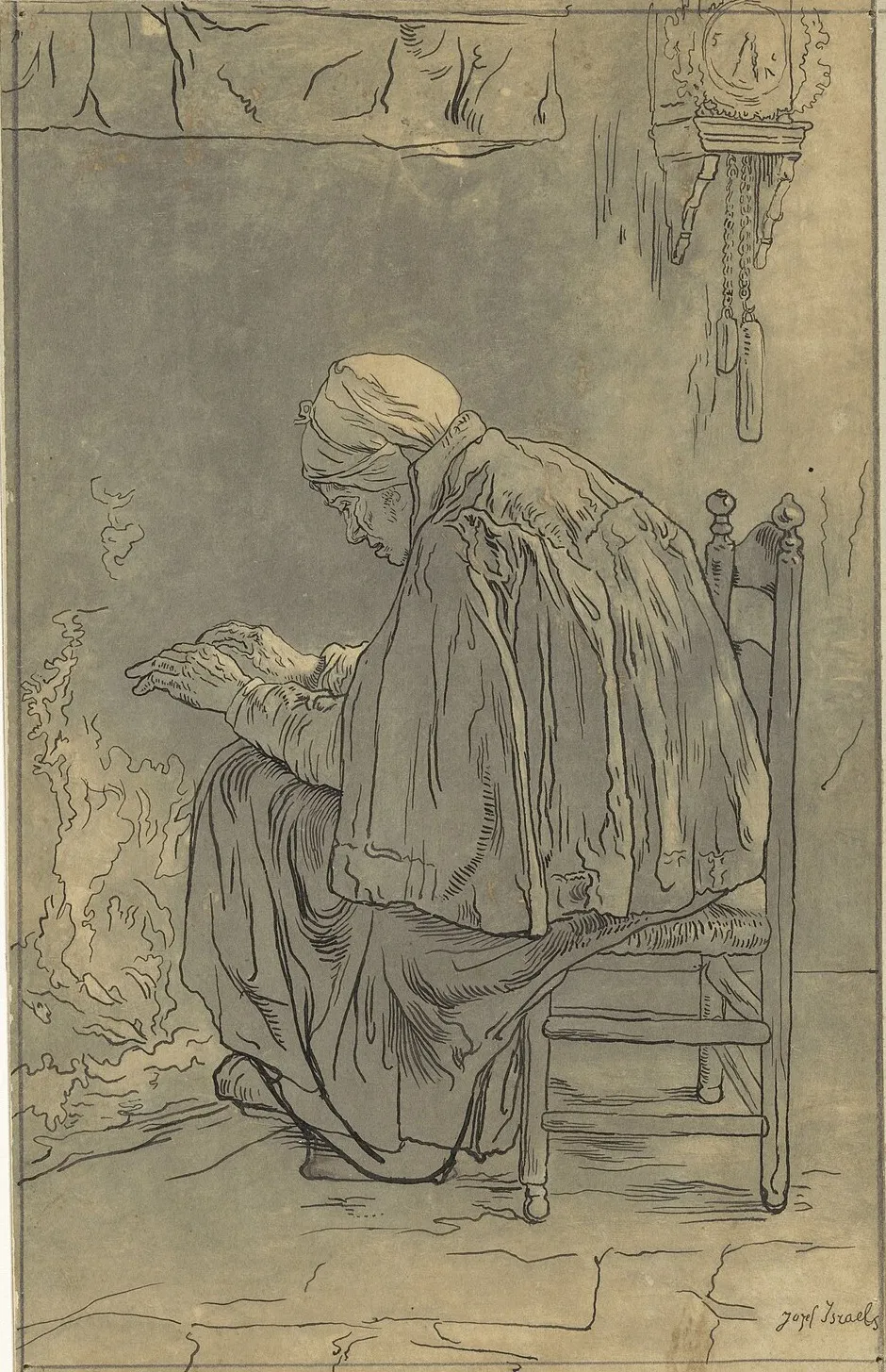 “When One Grows Old” (Als men oud wordt), drawing by Jozef Israëls, before 1911. Rijksmuseum, Amsterdam. CC0.
Questions about the senses
- What did your mother cook on Sundays? What did the kitchen smell like?
- What sound do you associate with the house you grew up in?
- What did you wear to dances when you were young?
- What was the best thing to eat in summer when you were a child?
Sensory questions work because they ask for a feeling rather than a fact. There is no wrong answer to “What did it smell like?”
Questions with music
- (Playing a song from their teens or twenties) Did you dance to this?
- What song did you and Grandpa have?
- What did your father sing?
In 2015 a team led by Jörn-Henrik Jacobsen published a study in the journal Brain suggesting why musical memory so often survives. The regions they found to be involved in recognising long-known music were among those relatively spared by Alzheimer’s disease. Choose songs from roughly their teens and twenties, the years of the reminiscence bump, when most people’s vivid memories cluster.
Questions about skills
- Can you show me how you used to fold a shirt? Plait hair? Shuffle cards?
- How do you make pastry? Show me with your hands.
- What was the hardest part of your job? How did you do it?
A person who cannot describe a skill can sometimes still perform it. Asking to be shown restores the old order of the relationship: the grandparent teaching, the grandchild learning.
Questions about feelings and values
- What makes a good friend?
- What were you proud of when you were young?
- What was your mother like when she was happy?
- What would you tell a young person getting married?
These do not depend on dates or names, and the answers are often the ones families keep.
Questions that use imagination instead of memory
- (Showing a striking old photograph of strangers) What do you think is happening here?
- What do you think this woman is saying to the man?
This group comes from Anne Basting, an American theatre scholar who founded TimeSlips Creative Storytelling in 1998 and was named a MacArthur Fellow in 2016 for it. Volunteering in a nursing home, she found memory exercises fell flat, and began instead asking residents to make up a story about a picture. Freed from the obligation to remember correctly, people who had been silent began to talk, and the stories they invented were often full of their own lives.
Does reminiscence actually help?
The evidence is real but modest, and it is worth being honest about it. A Cochrane review of reminiscence therapy for dementia, led by Bob Woods and published in 2018, found a small improvement in cognition immediately after treatment that did not last, some evidence of benefits to communication and mood, and inconsistent effects on quality of life, with the most promising results in care homes.
That is not the case for a cure. It is the case for a good afternoon. The point of asking is not to slow the disease. It is that a person who spends most of their day being helped, corrected and managed gets, for half an hour, to be the one with something to give.
How do you ask, practically?
The advice in how to interview older family members still applies, with some adjustments.
Choose the time of day carefully. Many people with dementia are more alert in the morning and more confused late in the afternoon. Ask carers when they are at their best.
One question at a time, short sentences, and wait. Processing takes longer. Count to ten before rephrasing. Silence is not failure.
Follow the emotion, not the facts. If your grandmother starts talking about her sister instead of the wedding photo, follow her. If she is speaking to you as though you were her brother, there is rarely any good in correcting her.
Stop while it is going well. Twenty minutes is plenty. Leave on a good note, so the next visit begins with a good feeling even if the visit itself has been forgotten.
Ask early, if you can. In the first years after a diagnosis, many people can still tell long, coherent stories, and can also decide for themselves whether they want them recorded. This is the window that matters most, and it is usually shorter than families expect. The regret described in questions I wish I had asked my parents is common among families of people with dementia for exactly this reason: the conversation was always going to happen next time.
Should you record it?
Recording someone with dementia raises a real question of consent, and it deserves a careful answer. Ask them while they can understand what you are asking. Involve whoever holds their power of attorney. Keep the recording within the family, and never film someone in distress.
Done with that care, recording is worth it for two reasons. The first is that a story told clearly this year may be fragments next year. The second is that a video keeps more than the answers. My grandmother has since passed away. I have four hours of her telling me her story, and what I value most in them is not the facts but her face while she told them. For a grandparent with dementia this matters even more, because their face when a song from 1955 begins to play is something no transcript could hold.
A phone propped on a table at eye level, in a quiet room with the television off, is enough. Apps such as Everyone are designed around one question at a time, which suits short sessions well, but the camera already in your pocket will do.
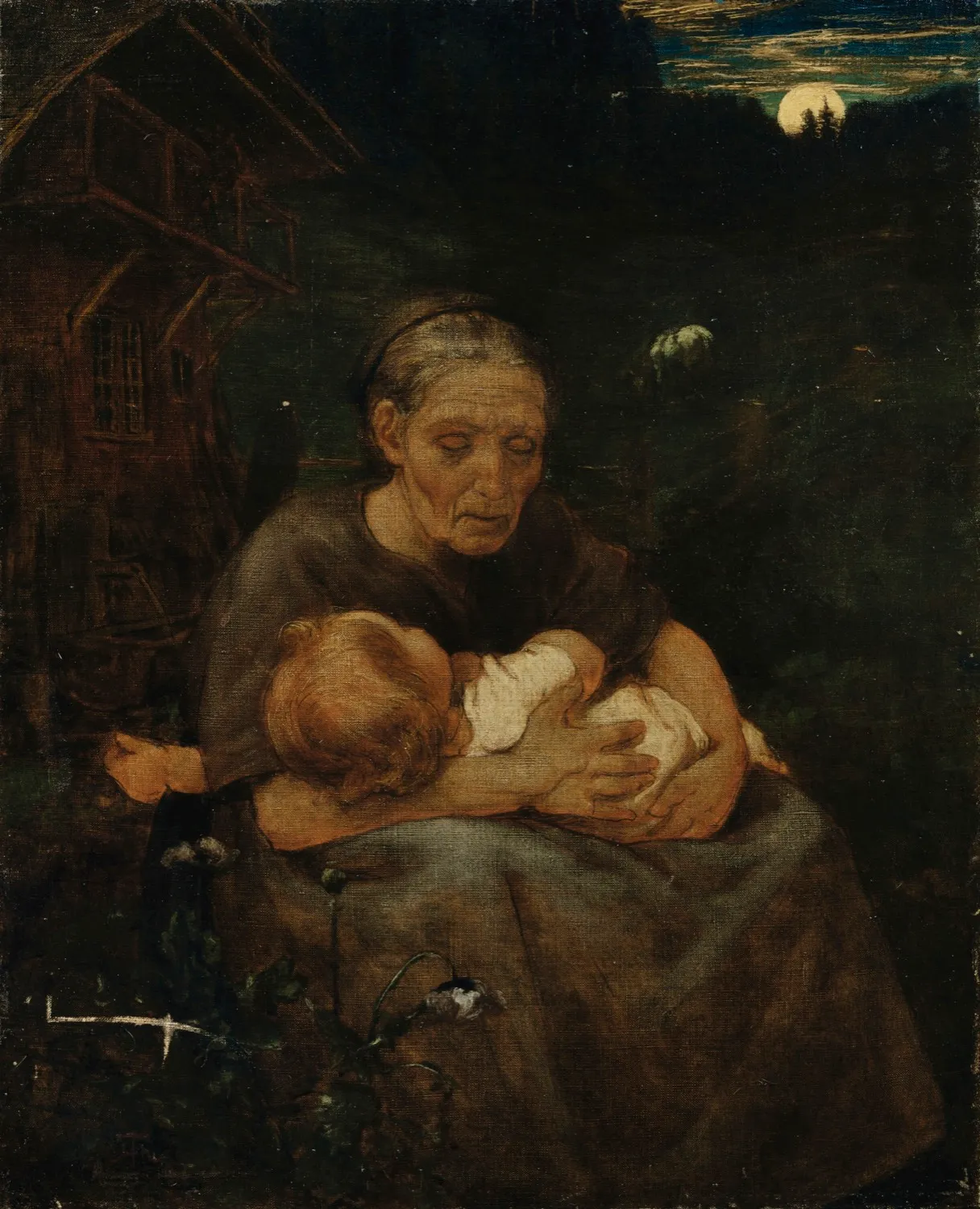 “Grandmother with Grandchild” by Hans Thoma, undated. Public domain.
What Ribot’s law leaves behind
Ribot’s observation is usually read as a description of loss, and it is one. But it also says something about what remains. Habits, feelings and the distant past are the last things to go, and they are, not by coincidence, much of what made the person who they are. A grandparent with dementia may not know what day it is. They may still know how to make pastry, what their mother sang, and that the person holding their hand is someone who loves them.
The best questions to ask grandparents with dementia are the ones that go to where they still are. They are less like an interview than a visit to an old house together, with you carrying the lamp.