The reminiscence bump: why our twenties outlast everything else.
Ask an 80-year-old about their life and most of the vivid memories come from ages 10 to 30. Psychologists call it the reminiscence bump. Here is why it happens.
In 1986 three psychologists, David Rubin, Scott Wetzler and Robert Nebes, did something simple that nobody had quite done before. They gathered data from several laboratories in which older adults had been given a list of ordinary cue words (boat, letter, dog) and asked to describe the first personal memory each word brought to mind. Then they dated every memory and plotted how many came from each year of the person’s life.
If memory simply faded over time, the graph would have been a smooth slope: many memories from last year, fewer from ten years ago, fewer still from fifty. A section of the curve did not fit. Between roughly the ages of ten and thirty, the line rose again, as if those two decades had been recorded at a higher resolution than the rest of life. People in their seventies were recalling more from when they were twenty than from when they were fifty.
The authors gave it the most literal name available. They called it the reminiscence bump, because that is what it looked like on the page. Four decades later it is one of the most reliable findings in the study of autobiographical memory, and its explanation says something important about who we are, and about which parts of a life are most likely to be lost.
What is the reminiscence bump?
The reminiscence bump is the tendency of adults over about forty to recall a disproportionate number of memories from adolescence and early adulthood. Rubin and his colleagues described the shape of a remembered life as having three parts:
- Childhood amnesia: very few memories from the first three or four years, and relatively few from early childhood.
- The bump: a surge of memories from roughly ten to thirty, peaking in the late teens and twenties.
- Recency: a steady rise in memories from the last decade or so, which is simply ordinary forgetting working in reverse.
The exact peak moves depending on how you ask: word cues centre it on the teens, while questions about the most important events push it into the twenties. But the bump appears in study after study, across countries and decades.
It shows up in shared memory too. In 1989 the sociologists Howard Schuman and Jacqueline Scott asked a national sample of Americans to name the most important events of the previous fifty years. People tended to name events that had happened when they were between about ten and thirty, which Schuman and Scott called the “critical years”. Each generation’s sense of what mattered in history is weighted towards its own youth.
Why do we remember our teens and twenties so well?
There is no single accepted answer, but three explanations do most of the work, and each one is supported by evidence the others struggle to explain.
Is it because everything is new?
The first explanation is about novelty. The years from fifteen to thirty are crowded with first times: first job, first flat, first love, first loss. Novel events get more attention when they happen and are more distinctive afterwards, so they are easier to retrieve. Later life is full of repetition, and repeated experiences blur into a single generic memory.
The strongest evidence for this comes from immigrants. Robert Schrauf and David Rubin studied older Spanish-speaking adults who had moved to the United States as adults and lived there for decades. In a 2001 study, those who had emigrated in their mid-thirties did not show the usual bump in their twenties. Their memories clustered around the age at which they had emigrated, the point at which everything in their lives had suddenly become new again.
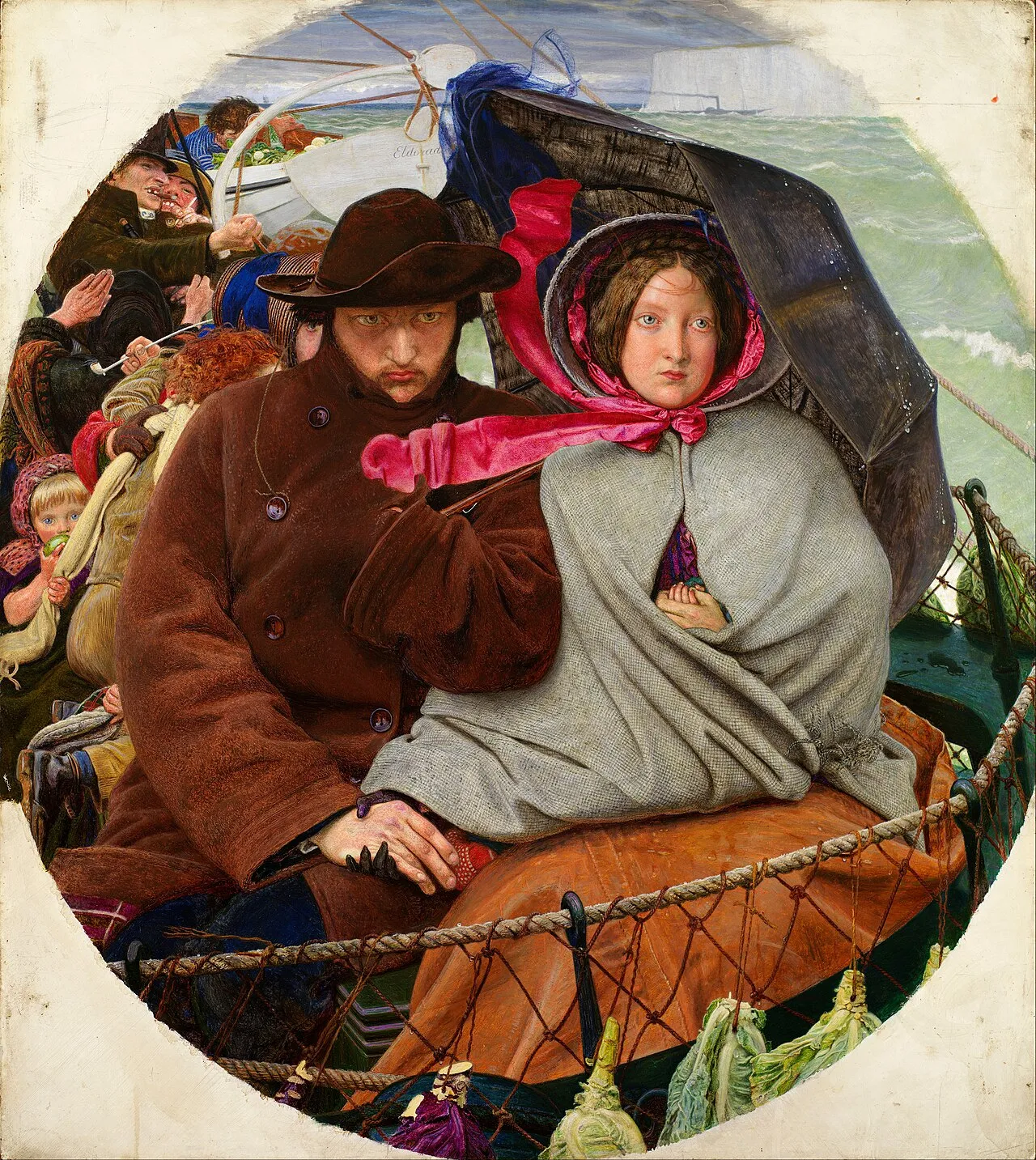 “The Last of England” by Ford Madox Brown, 1852–55. Public domain.
That finding has a useful implication. The bump is not strictly about age. It follows change. A person who started again at forty, after a migration, a war, a divorce or a career collapse, may have a second bump, and that is where their richest stories will be.
Is it because that is when we become ourselves?
The second explanation is about identity. Adolescence and early adulthood are when people work out who they are, and memories formed during that work become anchors for the self that remain accessible for the rest of life.
In 2008 Clare Rathbone, Chris Moulin and Martin Conway tested this with an elegant method. They asked participants to describe themselves in a series of statements beginning “I am…”, of the kind I am a mother or I am a teacher, and then to recall memories linked to each statement. The memories clustered around the period when that particular self-image had first formed, wherever in life that was. Memory, on this account, is organised less by date than by identity. We remember most clearly the moments when we became someone.
This connects to the work of the psychologist Dan McAdams, who argues that people begin to compose a story of their own lives in late adolescence (see the life story interview). The bump is where the plot is set: the period whose memories later explain everything else.
Is it because our culture tells us what a life should contain?
The third explanation is cultural. Dorthe Berntsen and David Rubin proposed that every culture carries a life script: a shared expectation of which events happen in a life and roughly when. A large share of those scripted milestones, from leaving home to a first child, fall between fifteen and thirty.
In a 2002 study of 1,241 adults aged twenty to ninety-three, Berntsen and Rubin found a bump in the twenties for people’s happiest and most important memories, but none for their saddest or most traumatic ones, which were spread across life. A follow-up in 2003 confirmed that the bump appeared for positive events and not negative ones. Novelty alone cannot explain that asymmetry: a first bereavement is as novel as a first kiss. The life script can. The script is mostly made of happy milestones, and it gives people a template for retrieving and telling their own story.
The bump is passed down
One of the more surprising findings concerns music. In 2013 Carol Krumhansl and Justin Zupnick played sixty-two university students the top hits from every year between 1955 and 2009. As expected, the students knew and liked the music of their own adolescence. But they also showed a strong second bump for songs from the early 1980s, when their parents were in their early twenties, and a smaller one for music from the 1960s, decades before they were born. The authors called these “cascading reminiscence bumps”.
The likeliest explanation is that parents play the music of their own youth at home, and children absorb it. The bump is one of the ways a family transmits its past: the years a parent remembers most vividly become a background presence in their children’s lives, even when the stories behind them are never told.
 “The Voyage of Life: Youth” by Thomas Cole, 1842. Public domain.
Why the bump is the part of a life most likely to be lost
The reminiscence bump means that the most vivid and formative stretch of a person’s life is the one that took place before their children knew them. A parent who had you at thirty met you after the bump was over. You know the second half of their life because you were present for it, and the first half only as a handful of repeated anecdotes. I made this argument in questions I wish I had asked my parents, and the bump is the mechanism behind it.
There is a second, quieter problem. The witnesses to someone’s twenties are mostly their own age: siblings, school friends, first colleagues. Those witnesses age and die alongside them. A person’s later decades are witnessed by children and grandchildren who will outlive them; their early decades, almost entirely by people who will not. When an eighty-five-year-old dies, the period of their life they remembered most clearly often has no one left who saw it.
So the part of a life that a person holds most vividly is also the part with the fewest surviving witnesses and the least documentation. Most of it exists in exactly one place.
What this means if you are asking the questions
Having filmed more than a hundred life stories since 2020, I see the bump in almost every interview. Questions about the teens and twenties are answered with names, places, smells and dialogue. Questions about the fifties are answered with summaries. That is not a sign of a failing memory. It is the normal shape of one.
The research suggests a few practical rules:
- Spend most of the interview in the bump. Ask about the years from about twelve to thirty in detail, and expect the best stories there. (For how to structure the conversation, see how to interview older family members.)
- Ask about first times. First job, first home, first time abroad, first time they felt like an adult. Novelty is what made those memories durable, so firsts are the most reliable cues.
- Look for a second bump. If the person emigrated, went to war, remarried or started again later in life, ask about the years around that change in the same detail.
- Use their music. Play the songs that were popular when they were around twenty. Music from the bump years is one of the most effective memory cues there is.
- Ask who they became. The identity explanation suggests a direct route in: “When did you first think of yourself as a nurse?” or “When did you start to feel Australian?” Each answer points to a cluster of memories.
The bump you are in now
There is one more implication, for younger readers. If you are between fifteen and thirty, you are living through the period you will remember most clearly for the rest of your life, and your grandchildren will one day hear about it from an eighty-year-old reconstructing it from memory. The generations who came of age in the 1940s or 1960s had no practical way to record those years from the inside. A few minutes of video now, of where you live, who your friends are and what you are worried about, would be better evidence than any later recollection. (See how to record your life story while you are living it.)
The reminiscence bump tells us where the richest part of a life is stored, and that, unless someone asks, it is stored in only one place. Filming the answer now takes nothing more than a phone. Everyone, which asks one question at a time, is built to make covering those years a little easier. The asking is still up to you.