“Remember me as you pass by”: the story of an epitaph.
A gravestone in an abandoned gold-rush town asked me to remember a man I knew nothing about. The verse is older than he was, and it meant something else.
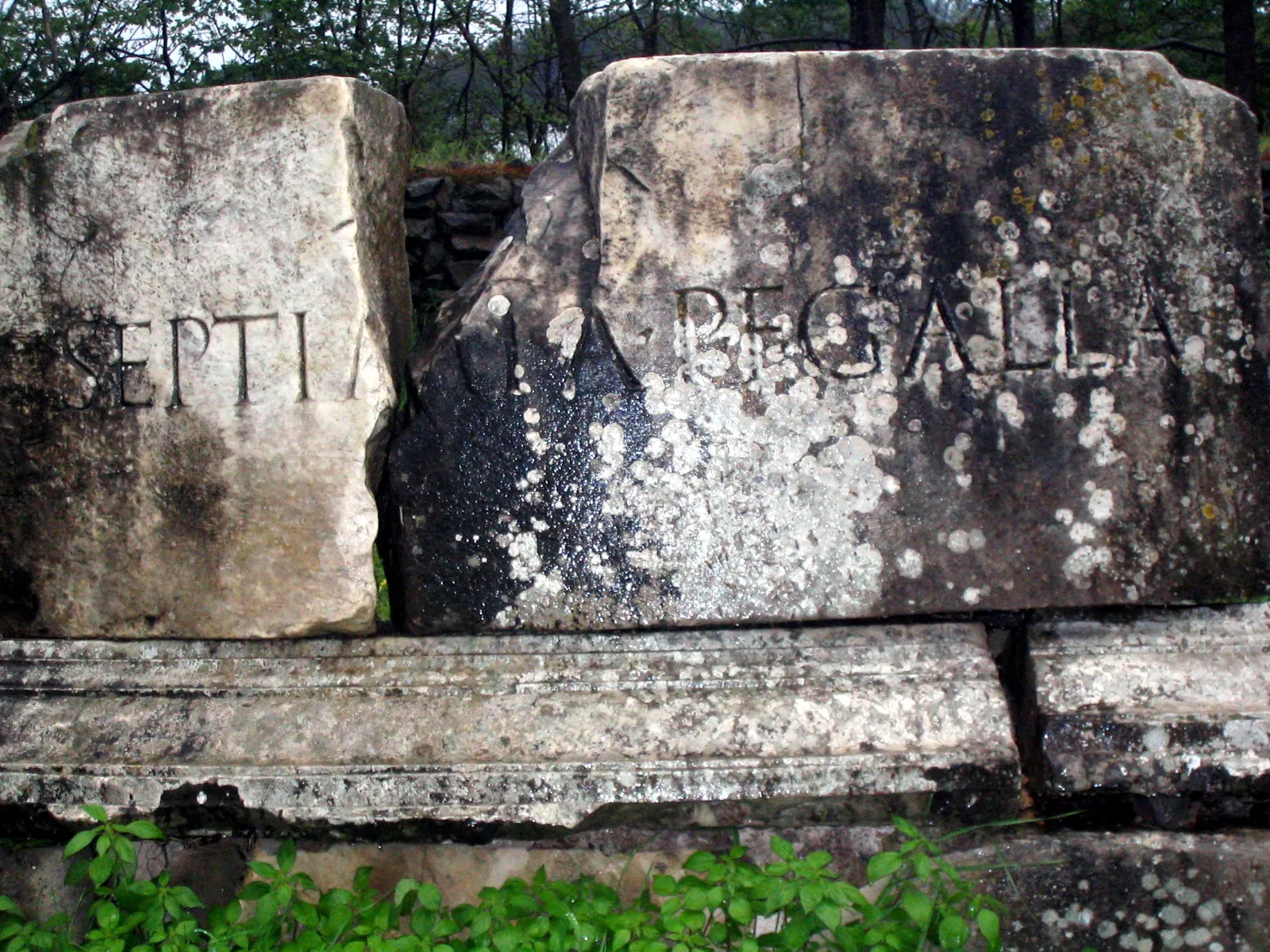
When I was a teenager, I came across a grave in Whroo, an abandoned gold-mining town in the forest of central Victoria. It belonged to a man named John Welch, and the verse on it began: “Remember me as you pass by.”
I took it as a plea. A man who had lived and died in a town that no longer exists was asking a stranger, a century or more later, not to let him disappear. It worked, in a limited way: I have remembered his name ever since. But I knew nothing else about him, and for a long time I assumed the line on his stone was the one thing he had chosen to say to the future.
It turns out that “remember me as you pass by” is one of the most common epitaphs in the English-speaking world, that it is several hundred years older than John Welch, and that it was never really a plea to be remembered at all. The story of how its meaning changed says a good deal about what we now fear about death, and about how little a gravestone can carry.
What does “Remember me as you pass by” mean?
In its most common form, the verse runs to four lines:
Remember me as you pass by,
As you are now, so once was I,
As I am now, so you must be,
Prepare for death and follow me.
Read in full, it is not a request for memory. It is a warning. The dead person is not saying do not forget me; they are saying look at me, and think about yourself. You are alive and walking past; I was once exactly that. I am now in the ground; you will be too. Get your soul in order while you still can.
The “me” to be remembered is not a personality but a condition. The verse would read the same on any grave, which is precisely the point. It was chosen because it applied to everyone.
Wording varies from stone to stone, and I cannot say for certain how many of the four lines appear on John Welch’s. But the opening line belongs to this family of verses, and it is the family that tells us what it was for.
Where did the epitaph come from?
The idea of a tomb speaking directly to a passer-by is ancient. Romans buried their dead outside city walls, and wealthier families lined the roads leading out of the city with tombs, so that anyone travelling would pass among them. Many inscriptions address the reader directly. The phrase siste, viator, “stop, traveller”, became so associated with the practice that it was still being carved on European gravestones well over a thousand years later. Some Roman epitaphs already contain the core of the later verse: what you are, I was; what I am, you will be.
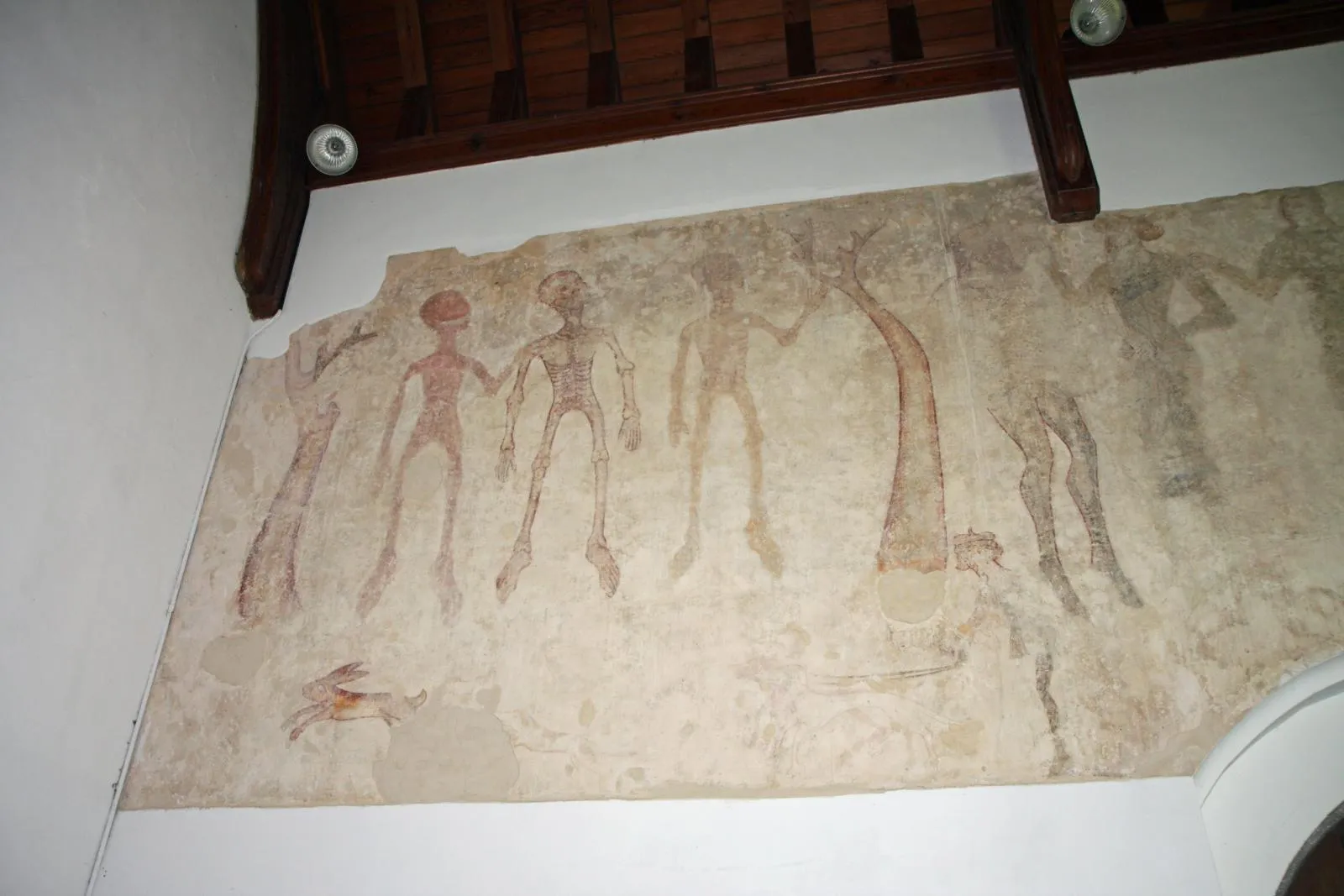 The Three Dead, from a 14th-century mural of the Three Living and the Three Dead, St Andrew’s Church, Wickhampton, Norfolk. Photo by David from Colorado Springs, 2009, CC BY 2.0.
The Middle Ages gave the idea its most vivid form. In the legend of the Three Living and the Three Dead, which circulated widely from the thirteenth century, three young noblemen out hunting meet three corpses, who tell them, in most versions, some form of as you are, we were; as we are, you will be. Painted on the walls of parish churches across England and France, the scene was a sermon anyone could read without being able to read.
The most famous English example is on a tomb. Edward of Woodstock, the Black Prince, eldest son of Edward III and one of the most celebrated soldiers of his age, dictated the wording of his own epitaph in his will, signed the day before he died in June 1376. The verse, in French, is inscribed around his tomb in Canterbury Cathedral, and it includes the lines usually translated as “Such as thou art, sometime was I. Such as I am, such shalt thou be.” Scholars have traced its source to the Disciplina Clericalis, a popular collection of moral tales compiled in Latin in the early twelfth century by Petrus Alfonsi.
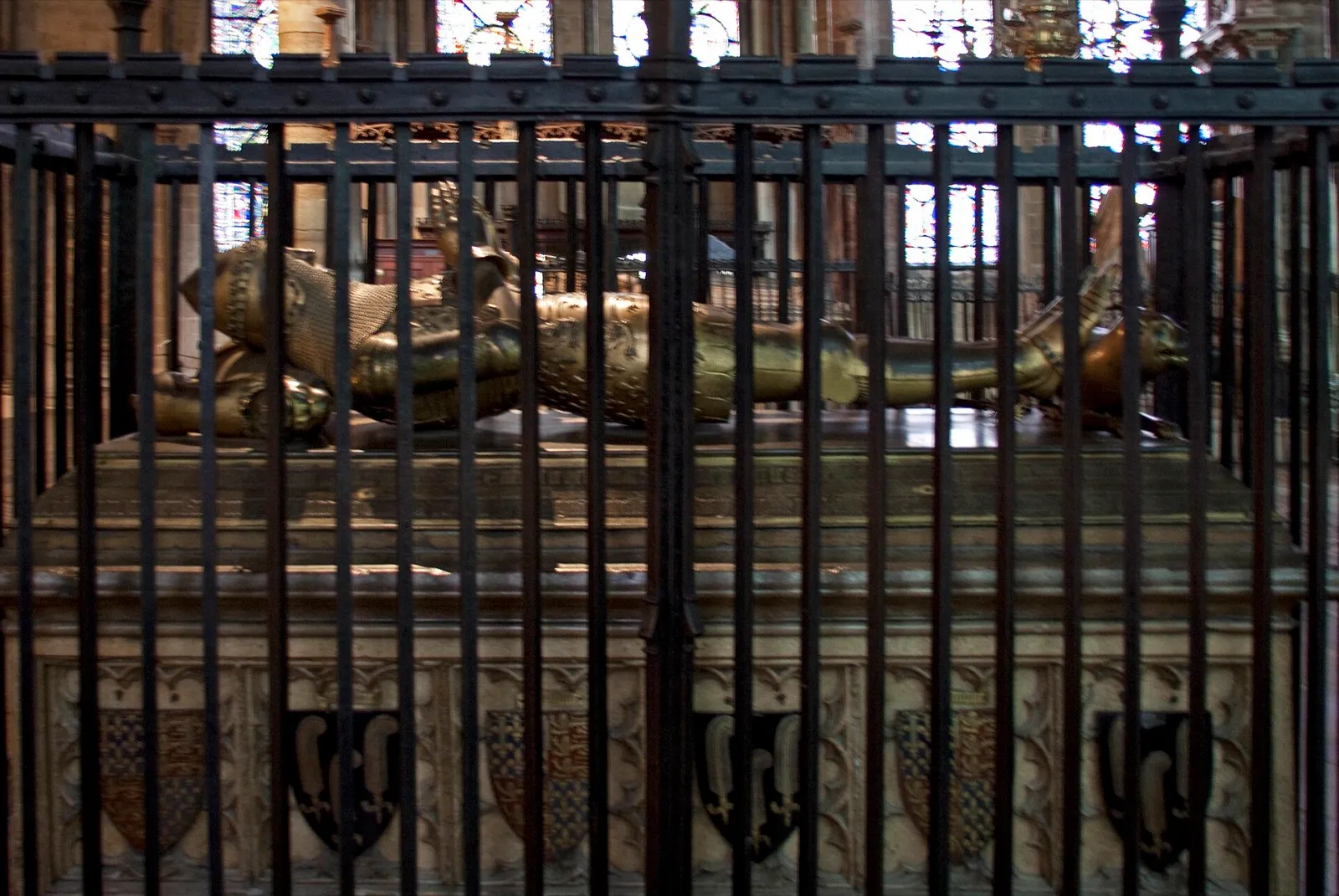 The tomb of Edward, the Black Prince, Canterbury Cathedral. Photo by Tony Hisgett, 2010, CC BY 2.0.
So by the time the verse reached a goldfields cemetery in Victoria, it had passed from Roman roadsides to medieval wall paintings, from the tomb of a prince to the churchyards of ordinary English villages, and from there into printed collections of epitaphs that stonemasons and grieving families could choose from. One such collection, Joseph Snow’s Lyra Memorialis, printed a version in 1847. The line that I took to be John Welch’s personal message to me was, very likely, picked from a repertoire of standard verses, much as people today choose a reading for a funeral.
Why did a warning become a plea?
When I read the verse as a teenager, I did not see a warning. I saw a man asking not to be forgotten. I do not think I was unusual. Most people I have mentioned it to read it the same way, and it is worth asking why.
The verse was written for readers whose great fear was what came after death: judgement, and the state of the soul. “Prepare for death” meant repentance. The reader was being told to think about eternity, and the corpse was the visual aid.
For many modern readers, the fear has shifted. What troubles us is less what happens to the soul than what happens to the memory: that we will be forgotten, that the people who knew us will die in turn, and that within a couple of generations nobody will know who we were. Read through that fear, the first line detaches itself from the rest and becomes something different. Remember me stops meaning “consider my condition” and starts meaning “keep me in existence”.
The shift was under way well before John Welch was buried. In 1751, Thomas Gray published his Elegy Written in a Country Churchyard, a meditation on the unremarkable graves of village labourers. Gray notices that even the poorest stones have some “frail memorial” on them, with “uncouth rhymes” that, in his words, implore “the passing tribute of a sigh”. He was already reading the churchyard verses as appeals for remembrance rather than sermons, and already noticing how little they managed to say.
What does a gravestone actually preserve?
Whroo makes the point more starkly than most places. Gold was found there in October 1854, at a spot named Balaclava Hill after the Crimean War battle being fought that same month. Thousands of miners arrived. Within four years the population had fallen to around 450, and by 1933 it was 52. The school closed that year; the last residents eventually left, and the buildings were removed. The township site is now forest.
The cemetery survives. It was registered in 1860, though burials took place there before that, and the last burial was in 1971; the Victorian Government formally closed it in December 2021. Many of the grave markers have long since deteriorated, and the volunteer trust that looks after the site has been able to identify a little over 200 of the people buried there. One of the town’s early cemetery trustees, John Lewis, a co-owner of the Balaclava mine, donated 150 numbered steel markers for graves that would otherwise have had nothing. Some still stand. They do not carry names. They carry numbers.
Against that background, John Welch was fortunate. He has a stone, a name and a verse. Yet consider what that amounts to. The name tells us that he existed. The verse, borrowed from a tradition centuries older than him, tells us almost nothing about who he was: not what he looked like, what he sounded like, why he came to Whroo, whether he found gold, who mourned him, or what he would have wanted a stranger to know. The most personal-seeming line on his grave is, in all likelihood, the least personal thing about it.
This is the general condition of being remembered by stone, and it is the same limit I have written about elsewhere, from ancient graffiti to the Egyptian fear of the second death. A grave can preserve that someone lived. It almost never preserves who they were. Different cultures have tried to close that gap with rituals, ancestor shrines and recited genealogies, but for most people in most of history, the gap stayed open.
“As I am now, so you must be”
The old verse still contains a truth, though not quite the one its authors intended. We are the passers-by. We read the names in the cemetery and feel the absence of everything behind them. And, as the verse insists, we will be in the same position. Unless something changes, our great-great-grandchildren will know about us roughly what I know about John Welch.
What has changed is the cost of leaving more. For almost all of history, preserving a person’s face, voice and manner of telling a story was impossible at any price. Now it requires a phone and some time. Since 2020 I have filmed more than a hundred life stories, including Holocaust survivors and my own grandmother, who gave me four hours of her life before she died. None of those recordings is a monument. Each of them preserves exactly what a gravestone cannot.
If the original verse were written for our situation, its last line might be different. Prepare for death meant putting your soul in order. The modern equivalent is putting your story in order: telling it, on camera, to someone who will keep it, while you are still the one who can tell it. Everyone, the app I built, is one way to do that, a question at a time. A notebook and a willing listener is another.
John Welch asked to be remembered, and the best the nineteenth century could offer him was a borrowed rhyme. Most of us will be able to leave our own words, in our own voices, if we get around to it.