
“We were here”: ancient graffiti and the desire to be remembered.
Kings built monuments to be remembered. Often, the only ordinary people we remember from the ancient world are the ones who scratched their names on a wall.
When I was nineteen, a piece of graffiti made me think seriously about my own mortality for the first time. It had been scratched into a wall in Pompeii at some point before Mount Vesuvius buried the town in 79 CE. Translated from the Latin, it reads:
We two dear men, friends forever, were here. If you want to know our names, they are Gaius and Aulus.
That is all. No date, no surnames, no explanation. We do not know whether Gaius and Aulus were soldiers, labourers or students; whether they died in the eruption or had long since left; whether they remained friends for the rest of their lives. I spent a long time afterwards imagining their story: two friends on their last night together before being separated, deciding that the night should not be forgotten.
What we do know is that it worked. Nearly two thousand years later, people still read their names. Two ordinary Romans, who left no other trace in history, are remembered because one of them picked up something sharp and scratched a sentence into plaster.
There is something both moving and absurd about that. It raises a question worth taking seriously: why do people do this, and why is it so often the only thing that survives?
How old is the urge to say “I was here”?
Very old. Possibly older than writing, older than agriculture, and older than any surviving story.
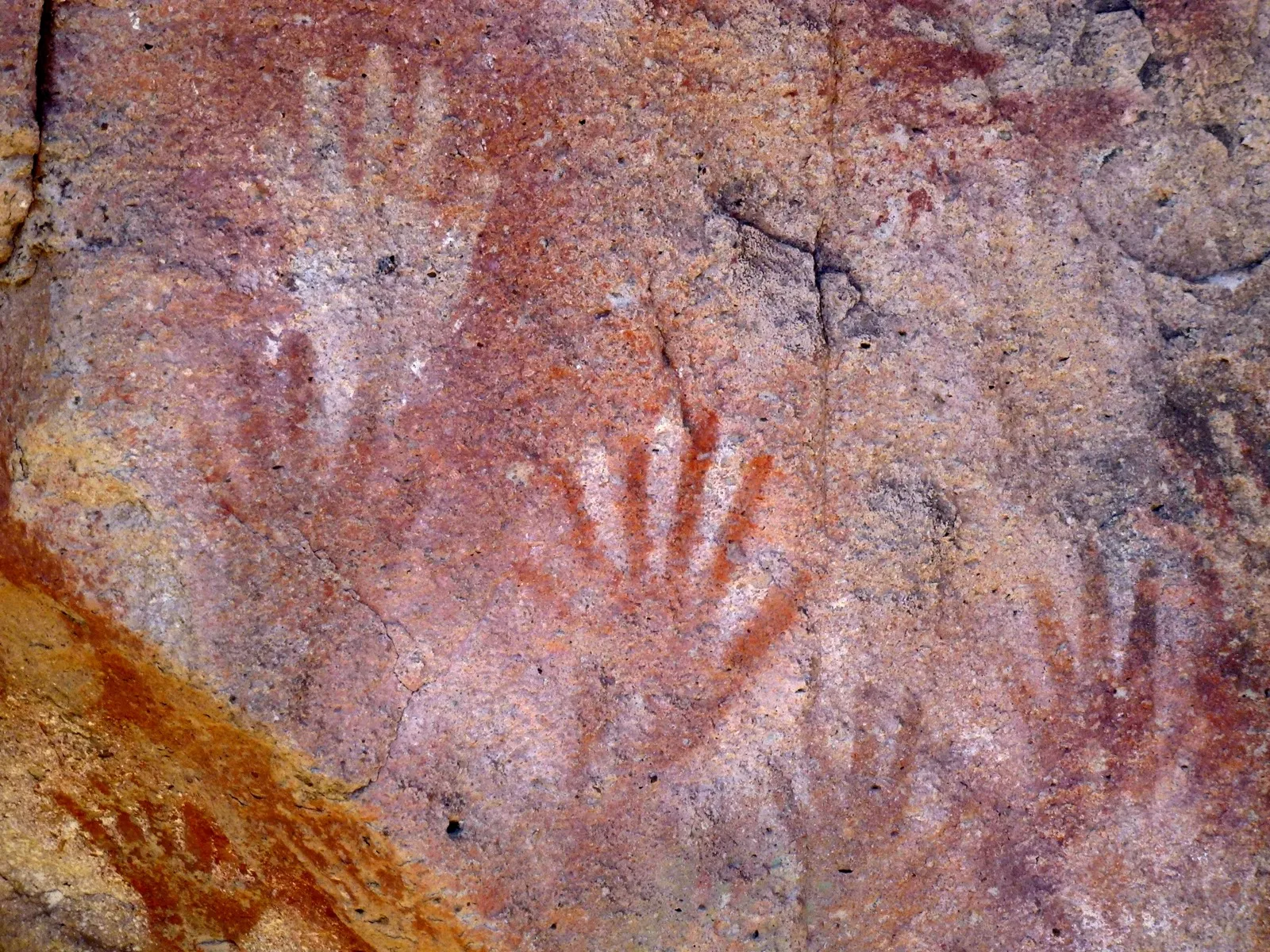
Across the world, from Indonesia to Europe to South America, early humans pressed their hands against cave walls and blew pigment around them, leaving a stencilled outline. Some of these hand stencils, on the Indonesian island of Sulawesi, are more than 40,000 years old. The image at the top of this page comes from the Cueva de las Manos in Argentina, where people left hundreds of hand outlines over thousands of years.
We cannot know exactly what these stencils meant to the people who made them. But the most basic reading is hard to escape. A hand stencil says: a particular person stood here. It is a signature made before there was any way to write a name. (How people later learnt to preserve far more than a signature is the subject of a short history of storytelling.)
Why do people leave their mark?
The anthropologist Ernest Becker argued in The Denial of Death (1973) that much of human behaviour is driven by the effort to manage our awareness of mortality. Because we cannot avoid physical death, we pursue what he called symbolic immortality: becoming part of something that will outlast us, whether a family, a nation, a body of work or a reputation.
Graffiti is the most compressed form of that impulse. A monument, a book or a dynasty requires wealth, talent or power. A name on a wall requires a few seconds and a sharp object. It is symbolic immortality available to anyone.
The format barely changes across thousands of years. A name, sometimes a place, sometimes a companion, and the assertion that someone was here. American soldiers in the Second World War drew “Kilroy was here” on walls across Europe and the Pacific. Teenagers carve initials into trees and school desks. The medium changes; the sentence does not.
What the walls of Pompeii reveal
Pompeii is the richest source of ancient graffiti anywhere, for a grim reason: the eruption sealed the town’s walls under ash before anyone could paint over them. Archaeologists have recorded more than ten thousand inscriptions there, painted and scratched, ranging from election notices to insults, love declarations, gladiator fan messages, debts, jokes and lists of prices.
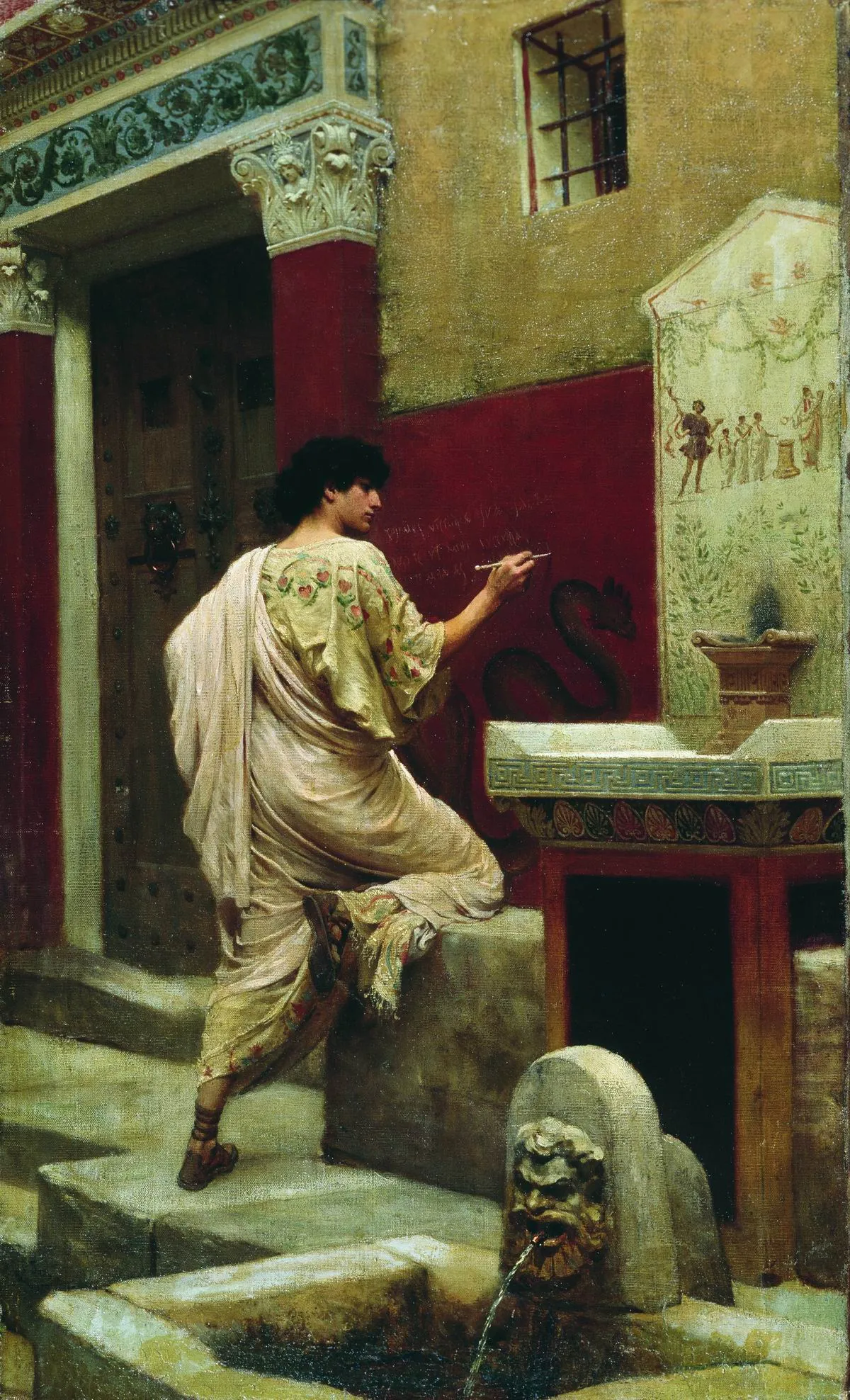 “Pompeii. At the Walls” by Stefan Bakałowicz, 1885. Public domain.
One of these inscriptions, which appears more than once in the town, is a joke about graffiti itself:
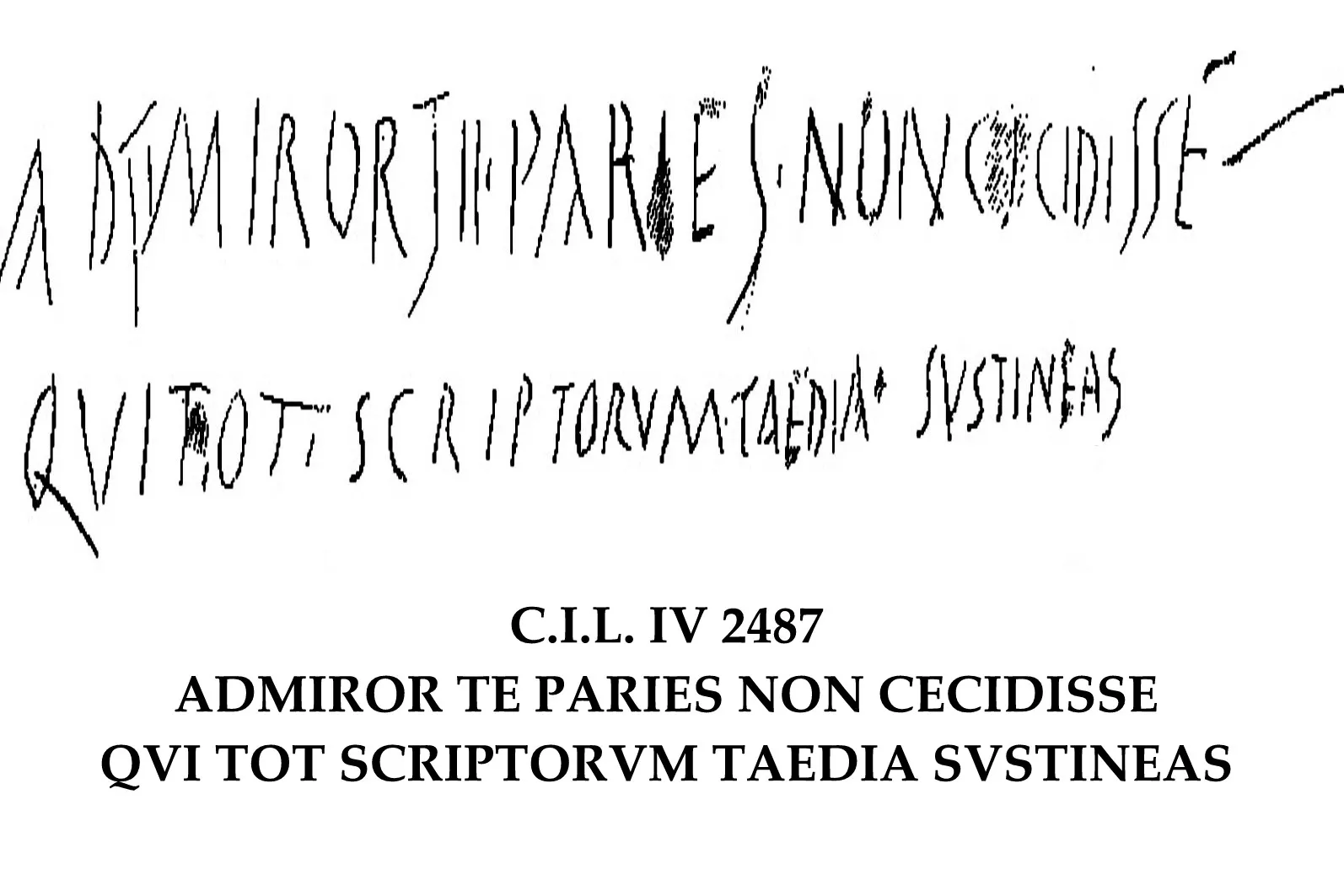 CIL IV 2487: “I am amazed, O wall, that you have not collapsed under the weight of so many writers’ tedious scribbles.” Public domain.
Two thousand years ago, a Pompeian was already complaining that there was too much graffiti. The person who wrote it was, of course, adding to the problem, and is now remembered for it.
What makes Pompeii’s walls so valuable to historians is precisely what makes them ordinary. Official inscriptions tell us what emperors and magistrates wanted posterity to believe. Graffiti tells us what ordinary people were thinking on an ordinary afternoon. It is the closest thing we have to the private voices of the ancient world.
The irony of the colossus
The contrast between how the powerful tried to be remembered and how ordinary people actually were is most striking at Abu Simbel in southern Egypt.
Ramesses II, perhaps the most self-promoting ruler in Egyptian history, had four colossal statues of himself carved into the cliff face, each around twenty metres tall. They were designed to project his power for eternity. Later generations knew him as Ozymandias, the name Shelley borrowed for his poem about a ruined statue and the vanity of kings.
In 591 BCE, around seven centuries after the statues were carved, an army of foreign mercenaries in Egyptian service marched past on campaign. Some of the soldiers, Greeks among them, carved their names into the legs of one of the colossi. One of them identifies himself as Archon, son of Amoibichos. These scratches are among the oldest surviving examples of Greek writing anywhere.
So the monument built to immortalise a pharaoh also preserved the names of a handful of passing soldiers, men who had no claim on history whatsoever, written on his shins.
Something similar can be seen in Istanbul. On a marble parapet in the upper gallery of the Hagia Sophia, a Norseman in the ninth century carved runes that are usually read as a name, Halfdan, and probably the words “carved these runes”. He was most likely a Viking in the service of the Byzantine emperor, a long way from home, bored during a service in one of the largest buildings in the world.
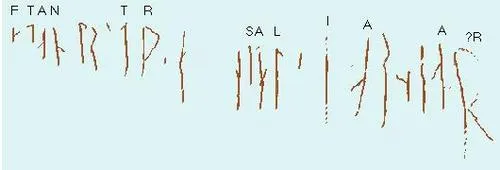 The Halfdan runes in the Hagia Sophia, Istanbul, 9th century. Public domain.
What a name can and cannot preserve
It would be easy to conclude that graffiti is a triumph: the powerless outlasting the powerful. In a narrow sense it is. But it is also a lesson in how little a name actually preserves.
Consider what we know about Gaius and Aulus. We know they existed, that they were friends, and that they wanted that friendship remembered. We do not know their faces, their voices, their families, what they found funny, what they feared, or what became of them. When I first read their inscription, my instinct was to invent a story to fill the space around their names, because the names alone felt unbearably incomplete.
Graffiti, at its best, preserves the fact that someone lived. It almost never preserves who they were. It is the minimum viable form of being remembered. The same is true of most family trees: with research you can usually recover the names of your sixteen great-great-grandparents, and very little else.
This is why I find the inscription so poignant, and also why I think of it as a warning. For most of human history, that minimum was the best ordinary people could hope for, and most did not even get that. Gaius and Aulus were unusually lucky.
The marks we leave now
We are the first generation for whom this is no longer true. The equivalent of a few seconds with a sharp object is now a few minutes with a phone, and what it can capture is not a name but a person: their face, their voice, their stories in their own words.
Yet most people still leave the modern equivalent of graffiti: a scattering of photographs, a few social media posts, a name on a headstone. The urge to say “I was here” is as strong as it has ever been. What has changed is that we can now say a great deal more than that.
If Gaius and Aulus had been able to leave a five-minute video of themselves explaining who they were and why their friendship mattered, it would be one of the most extraordinary artefacts of the Roman world. For your own family, recording something like that is now an afternoon’s work. The Egyptians had a related idea about the second death, and how to avoid it.


