Interview questions for kids to ask grandparents, and why children ask them best.
Children ask the questions adults think are too obvious, and those answers are the first to vanish. Interview questions for kids to ask grandparents, by age.
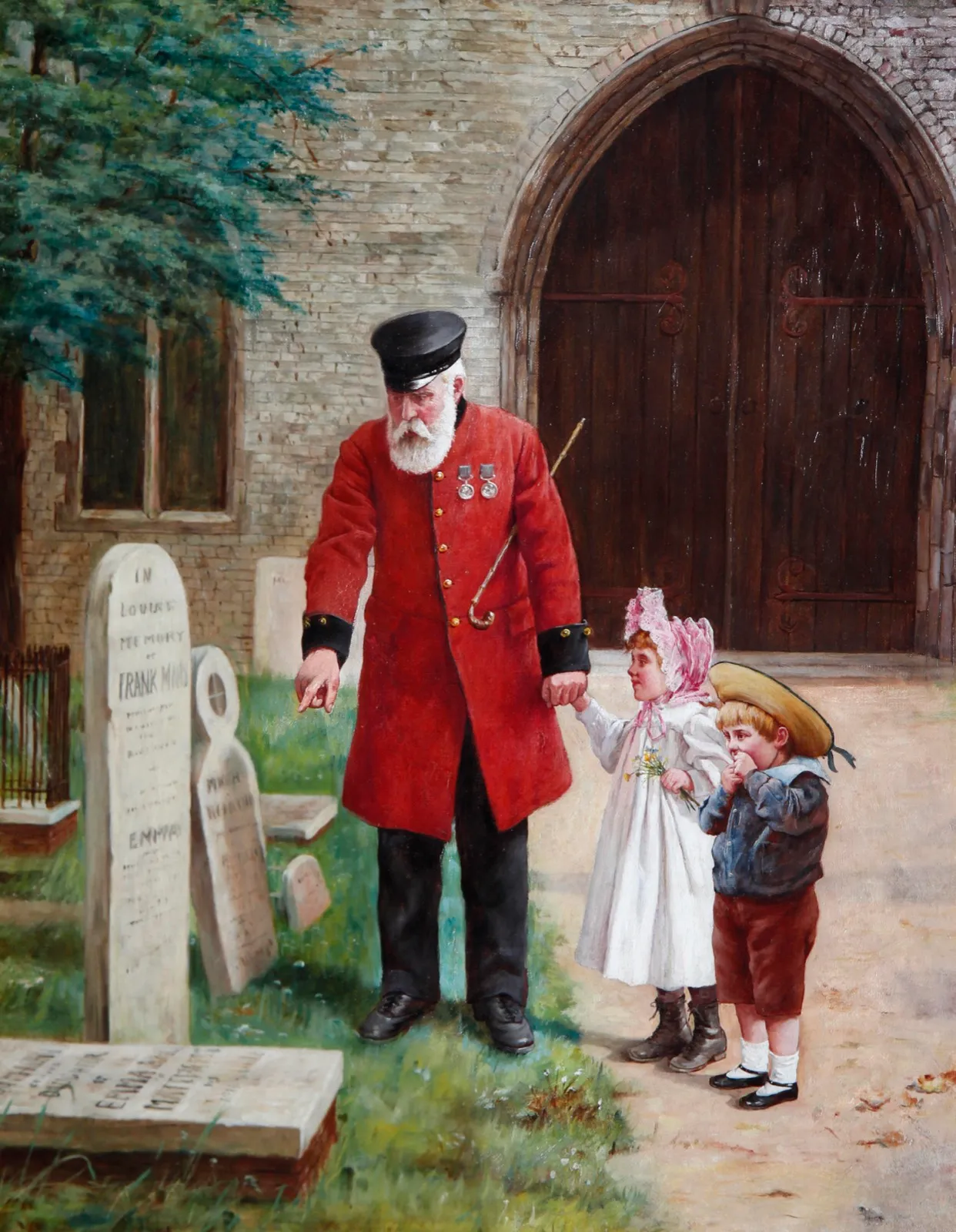
In 1966, students at a small school in Rabun County, in the mountains of north Georgia, began interviewing the old people who lived around them for a school magazine they called Foxfire. They asked how to build a log cabin, how to make soap, how to plant by the signs, how to cure a ham. These were things every adult in the county either already knew or considered too ordinary to write down. When the interviews were collected as The Foxfire Book in 1972, it became a bestseller, followed by a long series of sequels. Much of what those teenagers recorded would otherwise have died with the people who knew it.
The lesson of Foxfire is not only that young people can interview old people. It is that they ask a different kind of question, and that the different kind of question is often the one worth asking. That is the case for giving children a list of interview questions to ask their grandparents, and for taking what happens next more seriously than a school project.
Why do children ask better questions than adults?
Adults interviewing their parents or grandparents tend to go looking for the big story: the war, the migration, the marriage, the secret. Children do not know there is a big story. They ask what is in front of them. What did you eat? Did you have a television? What did your bedroom look like? Were you ever naughty? Did you have a dog?
Adults usually skip these questions because the answers seem obvious, or knowable from a history book. But they are exactly the answers that vanish first. Nobody writes down what an ordinary Tuesday dinner was in 1958, because in 1958 everyone knew. Historians spend careers trying to reconstruct daily life in the past precisely because the people living it did not think it worth recording. A seven-year-old asking “what did you have for breakfast?” is doing, without knowing it, what the Foxfire students did on purpose.
Children are also persistent. The developmental psychologist Michelle Chouinard, who studied the questions young children ask, has estimated that they ask on average about three questions every two minutes. Most of those are follow-ups: why?, then what?, what did it look like? The single most useful habit in any interview is following up, and it is the habit adults are most likely to drop out of politeness. Children have not learnt to drop it yet. (The difference between open and closed questions, and why follow-ups matter, is covered in how to interview someone.)
Why do grandparents answer children differently?
The other half of the exchange is the listener. A grandparent talking to an adult child is talking to someone with shared history and old arguments, and may edit accordingly. A grandparent talking to a grandchild is talking to someone who knows nothing, wants to know everything, and carries no grievance.
That changes the answers in two useful ways. First, the grandparent has to explain context. You cannot tell an eight-year-old that you queued for the telephone without explaining that most houses did not have one, which is the detail a historian would want. Second, the grandparent is often freer. In my experience of filming more than a hundred life stories since 2020, people tell grandchildren things they never told their own children, partly because enough time has passed, and partly because the question is asked with curiosity rather than judgement.
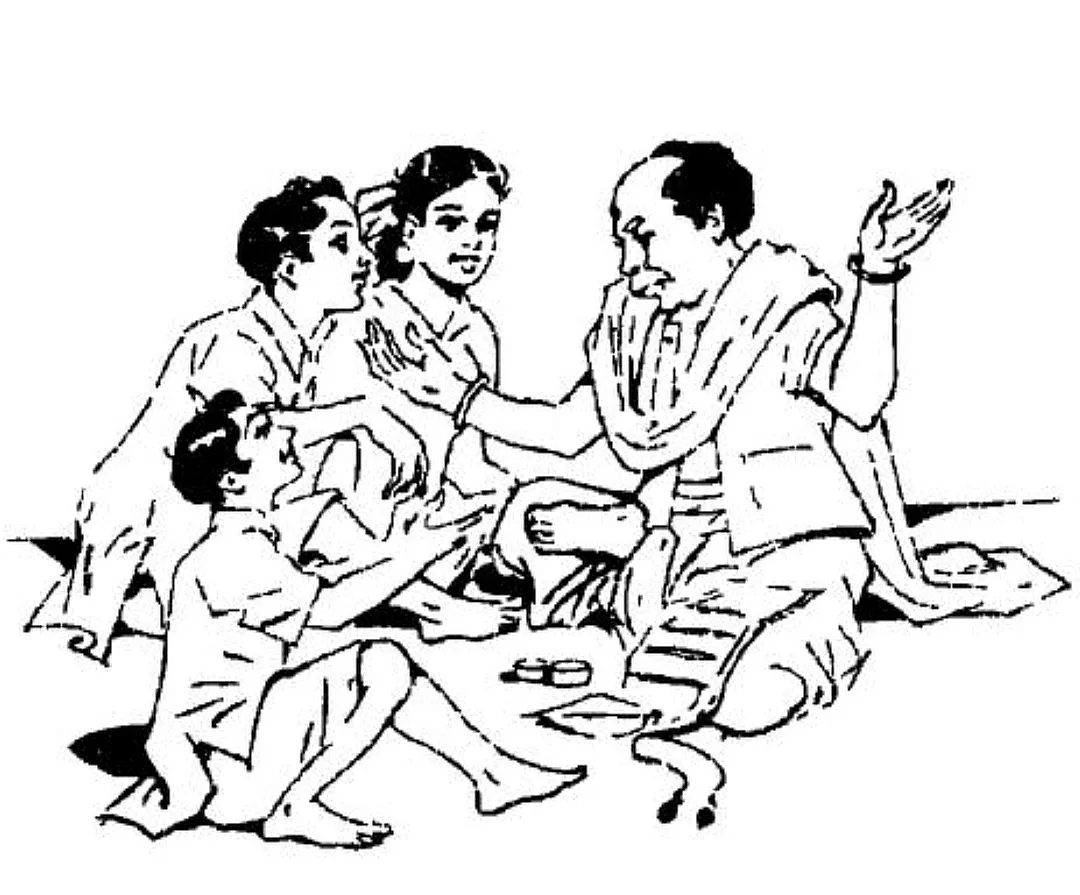 A grandfather telling a story to his grandchildren, a traditional scene in Meitei society in Manipur, India. Drawing by Arambam Nipamacha, 1996. CC0.
What do children gain from knowing family stories?
There is a reason to do this beyond preserving the grandparent’s memories. It appears to be good for the child.
In the 1990s the psychologist Sara Duke, who worked with children with learning disabilities, noticed that the children who knew a lot about their families seemed to cope better with setbacks. Her husband Marshall Duke, a psychologist at Emory University, and his colleague Robyn Fivush turned the observation into a test. They wrote twenty yes-or-no questions, which they called the “Do You Know?” scale. Among them:
- Do you know where some of your grandparents grew up?
- Do you know how your parents met?
- Do you know the source of your name?
- Do you know some of the lessons your parents learnt from good or bad experiences?
- Do you know which person in your family you act most like?
Across several studies, children and adolescents who could answer more of these questions tended to score higher on measures of self-esteem, a sense of control over their own lives and emotional wellbeing. As the writer Bruce Feiler recounted in a widely read 2013 New York Times column, the researchers had tested one group of families shortly before September 2001, and when they reassessed the children after the attacks, those who knew more about their families again appeared more resilient.
The findings are correlational. It is likely that families who tell more stories also talk more, eat together more and differ in other ways that matter. Fivush herself has argued that the facts are not the point. What helps is the experience of hearing them: a child learning that they belong to a story larger than themselves, in which people before them faced hardship and came through. Duke called the healthiest version of this an “oscillating” family narrative, one that includes both the good years and the bad. A child interviewing a grandparent is building exactly that story, directly from its source.
Interview questions for kids to ask their grandparents
The lists below are sorted by age, but they overlap. Let the child choose. A question they actually want to ask will produce a better conversation than a better question they were told to ask.
For younger children (about 5 to 8)
- What was your house like when you were my age?
- What did you have for breakfast?
- What games did you play? Can you teach me one?
- Did you have a pet? What was its name?
- What were you scared of when you were little?
- Did you ever get in trouble? What did you do?
- What was your favourite toy?
- What was Mum or Dad like when they were little?
For older children (about 9 to 12)
- What was school like? Was your teacher strict?
- What did you want to be when you grew up?
- What did things cost, like sweets or a trip to the pictures?
- Who was your best friend, and what did you do together?
- What did you do on weekends and holidays?
- What was the first big news event you remember?
- What did your own grandparents tell you about the old days?
- What is something that exists now that you could not have imagined as a child?
For teenagers
- What were you like at my age? What did you worry about?
- What was your first job, and how much were you paid?
- How did you meet Grandma or Grandpa?
- Where did our family come from, and why did they move?
- What was the hardest thing that ever happened to you, and how did you get through it?
- What is a mistake you learnt from?
- What do you think my generation gets wrong, and what do we get right?
- How would you like to be remembered?
Two questions are worth adding at any age. The first is “Can you show me something?”, whether a photograph, a medal, a recipe or an old letter. Objects unlock memories that questions cannot reach. The second is the question I end every interview with: “Is there anything you would like to tell me that I haven’t asked?” (For a longer list aimed at adults, see questions to ask your grandparents before it’s too late.)
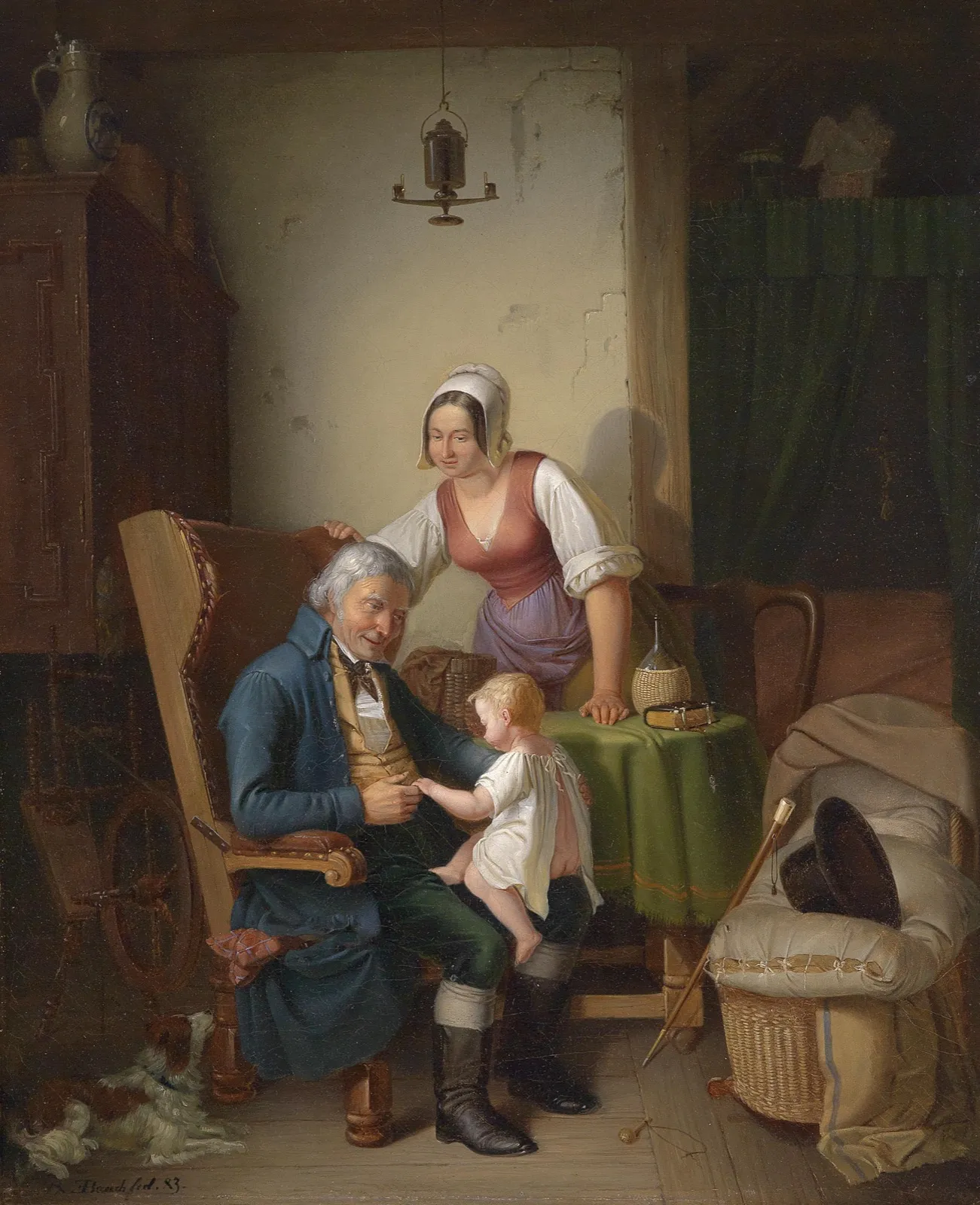 “Grandfather’s Joy” by Emil Bauch, 1883. Public domain.
How should a parent help?
The parent’s job is to set the scene and then get out of the way. A few things make the difference between a lovely conversation and a recording anyone will want to watch:
- Keep it short. Ten to twenty minutes is plenty for a young child. Several short sessions beat one long one.
- Choose a quiet room. Turn off the television and any background music. Noise ruins more home recordings than anything else, and an indoor room with soft furnishings sounds far better than a kitchen or a garden.
- Film it. Prop the phone at eye level, beside the child, so the grandparent looks towards the camera when they answer. (The details are in how to film an interview at home.)
- Let the child lead. Resist jumping in with the question you think is more important. If the child spends ten minutes on the family dog, the dog was important.
- Do not correct anyone. If a date is wrong, let it stand. The point is how the grandparent remembers their life.
Why film it, rather than write it down?
The Foxfire students wrote their interviews down, and the books are valuable. But a transcript records the information and loses the person. I have four hours of my grandmother telling me about her life. She has since passed away, and when I watch the recording it is not the facts I return to. It is her face as she decided whether to tell me the next part.
A child’s interview with a grandparent, filmed, captures two people: the grandparent as they are now, and the child as they were then. In twenty years both will be precious, and one of them will probably be gone. The Everyone app is built for this kind of recording, with one question at a time on screen, so a child can read the next question aloud and the grandparent can answer straight to camera.
StoryCorps tested this idea at scale. For its Great Thanksgiving Listen in 2015, it asked American high school students to record an interview with an older relative over the holiday. In roughly two weeks the students and their families uploaded around 50,000 interviews, nearly doubling an archive StoryCorps had been building since 2003, and they were archived at the Library of Congress. The barrier had never been willingness. It was that nobody had asked the children to ask.