The family Bible kept the dates. Who kept the people?
For two centuries the family Bible was the household archive. Its records are precise and trusted, and almost silent. What they kept, and what they left out.
In May 1851, Abraham Lincoln sat down with two blank sheets of paper that had been torn from his late father’s Bible and wrote out the family’s history. Births on one page, marriages on another, deaths on a third. His own entry reads: “Abraham Lincoln, Son of Thos & Nancy Lincoln, was born Feb 12th 1809.” His father’s reads that Thomas Lincoln “died January 17 aged 73 years & 11 days.”
Five days before that death, Lincoln had written to his stepbrother explaining why he would not travel to his dying father’s bedside. If they met now, he wrote, it was doubtful whether it would not be “more painful than pleasant.” He did not go, and he did not attend the funeral. A few months later he recorded the date with care.
The pages survive in the Chicago History Museum. They are, in a small way, a perfect specimen of the family Bible record: exact, trusted, kept for generations, and almost entirely silent about what the people in it were like. That combination is worth understanding, because it is the same trade most families still make with their records today.
What are family Bible records?
Family Bible records are the births, marriages and deaths that households wrote into their Bibles, usually on pages at the front, the back, or between the Old and New Testaments. Before civil registration was universal, they were often the only written record a family held of its own members.
The habit is older than the printed pages. In early Bibles, owners wrote on the flyleaves, the inside covers and the margins. Over time, publishers began printing dedicated pages for the purpose, with headings such as Births, Marriages and Deaths set inside engraved borders. The Worcester Bible printed by Isaiah Thomas in 1791 is often described as the first American edition to include them, and through the nineteenth century they became standard. Family Bibles were sold in shops, by catalogue and by travelling salesmen, and were a common wedding present: a new household received, along with the scriptures, a set of empty columns waiting to be filled.
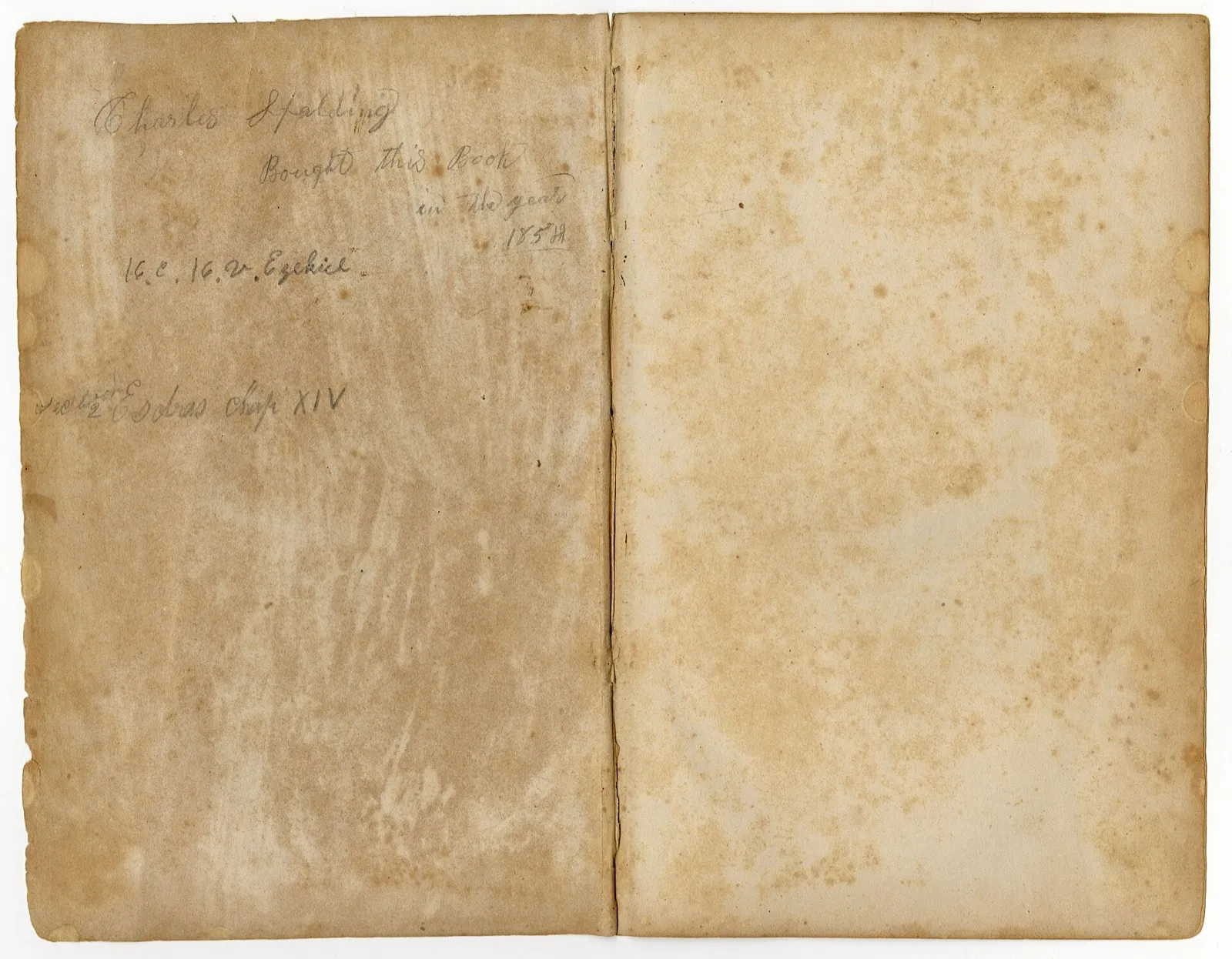 “Charles Spalding bought this book in the year 1858.” Inside cover of the Spaulding family Bible, published by H. Miller, Columbus, Ohio. Indiana State Library. Public domain.
Why were family Bibles trusted as evidence?
A family Bible was trusted for three reasons, and each of them says something about what makes any record last.
It was written at the time. Entries were usually made within days or weeks of the event, by someone who was there. A birth date written into a Bible in 1827 is closer to the truth than one recalled at a funeral in 1890.
It was kept. A Bible was the one book many homes owned, and the last thing anyone would throw away. It sat in the same place for decades and passed to whichever child inherited the house.
It was sacred. Writing a false date into a Bible felt different from writing one into a letter. Courts and governments recognised this. When the United States offered pensions to the widows of Revolutionary War soldiers, applicants had to prove they had been married to the veteran, and many did so by sending in the family record. As the US National Archives notes, family-record pages from Bibles and other books were sometimes submitted by widows as proof of marriage. Many of those pages stayed with the claims and are now in the National Archives, torn from books whose other pages are long gone.
The same qualities explain why libraries still collect them. The Indiana State Library, which scanned the pages on this one, holds hundreds. Genealogists treat them as primary sources. For a family trying to name its sixteen great-great-grandparents, a Bible page can be the document that breaks a dead end.
What did the family Bible leave out?
Almost everything.
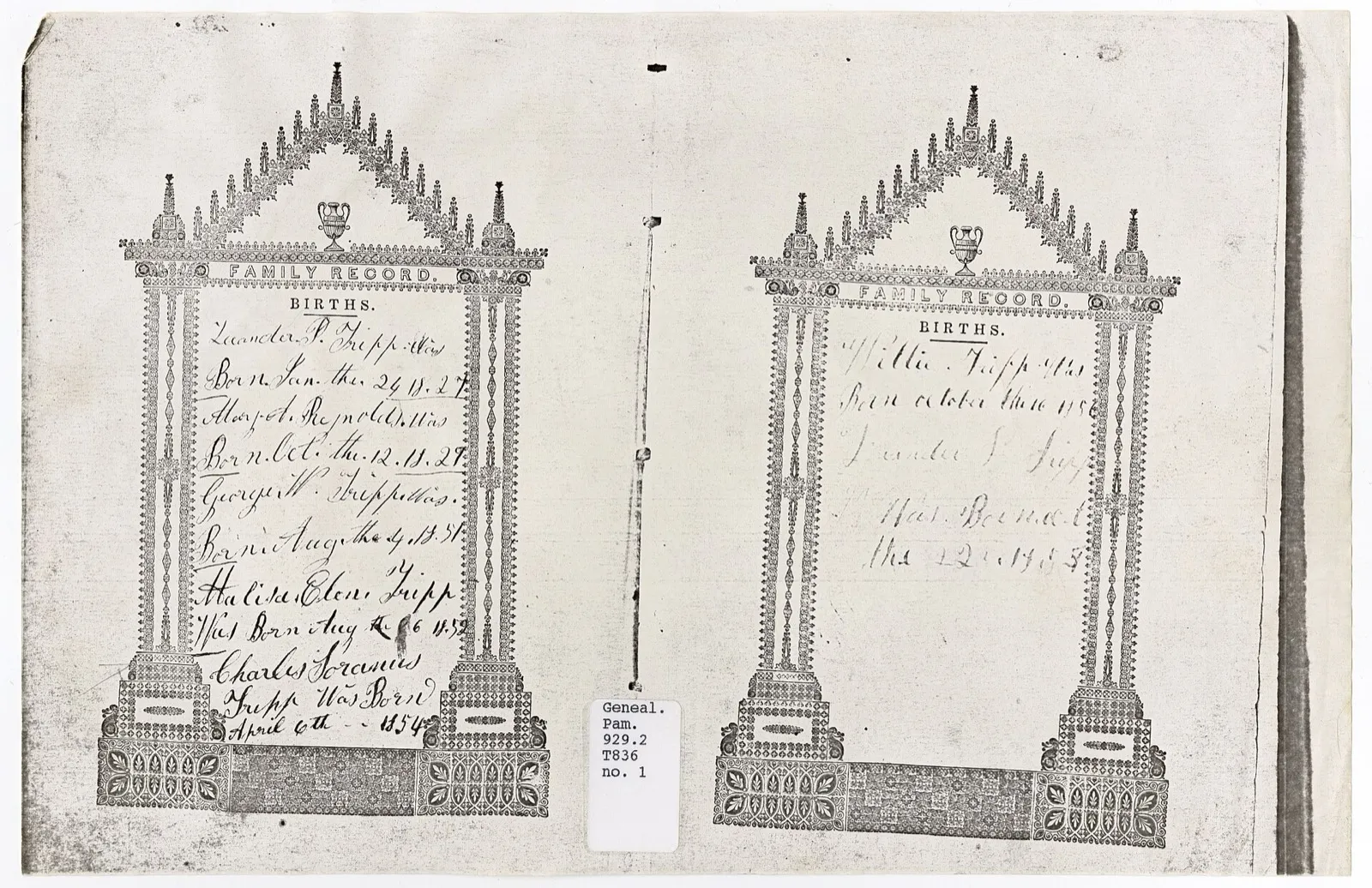
Look at the Tripp family pages at the top of this post. Leander P. Tripp was born in January 1827. Mary A. Reynolds was born in October 1829. Their children followed, one entry at a time, from George in 1851 to Willie a few years later. The handwriting changes between entries, and that is nearly the only sign that anyone was alive while writing them. A record like this tells us when each person began and, on the facing pages, when they married and died. It tells us nothing about what happened in between.
This was not carelessness. It was the format. The printed page offered three columns, and three columns are what every life has in common. Everyone is born; most marry; everyone dies. A record designed around the universal events will, by design, capture nothing that is particular. The family Bible was an excellent tool for proving that a person existed and was related to other people. It was never meant to say who they were.
Lincoln’s record makes the point twice. The single human detail on his pages is not his: in a later hand, his stepbrother recorded that his wife Mary died “about ½ hour before Sun down.” For one line, the record stops being a register and becomes a memory. Someone was in the room, noticed the light, and could not leave it out. Then the columns resume.
And the gap between the dates and the people is sharpest in Lincoln’s own family. When the journalist John Locke Scripps asked him in 1860 for material about his early life, Lincoln reportedly replied that it could all be condensed into one line from Thomas Gray’s Elegy Written in a Country Churchyard: “The short and simple annals of the poor.” The Bible pages are those annals, exactly. Whatever Thomas Lincoln was like, whatever his son resented or missed in him, none of it was written down by the people who knew.
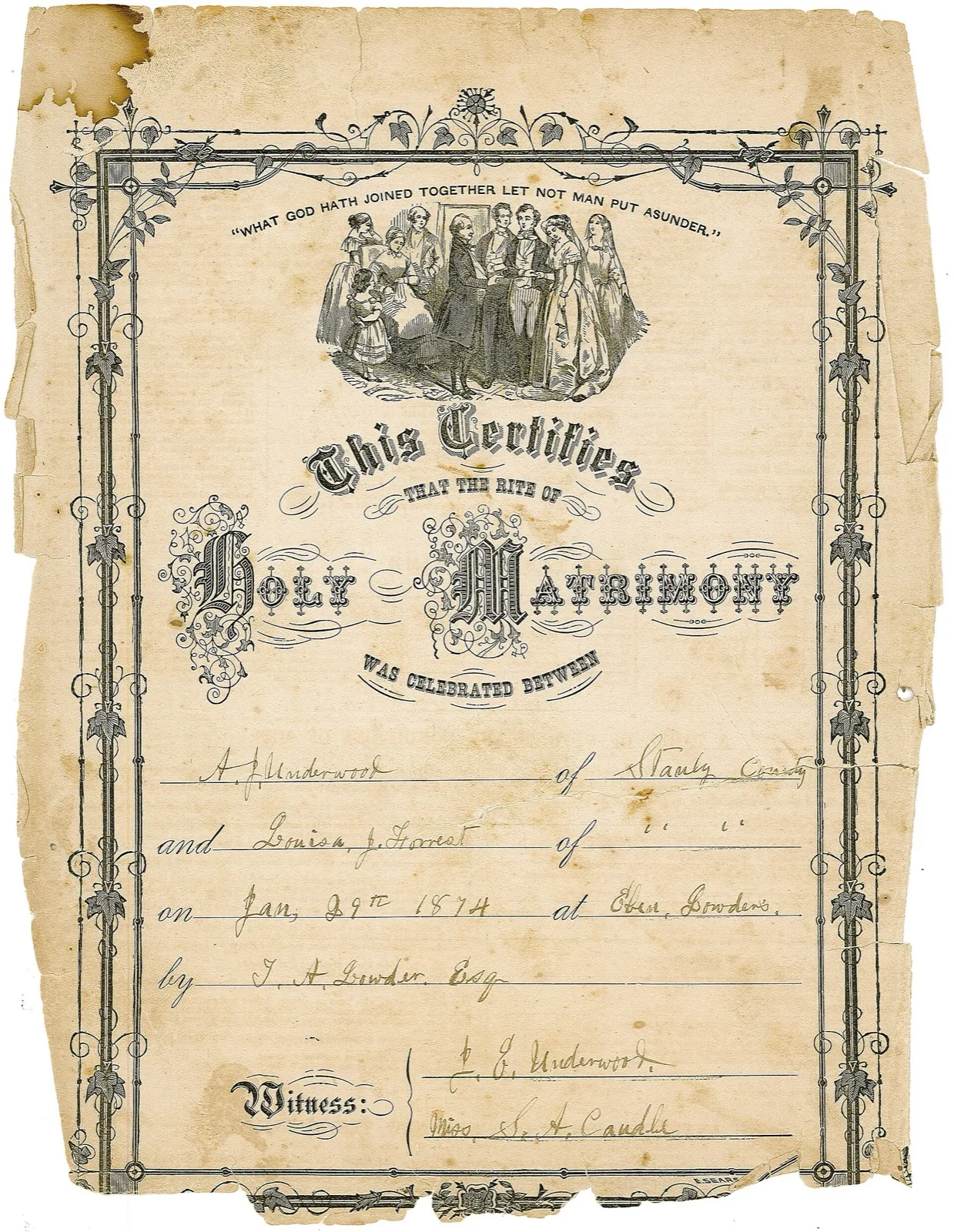 Marriage certificate from the Underwood family Bible: A. J. Underwood and Louisa J. Forrest, Stanly County, North Carolina, 29 January 1874. Stanly County Museum. Public domain.
Why does the format decide what survives?
The deeper lesson of the family Bible is that a record’s shape determines its content. People fill in what the page asks for. A form with three columns gets three facts. A gravestone gets a name, two years and, if the family is lucky, a line of verse. A census gets an age, an occupation and a birthplace. None of these is a bad record. Each is a narrow one, and the narrowness compounds: after a hundred years, the narrow record is often the only record left.
This is why the history of ordinary families looks the way it does. The rich commissioned portraits and memoirs. Everyone else got entries in other people’s ledgers: parish registers, ship manifests, pension files, and the front pages of the Bible. When we build a family tree, we are mostly assembling those entries. We end up knowing a great deal about when our ancestors lived and almost nothing about how.
The family Bible was the best domestic archive a household could have in 1851. It is worth asking what the equivalent is now. Most families have far more than three columns: thousands of photographs, years of messages, hours of incidental video. But most of it shares the Bible’s weakness in a different form. It records that people were present, at birthdays and holidays, without recording what they thought, remembered or meant. A phone full of party clips can be as silent about a person as a list of dates.
What should you do with a family Bible today?
If your family has one, it is worth treating as both a document and a prompt.
- Photograph every written page, including the inside covers and anything tucked between the leaves: funeral cards, pressed flowers, newspaper cuttings. Store the images in more than one place.
- Note the handwriting. Changes in hand often show who kept the record and when it passed from one person to another. A run of entries in the same ink may have been written all at once, years after the events, which matters for how far to trust them.
- Check the dates against other records. Bible entries are usually reliable, but later copies and recollections can drift.
- Find out who the names were. This is the step most families skip, and the one with a deadline. Somewhere there is probably a living relative who can look at a name in the Bible and say, “That was my grandmother’s sister. She ran the post office and never forgave her brother for selling the farm.” That sentence exists in no archive.
The best way to capture it is to film it. Sit an older relative down with the Bible, or with photographs of its pages, and ask them to go through the names one by one. Let them turn the pages. Let them pause. Objects are powerful memory cues, and an old book in the hands of someone who grew up with it will bring back stories that a list of questions will not. (For how to set this up well, see how to interview older family members.)
In more than a hundred life stories I have filmed since 2020, the moments that matter most are rarely the dates. They are the asides: the joke about a cousin, the half-sentence about a father, the detail about the light in a room. When I filmed four hours of my grandmother’s story, I already knew when she was born and when she married. What I did not have, until I asked, was her.
The column that was always missing
The printed family record had a heading for births, one for marriages and one for deaths. It never had a heading for the life. That was not a failure of love. For most of history, ink and paper and literacy were scarce, and three facts were what a family could afford to keep.
That constraint has gone. A phone can now hold a person’s face and voice telling their own story, which is a record no Bible page could contain. Apps such as Everyone are built around this: one question at a time, filmed and kept for the family. But the tool matters less than the habit. The families who kept Bibles were not wealthier or more literate than their neighbours; they were simply the ones who sat down and wrote the entry while the event was fresh.
The equivalent today is to sit down with the person while they are still here, and record the part the columns left out.