Your great-great-great-grandchildren could know you.
In 1888 a woman born around 1816 was filmed walking in a garden. Why your great-great-great-grandchildren could know you, and what it would take.
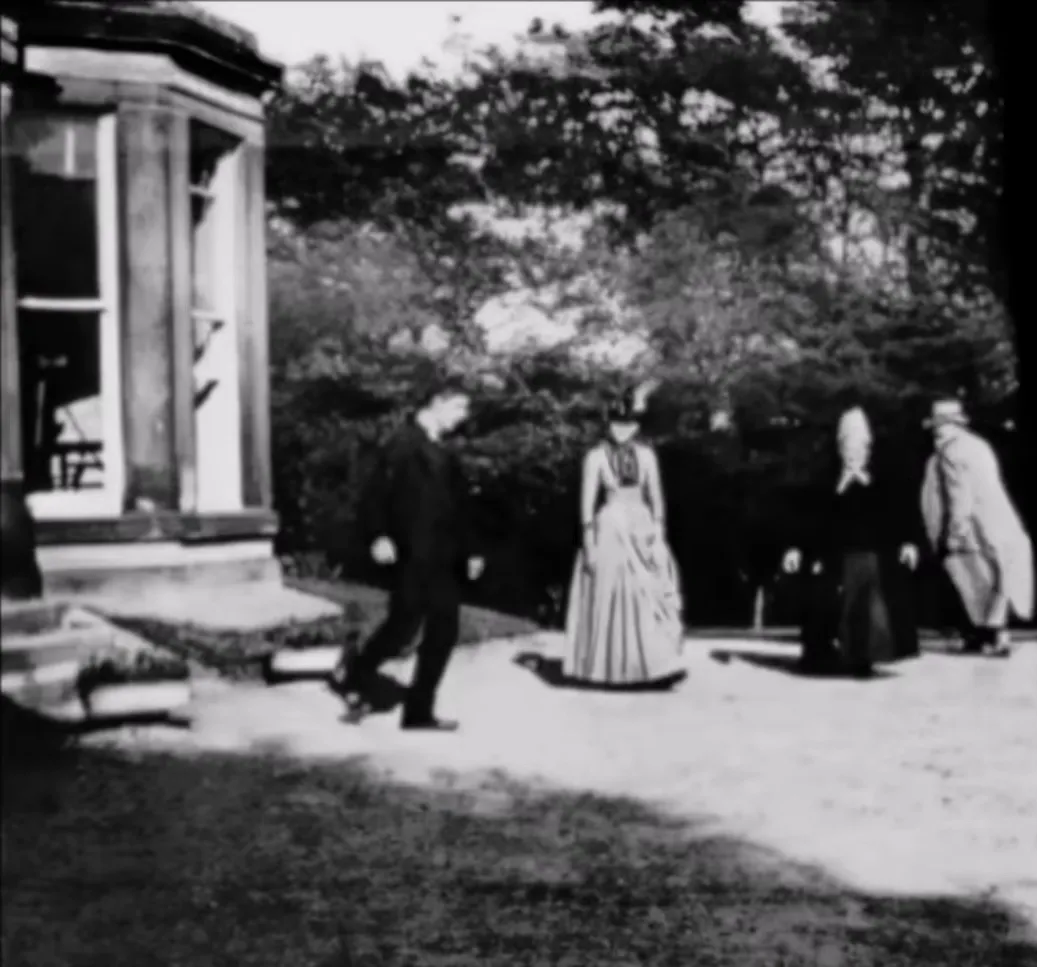
On 14 October 1888, in the garden of a house called Oakwood Grange in Roundhay, near Leeds, Louis Le Prince pointed a camera of his own design at four members of his family and filmed them walking in circles on the lawn. The film lasts a little over two seconds. It is usually described as the oldest surviving motion picture.
One of the four people is Sarah Whitley, the mother of Le Prince’s wife. She and her husband Joseph, who is also in the scene, were both born around 1816, which makes them among the earliest-born people ever to appear on film. In the frames, an elderly woman in dark clothes turns slowly on the gravel. Ten days later, on 24 October 1888, she died.
Sarah Whitley was born into a world in which no one could be seen by their descendants once they were gone, except through a painted portrait or, late in her life, a photograph. She became, by an accident of timing, one of the first people in history whose great-great-great-grandchildren could watch her move. Five generations after a woman born in 1816 brings us to roughly the 1960s, so if her family line continued, some of those descendants may well be alive today.
That is the subject of this piece. Your great-great-great-grandchildren will be born, on current patterns, sometime in the twenty-second century. For almost every human being who has ever lived, descendants at that distance were complete strangers. You are among the first generations for whom that is optional.
How far away are your great-great-great-grandchildren?
The anthropologist Jeffrey Fenner estimated in 2005 that the average generation in developed countries is about 31 years for men and 27 for women. Call it roughly 29. Five generations is therefore something like 140 to 150 years.
If you are in your thirties now, your great-great-great-grandchildren will probably be born around the middle of the twenty-second century. If each generation in your family has two children, there will be thirty-two of them. And each of those thirty-two will have thirty-two great-great-great-grandparents, of whom you will be one.
Try naming your own thirty-two great-great-great-grandparents, most of them born somewhere between the 1830s and the 1860s. Almost nobody can. As I wrote in the post on great-great-grandparents, most people cannot name even one of their sixteen great-great-grandparents, and family memory reliably fades after three or four generations. One generation further back is darker still. By default, that is exactly how your descendants will regard you.
Why have distant ancestors always been strangers?
The usual explanation is that families do not care enough, or that the records are poor. Neither is the main reason.
The main reason is that, until very recently, the only way for a person to reach five generations into the future was for someone to keep retelling their story. Memory travelled from mouth to ear, and each retelling passed on only a fraction of the last. A grandmother might tell a story about her own grandmother, but by the time it reached a great-great-great-grandchild it had passed through four or five narrators and been compressed to a sentence: she came out from Ireland, he was a blacksmith, she was very strict.
Writing should have changed this, and for a small minority of portrait sitters, diarists and letter-writers it did. But even those records preserve a strangely incomplete person. A letter contains what someone chose to say, filtered through the conventions of their time. A portrait shows what a painter, paid by the sitter, decided they should look like. Neither tells you how a person moved, what their voice sounded like, or how they behaved when they were not composing themselves for posterity.
That is why Sarah Whitley’s two seconds feel so different from a painting. There is nothing composed about them. She does not know what a film is. She is simply an old woman walking in her garden, and the camera records her as she was.
What would your descendants actually want to know?
It is tempting to assume that distant descendants would want your achievements. But what surprises us about people in old film is rarely what they did. It is the ordinary texture of their lives: how they walked, how they dressed, how they spoke, what they found funny. Some of that texture changes faster than we notice. In 2000 the phonetician Jonathan Harrington and his colleagues published an analysis in Nature of the vowels in Queen Elizabeth II’s Christmas broadcasts from the 1950s to the 1980s. They found that even the Queen’s accent, perhaps the most carefully maintained accent in Britain, had drifted measurably over three decades towards the speech of younger and less aristocratic speakers.
If a single voice shifts that much within one lifetime, consider how a voice from today will sound in 2150. The way you speak, the slang you use without thinking and the way you pronounce the names of places will all be historical evidence. So will the things you consider too mundane to mention: what your kitchen looked like, what a weekly shop cost, how you spent a Sunday, what you worried about at three in the morning.
Your descendants will be able to read the history of your century in detail. No history book will give them you, explaining in your own voice what it was like.
What did it take to reach five generations?
For most of history, the honest answer was luck plus wealth.
Consider Le Prince himself. He was an inventor of considerable ability, and in the autumn of 1888 he had a working motion-picture camera, years before the inventions that would make others famous. Then, on 16 September 1890, he boarded a train from Dijon to Paris and was never seen again. His body and luggage were never found, and his disappearance is still unexplained.
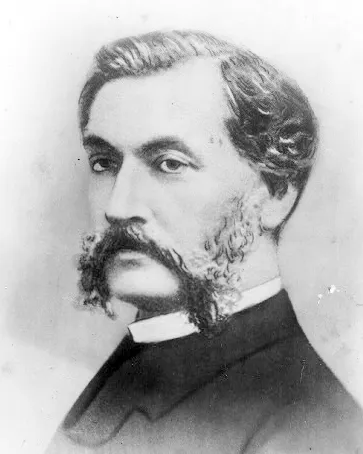 Louis Le Prince, 1880s. Photographer unknown. Public domain.
What survives of Sarah Whitley is even more fragile: a few frames of film, preserved because they happened to be part of the history of cinema. She was not filmed because anyone thought her descendants would want to see her. She was filmed because she was standing in the garden on the day an inventor wanted to test his camera.
That is how nearly everyone who reaches across five generations has done it, by accident. The difference now is that it can be done on purpose. The equipment that Le Prince spent years building is in almost every pocket, and it records sound as well as image, in colour, for hours rather than seconds.
Will a video still exist in 150 years?
The obvious objection is that digital files are fragile. It is a fair one. In 2015 the internet pioneer Vint Cerf warned the American Association for the Advancement of Science of a possible “digital Dark Age”, in which files survive but the software and hardware needed to read them do not. The BBC’s Domesday Project, which I discussed in what happens to your photos and videos when you die, became largely unreadable within about fifteen years of its creation.
But the history of the Roundhay film points to the real lesson. The original paper film did not survive. What survived was a copy: in the 1930s the Science Museum in London made a photographic glass-plate copy of twenty surviving frames from the original negative, which was later lost. Those frames were printed onto 35 mm film, and the version we watch today descends from that copy. The two seconds survived because people kept moving them from one medium to the next.
The same rule applies to any recording you make. A video kept in one account, under one person’s password, is unlikely to survive 150 years. One shared among several family members, in a common format, and copied whenever technology changes has a far better chance. It also needs a label. Say your full name, the date and where you are at the start of each recording, because your descendants will not know who you are unless you tell them.
Why does any of this matter?
There is a reasonable objection that people in 2150 will have their own lives to worry about, and will not care.
Some will not. But the enormous popularity of family history suggests that, given the chance, many people want to know where they came from, and that the desire tends to grow with age. The research of Marshall Duke and Robyn Fivush at Emory University, which I described in questions to ask your parents about their life, found that children who knew more about their family’s history tended to be more resilient. People draw strength from the sense of belonging to a story larger than themselves. For most of history, that story ran out after a few generations because the material ran out.
I have four hours of my grandmother telling me the story of her life. She has since passed away. It is already the most valuable thing my family owns, and I expect it to become more valuable with each generation that has no other way of meeting her. Since 2020 I have filmed more than a hundred life stories through The Archive, and the same thing holds every time: the recording matters most to people who were not in the room.
What would it take for them to know you?
Less than you might think. Sarah Whitley reached her great-great-great-grandchildren with two seconds of silent film she did not know was being made. You can leave hours, in your own voice, deliberately.
A practical minimum:
- Record yourself, not only your elders. Most people film their grandparents and forget that they will be someone’s ancestor too. (There is more on this in how to record your life story.)
- Speak to the future directly. Begin with your name, the date and the year you were born.
- Describe the ordinary. Your house, your work, your day, your prices, your worries. These are what will seem most foreign in 2150.
- Tell stories, not summaries. One story per recording, a few minutes each.
- Keep several copies with several people. Survival depends on copying.
The Everyone app was built to make this easy: it asks one question at a time and keeps each answer as its own short video. But any phone will do. The point is not the tool. It is that, for the first time, the people who will descend from you in 150 years can see and hear you, and whether they do is now mostly a matter of whether you choose to leave something for them.