What to say in a legacy video for your children, and what they will actually want.
Most legacy videos are full of advice. What children want later is the person. Legacy video questions that capture who you are, and the reasoning behind them.
On 18 September 2007, Randy Pausch, a computer science professor at Carnegie Mellon University, gave a lecture called “Really Achieving Your Childhood Dreams”. A month earlier he had been told that his pancreatic cancer was terminal and that he had months to live. He had three children, all under six. For an hour he talked about his childhood ambitions, told jokes, showed slides and at one point dropped to the floor to do push-ups. Then, near the end, he explained what the lecture had really been. “The talk’s not for you,” he told the audience. “It’s for my kids.”
The recording was watched by millions, but its intended audience was three. It is probably the best-known legacy video ever made, and it is worth noticing what kind it was. Pausch did not sit in front of a camera and list instructions for his children’s lives. He let them watch him being himself, and let the lessons come through on the way.
That distinction is the subject of this post. When people sit down to record a message for their children, they almost always reach for advice. What the children usually want, years later, is something else. Choosing the right legacy video questions is mostly a matter of understanding that gap.
Why do people fill legacy videos with advice?
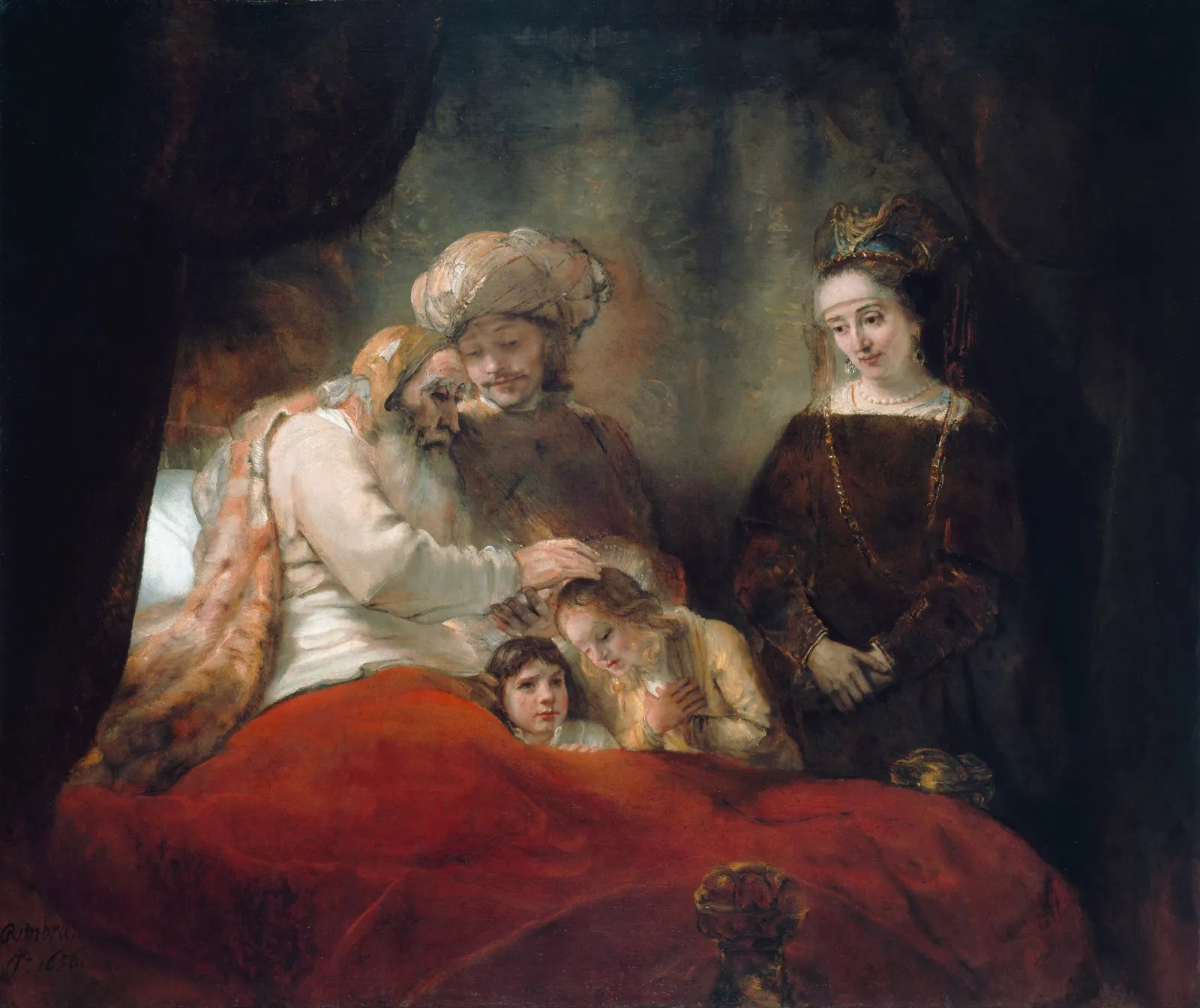
The instinct is very old. In Genesis, the dying Jacob gathers his sons around his bed and speaks to each in turn, and Jewish tradition treats that scene as the model for the tzava’ah, or ethical will: a document in which a parent passes on not property but values. Rabbis and ordinary families wrote them for centuries, and many people still do. The modern legacy video is, in most cases, an ethical will with a camera pointed at it.
Advice feels like the most useful thing a parent can leave. The difficulty is that advice ages badly and travels poorly. Recorded for a twenty-five-year-old you have never met, it tends to come out general: work hard, be kind, look after your mother. These are good principles. They are also principles your children will hear from many other people, and that most of them will already hold. The one thing nobody else can give them is you.
What did Glückel of Hameln actually leave her children?
The clearest historical example of this gap was written in Yiddish in the 1690s.
Glückel of Hameln was a Jewish businesswoman from Hamburg. When her husband, Chaim, died in 1689, she was left with a large family and his trading business to run. About two years later she began writing what she called books for her children, partly, she said, to get through the sleepless nights of her grief. She wrote five of them by 1699, stopped, and returned years later to add two more. They were never meant for publication. Her original manuscript is lost, but her son Moses and a son-in-law had copied it out, and the copies survived for two centuries before the memoir was printed in 1896.
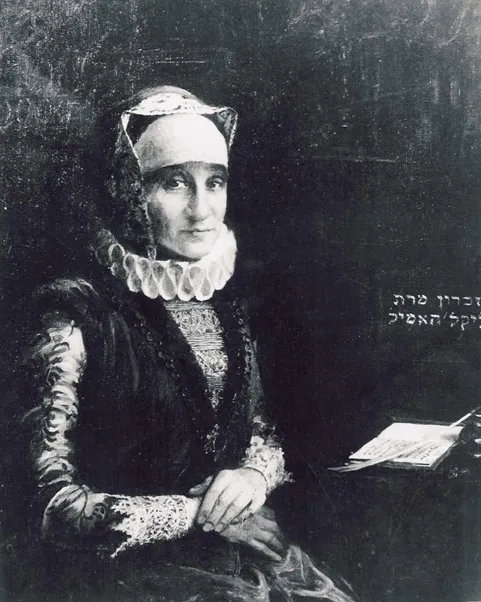 Bertha Pappenheim, who translated Glückel’s memoir into German, painted in the costume of Glückel by Leopold Pilichowski. Reproduced in 1925; the original is lost. Public domain.
Glückel intended much of the work as moral instruction. It is full of exhortation, pious reflection and folk tales chosen to teach her children how to live. But that is not why the book is still read. Historians value it because it is one of the most detailed accounts of Jewish family life in seventeenth-century Germany that survives, written by a woman, in her own voice. She describes negotiating her children’s marriages, the anxieties of trade, outbreaks of plague, and the frenzy of 1666, when many Jews believed the messiah had come in the person of Sabbatai Zevi. Her father-in-law, she writes, packed barrels of linen and provisions in readiness to leave for the Holy Land. The barrels stayed packed for a long time, waiting for a summons that never came.
Three hundred years later, the advice reads as the conventional piety of its age. The barrels are unforgettable. That is the pattern in miniature: what a parent thinks is the message and what the descendants treasure are often different things.
What do people value most after a parent has gone?
There is a body of research on this, from an unexpected source. In the early 2000s the Canadian psychiatrist Harvey Max Chochinov developed an approach for people in palliative care called dignity therapy. A trained interviewer asks the patient a short set of questions, records the conversation, and turns the transcript into a document the patient can leave to their family.
The questions are revealing in their balance. One asks, “Tell me a little about your life history, particularly the parts that you either remember most, or think are the most important.” Others ask when the person felt most alive, what roles they have played, what they are proudest of, and what they would want their family to know about them and remember. Only near the end does the protocol ask for advice or words of guidance. The life comes first; the lessons follow from it.
In a 2007 study led by Susan McClement, sixty bereaved family members were asked about the documents months after their relative had died. Ninety-five per cent said the process had helped the patient, and 78 per cent said the document had helped them in their own grief. It was a survey rather than a controlled trial, so the numbers should be held lightly. But they are consistent with what I have seen filming more than a hundred life stories through The Archive since 2020. When families watch the recordings later, the moments they return to are rarely the summaries of wisdom. They are the stories, the tangents, and the way a person laughs halfway through a sentence.
What should you say in a legacy video?
If the goal is to leave your children the person rather than the lecture, the questions should be weighted the same way dignity therapy weights them: mostly life, a little advice. Here is a set of legacy video questions, grouped so that you can record a few at a time.
Who you were before them
- Where did you grow up, and what did the house sound and smell like?
- What did you want to be when you were the age your child is now?
- Who were your closest friends at fifteen, and what did you get up to?
- What did your own parents get right, and what did they get wrong?
The turning points
- Tell me about a decision that changed the direction of your life.
- When did you feel most alive?
- What is something you failed at, and what happened next?
- How did you meet the people who became your family?
Them
- What do you remember about the day each of your children was born?
- What were they like as small children, in specific detail?
- What do you see in them that they may not see in themselves?
The ordinary
- Describe an ordinary weekday in your life right now, from waking up to going to bed.
- What makes you laugh, reliably?
- What are you worried about at the moment, and what are you looking forward to?
What you would pass on
- What have you learnt that took you far too long to learn?
- Is there anything you would want to say to your children at particular moments: leaving home, a wedding, the birth of a child, the death of a parent?
Notice how few of these ask for advice directly. The open-ended questions do most of the work, for reasons I explored in how to interview someone using open-ended questions. Advice that emerges from a story (“and that is why I have never lent money to a friend”) is remembered. Advice delivered as a list is not.
How do you record it so it is watched?
A few practical principles follow from the argument.
- Record in short pieces. A three-minute answer to one question will be watched many times. A ninety-minute monologue will be watched once, if at all.
- Do not wait for a diagnosis. Pausch recorded his lecture because he knew he was dying. Most people do not get that warning, and many of the best legacy recordings are made by people in good health, simply because they decided to. Recording your own life as it happens also gives your children something no deathbed message can: you at different ages.
- Have someone ask the questions. Talking to a person rather than a lens makes you warmer and more specific. A partner, a friend or one of the children can be the interviewer.
- Film indoors, in a quiet room, with things around you that mean something. A familiar chair or a shelf of your own books gives the video a sense of place. More on the set-up in how to film an interview at home.
- Use video, not only writing. Glückel’s children had her words, which is a great deal. They did not have her face or her voice. A video carries both, and with them all the information that a transcript strips out. I made the longer case for this in why recording a life story on video beats writing.
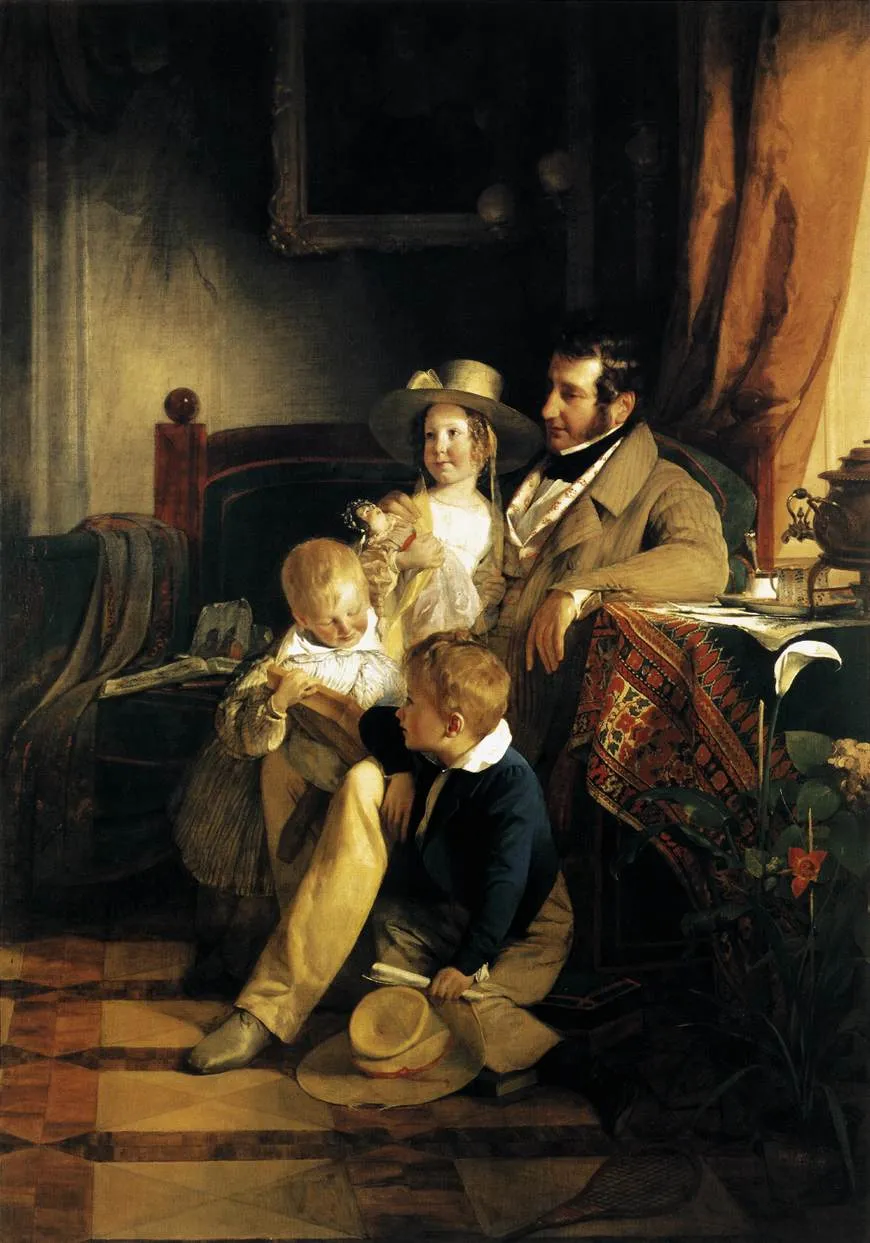 “Rudolf von Arthaber with his Children” by Friedrich von Amerling, 1837. Belvedere, Vienna. The small picture in the scene is said to show the children’s late mother. Public domain.
The head fake
Pausch described the central idea of his lecture as a “head fake”: the best way to teach somebody something, he said, is to have them think they are learning something else. It is also the best description I know of a good legacy video. You set out to tell your children about your childhood, your mistakes and your ordinary Tuesdays. What they receive, years later, is a sense of who their parent was, and from that, more of your values than any list of advice would have carried.
I have four hours of my grandmother telling me her life story. She has since passed away. There is very little advice in those four hours. There is a great deal of her, and that has turned out to be the part that matters.
The Everyone app was built for exactly this: it asks one question at a time and keeps each answer as its own short video, so the recording can be made in pieces, over weeks, while there is no hurry. But a phone and an afternoon are enough to begin. The hard part is not the technology. It is deciding that your children will one day want to know you, and starting before you have to.