Is oral history reliable? What the mistakes reveal.
People misremember dates, places and numbers. So is oral history reliable? Why historians came to treat memory's errors as evidence, not just as mistakes.
On 17 March 1949, a young steelworker named Luigi Trastulli was shot dead by police in Terni, an industrial town in central Italy. He had joined a protest against Italy’s entry into NATO. Decades later, the historian Alessandro Portelli began interviewing the people of Terni about their lives, and many of them told him about Trastulli’s death. A striking number of them got the date wrong. They placed it not in 1949 but in 1953, during the bitter strikes and street fighting that followed mass layoffs at the town’s steelworks.
These were not careless witnesses. Some had been there. And the mistake was not random: it moved the death four years forward, out of a political protest that had failed and into a fight over jobs that defined the town.
The obvious conclusion is that memory cannot be trusted, and that oral history, which depends on it, is a second-rate source. Portelli drew the opposite conclusion, and his reasoning is the best answer I know to a question that anyone who records family stories eventually asks: is oral history reliable?
Why do historians doubt oral history?
The case against is real, and it is worth stating at full strength.
Memory is not a recording. It is rebuilt each time it is used, and it drifts. Frederic Bartlett showed in the 1930s that stories retold over time become shorter, smoother and more conventional; Ulric Neisser showed in the 1980s that people’s vivid memories of where they heard about the Challenger disaster had changed within three years, often completely. I have written about both studies before, in why old people repeat the same stories and how to record your life story while you are living it. The short version is that an honest, confident witness can be wrong about who was there, what was said and when it happened.
Oral accounts have other weaknesses too. They are given long after the event, by people who know how things turned out. They are shaped by the interviewer, by what the speaker thinks the listener wants to hear, and by the stories the community already tells about itself.
So if the question is “Will an oral account give me the correct date?”, the answer is often no. The interesting question is whether that is the only question worth asking.
What did the Terni mistake reveal?
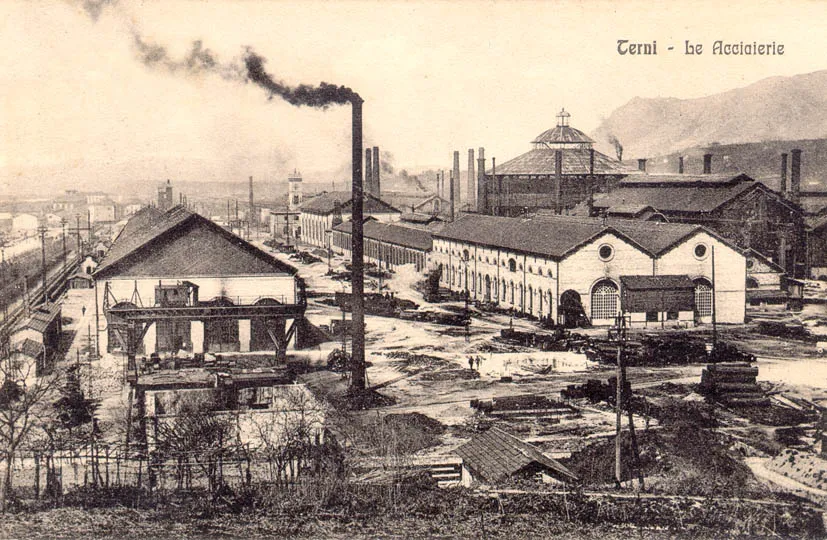 The steelworks at Terni on a postcard from about 1912. Unknown photographer. Public domain.
Portelli did not treat the misdated death as noise to be corrected and discarded. He treated it as data. If many people independently moved an event to the wrong year, the movement itself was telling him something about how the town understood its past.
His reading, set out in his essay “The Death of Luigi Trastulli: Memory and the Event”, was roughly this. In 1949 a worker had been killed at a demonstration about foreign policy, and nothing had come of it. The death was hard to fit into a meaningful story. In 1953, by contrast, the town had fought for its jobs, and that struggle became the centre of its working-class identity. Relocating Trastulli’s death into that struggle gave it a place and a purpose. It turned a death that seemed to mean little into a sacrifice that meant a great deal.
None of this makes 1953 the correct date. Documents settle that, and they say 1949. What the oral accounts provide is something the documents cannot: evidence of what the event meant to the people who lived with it, and how that meaning reshaped the memory over time. Portelli’s broader argument was that an oral source can be factually wrong and still psychologically true, and that the second kind of truth is often what historians most need and least often find.
Can a witness be wrong and still tell the truth?
The psychiatrist Dori Laub, who co-founded the project that became Yale’s Fortunoff Video Archive for Holocaust Testimonies, described a case that makes the point more sharply.
A woman who had been a prisoner at Auschwitz gave a filmed testimony in which she described the uprising of October 1944, when members of the Sonderkommando, the prisoners forced to work in the crematoria, revolted. She remembered four chimneys going up in flames. When the testimony was shown at a conference, historians objected. Only one crematorium had been blown up in the revolt, so her account was inaccurate, and in their view a witness who was wrong about something so concrete could not be relied on for the rest. Accuracy mattered, they argued, because Holocaust deniers would seize on every error.
Laub disagreed. In his account, she was testifying not to the number of chimneys but to “the reality of an unimaginable occurrence”: that prisoners in Auschwitz had risen up at all, which to her had seemed impossible. The scale of her memory matched the scale of what the event meant to her.
Both sides had a point. The number was wrong, and it mattered for the factual record. But discarding the testimony because of the number would throw away the one thing only she could supply. The lesson is not that facts do not matter. It is that oral testimony answers different questions from documents, and is judged badly when it is judged only by the questions documents answer.
When is memory surprisingly accurate?
The case for oral history is not only that its errors are meaningful. Sometimes memory, carried carefully, is astonishingly reliable over spans that no written record can match.
In 2015 the geographer Patrick Nunn and the linguist Nicholas Reid published a study of Aboriginal stories from twenty-one places around the Australian coast. Each story described a time when the coastline was further out: land that could once be walked on, before the sea came in and covered it. The researchers compared each account with the known history of sea-level rise after the last ice age, and calculated when the coast would last have looked as described. Their answer was more than seven thousand years ago, and in some cases much longer.
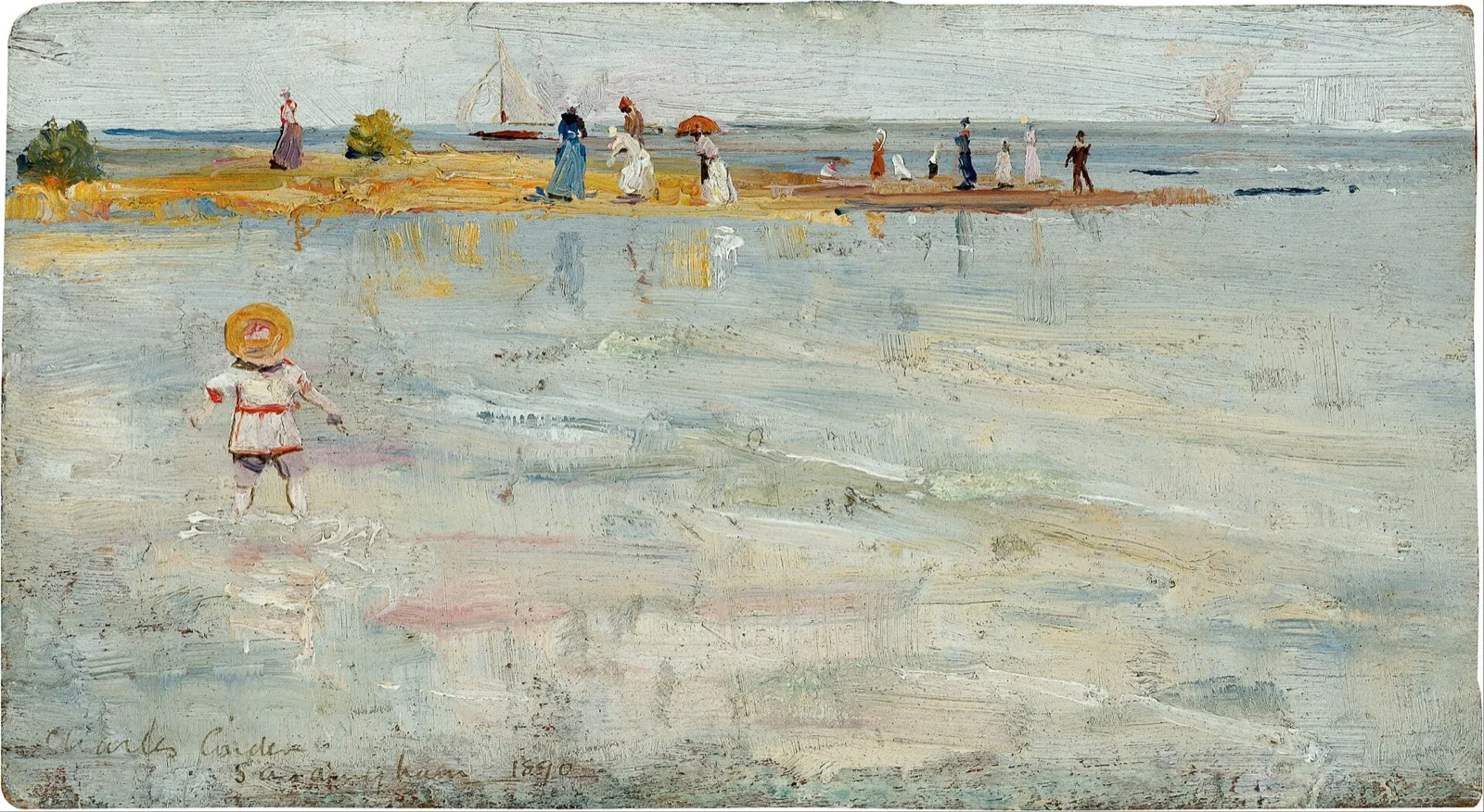
One of the best-known examples comes from Port Phillip Bay, the bay in the painting at the top of this page. Accounts recorded in the nineteenth century describe the bay as once having been dry land, a hunting ground, before the sea broke in. Geologists agree that during the last ice age, when sea levels were far lower, the bay was dry land, and that the sea flooded it thousands of years ago.
The argument is debated. Critics have pointed out that the stories cannot be dated independently, and that some were recorded and possibly reshaped by European collectors. But even with those caveats, it suggests something important. Memory degrades fastest when it is casual: a single person, a single event, recalled once after many years. It holds up best when it is deliberate, repeated and shared, when a community treats a story as something to be passed on intact. I touched on this in the story of Kushim, the first name in writing; oral cultures were not waiting for writing to rescue them.
Are written sources more reliable?
It is tempting to treat documents as the solid ground against which memory is measured. Often they are. But documents are also written by people, for purposes, after the fact.
A police report is a witness account written by one side of an incident. A newspaper story is assembled from interviews, frequently on deadline. Minutes of a meeting record what the secretary thought worth recording. Portelli made this point too: many written sources are oral sources that someone has transcribed and tidied, and the tidying hides the uncertainty rather than removing it. A document that is wrong looks exactly as authoritative as one that is right.
The sensible position is that no single source is reliable on its own. Historians cross-check: documents against documents, testimony against testimony, both against physical evidence. Oral history earns its place in that process not because it is always accurate but because it captures things nothing else does, above all the experience of ordinary people who never wrote anything down. That is the argument I made at more length in why capturing life stories matters for all of humanity.
How do you make an oral history more reliable?
For anyone recording a parent or grandparent, the research points to a few practical habits.
- Ask for specifics, gently. “Where were you living then?” and “Who else was there?” anchor a memory in time and place, and give you details you can check later.
- Do not lead. A question that contains its own answer (“You were scared, weren’t you?”) is one of the easiest ways to change a memory. Open questions are safer, as the guide to conducting an oral history interview explains.
- Check what can be checked, afterwards. Dates, addresses and names can often be confirmed with certificates, letters or newspapers. Do it after the interview, not during it; correcting someone mid-story tends to end the story.
- Keep the error. If Grandpa says he arrived in 1951 and the ship’s manifest says 1952, note both. Do not edit his version out of the record. Which year he remembers, and why, may turn out to be the more interesting fact.
- Record sooner. Every year of retelling smooths a memory further. The best time to capture a story is before it has settled into its final shape.
- Record on video. A transcript keeps the words. A video keeps the hesitation before an answer, the change in voice, the moment someone stops and corrects themselves. These are exactly the signals that tell a later listener how certain the speaker was, and what the memory cost them to tell.
What is oral history actually good for?
In filming more than a hundred life stories through The Archive since 2020, I have heard plenty of dates that were probably wrong and names that were certainly misspelt in memory. I have never heard a story that was worthless because of it. When I listen back to the four hours I recorded with my grandmother, who has since passed away, I do not care whether every year is correct. I care that it is her telling it: what she chose to include, where she paused, what still made her laugh.
That is the real answer to whether oral history is reliable. As a source of exact dates, it is unreliable and should be checked. As a source of what a life was like and what it meant to the person who lived it, it is the most reliable source there is, because it is the only one. The documents will survive whether or not anyone records your family. The meaning will not.
The Everyone app was built for exactly this kind of recording: one question at a time, each answer kept as a short video in the speaker’s own face and voice. Whatever you use, the errors can be corrected later. The person cannot be asked later.