
How to write a eulogy, and why their stories make it easier.
Most eulogies are written in a few days, in grief, by someone who realises how little they know. How to write a good one, and how to make it easier.
Most eulogies are written in less than a week. Someone dies, a date is set for the funeral, and a son, a daughter or an old friend sits down in the evenings between phone calls and paperwork to write five minutes that are supposed to sum up a life. It is one of the few pieces of writing most people will ever be asked to produce under real pressure, and it is usually done while grieving.
If you are searching for how to write a eulogy, you are probably in that position now. This piece will help you write one. It will also make an argument that is easy to miss in the moment: the hardest part of a eulogy is rarely the writing. It is discovering, often for the first time, how much of the person’s life you never asked about.
What is a eulogy actually for?
The word comes from the Greek eulogia, from eu, “well”, and logos, “word”: speaking well of someone. That definition is older than it sounds, and the history of the form explains a good deal about why some eulogies work and others do not.
The most famous funeral speech of the ancient world, Pericles’ oration for the Athenian dead in the first year of the Peloponnesian War (431 BCE), as recorded by Thucydides, says almost nothing about the people being buried. It is a speech about Athens: its democracy, its openness, its superiority to its enemies. The dead are honoured as examples of a civic ideal, not as individuals.
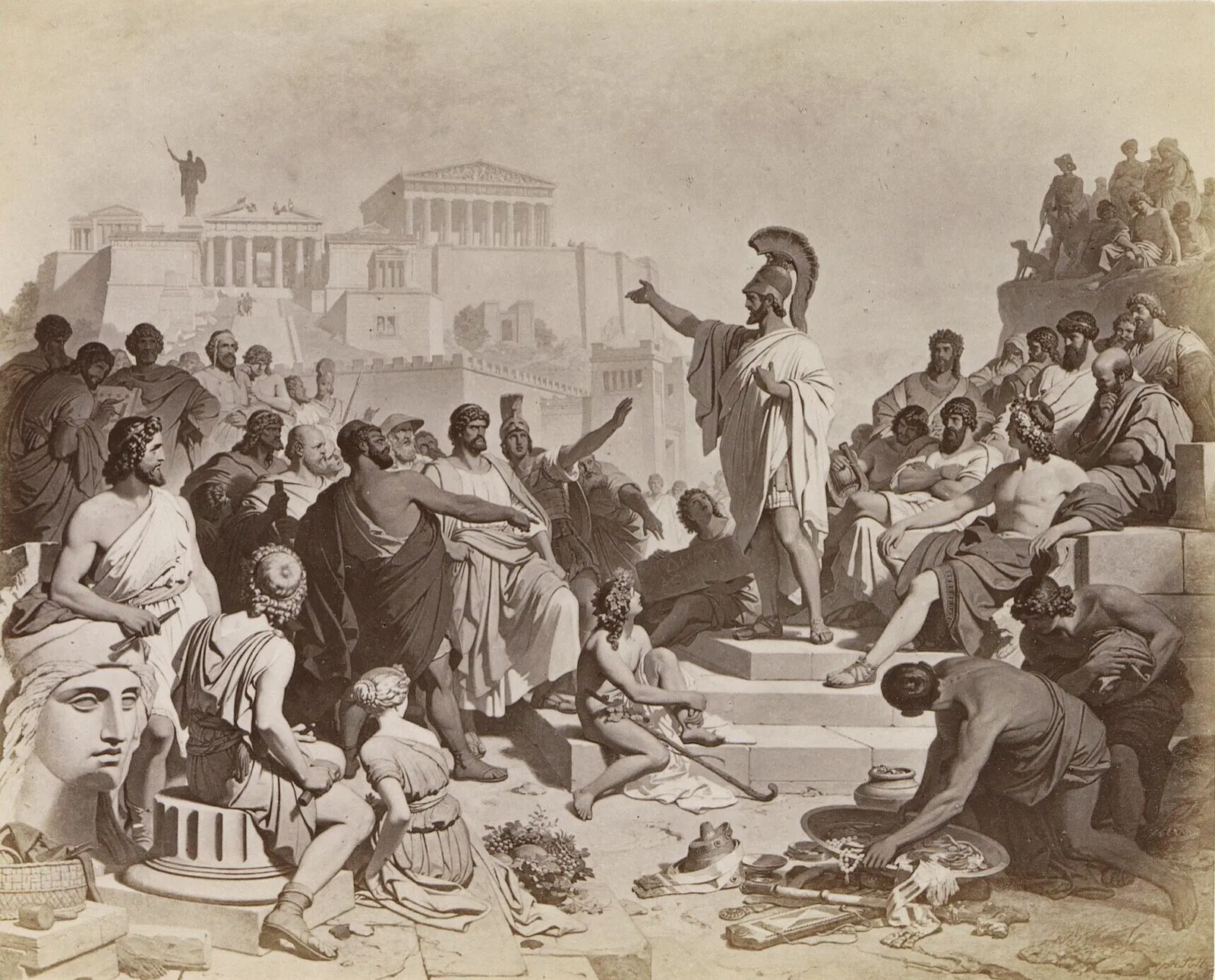 Photograph of Philipp Foltz’s painting of Pericles delivering the funeral oration, c. 1875–80. Rijksmuseum, Amsterdam. CC0.
The Romans did something more personal. The Greek historian Polybius, writing in the second century BCE, describes how a leading Roman family would carry its dead to the Forum, where a son or relative would mount the speaker’s platform and recount the dead man’s virtues and achievements. Actors wearing wax masks of the family’s ancestors sat beside him, and the speaker went on to recount the deeds of each of those ancestors in turn. The eulogy was a way of placing one life inside a family story that stretched back generations.
The most moving Roman example, though, is not a speech by a politician. It is an inscription now known as the Laudatio Turiae, carved in the late first century BCE by a husband for his dead wife. (Her name has not survived with certainty; “Turia” is a scholarly guess.) What makes it remarkable is how specific it is. He describes how she pursued justice after her parents were murdered, how she protected him during the civil wars and pleaded for his life, and how, when they could not have children, she offered to step aside so that he could remarry. He refused. He notes that marriages as long as theirs, about forty years, ended by death rather than divorce, were rare.
Two thousand years later, we know almost nothing about this couple except what he chose to say. That is the first lesson of the eulogy: the abstract praise has faded, and the specific stories are what last.
Why are most eulogies so hard to write?
Most people sit down to write a eulogy and find that they have plenty of feelings and very little material. They know the person was kind, hard-working, funny and devoted to their family. They have a handful of memories from their own relationship. Beyond that, the life has surprising gaps: what the person was like at twenty, how they met their partner, what they were afraid of, what they were proud of, why they made the decisions that shaped everyone else’s lives.
There is a reason for this. Most of what we know about our parents and grandparents comes from the period in which we knew them, which is usually the second half of their lives. The first half, the part that formed them, reaches us second-hand, if at all. Families often realise this at the funeral, when an old friend tells a story nobody in the family had heard.
The result is a familiar kind of eulogy: a list of adjectives, a few dates, and a sense in the room that the person being described is somehow smaller than the person who lived.
How to write a eulogy, step by step
The method below works whether you have weeks or a few evenings.
1. Gather before you write. Spend the first session collecting, not composing. Call the people who knew the person at different stages of their life: siblings, old friends, colleagues, neighbours. Ask each of them for one story, not one word. “What is something she did that you still think about?” produces far better material than “How would you describe her?” The same principle applies to any interview: open questions retrieve specific memories, closed ones retrieve summaries.
2. Look for the person’s own words. Letters, cards, emails, voice messages and videos are the most valuable material you will find, because they let the person speak at their own funeral. A phrase they always used, a piece of advice they gave, a line from a birthday card: a sentence in their voice will do more than a paragraph in yours.
3. Choose a shape, not a timeline. A strict chronology from birth to death tends to become a recitation. A better structure is a small number of themes, each carried by a story. For example: what she was like as a young woman; what she was like as a mother; the thing she cared about most. Three or four stories, chosen well, will say more than thirty facts.
4. Show the qualities instead of naming them. Do not say he was generous. Tell the story of the time he drove four hours to help someone move house and refused to be thanked. The audience will supply the adjective themselves, and they will believe it more because they reached it on their own.
5. Include the flaws gently. The most credible eulogies admit that the person was a real human being. A stubborn streak, a terrible sense of direction, a habit of being late to everything. Affectionate honesty makes the praise believable, and it is often where the laughter comes from. Laughter at a funeral is not disrespect; it is recognition.
6. Keep it to about five to seven minutes. At a typical speaking pace of roughly 130 to 150 words a minute, that is somewhere between 700 and 1,000 words. Funerals often have several speakers, and a shorter eulogy delivered calmly is better than a longer one rushed.
7. Read it aloud before the day. Written sentences are often too long to say in one breath. Reading aloud shows you where to cut, where to pause, and which lines are likely to make your voice catch, so they will not surprise you at the lectern. Print it in a large font. Bring a glass of water.
What makes a eulogy memorable?
The writer David Brooks drew a distinction, in The Road to Character (2015), between what he called résumé virtues and eulogy virtues. Résumé virtues are the skills you bring to the job market. Eulogy virtues are the things people talk about at your funeral: whether you were kind, brave, honest, faithful, what kind of relationships you formed.
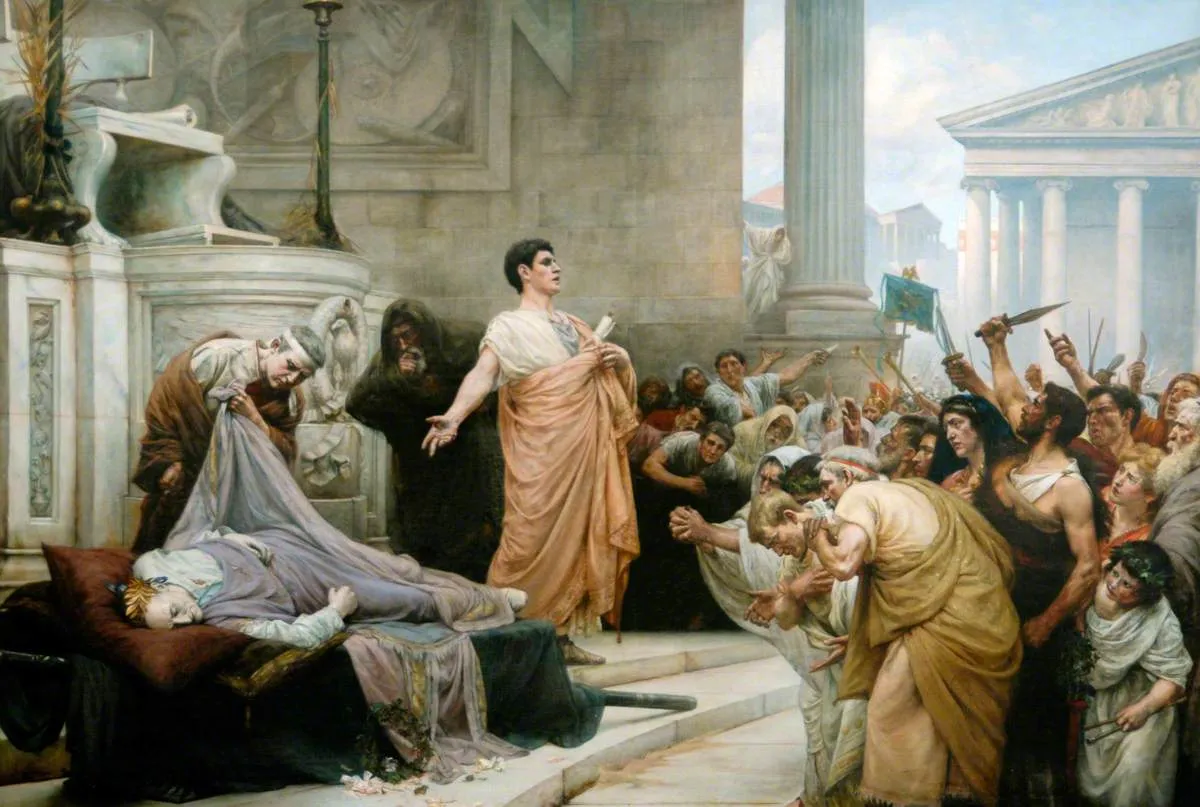 “Marc Antony’s Oration at Caesar’s Funeral” by George Edward Robertson, late 19th or early 20th century. Public domain.
The distinction is useful for anyone writing a eulogy, because it tells you what to leave out. Job titles, awards and dates matter less than you think. What the audience wants to hear is evidence of character, and character is revealed almost entirely through stories: what someone did when it was difficult, how they treated people who could do nothing for them, what made them laugh.
The ancient world understood the power of this better than we sometimes credit. According to the Roman historians, Mark Antony’s funeral for Julius Caesar in 44 BCE turned the crowd against the assassins less through argument than through concrete detail: the reading of Caesar’s will, and the display of his bloodied robe. Shakespeare later built one of the most famous speeches in English around the same instinct. Specifics persuade. Generalities are forgotten before the reception.
Why recorded stories make a eulogy easier
Everything above depends on material, and material is exactly what a family does not have when someone dies unexpectedly, or when they die before anyone thought to ask.
Now consider the alternative. If someone has recorded a parent or grandparent telling their life story, the eulogy writer starts with an extraordinary advantage. The gaps in the first half of the life are filled. The dates are correct. The stories are told the way the person told them, with their phrasing and their jokes. Some families play a short clip of the person speaking during the service, so that the last word at the funeral belongs to the person being remembered.
Since 2020 I have filmed more than a hundred life stories, including those of Holocaust survivors and people in my own family. I have four hours of my grandmother telling me about her life before she died. Whoever speaks about her in future, at a gathering or simply to a great-grandchild, has her own account to draw on rather than a handful of half-remembered details.
This is the uncomfortable truth behind every eulogy: it is written after the person dies, but the material for it has to be gathered while they are alive. The questions you wish you could ask while writing a eulogy are the same questions you could ask a parent this weekend. A useful starting list is these questions to ask your parents about their life, and there is a reason the most important ones tend to occur to us too late: see questions I wish I had asked my parents.
The eulogy you can prepare now
Nobody wants to think about the eulogy they will one day give for a parent. But the most common regret people describe after a death is not anything they did. It is the conversation they never had, which, as the research on the regrets of the dying suggests, tends to grow heavier with time.
Recording a life story does not need to be framed as preparation for a funeral. It is better understood as getting to know someone properly while they can still answer. The practical side is simple: a phone, a quiet room and a list of good questions (see how to capture someone’s life story on video). Everyone, the app we built for this, guides you through it one question at a time.
If the time to write a eulogy has already come, write it from the stories you can gather, in the person’s own words wherever you can find them. If it has not, the best eulogy you will ever give may be the one you start preparing today, simply by asking.


