Memento mori, and what remembering death is really for.
Memento mori means “remember that you will die”. For two thousand years it was a tool for spending time well. Its most useful form today is about other people.
Under the church of Santa Maria della Concezione dei Cappuccini in Rome, a few minutes’ walk from the Spanish Steps, there is a series of small chapels decorated entirely with human bones. When the Capuchin friars moved to the church in 1631, they are said to have brought around three hundred cartloads of the remains of their dead brothers with them. Over the following century and a half, the bones of several thousand friars were arranged into arches, rosettes and chandeliers. In one of the chapels a placard, in five languages, addresses the visitor directly: What you are now we used to be; what we are now you will be.
This is the idea known as memento mori, Latin for “remember that you will die”. It is usually treated in one of two ways: as a gloomy medieval obsession, or, more recently, as a productivity slogan stamped on coins and desk ornaments. Both miss what it was for. For most of its history, memento mori was a practical tool for correcting a predictable mistake in how people spend their time. And the most useful version of it today is not about your own death at all.
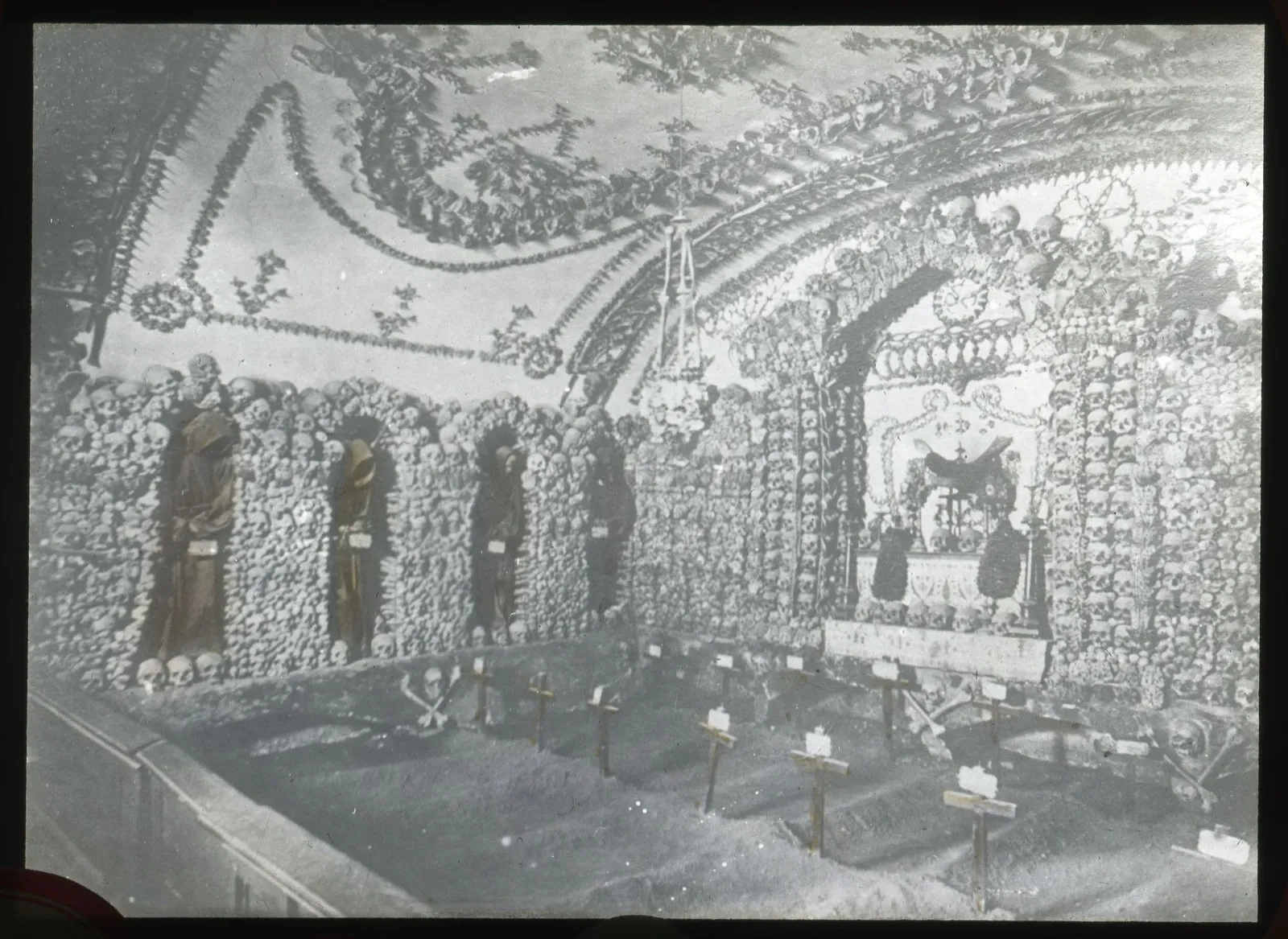 The Capuchin Crypt beneath Santa Maria della Concezione, Rome. Lantern slide by Edmund F. Arras, 1913. Public domain.
What does memento mori mean, and where does it come from?
The phrase is often linked to a scene from the Roman triumph, the parade granted to a victorious general. A slave, the story goes, stood behind him in the chariot and whispered “Remember that you are mortal.” The real source is thinner than the legend. Around 197 CE, the Christian writer Tertullian mentioned in passing that even a general in his triumphal chariot is reminded that he is only a man, by a voice from behind him telling him to look back. The whispering slave and the exact words are later embellishments. What survives is the core idea: that the moment of greatest success is the moment you most need to remember your limits.
The Stoic philosophers made the idea into a daily discipline. Seneca returned to it repeatedly in his letters, and Marcus Aurelius, emperor of Rome, wrote in his private notebook, now known as the Meditations: “Since it is possible that thou mayest depart from life this very moment, regulate every act and thought accordingly.” (That is George Long’s 1862 translation.) For the Stoics, remembering death was not morbid. It was a way of seeing clearly what mattered and what did not.
Medieval Christianity turned the same idea into images and manuals. The danse macabre, in which skeletons lead popes, kings and peasants alike in a dance, appeared on church walls across Europe from the fifteenth century. The ars moriendi, the “art of dying”, taught readers how to prepare for a good death, and helped start a long fascination with famous last words. And the verse that ends up on countless English gravestones, “As you are now, so once was I”, is the same sentence as the Capuchin placard, written in stone. (I traced how that verse travelled to a goldfields cemetery in Victoria in Remember me as you pass by.)
Why did painters fill rooms with skulls?
In the Dutch Republic of the seventeenth century, memento mori became a genre of painting. These works are called vanitas still lifes, after a line in the Latin Bible’s Book of Ecclesiastes: vanitas vanitatum, “vanity of vanities; all is vanity”.
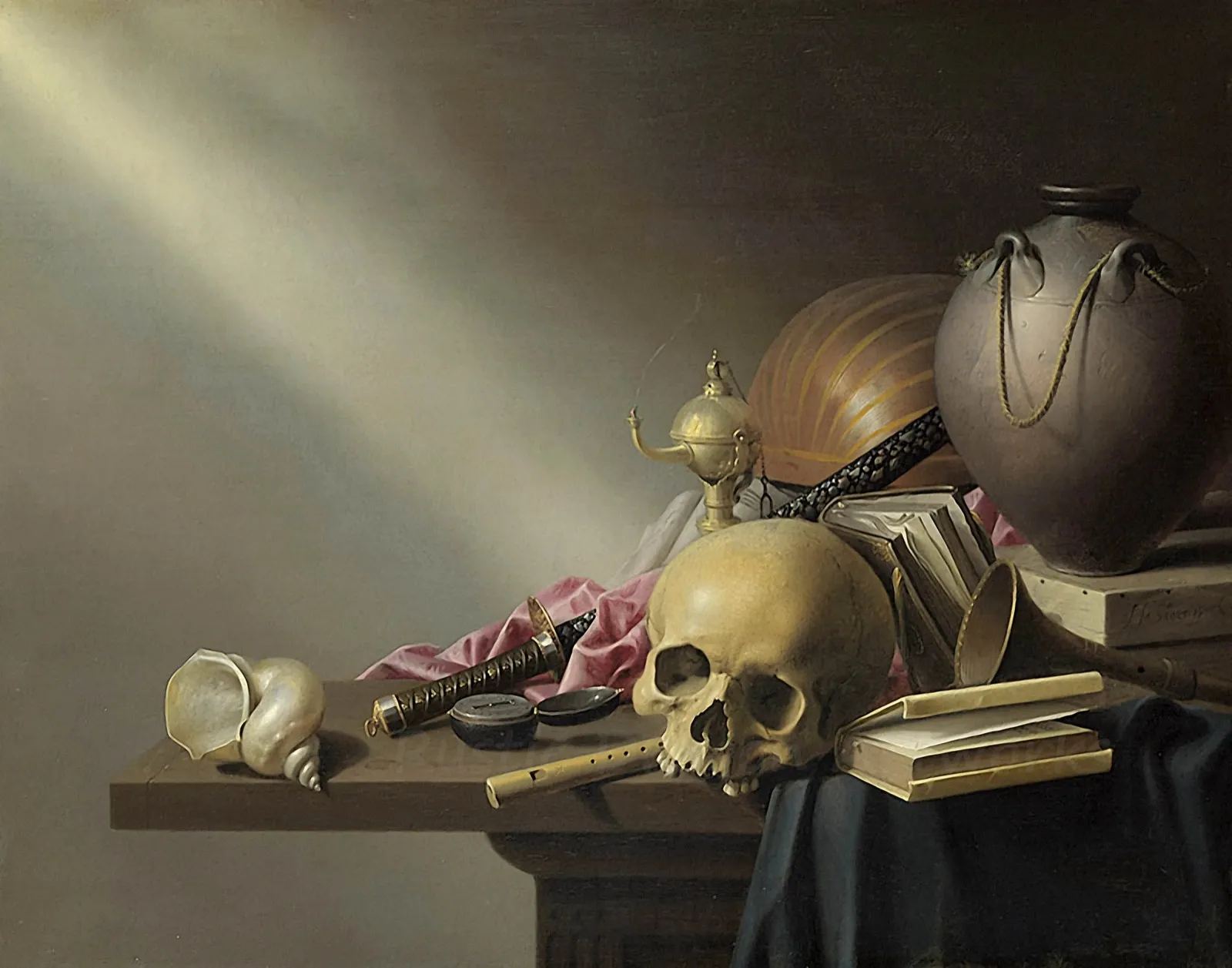 “An Allegory of the Vanities of Human Life” by Harmen Steenwijck, about 1640. National Gallery, London. Public domain.
Harmen Steenwijck’s painting above is a catalogue of the things people spend their lives acquiring: books for learning, a sword for power, a lute and a flute for pleasure, a rare shell for wealth. In the middle sits a skull, and the oil lamp has just gone out. The message is not that these things are worthless. It is that they are temporary, and that a life spent only collecting them has misjudged its own length.
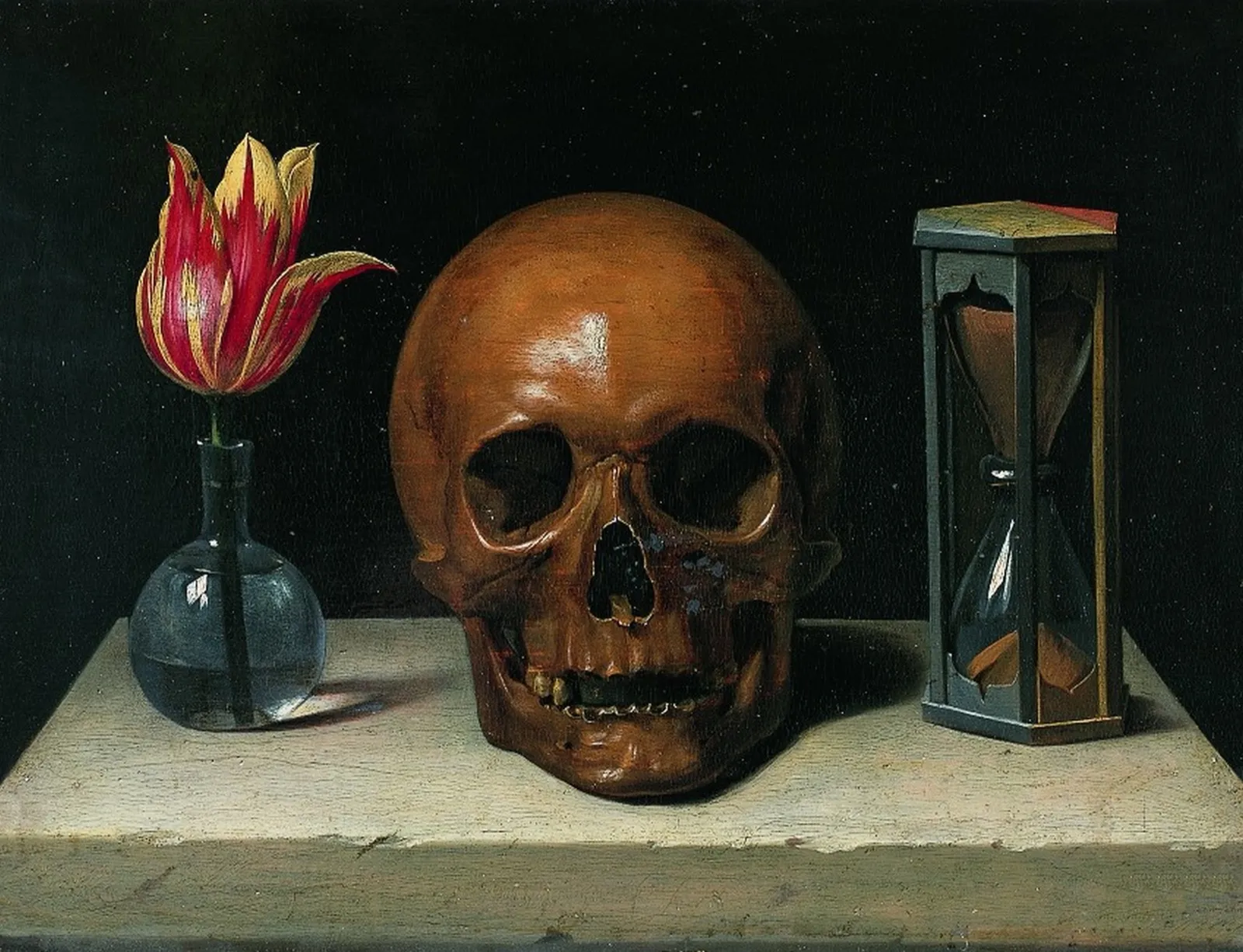
Philippe de Champaigne’s version, at the top of this page, is simpler. It shows three ways of measuring a life: a tulip, which will be dead within days; an hourglass, which is running; and a skull, which is where both end. The painting asks the viewer to look at all three together, which is the one thing people find hard to do.
Why do people need reminding at all?
Because human beings are reliably bad at feeling the finiteness of time, even when they know it perfectly well. Everyone knows they will die. Very few people behave, day to day, as though the time they have with any particular person is limited.
The psychologist Laura Carstensen, at Stanford University, has spent decades studying what changes when people do feel it. Her socioemotional selectivity theory proposes that when time feels open-ended, people prioritise goals related to exploration and acquiring information: meeting new people, learning new things, preparing for the future. When time feels limited, priorities shift toward emotionally meaningful goals and the relationships that matter most. Crucially, her work suggests the shift is driven not by age itself but by how much time a person believes they have left. Younger people facing serious illness, or simply asked to imagine an approaching ending, show some of the same shift as older people. The theory has its critics, and not every study supports it, but its central observation matches ordinary experience: people tend to reorder their lives only once the end becomes visible.
Seen this way, memento mori is a technique for borrowing an older person’s sense of time while you still have a younger person’s amount of it. The skull on the desk was a way of making the ending visible early, before the changes it prompts become impossible.
Why did we stop remembering death?
For most of history, the reminder did not need to be painted. Death happened at home, in front of family, and at every age. Children died often, and adults were laid out in the front room. Many Victorian families even photographed their dead, because it was the only portrait they would ever have. A vanitas painting reinforced a lesson that daily life was already teaching.
The French historian Philippe Ariès argued, in Western Attitudes toward Death (1974) and The Hour of Our Death (first published in French in 1977), that this changed in the twentieth century. Death moved out of the home and into the hospital, and became something to be managed by professionals and kept out of sight. He called the result “forbidden death”. In Australia today, available data suggest that most people die in hospitals or residential aged care, and only a minority at home. Many adults reach middle age without having seen anyone die.
There are good reasons for some of this: hospitals relieve pain and prolong life. But one consequence is that the old reminder has disappeared from ordinary life, and nothing has replaced it. Without it, the default assumption takes over. The people around us, and especially our parents, feel permanent.
The memento mori we forget: other people
The Capuchin placard speaks to the visitor about the visitor’s own death. That is the classical form of the idea, and it has its uses. But for most people, the more consequential error is not forgetting that they will die. It is forgetting that the people they love will die first, and that a great deal goes with them.
When an older person dies, their knowledge does not pass to anyone automatically. The story of how they met their partner, what they did in the years before their children were born, what their own parents were like, the decisions they would make differently: all of it exists in one place until it is asked for. The regret that people describe after a parent’s death is rarely about grand unfinished business. It is about questions they never got around to asking, on the assumption that there would always be another visit.
I have filmed more than a hundred life stories through The Archive since 2020, and what strikes me most is how often the recording is the first time anyone in the family has heard the whole story. My own grandmother recorded four hours of hers with me. She has since passed, and those four hours are now the only place her account of her life exists in her own words.
What does a practical memento mori look like?
If the purpose of the old practice was to make the ending visible early enough to act on, the modern version is not a skull on the desk. It is a small, specific action taken while there is still time to take it.
- Name the people. Think of the three or four older people whose stories you would most regret losing. Most people can do this in a few seconds, which is itself revealing.
- Ask one question. Not a full interview, just one: “Tell me about the house you grew up in.” Good questions are open-ended and invite scenes, not facts. There is a longer list in questions to ask your grandparents.
- Record it on video. A transcript keeps the words. Video keeps the face, the voice, the pauses and the laugh, which are what the family will miss most.
- Do it before there is a reason to. The best time to record someone is when nothing is wrong, because that is when they will speak most freely and at length.
- Include yourself. The Capuchin sentence applies to you as well. A few minutes of your own story, recorded now, is the gift you would want from your own great-grandparents.
Remembering death, remembering them
Memento mori has always had two halves. One says you will die, and asks you to live accordingly. The other, carved on gravestones for centuries, says remember me. The friars in the Roman crypt had only their bones with which to make the point. Most of our ancestors had a name on a stone at best.
We are in a stranger position. The people we love can still speak for themselves, at length, in their own voices, and recording them costs almost nothing. The only scarce resource is the thing memento mori was always about: the time left in which to ask.
That is the thinking behind the Everyone app, which asks one question at a time and keeps each answer as a short video for the family. But the tool matters less than the decision. Remember that you will die. Remember, more urgently, that they will too, and ask them something this week.