The memory palace, and why we remember in places.
The memory palace began with a collapsed roof and a list of the dead. Why the 2,500-year-old trick works, and what it teaches us about asking for stories.
The memory palace, the most famous memory technique in history, begins with a disaster. According to the story Cicero tells in De Oratore, written in 55 BCE, the Greek poet Simonides of Ceos was performing at a banquet in Thessaly when he was called outside by two young men who wanted to see him. When he stepped out, there was no one there. Behind him, the roof of the banqueting hall collapsed, killing everyone inside.
The bodies were crushed so badly that their families could not tell who was who. Simonides could. He found that he remembered exactly where each guest had been sitting, and by walking through the room in his mind, place by place, he named the dead so they could be buried.
From that moment, the story goes, Simonides understood something about memory: we remember places far better than lists, and anything attached to a place comes back with it. For the next two thousand years, orators, priests and scholars trained their memories this way. The method of loci, as it is formally called, is still how memory champions win competitions today.
It is a lovely story, and probably partly legend. But there is a second lesson in it that is usually missed. Simonides’ memory was the only record of who had died. If he had been inside the hall, nobody would have known.
What is a memory palace?
A memory palace is a place you know well, such as your house, your street or the walk to school, used as a filing system. To remember a list, you imagine walking through that place and leave a vivid image at each spot: something at the front door, something on the hall table, something in the kitchen sink. To recall the list, you take the walk again and see what is waiting at each stop.
The oldest surviving Latin instructions are in the Rhetorica ad Herennium, a textbook on public speaking written around the 80s BCE by an author we cannot name. Its advice on images is surprisingly modern. Ordinary things slide out of memory, it says, so make your images strange: exceptionally beautiful or ugly, wearing a crown or a purple cloak, stained with blood or mud, or comic. Nearly two centuries later, the Roman teacher Quintilian described orators placing the parts of a speech around a large house, the first in the entrance, the next in the atrium, and so on through the rooms, then walking back through it as they spoke.
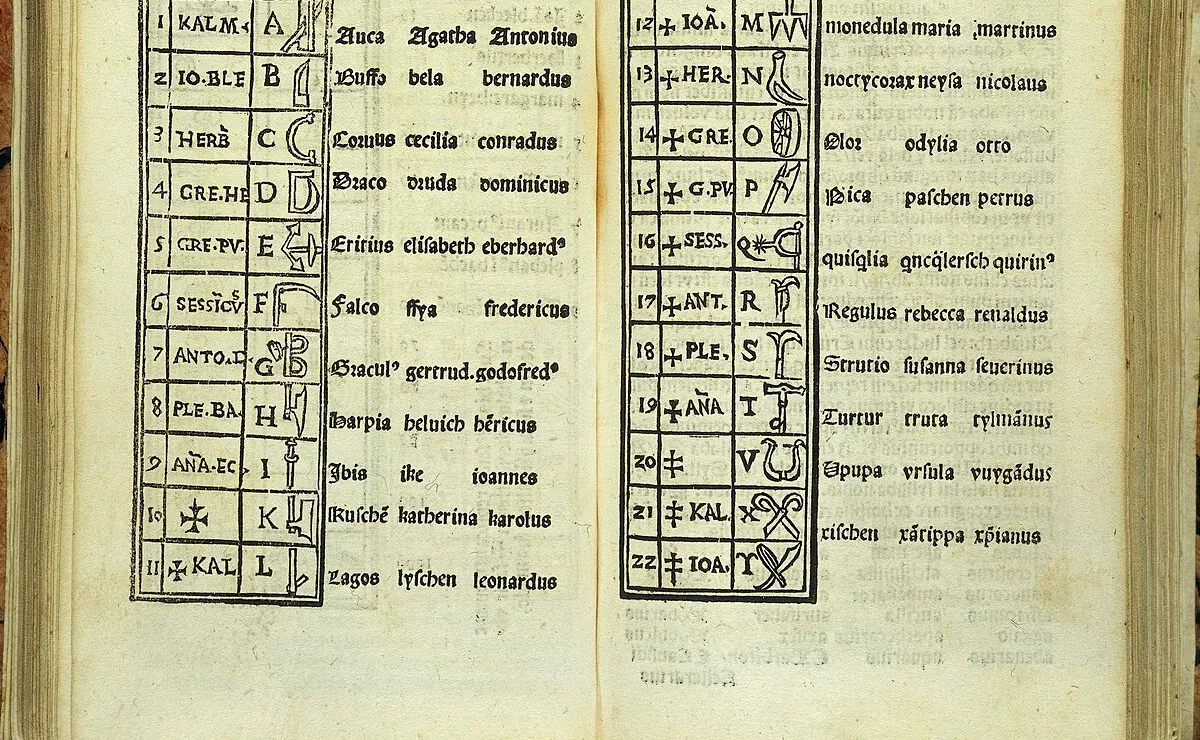
The technique survived the fall of Rome. Medieval monks used it to hold scripture in their heads, and when printing arrived, manuals on the “art of memory” became popular books. The images on this page come from one of them, Johann Romberch’s Congestorium artificiose memorie, first printed in 1520. Romberch even offered a visual alphabet, in which each letter is paired with an object of the same shape, so that words could be stored as rows of things.
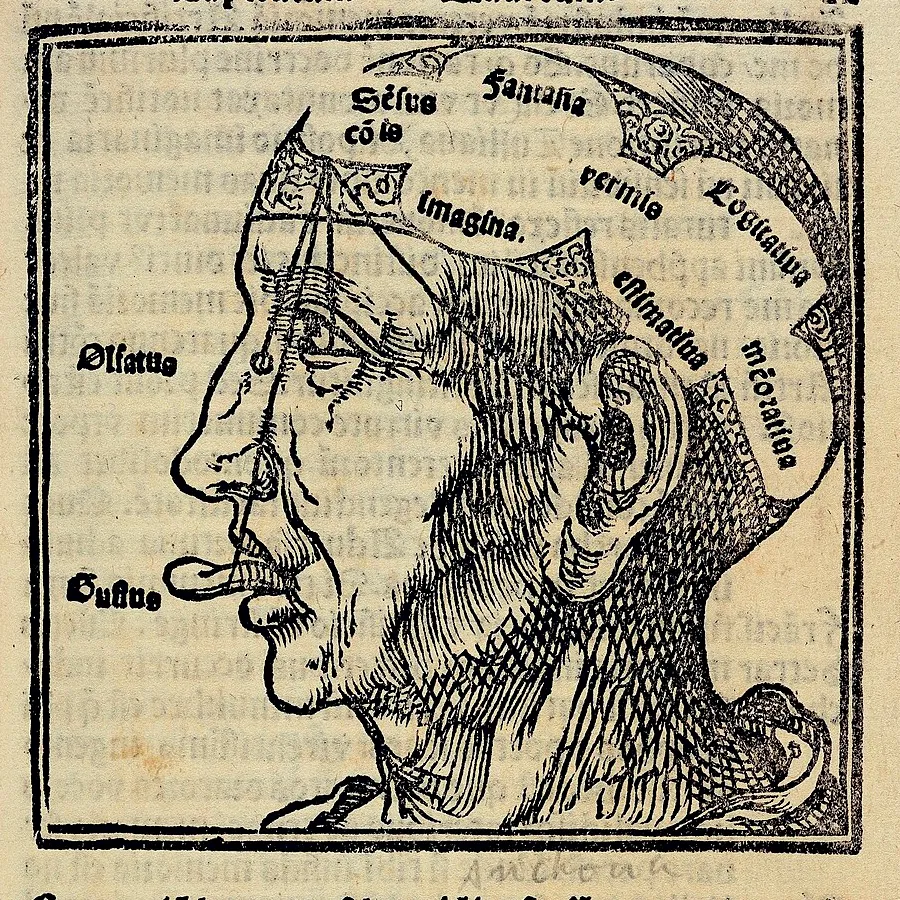 The faculties of the mind, with memory (“memorativa”) at the back of the head. Woodcut from Johann Romberch, Congestorium artificiose memorie, Venice, 1533. Wellcome Collection, CC BY 4.0.
In 1596 the Jesuit missionary Matteo Ricci wrote a short treatise in Chinese teaching the method to young men preparing for the imperial civil service examinations, which required memorising enormous amounts of classical text. The historian Jonathan Spence built a whole book around it, The Memory Palace of Matteo Ricci (1984). The idea travelled from a Greek banquet hall to Ming China because it works anywhere there are human brains.
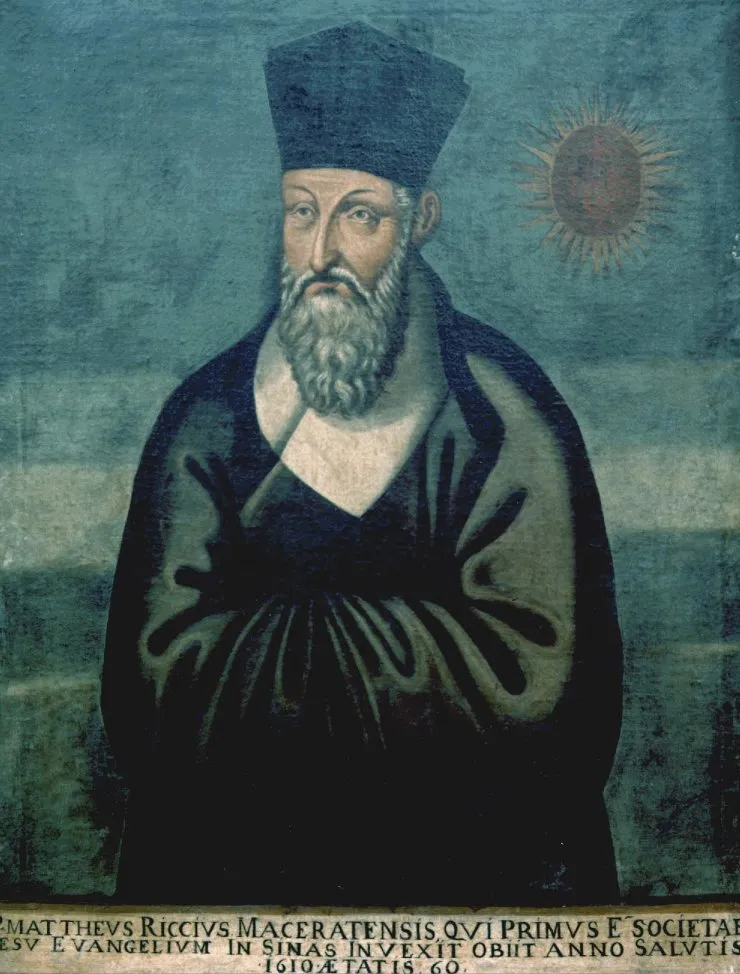 Matteo Ricci, painted by Emmanuel Pereira (You Wenhui) in 1610, the year Ricci died in Beijing. Public domain.
Why does the memory palace work?
For most of its history, nobody could say. The answer has come from neuroscience over the past fifty years, and it is more interesting than “it is a clever trick”.
In 2003 the neuroscientist Eleanor Maguire and colleagues published a study in Nature Neuroscience of ten people who had placed highly in the World Memory Championships. They expected to find something unusual about their brains or their intelligence. They found neither. The champions’ brains were structurally ordinary and their general intelligence was unremarkable. What differed was what happened when they memorised: they used brain regions involved in spatial memory and navigation, including the hippocampus, much more than the comparison group did. Most of them reported using the method of loci.
In 2017 a team led by Martin Dresler tested whether ordinary people could do the same. They took 51 people with normal memories and gave a third of them six weeks of training in the memory palace, forty sessions of half an hour each. Before training, the group recalled roughly 26 to 30 words from a list of 72. Afterwards, they recalled about 35 more on average, and four months later they were still far above where they started.
The reason lies in what memory evolved for. The hippocampus, which is essential for forming new memories, is also where the brain builds maps. John O’Keefe, May-Britt Moser and Edvard Moser shared the 2014 Nobel Prize in Physiology or Medicine for discovering cells there and nearby that fire when an animal is in a particular place, a kind of internal positioning system. For a foraging animal, the most important things to remember were where things were: where the water was, where the danger was, where the fruit ripened last year. Abstract lists are a very recent problem. Places are an ancient one, and our memory is built around them.
The memory palace, in other words, does not add a new ability. It borrows an old one. It takes information the brain is bad at holding, such as a list of words, and disguises it as information the brain is very good at holding: what is where.
What does this mean for remembering a life?
If memory is organised by place, then the way to help someone remember is to put them back in a place.
Psychologists have tested this directly. In a well-known 1975 experiment, Duncan Godden and Alan Baddeley had divers learn lists of words either on land or underwater. The divers recalled more when they were tested in the same environment where they had learnt the words. Memory, it turns out, keeps the surroundings attached.
Police interviewers use the same principle. The cognitive interview, developed in the 1980s by the psychologists Ronald Fisher and Edward Geiselman, asks witnesses to mentally return to the scene before describing what happened: picture the room, the light, the sounds, where you were standing. In study after study, it draws out more accurate detail than simply asking “what happened?” (For more on how memory fills gaps and where it can be trusted, see is oral history reliable?)
This is exactly what a good life story interview does, often without knowing why. Ask an older person “What was your childhood like?” and the question lands on nothing in particular; you will usually get a summary. Ask “Can you walk me through the house you grew up in, starting at the front door?” and you have handed them their own memory palace. Each room has things waiting in it. The kitchen brings back a mother at the stove and a smell. The back step brings back a brother, a dog and the day something went wrong. The person is not inventing a structure for their story. They are walking through the one their brain has kept all along.
In the life stories I have filmed since 2020, the questions that open the most memories are almost always the ones tied to a place: the street, the school, the shop, the ship, the first flat. A few that work:
- Walk me through the house you grew up in, room by room.
- What could you see from your bedroom window?
- Describe the walk to school. What did you pass on the way?
- Where did your family eat, and who sat where?
- Take me to the place you went when you wanted to be alone.
- What was on the main street of your town, from one end to the other?
The fourth is Simonides’ question. Ask who sat where at the dinner table and you often get the whole family at once: the father at the head, the grandmother who lived with them, the child who was always in trouble.
Objects work in the same way, because objects belong to places. A photograph of the old house, a key, a school report, a recipe card can act as a stop on the walk. (There is more on this in how to interview older family members.)
What happens to the palace when its owner dies?
Here is the part of the Simonides story that matters most, and the part the memory manuals never dwell on.
A memory palace is private. It is built from one person’s places and one person’s images, and it exists in one person’s head. The plan of the banquet hall was not written down anywhere. It survived because Simonides happened to step outside. Had he been sitting at the table, the dead would have stayed nameless.
Every person who has lived a long life carries a memory palace of exactly this kind, without ever having trained for it. Your grandmother can walk through a house that was demolished sixty years ago, and name everyone who sat at its table, some of them people nobody else alive remembers. That house now exists in one place only. When she dies, it goes with her, rooms and all.
Some cultures solved this problem by making memory shared and public. The Australian writer Lynne Kelly, in The Memory Code (2016), argues that many oral cultures, including Aboriginal Australians with their songlines, attached knowledge to features of the landscape and kept it alive by performing it together, so that no single death could erase it. Whatever one makes of every part of her argument, the principle is sound: knowledge outlives a person only when it is passed on before they go.
Most families do not have songlines. What we have instead is something no earlier generation had: a way to record the walk itself. A written account turns a memory palace into a summary. A video keeps the person in it, looking slightly past the camera as they move from the kitchen to the back step, slowing at the room where something happened, the pause before a name. (Why that difference matters is the subject of record a life story on video.)
The ancient art of memory was a way to keep more inside one head. The more useful skill now is the opposite: getting what is inside one head out, before it is too late. That begins with a simple request. Ask someone to show you around the house they grew up in, and film the tour. Everyone, the app I work on, gives you questions like these one at a time, but a phone and a quiet room are all it really takes.
Simonides was lucky to be outside. Our families do not need luck. They need someone to ask.