
What psychologists learnt from the life story interview.
Dan McAdams has asked people to tell their lives as stories for decades. Here is what the life story interview found, and how to use it with family.
Imagine someone hands you a blank book and says: your life is the story in it. How many chapters does it have? What are they called?
That is the opening request of the life story interview, a method developed by the psychologist Dan McAdams at Northwestern University, and it is stranger than it sounds. Most people have never been asked to divide their own lives into chapters. Almost all of them can do it within a few minutes, and the chapters they choose, along with the way they describe them, turn out to say a surprising amount about who they are and how well they are living.
McAdams has been refining this interview since the 1990s. It is a better guide to interviewing a parent or grandparent than most of the advice written for families, and the research behind it explains why recording a life story is more than a keepsake.
What is the life story interview?
It is a semi-structured conversation, often lasting two hours or more, in which a person tells the story of their life rather than a list of its events. McAdams’s published outline, which he has revised over the years, moves through a consistent set of parts:
- Life chapters. The person divides their life into chapters, titles each one and says what it is about.
- Key scenes. They describe particular moments in detail: a high point, a low point and a turning point; an early positive and an early negative memory; a vivid adult memory; a moment of spiritual experience if there was one; and an event that taught them something about wisdom.
- The future. What the next chapter might be, and what they hope to achieve.
- Challenges. Illness, loss, failure and regret, and how they dealt with them.
- Beliefs. What they value, and how they came to hold those values.
- Themes. What the whole story is about, if anything.
The design is deliberate. Notice what the questions ask for: particular scenes, and what each scene meant to the person, rather than a summary of events. This is the same principle that makes open questions work better than closed ones: a scene requires a person to retrieve and interpret a memory, rather than answer a fact.
Why would a story count as evidence about a person?
The idea behind the interview is that identity is not a fixed trait, like height, but something people build over time as a story. The psychoanalyst Erik Erikson had argued in the mid-twentieth century that adolescence is when we face the question of who we are. McAdams proposed, in Power, Intimacy, and the Life Story (1985) and then The Stories We Live By (1993), that the answer we construct is a narrative: a reconstructed past, a perceived present and an imagined future, linked together by cause and meaning so that they make a single life.
This is sometimes called narrative identity, and the key word is reconstructed. A life story is not a transcript. Two people with nearly identical childhoods will tell them very differently, and the same person will tell their story differently at forty and at eighty. What the story preserves is not the events but the interpretation: what the person believes those events mean.
That is exactly what a photograph or a family tree cannot capture. A tree records that your great-grandmother existed. It does not record what she believed her life had been for. (Most of us cannot even supply the names: see the sixteen great-great-grandparents you probably cannot name.)
It also explains why the teens and twenties dominate so many life stories. The life story model proposes that people begin to assemble a story of the self in late adolescence and early adulthood, which is also the period that most strongly populates our memory, a pattern psychologists call the reminiscence bump. It is where the plot is set.
What is the difference between a redemptive and a contaminated story?
This is the finding that has travelled furthest beyond psychology.
When McAdams and his colleagues examined how people narrate their key scenes, they noticed two opposite patterns. In a redemptive sequence, a bad situation leads to something good: a failure becomes a lesson, a loss becomes a source of compassion, a hardship becomes the origin of a strength. In a contamination sequence, the movement runs the other way: something good is spoiled, as when the joy of a wedding or a promotion is remembered mainly for the disappointment that followed.
The researchers found that these patterns are not randomly distributed. In his studies, adults who told more redemptive stories about their lives tended to rate their lives as more meaningful and to score higher on measures of generativity, the concern for contributing to younger generations that Erikson had described. People who told more contamination stories tended to score lower on both. Later longitudinal work by other researchers reported a similar association between redemptive narration and mental health. As with most of this research, the evidence is correlational: we cannot say from it that changing the story changes the life, and the effects are modest. But the direction is consistent.
The practical implication is easy to miss. Two people can survive the same war, the same bankruptcy, the same bereavement. What differs is the chapter they place it in. One tells it as the moment everything fell apart. The other tells it as the moment they learnt what they were made of. Both can be honest. Neither is the transcript. And the second version is the one that appears to help the teller.
McAdams explored the American cultural version of this idea in The Redemptive Self (2006), arguing that the redemption narrative is deeply embedded in how Americans think about success and suffering. The structure is not unique to any country, though. It is a way of making hardship bearable, and it appears in the stories of nearly every culture.
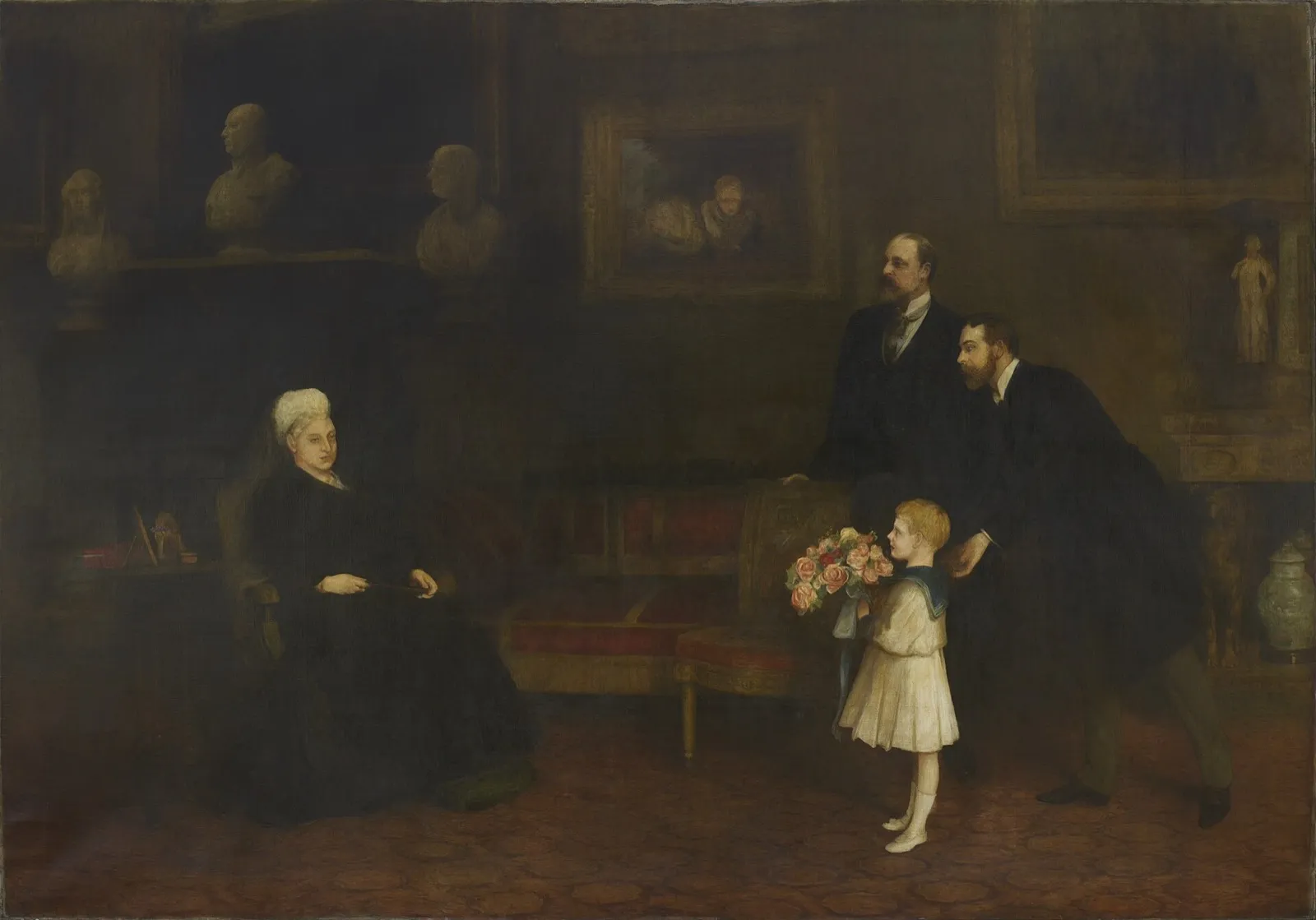 “The Four Generations” by William Quiller Orchardson, 1899. Government Art Collection. Public domain.
Do family stories matter for children too?
They appear to. The psychologists Marshall Duke and Robyn Fivush, at Emory University, developed a short questionnaire called the “Do You Know?” scale, which asks children whether they know basic facts of their family’s history: where their grandparents grew up, where their parents met, what illness or hardship the family went through, the story of their own birth. In a study of about four dozen families in the early 2000s, they reported that children who knew more of these stories had a stronger sense of control over their lives, higher self-esteem and greater confidence in how well their family functioned. Duke and Fivush describe the scale as a rough index, and the finding is a correlation: families who talk about their past may differ in many other ways.
Duke also drew attention to the shape of the family story. He suggested that the most healthy version is neither a tale of constant success nor a tale of decline, but one that admits both highs and lows and shows the family getting through them. Children who hear that “we have had hard times and we got through them” seem to draw on it.
The common thread is worth stating plainly. What helps is not a flattering account. It is a true and complete one, in which the difficult parts are included and given a meaning. That is only possible if someone tells the story.
What does this mean for interviewing your own family?
Four practical points follow from the research.
- Ask for chapters first. “If your life were a book, what would the chapters be?” gives the person control of the structure and tells you what they consider important, which is often not what you expected.
- Ask for the scenes behind the turning points. A high point, a low point and a turning point are the three best questions in the protocol. They are open, they invite a scene rather than a summary, and they reveal how the person interprets their life. (More questions in this spirit are in questions to ask your parents about their life.)
- Include the hard chapters, and ask what came after. The redemptive finding is a reminder that the useful part of a hardship story is often what the person did with it. “What did that period teach you?” and “What changed afterwards?” are not sentimental questions; they are where the interpretation lives.
- Do not correct the interpretation. You are not auditing the facts. You are recording how a person understands their own life. Professional oral historians draw the same line between a testimony and a record (see how to conduct an oral history interview).
Why film it, rather than write it down?
A life story, in McAdams’s sense, is an act of interpretation, and interpretation lives in delivery: the pause before a low point, the way a voice lifts when describing a turning point, the laugh that changes the meaning of a sentence. A transcript preserves the sentences. A video preserves the telling.
In the more than a hundred life stories I have filmed since 2020, the best material has rarely come from the first answer. It has come from the follow-up, or after a long silence, when the person stops reporting what happened and starts saying what it meant. The research describes the same process from the outside.
There is a further reason it matters. A person’s life story is partly a gift to whoever receives it. If the evidence is right, children and grandchildren who hear how someone got through their hard chapters inherit something more useful than a date of birth. The people with these stories are not going to be here indefinitely, and a story that is never asked for is, for practical purposes, lost. The only part of this that anyone has to do is ask. Tools such as Everyone are built to make that part simple, one question and one short video at a time, but the interview itself is the thing that matters, and it can begin with a single question: if your life were a book, what would the chapters be?


