Questions to ask your kids to really know them, and keep the answers.
Ask your kids the same questions every year, on video, and you build your own Up series. The best questions to ask your kids, and how to keep the answers.
In 2004 a team led by the psychologists Marjorie Taylor and Stephanie Carlson published a study of children and their imaginary companions. They had interviewed 152 preschoolers and their parents, then returned three years later, as the children started school, to ask again. By the age of seven, 65 per cent of the children had at some point had an imaginary companion, and almost one in three of the school-age children had one at the time they were asked.
Most of those companions are gone by adolescence. The child who invented them has no memory of them, because almost no one remembers their first three or four years. The parents may remember that there was a friend, but not the name, the voice or what the friend was supposed to be good at. So the one person who could have described that world, the child, cannot, and the people who watched it are already losing it.
That is the problem this piece is about. The questions to ask your kids matter, because a child’s answers are the most direct view you will ever have of how a particular person thinks at a particular age. But the questions are only half of it. The other half is that every answer expires, and almost none of us keep them.
Why do parents forget what their children were like?
Because a child is not one person. At four, six and nine your child is three different people who happen to share a name, a face that is changing and a bedroom. Each version has its own theory of how the world works, its own vocabulary, its own fears and its own jokes.
Each version is replaced, not added to. The four-year-old is overwritten by the six-year-old, and what remains is a composite built from a few photographs and a handful of stories told so often that they have become the family version.
The psychologists call this reconstruction. Each time we recall something we rebuild it, and the rebuilt version drifts towards the story we now tell. I went through this evidence in how to record your life story while you are living it. It applies to parents more than to most people, because the period when children change fastest is also the period when parents have the least spare attention.
The children cannot fill the gap. They are subject to what psychologists call childhood amnesia, and the adult your child becomes will have almost nothing of their own from the first years. You are the only witness.
What would your own Up series look like?
In 1964 Granada Television filmed fourteen British seven-year-olds and asked them about school, money, their friends and what they hoped to become. Then they went back every seven years. I have written about what the series showed in the Up series and what it means to film a life every seven years. What matters here is the method, not the production. The footage is valuable because the same sort of question was asked at each age, so that the viewer can put the answers side by side.
Almost no family can do that, because almost no family asks the same questions twice. We ask a child what they want for their birthday, how school was and whether they have brushed their teeth. Their answers are worthless by the following week.
The alternative is simple. Choose a small set of questions, ask them on the same day each year, and film the answers. A birthday is the obvious day. After five years you have five recordings of one child answering the same questions, and you can see something that no photograph shows: how a mind develops.
What makes a good question for a child?
A good question for a child shares three features, and they are not the ones we usually reach for.
It is concrete. Children are poor at abstraction and good at particulars. “What is your favourite thing about school?” gets a shrug. “Who did you sit next to at lunch today, and what did they have?” gets a story. Ask about a specific thing and let the details carry the personality.
It is open. A question that can be answered with yes or no will be. Ask “Tell me about” and “What happens when”, and then wait. The silence is where the answer comes from, as it is in an interview with an adult. The difference between open and closed questions is covered in how to interview someone.
It has no right answer. Children are sensitive to being tested. Questions about who they would invite to a dinner, what they think happens to the sun at night, or what a dog thinks about all day cannot be answered wrongly, and so they produce the unguarded version of the child.
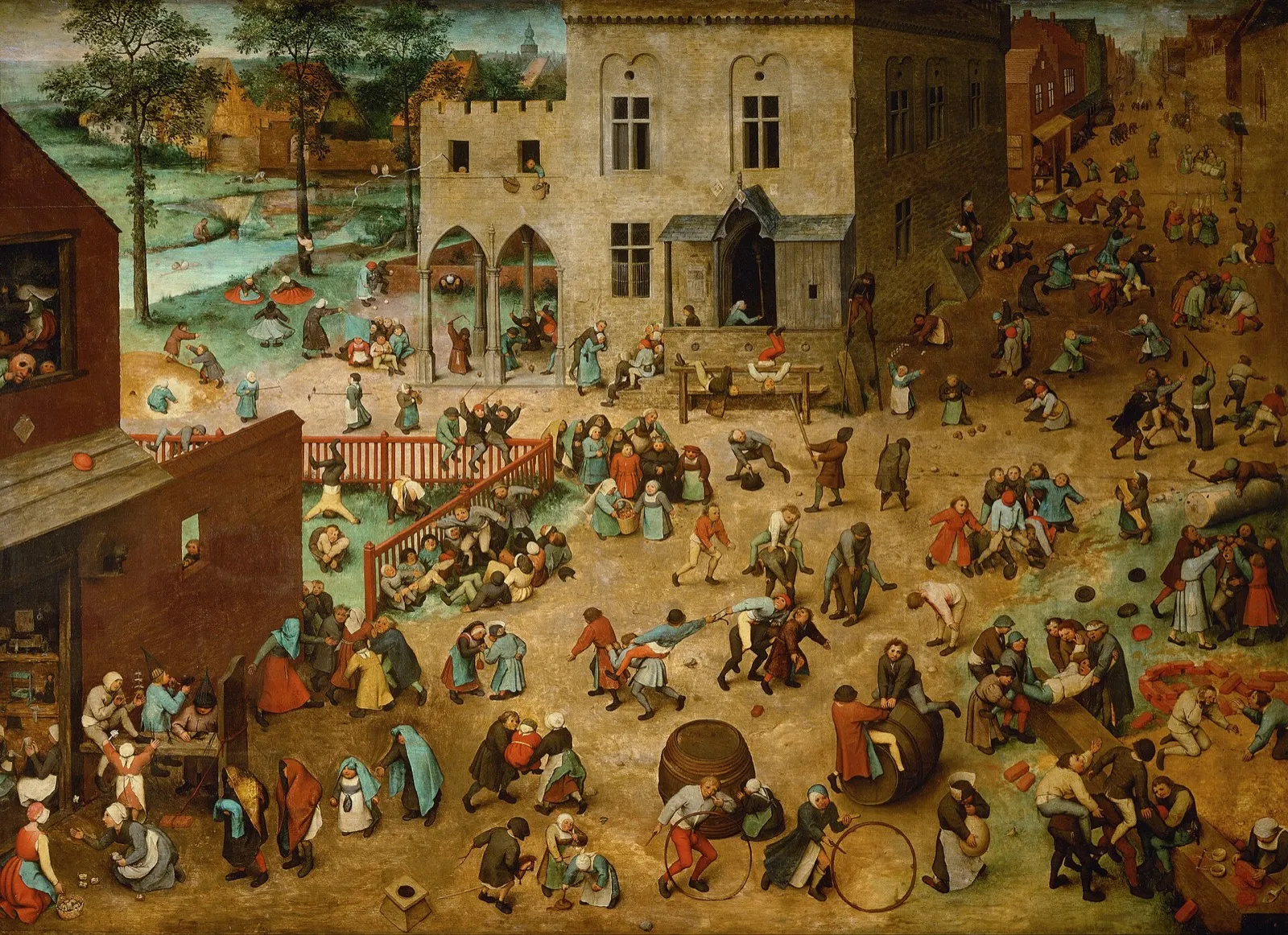 “Children’s Games” by Pieter Bruegel the Elder, 1560. Kunsthistorisches Museum, Vienna. Public domain. Parents have been unable to keep track of what their children are doing for a very long time.
What are the best questions to ask your kids?
These work for most ages from about four. Ask three or four, and repeat the same ones next year.
About who they are now
- What are you best at? What are you worst at?
- What is your favourite thing to do at the moment? Show me, or tell me how to do it.
- What is the best thing that happened this week? What is the worst?
- Who are your best friends? What do you like about them?
- What is something you know a lot about that I don’t?
About how they see the world
- What do you think the world was like before you were born?
- What is the thing you most want to understand? Why do you think it works the way it does?
- If you could change one rule at home, or at school, what would it be?
- What makes you laugh the most?
- What do you worry about at night?
About us
- What am I like as a parent? What do I say too much?
- What is something we do together that you will remember when you are grown up?
- What did I do that made you feel proud, or safe, or loved?
- If you could ask me anything, what would you ask?
About the future
- What do you want to be when you grow up? Why?
- What do you think you will be like when you are my age?
- What do you hope someone says about you when you are old?
Questions 6, 16 and 17 are the ones you will most want to watch in twenty years. A child’s guess at their own future is the only version of it that is unaffected by how it turned out.
How do you ask without making it feel like a test?
The common failure is to turn the conversation into an interrogation, with the camera as a spotlight. A few small choices avoid it.
- Keep it short. Five to ten minutes is plenty for a young child. Stop before they want to.
- Do it in a familiar place. The kitchen table, the couch, the back step. Children perform less in places they own.
- Do not correct. If a six-year-old explains with great confidence that clouds are made of cotton, that is the answer you came for. Correction teaches them that the camera wants a right answer.
- Prop the phone against a book and look at your child, not the lens. Children copy where you look.
Teenagers will often refuse. A request declined at fifteen may be accepted at twenty, so keep the invitation light and open. Many of the questions above also work with adults, and they are a good place to start with your own parents, as in questions to ask your parents about their life.
Why film the answers rather than write them down?
A written answer preserves the words. A film preserves the child.
Imagine reading, at forty, that at five you said the best thing about your family was “the dog and the biscuits.” Now imagine watching yourself say it: the pause, the glance at the person behind the camera, the grin. The first is a fact about you. The second is a meeting.
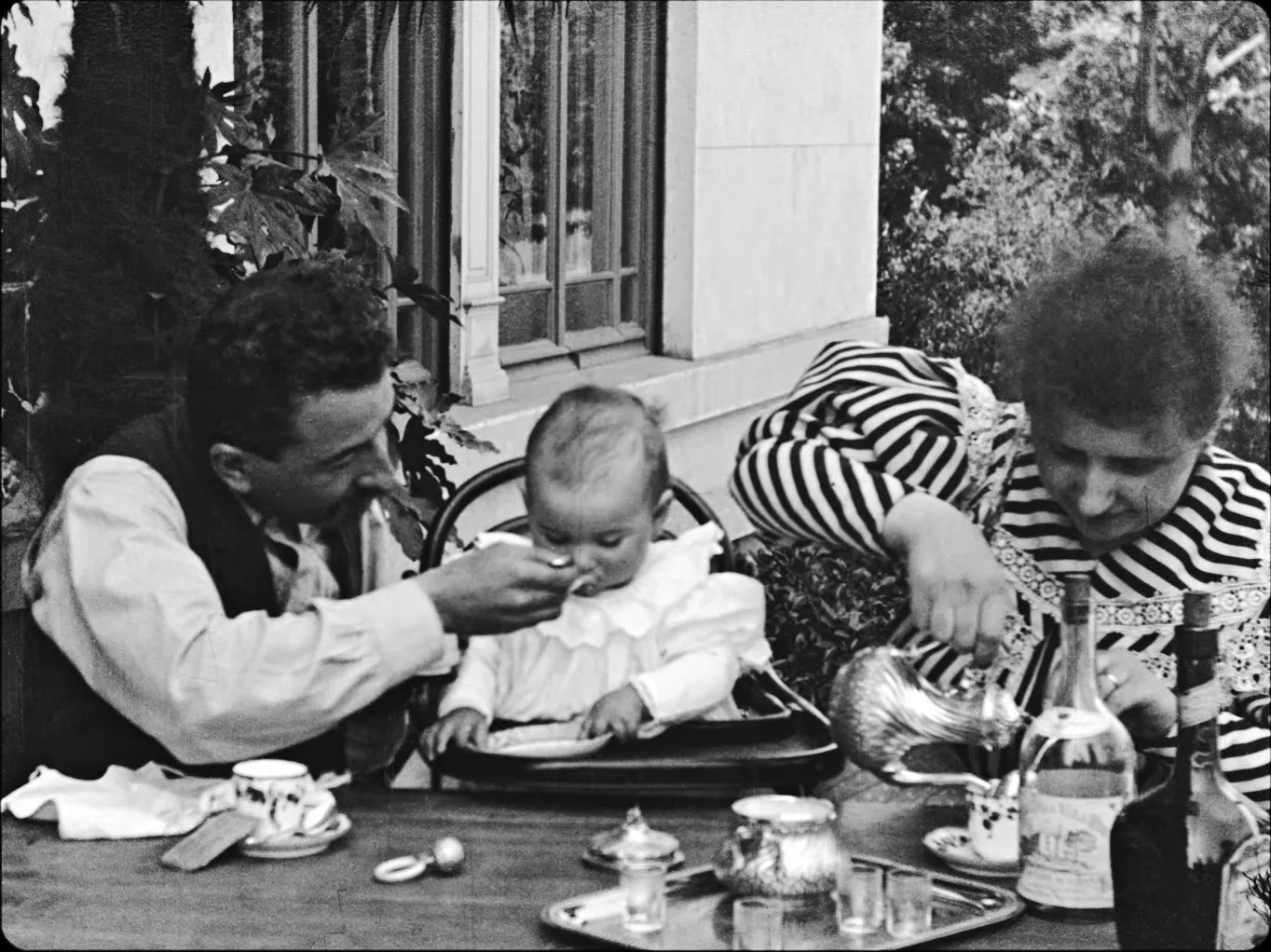
The earliest films of family life make the same point. Louis Lumière’s Repas de bébé of 1895, the still at the top of this page, shows his brother Auguste feeding his infant daughter Andrée while his wife pours coffee. Nothing happens in it. The baby grabs at a plate. It is among the oldest films ever made of an ordinary family, and the reason we still watch it is that it shows a particular child on a particular afternoon, not a summary of one.
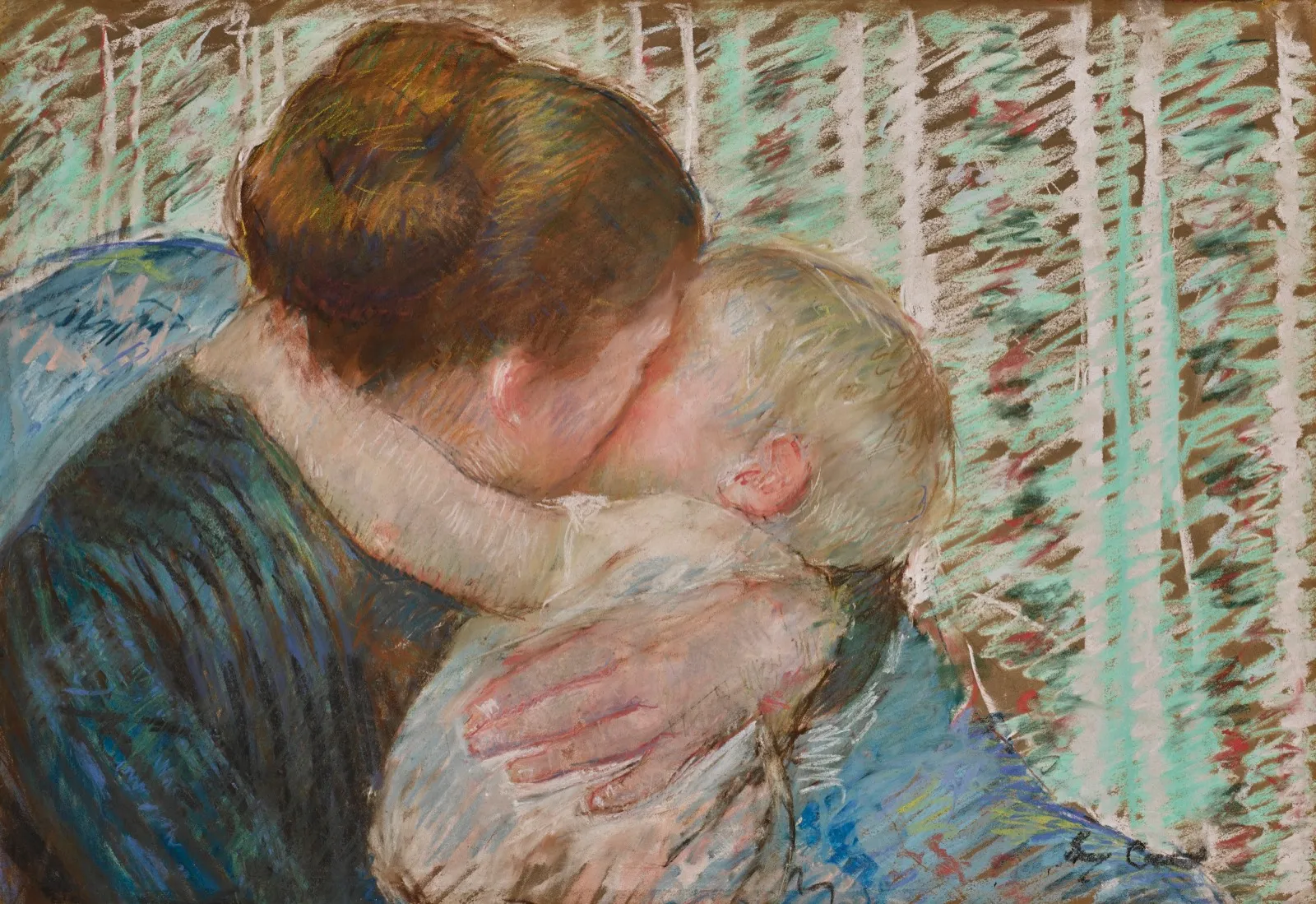 “Mother and Child (The Goodnight Hug)” by Mary Cassatt, 1880. Pastel. Public domain.
What do you do with the recordings?
Very little, and that is the point. Name each file with the child’s name and age, keep them in one folder, and copy the folder somewhere other than your phone. Then leave them.
The recordings are not for now. Their value grows with distance. At the end of a year they will be mildly amusing. After five they will be the most interesting thing on your phone. After twenty they will be something your child may want to give their own children, who will meet the person their parent used to be.
I have filmed more than a hundred life stories through The Archive since 2020, and I have four hours of my grandmother talking about her life. What I notice, watching her, is how much of her I would have lost if I had waited for a better moment. The cost of keeping what a child says is a phone and ten minutes a year.
If you want help with the asking, the Everyone app has question packs and keeps each answer as its own short video, which suits this method. But the method needs only a day of the year, the same few questions and the patience to stop talking.