The best questions to ask your aunt, from the side of the family.
The best questions to ask your aunt or aunty about her life and your family, and why she often holds the stories your parents never told you.
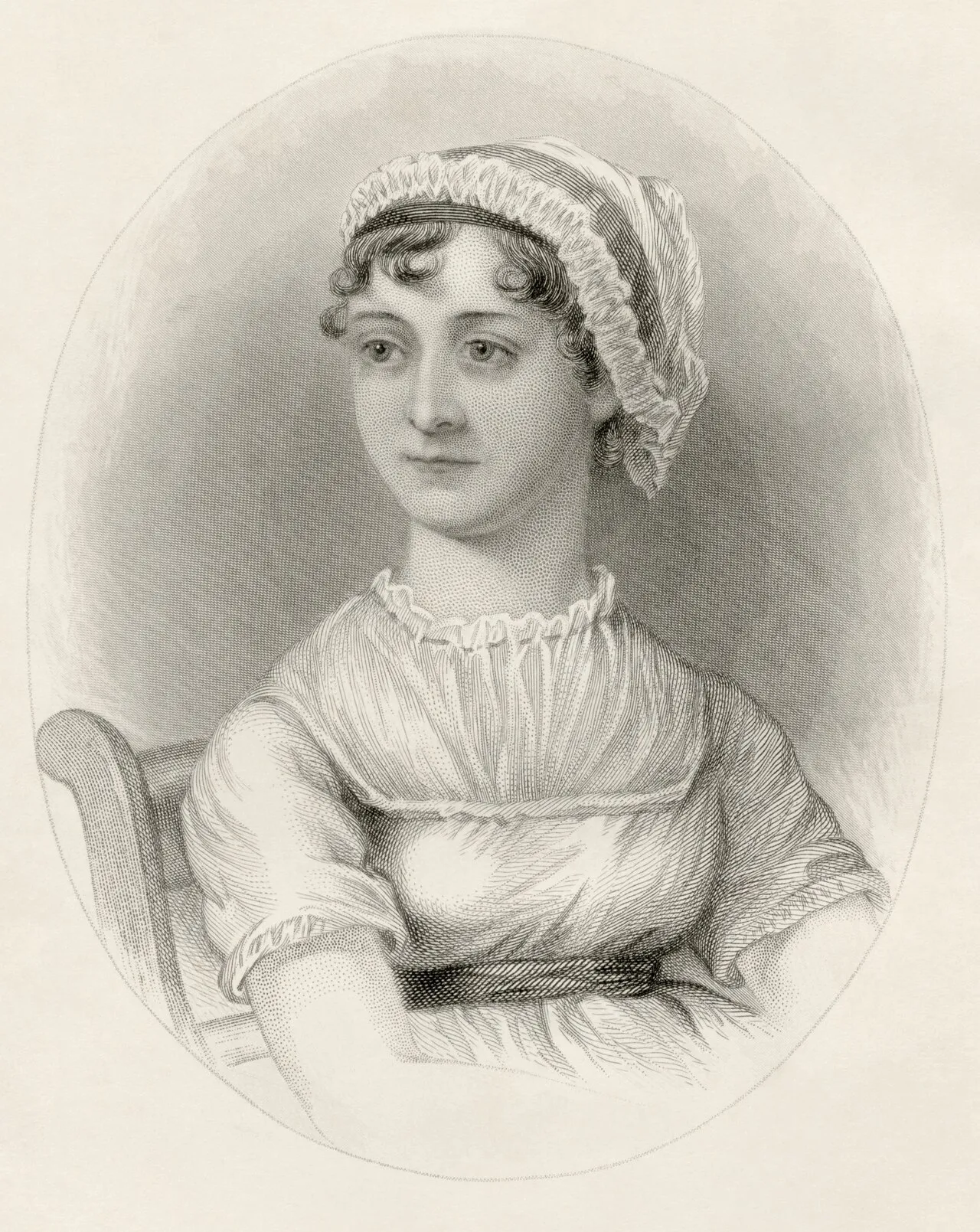
When Jane Austen died in 1817, her nephew James Edward was eighteen. More than fifty years later, in 1869, he began to write her life. His Memoir of Jane Austen, published that December, was the first biography of her, and it was the work of someone who had known her as “Aunt Jane”. He had almost nothing else to go on. Her sister Cassandra, by one family account, had gone through Jane’s letters and burnt the greater part of them, and the rest had been scattered among relatives. So the nephew asked the family what they remembered, and the book is built largely from what they told him.
That detail is easy to overlook. The family that surrounded one of the greatest novelists in English did not keep her story in her parents or her own papers. It was kept by an aunt, Cassandra, who edited it, and by nieces and nephews, who remembered it. Most families work the same way. If you want to know what questions to ask your aunt, the starting point is that she is often the person standing closest to the family’s history without being responsible for any of it.
This post gives you the best questions to ask your aunt, or your aunty, about her own life and about the family you share, and explains why she tends to answer more freely than your parents.
Why ask your aunt rather than your parents?
An aunt occupies an unusual position. She is old enough to remember events you were never told about, and she is close enough to the family to have been there for them. But she is not your parent. That difference matters in three ways.
She remembers your parent as a child. If she is your parent’s sister or sister-in-law, she may have shared a bedroom, a school or a kitchen with them. She knows what your mother was like at twelve and what your father got away with. Your parents cannot tell you this from the inside, because they were the ones it happened to. Siblings tell different versions of a shared childhood, and a sibling’s version is the only one you can still hear. (The questions to ask your siblings post goes into why those versions differ.)
She has less to protect. Parents edit what they tell their children, usually out of love. An aunt has the same affection with fewer stakes. She did not have to discipline you, and she does not have to look good in your eyes. Asked sincerely, she will often tell you what your parents would shrink into one sentence.
She was often a second adult in your own childhood. The anthropologist Sarah Blaffer Hrdy has argued, in Mothers and Others (2009), that human children evolved to be raised by more than their mothers, with grandmothers, siblings and other relatives sharing the work. If your aunt helped raise you, she holds a view of you that nobody else has, and this is a good reason to ask her about it.
What are the best questions to ask your aunt?
The questions below are grouped by what she can tell you that nobody else can. As with any interview, ask for scenes and examples, not summaries: “Tell me about a Christmas at your parents’ house” will always do better than “Were your family close?”
About her own life
Aunts are asked about everyone else’s life. Start with hers.
- What was your first job, and what did you spend your first pay on?
- What did you want to be when you were young, and what happened to that?
- Where did you live before you were married, or before you moved here?
- What was the best year of your life so far?
- What is something you did that your family did not expect of you?
- Is there a decision in your life you would make differently now?
About my parent as a child
- What was my mum (or dad) like when she was my age?
- What did the two of you fight about?
- What did they get away with that you did not?
- Who in the house did they take after?
- What was the funniest thing you saw them do?
About your grandparents
You may know them only as grandparents. She knew them as parents, which is a different person.
- What were your parents like when you were small?
- What did they argue about, and what made them laugh?
- Who was in charge at home, and how could you tell?
- What was their house like, room by room?
- What do you wish I had known about them?
About the family’s history
- Where did our family come from, and who told you that?
- What did we have that we lost? (A house, a business, a farm, money, a country.)
- Is there anyone in the family who is rarely mentioned? What happened?
- What was the hardest year the family went through, and how did you cope?
- What traditions came from your parents, and which did you invent yourselves?
For the wider set, with advice on the source of each story, see family history interview questions.
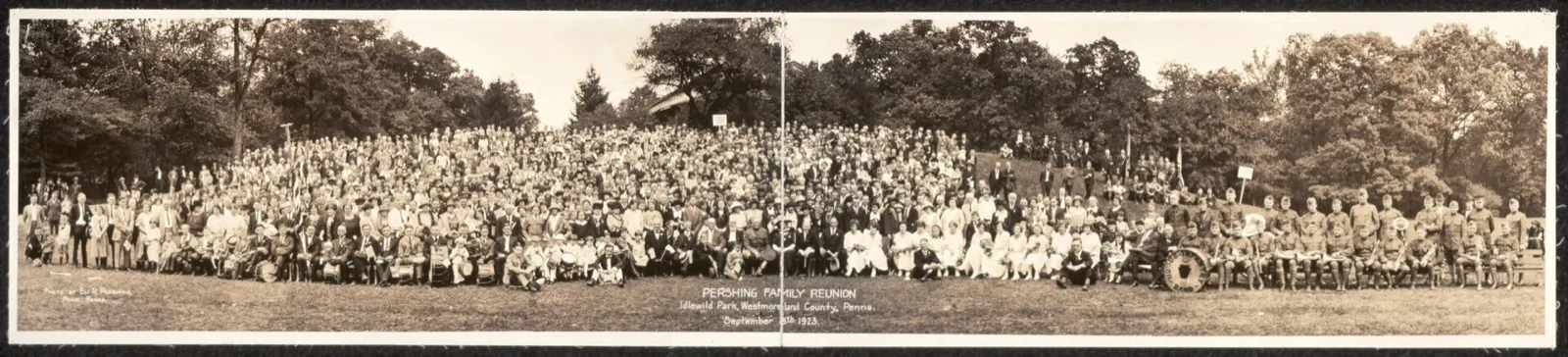 Pershing Family Reunion, Idlewild Park, Westmoreland County, Pennsylvania, 8 September 1923. John J. Pershing Collection, Library of Congress. Public domain.
About you
An aunt or uncle may be the only other adult who watched you grow up without being responsible for you.
- What was I like as a child? What did I say or do that you still remember?
- What did you notice about our family that I could not have seen from inside it?
- What did you hope for me?
Looking back
- What are you proudest of that nobody has thanked you for?
- What advice would you give your younger self?
- Is there a story you have wanted to tell and no one has asked for?
- What should I ask you next?
How do you ask your aunt without it feeling like an interview?
Most of the work is done by the setting and the order.
Begin with her, not with the family. If you open with “I’m researching the family tree”, you are asking her to be a source. If you open with “I realised I do not know what you did before you had children”, you are asking her to be herself. The family stories usually follow within the hour.
Use a prompt that is already there. A box of photographs, a recipe in her handwriting, a piece of jewellery or the house she grew up in will draw out more than a list. Ask her to tell you who is in the picture and what the day was like. The question “Who told you that?” is also worth asking whenever a family story comes up, because it reveals how old the account is and how many people have retold it.
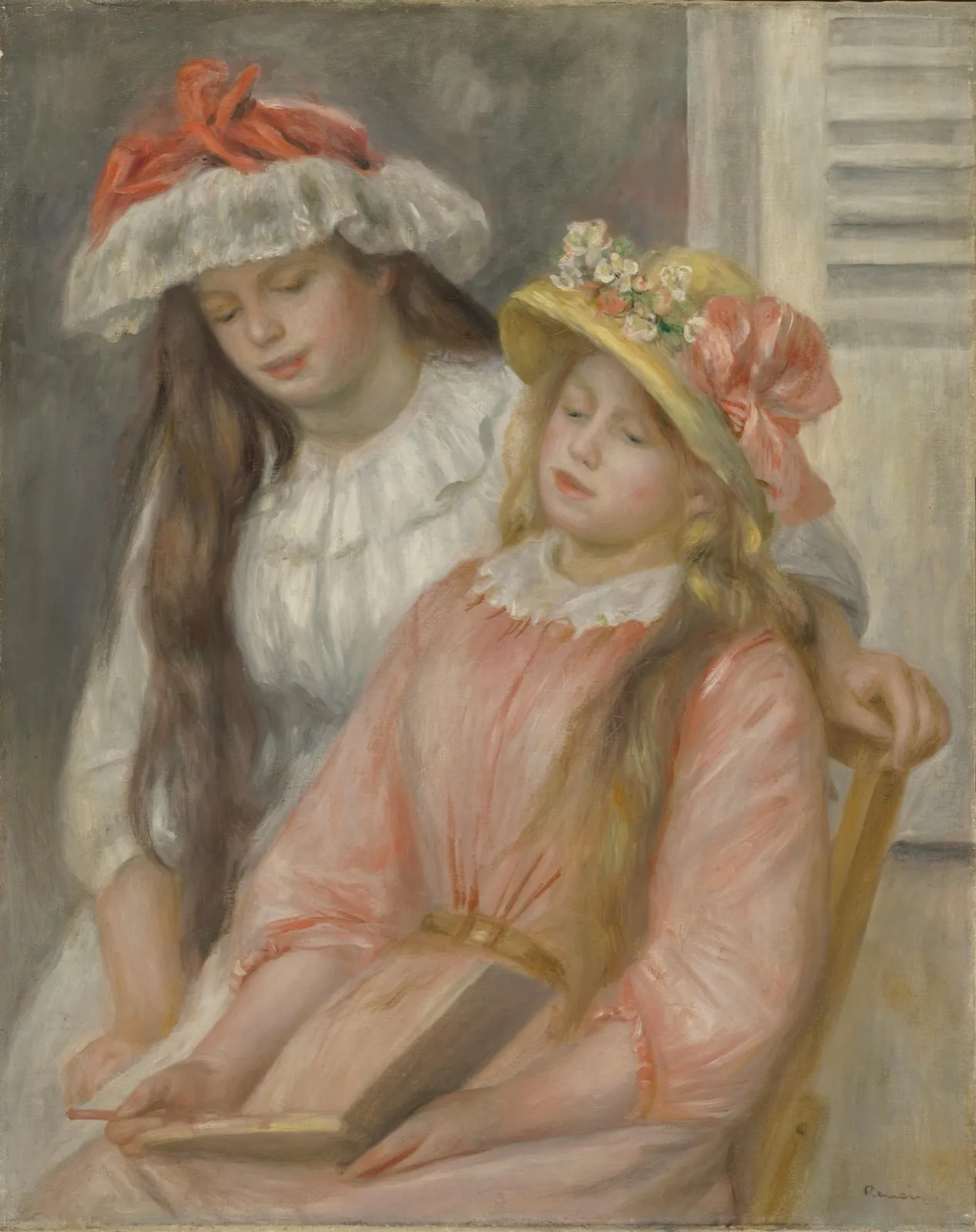 “Young Girls Looking at an Album” by Pierre-Auguste Renoir, c. 1892. Virginia Museum of Fine Arts. Public domain.
Say what you will do with it. An aunt who knows you will keep it, and share it with the cousins, will tell it more carefully than one who suspects you are only filling time. You do not need to promise anything large: “I would like to keep this so the rest of the family can hear it” is enough.
Keep it short, and come back. Forty minutes is plenty. If she is older, tires easily or is hard of hearing, the practical advice in how to interview older family members applies to her as it would to a grandparent.
If you are asking an aunt about a parent who has died, or about something painful, let her set the pace. “You do not have to answer this” costs nothing, and it often makes the answer longer.
Why film the answers?
Every family needs someone who writes things down, and in most families that person is not the one who is asked. The aunt who has the stories rarely records them, and her nieces and nephews rarely think to. When she dies, a large part of the record goes with her, and what remains is whatever the next generation can reconstruct from memory.
Video keeps the part a letter or a notebook loses: her laugh at the memory of your father at twelve, the way she lowers her voice before the unflattering story, the hand gesture she has always made when she describes the old house. The family will want those more than the facts. Austen-Leigh could describe his aunt to the Victorian public, but he could not let readers see her or hear her. A phone can do that for the next generation.
Since 2020 I have filmed more than a hundred life stories, and what stands out is how often the person who would have said “I have nothing to tell you” had the most to tell: the one who stood at the side of every important family event and was never at the centre of it. Prop your phone against a stack of books, with a window beside you rather than behind, and ask her the first question. The Everyone app can offer one question at a time, but any phone will do.
Start with one question
You do not need the whole list. Pick one from the groups above, perhaps “What was my mum like when she was my age?”, and ask it the next time you are in the same room as your aunt. Then ask, “What happened next?”
Jane Austen’s family had a nephew who was willing to ask. Most do not have anyone. If there is an uncle too, the questions to ask your uncle post covers his side of the family. If there is an aunt in your family, she may be the only person alive who remembers your parents as children, and she is waiting to be asked.