Questions to ask your in-laws to really know them.
Most of us know our in-laws only as roles. Questions to ask your partner's parents about their lives, and why an outsider is often the best person to ask.
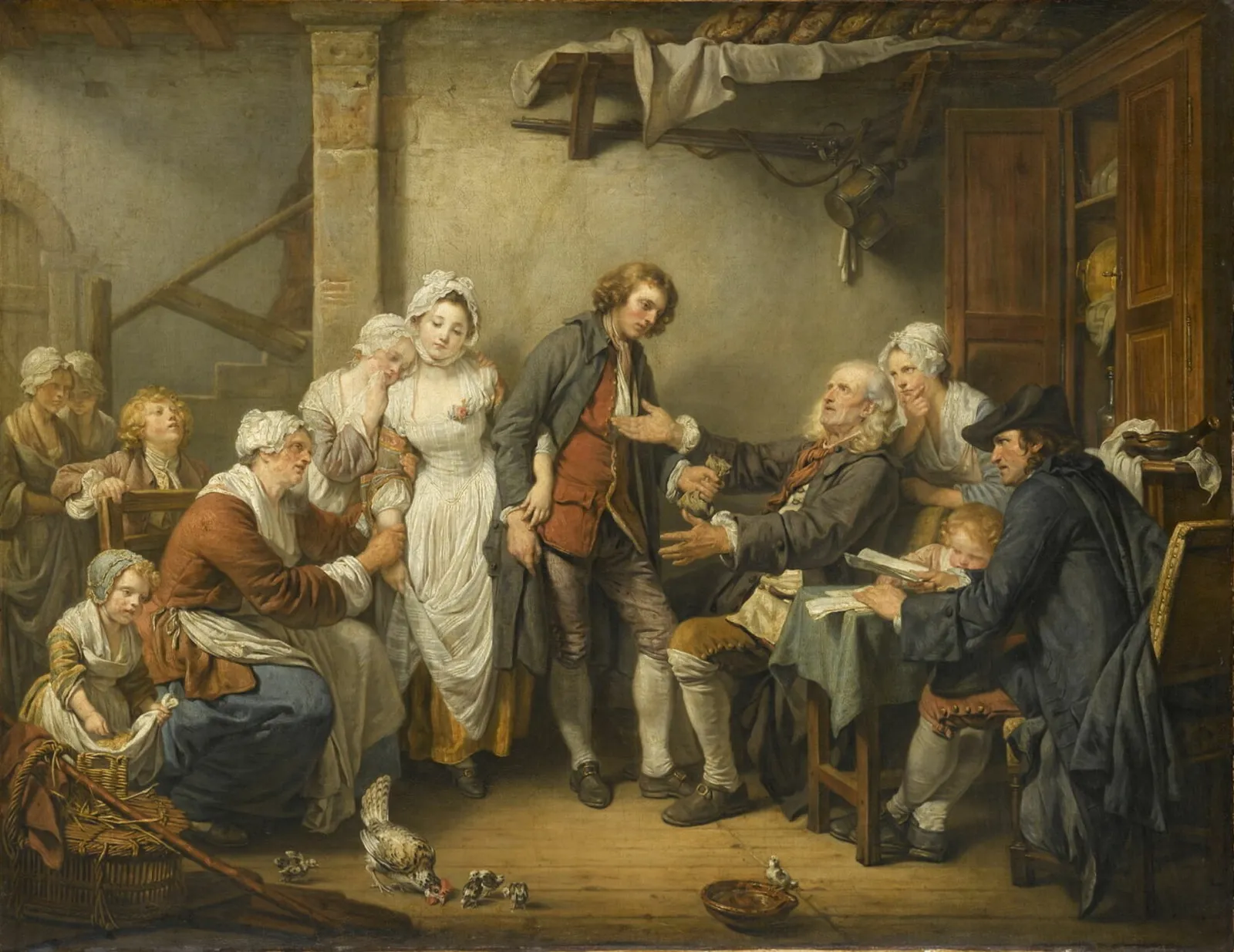
In the rainforest country of north Queensland, speakers of Dyirbal traditionally used two versions of their language. One was the everyday style. The other, called Jalnguy, was required whenever a person was within earshot of certain relatives, above all a mother-in-law. Jalnguy had the same grammar as everyday Dyirbal, but a vocabulary about one-sixth the size, with a different word for almost everything. The linguist R. M. W. Dixon, who recorded it from some of the last people who remembered it, beginning in the 1960s, describes rules that went with it: you did not look your mother-in-law in the eye, and you were not left alone with her.
Many cultures have had customs like this, and Western culture has its own, less formal version. Early in the second century the Roman poet Juvenal told a friend thinking of marriage that he could give up hope of peace at home while his mother-in-law was alive. Two thousand years of mother-in-law jokes have followed. Across very different societies, people have treated in-laws as a relationship to be managed, kept at a polite distance, and survived.
This piece takes the opposite approach. It offers questions to ask your in-laws about their lives, and argues that you are in an unusually good position to ask them, precisely because you are an outsider.
Why do so many people barely know their in-laws?
The in-law relationship starts in an odd place. You meet your partner’s parents as fully formed adults, usually in their fifties or sixties, often at a moment when they are deciding what they think of you. You meet them in their roles: the host, the grandparent-in-waiting, the person who carves the meat at Christmas. And the relationship then tends to be conducted almost entirely through logistics. Whose house for the holidays, who picks up the children, who is driving.
It is possible to spend twenty years in this pattern and know almost nothing about who your father-in-law was at twenty-two. Your partner is rarely much help. Children hear their parents’ stories in fragments over a lifetime, and often assume they know them better than they do. They also have no reason to ask questions about a family they grew up in. You do.
This matters for reasons beyond politeness. Terri Orbuch, a researcher at the University of Michigan, followed 373 couples from their first year of marriage in 1986 for more than two decades. As reported in 2012, husbands who said they were close to their wife’s parents were about 20 per cent less likely to divorce. The finding ran the other way for wives: those who reported being close to their husband’s parents had a higher risk. Orbuch’s explanation was that women tend to take in-law involvement more personally and find boundaries harder to hold. The result is a correlation from one American study, and should not be read as a rule. But it suggests the in-law relationship is not a side issue. It is part of the marriage.
Questions to ask your in-laws
These are grouped by theme. Start with the easier sections, and keep most of your attention for the follow-up questions: What was that like? What happened next? Why do you think you did that?
Where they come from
- Where did you grow up? Describe the house, as you remember it.
- What were your own parents like? What did they do for work?
- What did your family do on a normal weekend?
- What languages were spoken at home? Were there any you lost?
- Is there a family story about where your family came from that everyone tells?
Being young
- What were you like as a teenager? What did you want to be?
- What was your first job, and what did you earn?
- Who were your friends, and what did you do together?
- What did your parents worry about with you?
How they met, and the early years
- How did the two of you meet? What did you think of each other at first?
- What did your parents think of your partner?
- What was your first home together like?
- What was money like in those years?
Raising my partner
- What was my partner like as a baby? As a small child?
- What was the hardest stage of raising them?
- Was there a moment you worried about them more than any other?
- What do you see in them now that was already there at five years old?
Work, hard times and turning points
- What work were you proudest of?
- What was the hardest year of your life, and how did you get through it?
- Was there a decision that changed the direction of everything?
- What would you do differently, if you could?
What they would pass on
- What did your own parents teach you that you still live by?
- What do you hope your grandchildren will know about you?
- Is there a family recipe, saying or object that should never be lost?
- What do you know now that you wish someone had told you at my age?
The “raising my partner” section is the natural place to start. Almost every parent likes talking about their child, and it is the one subject on which you are obviously, sincerely curious. It also reassures them that you are asking out of interest, not for ammunition. For more questions in the same vein, see questions to ask your parents about their life and questions to ask your parents about how they met.
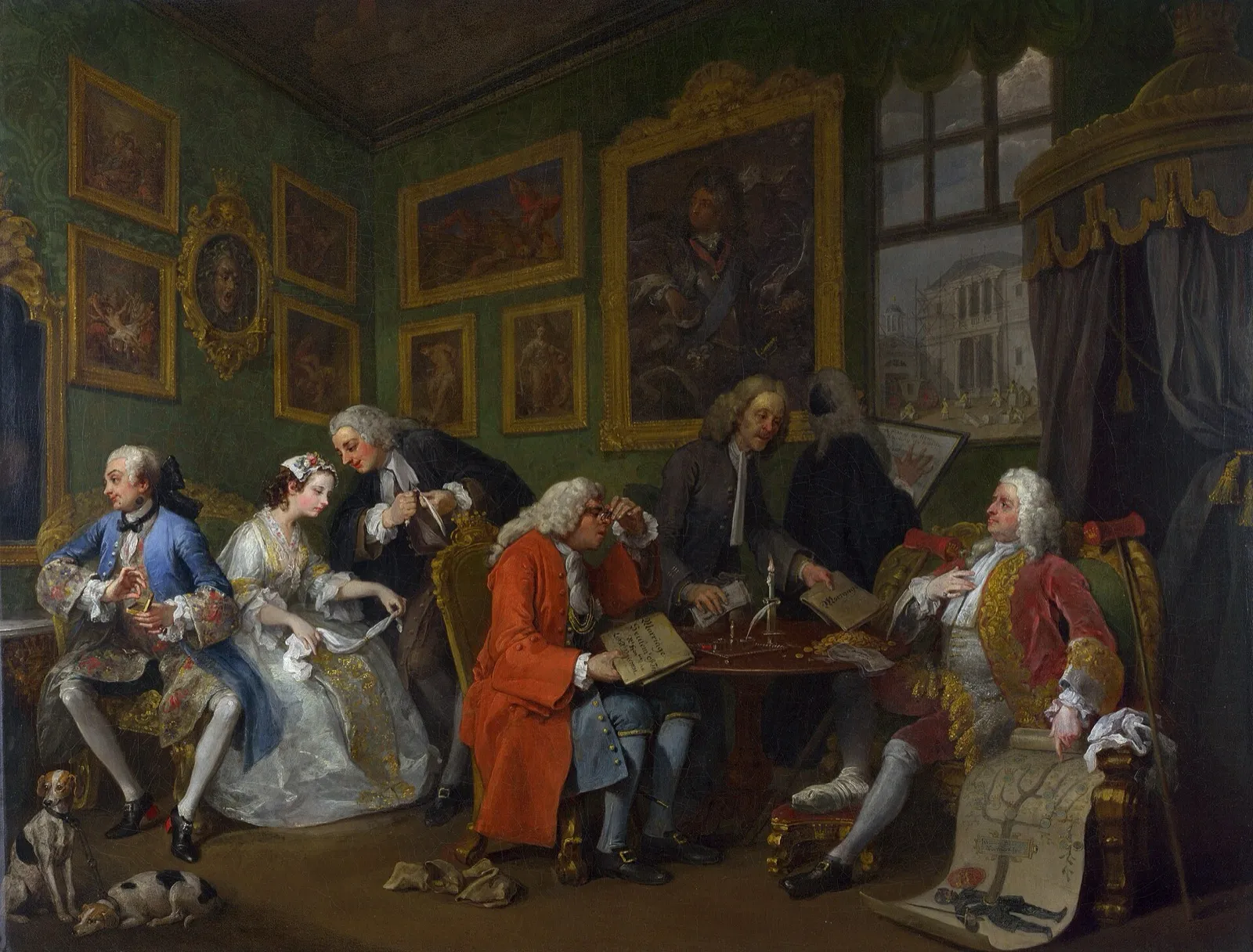 “Marriage A-la-Mode: 1, The Marriage Settlement” by William Hogarth, about 1743. National Gallery, London. Public domain.
Why is an outsider often the best person to ask?
Hogarth’s painting shows the older view of in-laws as two families negotiating a deal: an earl in need of money, a merchant in need of a title, and the bride and groom as an afterthought, sitting apart and paying each other no attention. For most of history, the families on either side of a marriage met as parties to a contract. They had every reason to be guarded with each other.
Something useful survives from that arrangement. In 1908 the German sociologist Georg Simmel wrote a short essay called “The Stranger”. He observed that people often confide things to a stranger, someone who is in the group but not fully of it, that they would hold back from those closest to them. A stranger brings no shared history, takes no side in old disputes, and has not already heard the official version.
A son-in-law or daughter-in-law is a stranger in exactly this sense. Your mother-in-law has told her own children the story of her first marriage, or the year the business failed, in a form shaped by her role as their mother. She may have softened it, left out what might worry them, or never told it at all. With you, the role is different. You can ask the naïve questions her children would feel they ought to know the answers to. In my experience of filming more than a hundred life stories since 2020, some of the most open interviews have been ones where the interviewer was not a son or daughter. People explain more to someone who needs it explained.
There is a second advantage. Your partner hears their parents’ stories as part of their own life, and it can be hard to listen to the story of your parents’ divorce, or your father’s illness, without hearing it as a story about yourself. You can listen to it simply as the story of a life.
How should you ask your in-laws?
Tell your partner first. This is their family. They may know which subjects are painful, and they should never feel that you are investigating their parents behind their back. Ideally, they will help you choose the questions.
Start with objects. Old photo albums, a wedding photo on the wall or a piece of furniture that came from overseas are easier openings than a formal request. “Who is this?” is a question almost anyone is happy to answer.
Ask about their parents. If you have children, your in-laws’ parents are your children’s great-grandparents, and your in-laws may be the last people alive who knew them. Questions about the generation above are also less personal, which makes them a gentle place to begin. (Family history interview questions goes further in that direction.)
Keep away from current disputes. The point is their life before you arrived, not the argument about last Christmas. If a question touches a live issue, move on.
Expect some reluctance. Many people in their seventies or eighties have never been asked about their lives, and some will deflect the first few questions with “there’s nothing interesting to tell”. That is almost never true. (For ways through that, see how to get a parent to talk about their past.)
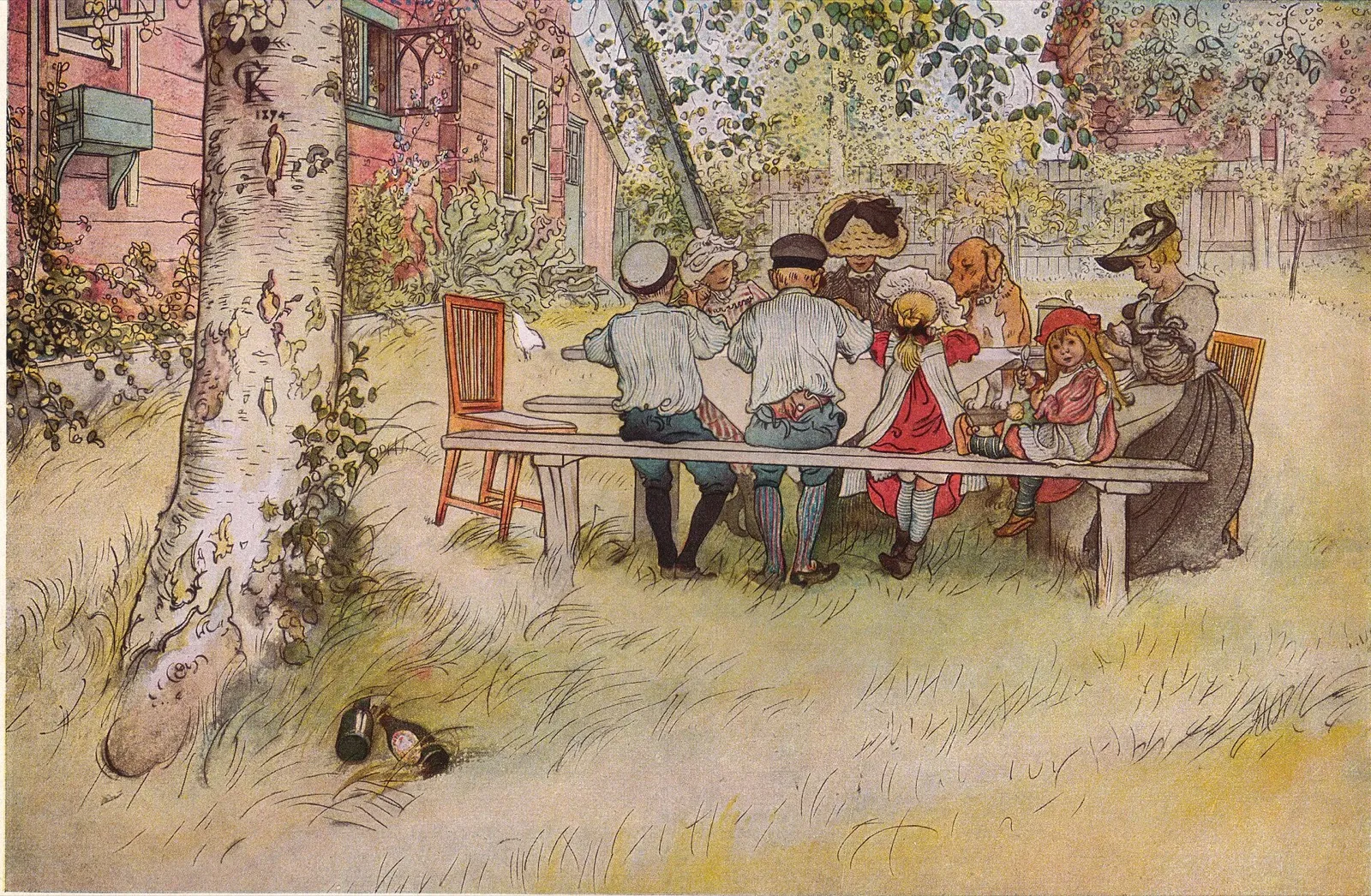 “Breakfast under the Big Birch” by Carl Larsson, 1896, from the series A Home. Nationalmuseum, Stockholm. Public domain.
Why record the answers?
If you have children, or plan to, there is a simple piece of arithmetic worth keeping in mind. Half of your children’s grandparents, and half of everything that came before them, is on your partner’s side of the family. Yet the stories that get kept in a family are usually the ones somebody makes an effort to keep, and the effort tends to fall to whoever is most interested. If you are the person in your marriage who cares about family history, it is easy to record your own parents carefully and leave your in-laws’ stories to chance.
My grandmother has since passed away. I have four hours of her telling me about her life, and I watch them now in a way I could not have imagined when we filmed them. Your in-laws’ stories will one day matter in the same way to your partner, and later to your children, who will want to know where their other half came from. Your partner may not think to ask until it is too late. You can.
A video does what a written note cannot. It keeps your father-in-law’s accent, the way your mother-in-law laughs at her own story, and the glance between them when one of them gets a detail wrong. If you want a simple structure, the Everyone app lets you film one question at a time on a phone, so the conversation can be built up over several visits instead of one long sitting. Any camera will do.
For most of history, families joined by marriage have kept a careful distance from each other. A good question is a better way to close it.
Your partner’s own early years deserve the same curiosity: see the questions to ask your partner about their childhood.