Questions to ask your parents about how they met.
How a couple tells the story of how they met says more than the facts. The questions to ask your parents, whether they stayed together or not.
In 1992 the psychologists Kim Buehlman, John Gottman and Lynn Katz published a study built on a simple interview. They sat down with 56 married couples, most of them with young children, and asked them to tell the history of their relationship: how they met, what they first noticed about each other, how they decided to commit, and how they got through the hard times. The researchers paid less attention to what the couples said than to how they said it. Did they speak warmly about each other? Did they say “we” or “I”? Did they describe their difficulties as something they had come through together? Three years later, the way couples had told that story lined up with which of them had separated with about 94 per cent accuracy.
That figure needs a caution, and I will come back to it. But the basic finding has held up well enough to change how therapists listen: the story of how two people met is not a neutral record of the past. It is a portrait of the relationship as it stands at the moment of telling. Which means that when you ask your parents how they met, you are asking two questions at once. One is about history. The other is about them.
This piece is about the questions to ask your parents about how they met, and about the rest of their relationship, including the parts that did not go to plan. It does not assume your parents married, stayed together or are both alive. Some of the best answers come from parents who separated decades ago.
Why does it matter whether you know how your parents met?
The psychologist Marshall Duke and his colleague Robyn Fivush, at Emory University, developed a twenty-item questionnaire for children called the “Do You Know?” scale. The questions are simple yes-or-no items: do you know where your grandparents grew up, do you know where your parents went to school, do you know the story behind your name. The first item on the list is: Do you know how your parents met?
In a 2008 paper, Duke, Amber Lazarus and Fivush reported that children who knew more of these stories tended to score better on measures of self-esteem, sense of control over their lives and family functioning. The journalist Bruce Feiler brought the scale to a wide audience in a 2013 New York Times column, “The Stories That Bind Us”. The researchers were careful to say that knowing the facts is not what helps. The knowledge is a sign of something else: a family that talks, where older people tell younger ones where they came from. A child who knows how their parents met has usually heard it told, more than once, at a table.
Plenty of adults have only a single sentence. “They met at a dance.” “They were introduced by a friend.” The sentence is a placeholder for a story that was never asked for.
Questions to ask your parents about how they met
These are grouped roughly in the order a relationship unfolds. You will not need all of them. Pick a handful, and spend most of your time on the follow-up: What happened next? What did you think at the time?
Before they met
- What was your life like in the year before you met? Where were you living, and what were you hoping for?
- Were you looking for someone? Had you been in love before?
- What did your friends do on a Saturday night?
The first meeting
- Where exactly did you meet? Can you describe the room or the place?
- What was your first impression? Was it the right one?
- Who spoke first, and what did they say?
- Did you know straight away, or did it take time?
- If I asked the other person, would they tell it the same way?
Getting to know each other
- What did you do on your first proper outing together? Who paid?
- How did you keep in touch? Letters, the phone in the hallway, turning up at the door?
- What did your parents think of them? Did anyone object?
- What was the first argument you remember?
- What did you love about them that other people did not see?
Deciding
- Was there a moment when it became serious? What happened?
- If there was a proposal, a ceremony or a move in together, how did it come about?
- What did you think your life together would look like? How close did it come?
The hard years
- What was the hardest time you went through together?
- What got you through it, or what didn’t?
- What did you learn about each other that you did not know at the start?
If they separated
- What do you remember most fondly from when it was good?
- When did you first sense it was not going to last?
- What would you tell your younger self on the night you met?
- Is there anything about that time you have never explained to me?
Looking back
- What do you think made you a good match, or a bad one?
- What do you know about love now that you did not know then?
- What would you want me to understand about your relationship?
For questions about the rest of their lives, from childhood to work, see questions to ask your parents about their life. For harder ground, such as fears and mistakes, see deep questions to ask your parents.
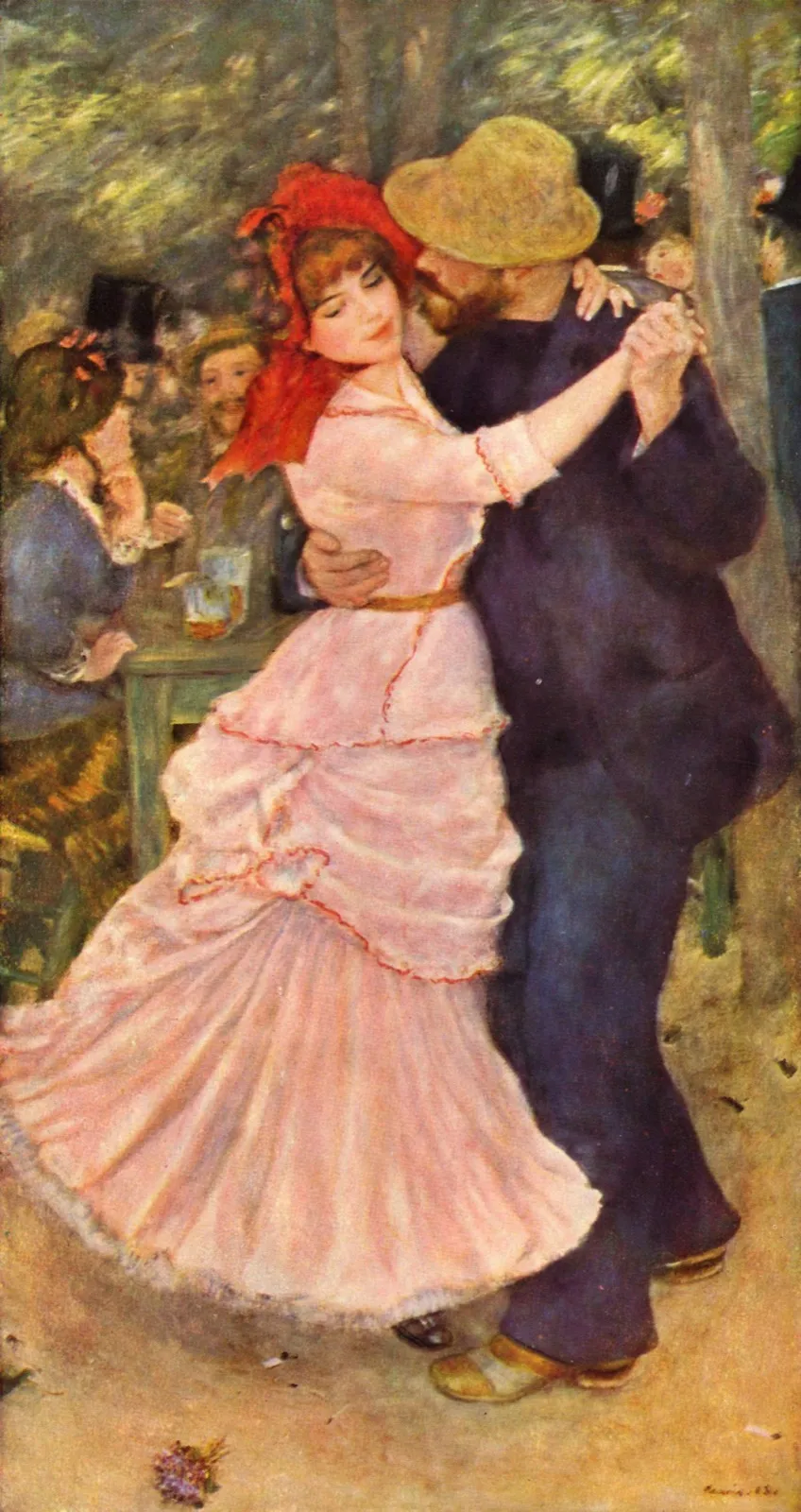 “Dance at Bougival” by Pierre-Auguste Renoir, 1883. Museum of Fine Arts, Boston. Public domain.
Why is “how did you meet?” such a good opening question?
Most life story interviews stall at the start because the first questions are too large. “Tell me about your childhood” asks someone to summarise decades. “How did you meet Dad?” asks for a single scene, with a place, a time, other people and a feeling. Scenes are easy to remember and easy to tell, and once a person is inside one, the next scene tends to follow. (Why open questions anchored in specific moments work so well is covered in more detail in how to interview someone.)
It is also a question that tends to bring out a person’s younger self. Asked about the night they met, people often begin to speak as they did at twenty-two: more playful, more uncertain, more willing to admit they were nervous. For many children it is the first time they have heard a parent describe themselves as someone who did not yet know how things would turn out.
How did people meet, and how has that changed?
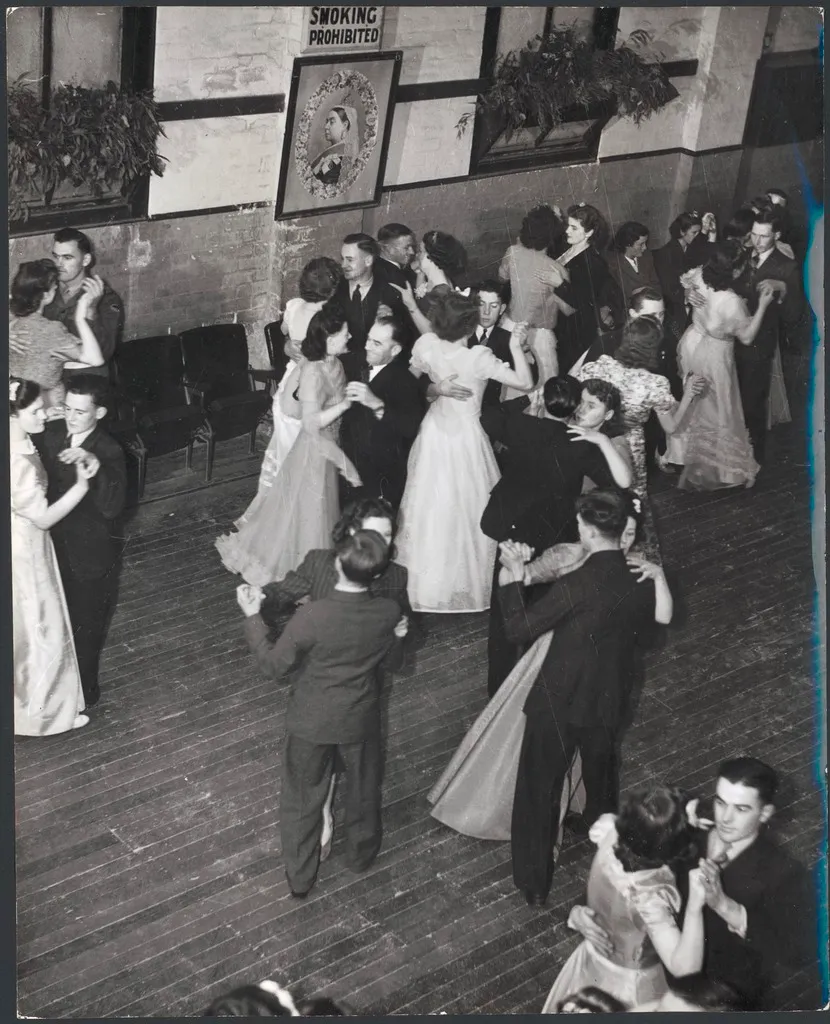
The answer you hear will depend heavily on when your parents met. For most of the twentieth century, couples met through the institutions of ordinary life: school, work, church or synagogue, the local dance, a neighbour’s introduction. The photograph at the top of this page, taken in a country hall in Gippsland in 1944, shows one of those institutions in action. Its original caption notes that half the dances were old-style and half “modern”, and that few people could jitterbug because there was never enough room.
That world has changed faster than most people realise. The sociologist Michael Rosenfeld and his colleagues, using the long-running How Couples Meet and Stay Together survey, found that among heterosexual couples in the United States who met in 2017, about 39 per cent had met online, up from 22 per cent in 2009. For same-sex couples the figure was around 65 per cent. Over the same period, meeting through friends and family declined sharply. Their 2019 paper was titled, a little bleakly, “Disintermediating your friends”.
This is one reason your parents’ story is worth recording in detail. The ways they met, the rules of courtship they followed, who was allowed to be introduced to whom, and what a family had to say about it, describe a social world that is disappearing. Ask about the details that seem ordinary to them: how much a ticket to the dance cost, whether they needed a chaperone, how long they waited for a letter.
How should you ask?
Ask each parent separately, then together. Couples who have been together for decades usually have a polished joint version of the story, told the same way at every anniversary. Asked alone, each person tends to add things the joint version leaves out. Then, if they are both willing, ask them together and watch where the two versions disagree. In my experience of filming more than a hundred life stories since 2020, the disagreements are often the best part: who noticed whom first, who was actually late, whose idea it was. The same is true of brothers and sisters remembering a shared childhood (see questions to ask your siblings). And your partner’s parents have a meeting story too, which they may tell more freely to you than to their own children (see questions to ask your in-laws).
Do not assume the ending. Ask how they met, not how they “fell in love” or “got married”, and let them choose the words. A parent who separated may still have a lovely story about the beginning, and may be relieved to be asked about it without having to defend how it ended. If a parent has a later partner, they may have two stories worth telling.
Ask about the other parent, carefully, if one has died. A widowed parent asked how they met is often given a rare chance to speak about their partner as a person rather than as a loss. Let them set the pace, and expect the answer to take longer than you planned.
Bring something to look at. An old photo, a wedding invitation, a letter or a ticket stub gives the conversation an anchor. If a parent resists the whole idea of being interviewed, see how to get a parent to talk about their past.
What can the way they tell it reveal?
Back to the caution. Critics of the 1992 study, including the journalist Laurie Abraham, have pointed out that the 94 per cent figure came from a statistical model fitted after the researchers already knew which couples had separated, so it is better described as a strong association than as a crystal ball. Gottman’s group has argued that later studies repeated the pattern. Either way, the core observation is hard to dispute: people retell their shared past in a way that reflects how they feel about each other now.
That is precisely why these stories should be recorded rather than simply heard. The facts of how two people met rarely change. The telling does, and so does the way a person’s face moves when they get to the part where the other one walked in. A written note of the story keeps the facts. A recording keeps the telling, including the glance across the room at the other parent, the pause, and the laugh at a detail neither of them has mentioned for thirty years.
I have four hours of my grandmother telling me about her life. She has since passed away. The facts in that recording could mostly be reconstructed from documents. What could not be reconstructed is the way she told them. If your parents are willing, prop up a phone and record the conversation. The Everyone app presents the questions one at a time so you can keep your eyes on them rather than on a list. But any camera will do. The story of how they met is the first chapter of yours, and at the moment the only copies are in their heads.
Once you have asked your parents, ask your partner too: the questions to ask your partner about their childhood cover the years you missed.