Family reunion ideas people will actually remember.
The largest family reunion gathered 4,514 descendants of one couple. Family reunion ideas and activities that keep the stories, not just the names.
In August 2012, 4,514 people gathered in the village of Saint-Paul-Mont-Penit in the Vendée, in western France. According to Guinness World Records, it remains the largest family reunion ever recorded. Everyone there descended from a single couple, Georges Porteau and Madeleine Boileve, who lived in the seventeenth century. One descendant, Jean-Michel Cheneau, had spent years tracing the tree that connected them.
It is a remarkable achievement, and it also shows what a family usually keeps over three or four centuries. The cousins had names, dates and a diagram of who descended from whom. As far as anyone can tell, they had nothing of Georges and Madeleine themselves: not a face, not a saying, not a single story. The family survived. The people at the root of it did not.
Most family reunion ideas are about the day itself: games, food, matching T-shirts. Those matter, because a reunion nobody enjoys is not repeated. But the reunions people remember, and the ones that still matter fifty years later, are the ones where something was passed on. This piece is a list of family reunion activities built around that idea, with the most important one first.
What is a family reunion actually for?
A family reunion is usually described as a chance to catch up. It is also something rarer. It is the one day in a year, or a decade, when most of a family’s memory is in one place.
Every family’s history is held by a few people: the great-aunt who knows why the brothers stopped speaking, the grandfather who remembers the farm before it was sold, the cousin who kept the letters. On an ordinary day those people are spread across suburbs, cities and sometimes countries. At a reunion they are sitting at the same table, often for the last time in that combination. Each reunion has a slightly different guest list from the one before, and the difference is mostly people who will not be at the next.
This is not a new insight. In the United States, African American families have held reunions since the years after emancipation, when freed people searched for relatives who had been sold away. Ione Vargus, the social work professor who founded the Family Reunion Institute at Temple University in 1990, argued that a reunion should be “more than a picnic”. In her account, the 1977 television series Roots, based on Alex Haley’s search for his ancestors, prompted a wave of larger and more organised reunions in the decades that followed, many with family histories, genealogy tables and ceremonies for elders. The families who took reunions most seriously were, not by coincidence, those who had come closest to losing their history altogether.
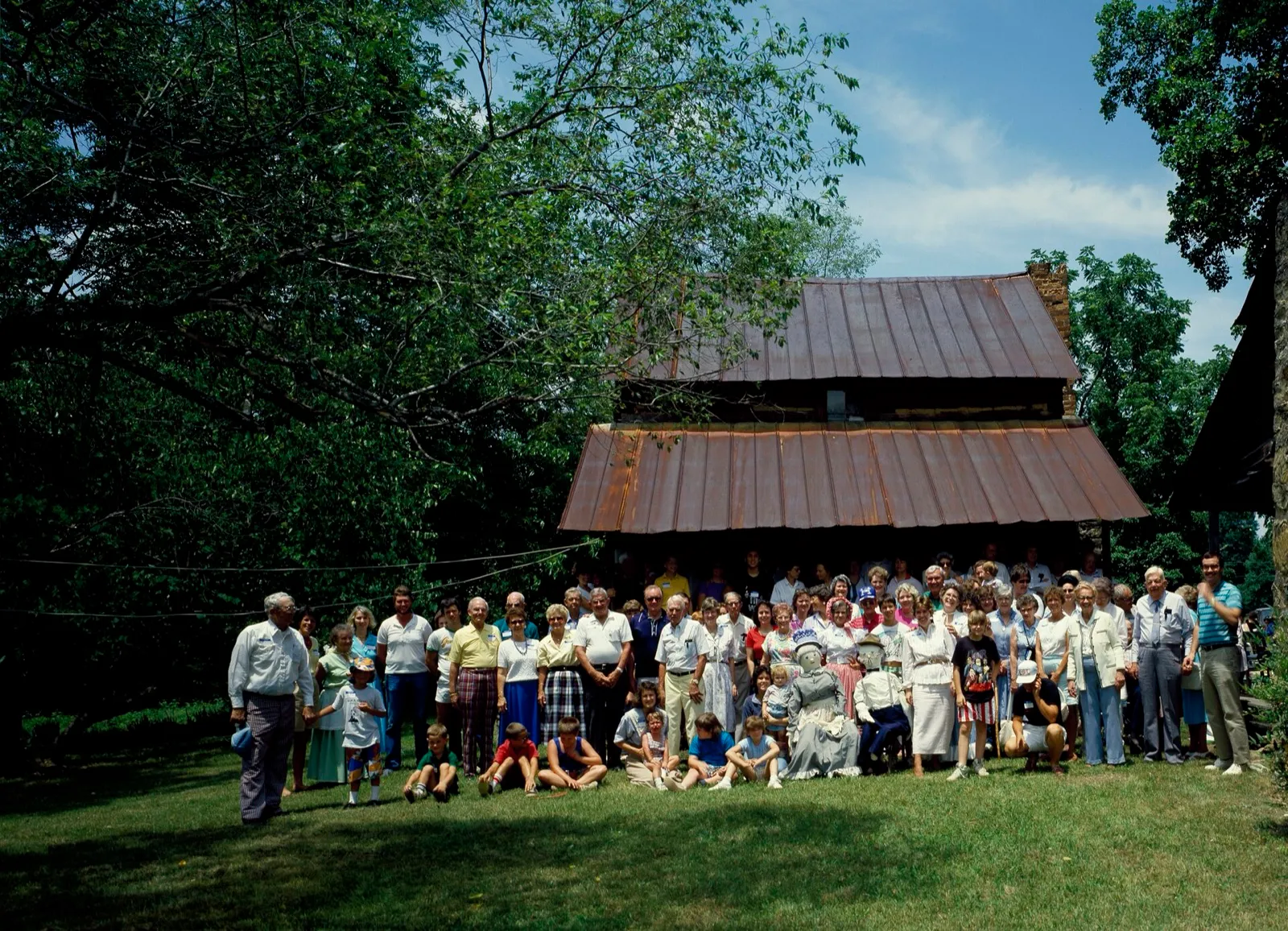 Photographer Carol M. Highsmith’s family reunion at the log cabins in Wentworth, North Carolina, where her grandfather and great-grandfather were born. Photo by Carol M. Highsmith, between 1980 and 2006. Library of Congress. Public domain.
Why do family stories matter to the children there?
There is some evidence that the stories told at gatherings like these do more than entertain.
In the early 2000s, the Emory University psychologists Marshall Duke and Robyn Fivush developed a simple questionnaire for children called the “Do You Know?” scale. It contains twenty yes-or-no questions: Do you know how your parents met? Do you know where your grandparents grew up? Do you know of an illness or something terrible that happened in your family? In their studies, children and teenagers who knew more of these answers tended to score higher on measures of self-esteem and a sense of control over their lives, and lower on measures of anxiety and behaviour problems.
The research is correlational, so it does not prove that learning family history makes children resilient. Duke’s own interpretation was that the answers are a marker of something else: families in which older relatives tell stories, and children are around to hear them. The knowledge is the trace left by the telling. A reunion is one of the few occasions designed for exactly that kind of telling, if anyone organises it.
Family reunion ideas that keep the stories
These are ordered roughly by how much each one preserves. The first is the one I would build the day around. (For questions to use at any of them, see questions to ask your grandparents before it’s too late.)
1. A story corner. Set aside a quiet room, or a shaded spot away from the music, with two chairs, a phone on a small tripod and a printed list of questions. Through the day, invite relatives in pairs: a grandchild with a grandparent, two cousins, siblings who have not seen each other in years. Each conversation lasts ten or fifteen minutes and is filmed. By the evening you have a collection of short interviews that no amount of photographs could replace.
2. A mystery photo table. Most families have boxes of old prints in which nobody under sixty can name anyone. Lay them out on a table with sticky notes and pens, and ask the older guests to write names, places and years on the notes. Better still, film them going through the box, because the story behind a photo is usually longer than a sticky note.
3. A family tree wall. Print a large tree with gaps left where names or dates are missing, and let relatives fill them in during the day. It gives people a reason to talk to the branches they barely know, and it is a natural starting point for anyone who wants to start a family tree properly afterwards.
4. A “where we came from” map. Pin a map of the world to a board and ask each household to mark where their parents, grandparents and great-grandparents were born. Migration is one of the strongest threads in most families, and seeing it laid out tends to start conversations about why people left.
5. A recipe swap with a cook-off. Ask each branch to bring a dish from an older generation, along with the story of who made it. Recipes are among the most fragile family knowledge, because so much of it was never written down. (How to preserve family recipes covers why, and how to keep them.)
6. A home-movie screening. If anyone has old film reels or video tapes, have them digitised beforehand and show them after dinner. Then ask the older guests who is on screen, and record what they say.
7. A “Do You Know?” quiz for the children. Borrow a few of Duke and Fivush’s questions and turn them into a team game: How did Grandma and Grandpa meet? Which country did our great-grandparents come from? The children will not know many answers, which is the point. The adults will enjoy supplying them.
8. A generations photo. Line up the oldest and youngest members of every branch for one photograph. It costs nothing and becomes, years later, one of the most looked-at images a family owns.
9. A walk to an old place. If the reunion is near a family house, church, school or farm, walk there together and ask whoever remembers it best to describe what it was like. People recall far more when they are standing in the place itself.
10. A message to the next reunion. Ask each household to record a one-minute video for whoever is at the reunion in ten years’ time: who they are, what they hope for, what they want remembered. Seal the collection and open it at the next gathering.
Sports, a talent show, matching shirts and name tags coloured by branch still have their place, especially for the younger cousins. But the activities above are the ones whose results outlast the leftovers.
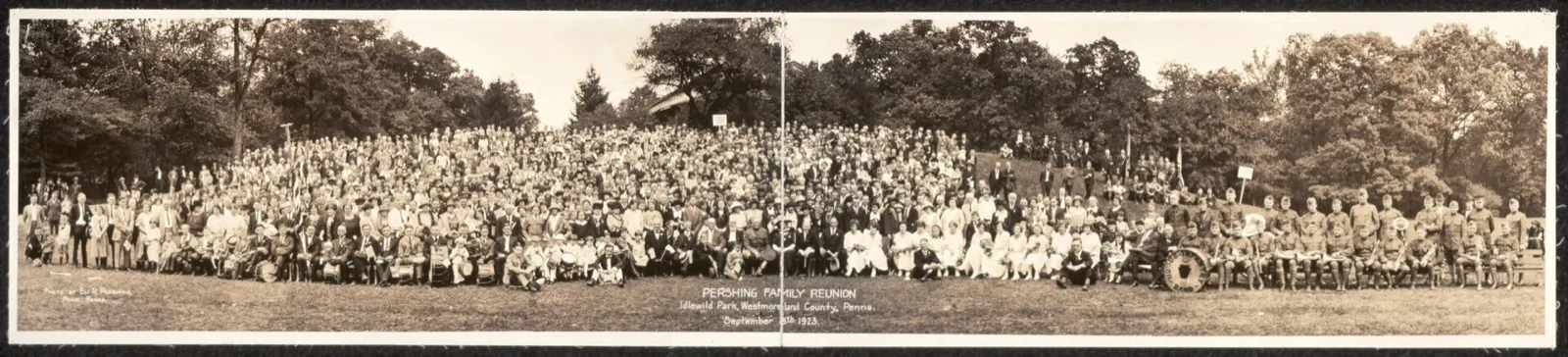 Pershing Family Reunion, Idlewild Park, Westmoreland County, Pennsylvania, 8 September 1923. John J. Pershing Collection, Library of Congress. Public domain.
How do you run a story corner at a reunion?
The story corner is the one idea on this list that needs some planning. In my experience of filming more than a hundred life stories through The Archive since 2020, these are the details that decide whether it works.
Choose the room for sound, not looks. A reunion is loud. A recording made next to a barbecue or a children’s game is often unusable. A spare bedroom or a quiet office, with the door closed, is better than any garden. (There is more on this in how to film an interview at home.)
Put someone in charge of it. A story corner with no host stays empty, because nobody wants to be the first to ask Grandpa to be interviewed. One person, ideally a teenager or young adult who is comfortable with a phone, should own it for the day, invite people in and keep a list of who has been recorded.
Start with the oldest guests, early. Older relatives tire by mid-afternoon, and some leave before dinner. Record them first, while they have the most energy. (The same applies to a big birthday; see 90th birthday ideas.)
Ask for scenes, not summaries. “Tell me about the house you grew up in” works better than “Where did you grow up?”. The best material comes from the follow-up: What happened next? Who else was there?
Pair people deliberately. Two siblings remembering the same childhood will often disagree about it, and the disagreement is usually the best part. (For prompts, see these questions to ask your siblings about growing up.)
Collect the files before people go home. Videos left on twenty different phones tend never to be gathered. Agree on one place where every recording goes, and copy them there before the day ends.
What will the family remember in fifty years?
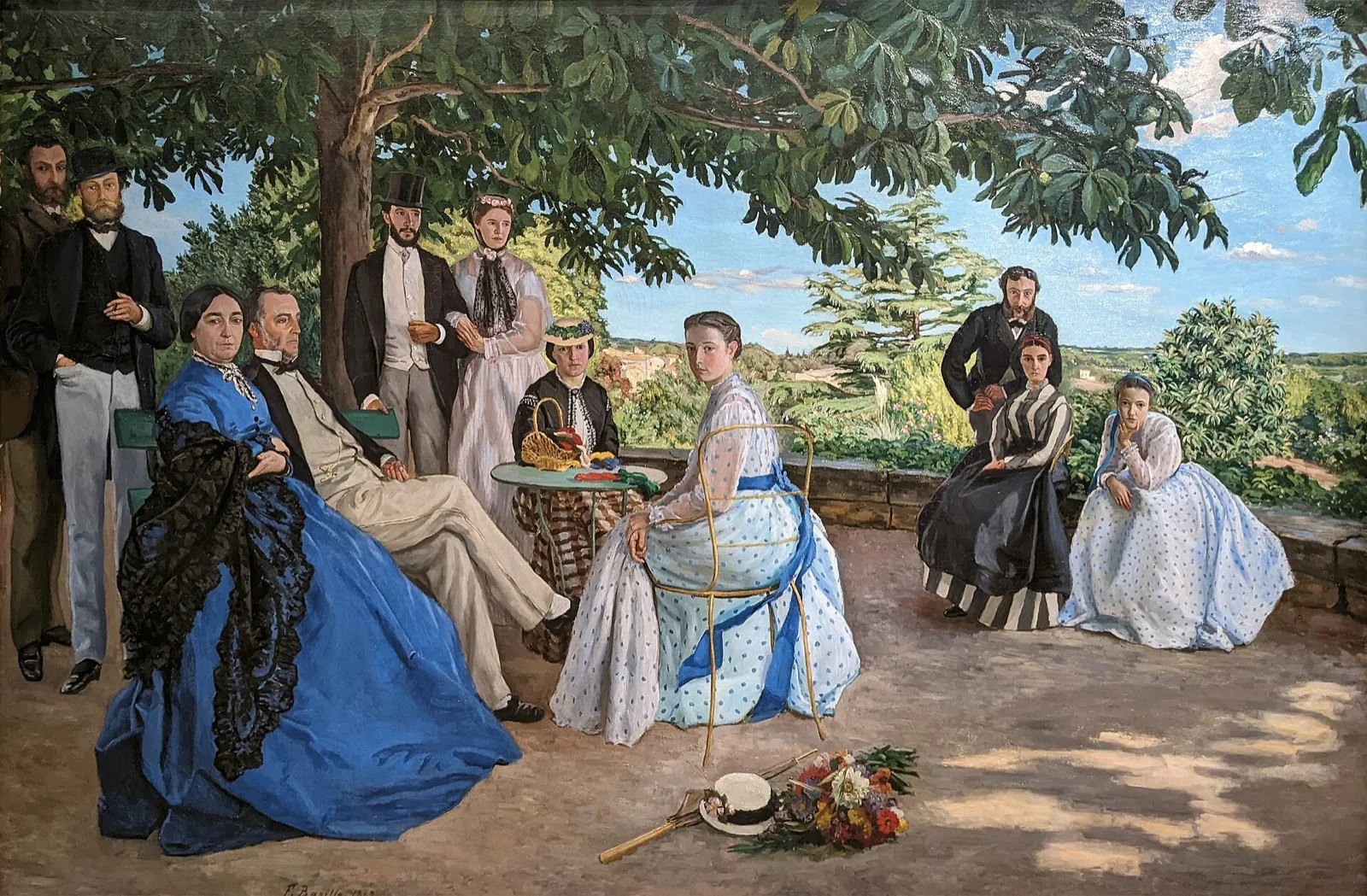
Frédéric Bazille’s painting at the top of this page shows his own family on the terrace of their summer house at Méric, outside Montpellier, in 1867. Bazille was killed in the Franco-Prussian War three years later, aged twenty-eight. The painting is now in the Musée d’Orsay, and it is a fine record of what his family wore, how they sat and how they looked at the painter. It cannot tell us a single thing any of them said that afternoon.
The Pershing panorama of 1923 is the same: hundreds of faces, almost none named for a modern viewer. Your own reunion photographs will be in that position in a century, unless someone records the voices that go with them.
The Porteau-Boileve cousins could reconstruct their family tree because a few people had kept careful records of names. What no record kept was what Georges and Madeleine were like. For the first time, keeping that is easy: ten minutes, a phone and a quiet room. The Everyone app was built for this kind of recording, offering one question at a time and keeping each family’s videos together in one place, though any camera will do. What matters is that at your next reunion, someone takes the oldest person in the room aside and asks them to tell a story, and that the story is still there when the great-grandchildren hold a reunion of their own.