How to record your grandparents’ stories on the phone in your pocket.
In 1933 recording a voice took a 315-pound machine. Now it takes a phone. How to record your grandparents’ stories well: settings, sound, storage and asking.
In the summer of 1933, the folklorist John Lomax and his teenage son Alan drove into the South to record songs for the Library of Congress. In the boot of their Ford sedan, by the Library’s own account, was a disc recorder weighing about 315 pounds, or roughly 140 kilograms. With it, that July, they recorded a prisoner at the Louisiana State Penitentiary in Angola named Huddie Ledbetter, later known to the world as Lead Belly. Every recording they made that year required a car, a heavy machine, blank discs that could be cut only once, and a reason important enough to justify the trip.
The phone in your pocket weighs about two hundred grams. It records better sound than the Lomax machine did, and it records the face as well. If you want to record your grandparents’ stories, the problem that limited the Lomaxes, and every collector of voices for most of the twentieth century, has been solved. That is worth stating plainly, because it changes what the remaining problems are. They are no longer about equipment. They are about a handful of settings, the distance between a phone and a mouth, where the files end up, and whether anyone asks.
Why was equipment the bottleneck for so long?
For most of history, recording an ordinary person required either literacy or money. A life could be written down, which meant the person, or someone close to them, had to be able to write and willing to spend weeks doing it. Or it could be captured by a machine, which in the 1930s meant institutional funding and for decades afterwards meant expensive equipment few families owned.
The result was a filter. The voices that survive from the early twentieth century are disproportionately those that someone with a machine decided were important: singers, as with the Lomaxes, or people at the centre of public events. Almost nobody recorded their grandmother explaining how she met their grandfather, because almost nobody could.
That filter has gone. Most adults now carry a high-definition video camera at all times. Yet when I ask people whether they have a recording of their grandparents telling their own stories, most say no. The equipment arrived, and the habit did not follow. The rest of this piece is about closing that gap, using nothing but a phone.
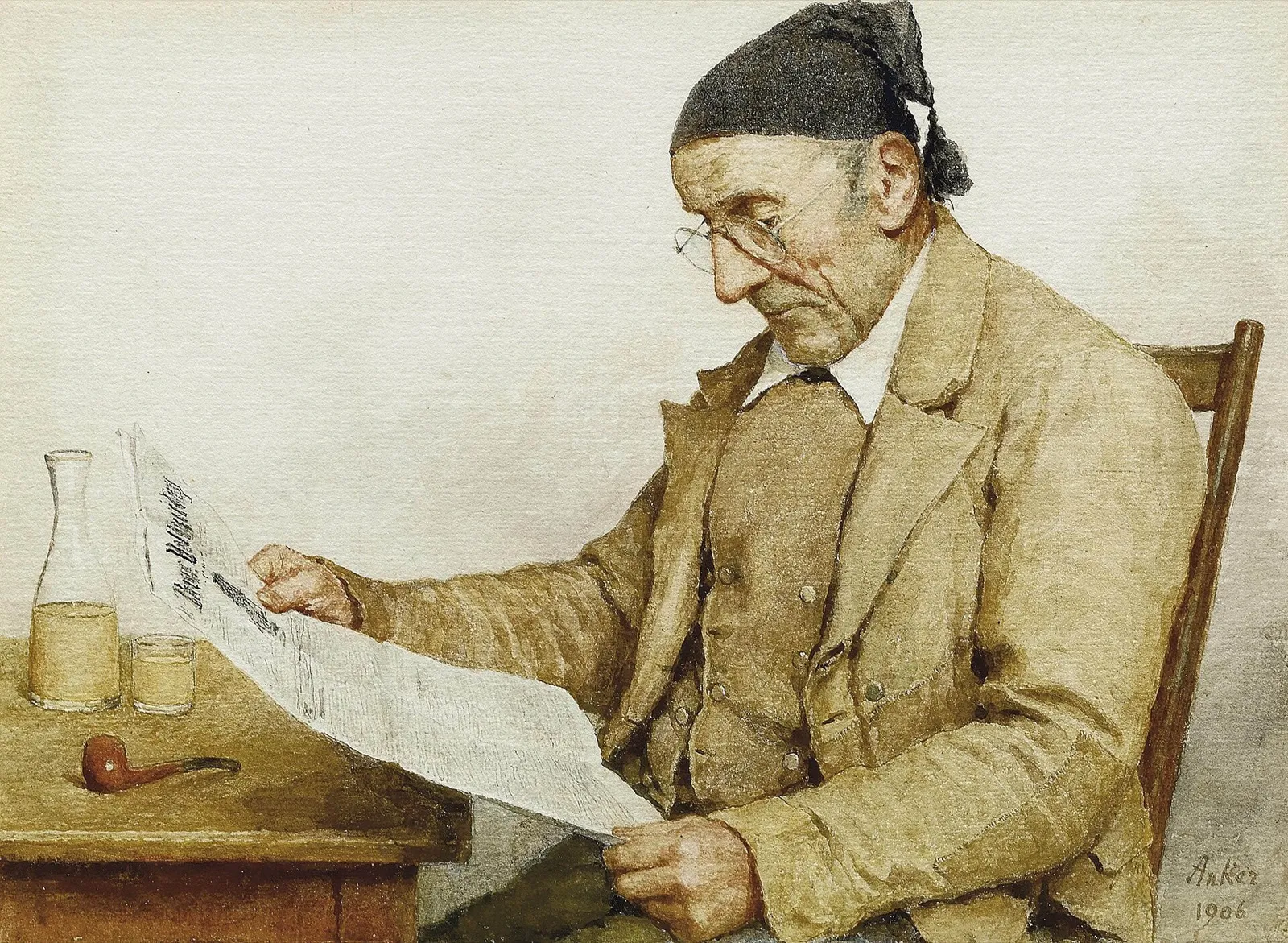
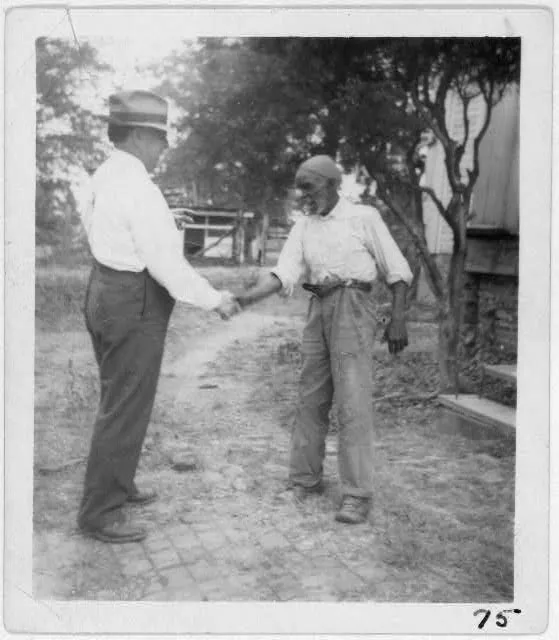 John A. Lomax shaking hands with “Uncle” Rich Brown, a singer of spirituals, near Sumterville, Alabama, in 1940. Photograph by Ruby Terrill Lomax. Library of Congress, Lomax Collection. Public domain.
How to record your grandparents’ stories: the phone settings
A modern phone will make a watchable recording on its default settings. A few changes make it a good one, and all of them take less than five minutes the day before.
- Use the rear camera and the main lens. The rear camera is almost always better than the selfie camera, and the main (1×) lens is the best of the rear lenses. Ultra-wide lenses distort faces at close range.
- Choose 1080p at 30 frames per second. On a recent iPhone this uses roughly 60 megabytes a minute; 4K uses about three times as much. A forty-five-minute session in 1080p is under three gigabytes. 4K is fine if you have the space, but higher resolution adds nothing to a story and makes the files harder to store and share.
- Turn off special modes. Cinematic, portrait-video and action modes are designed for other purposes. They can blur the background in odd ways or crop the frame.
- Free up space and charge the phone. Check that you have at least ten gigabytes free. Run the phone from a charger during the session.
- Silence everything. Switch on Do Not Disturb or aeroplane mode on the recording phone and on yours. An incoming call can stop a recording on some phones, and a notification sound can ruin the best minute of the afternoon.
- Lock focus and exposure. On most phones, pressing and holding on the person’s face locks both, so the picture stops shifting each time they move their hands.
Portrait or landscape both work. What does not work is switching halfway through.
Why does sound matter more than the picture?
People will watch a slightly soft image for an hour. They will not listen to thirty seconds of a voice they have to strain to hear. The picture is what we notice; the sound is what carries the story.
A phone’s microphone is built into the phone, so the phone’s position decides the sound. Each time the distance between a microphone and a mouth doubles, the voice reaching it drops by about six decibels, while the echo of the room stays the same. A phone propped two metres away records mostly room. A phone within about a metre, at the height of the person’s eyes, records mostly person. A small clip-on microphone that plugs into the phone, or a wireless one, solves the problem entirely and costs less than a meal out.
Then listen to the room. Turn off the television, the radio and anything with a fan. Close the doors. Carpeted rooms with curtains and soft furniture sound far better than kitchens. There is more on choosing the room, the light and the background in how to film an interview at home.
Before you start properly, record thirty seconds, play it back through headphones, and listen. It is the most useful minute of the whole afternoon.
Should you record video, or just their voice?
A voice recording is better than nothing, and if a grandparent refuses to be filmed, a voice memo on the table is a reasonable compromise. But if there is a choice, film.
So much of what we know about a person is not in their words. It is in the way their face changes before they answer, the gesture they make when describing a house, the moment they look away. My grandmother has since passed away, and I have four hours of her telling me about her life. What I return to is not only what she said, but how she looked while saying it. A transcript, or even a voice, cannot give me that. (The longer case is in audio vs video recording.)
What should you say before you press record?
Two things: what the recording is for, and whether they agree.
Tell them who will see it. Usually the honest answer is “the family”, and most grandparents are pleased by the idea that their great-grandchildren might one day watch them. Then, once recording, ask them to say their name, the date, and that they are happy to be recorded. Professional oral historians always do something like this, and it is good practice for families too. It also settles, in their own words, any later question about whether they wanted the recording made.
Then start somewhere easy. Their full name and where they were born. The house they grew up in. Their parents. One memory tends to bring the next within reach, so a life told roughly in order flows better than questions asked at random. The fuller list is in questions to ask your grandparents.
How should you behave once it is recording?
Since 2020 I have filmed more than a hundred life stories, and the advice I would give most people is to talk less than feels natural.
- Ask for scenes, not summaries. “Describe the kitchen in the house you grew up in” produces a far richer answer than “Where did you live?”
- Follow up. The best material usually comes from the second and third questions: “What happened next?” “How did you feel about that?”
- Wait. When they stop, count to five before you speak. People often add the most honest part of a story after a pause.
- Do not correct them. If they remember a year wrongly, let it stand. You are recording how they remember their life, not compiling a history.
- Keep sessions short. Thirty to forty-five minutes is enough, especially for someone in their eighties or nineties. Several short sessions produce better stories than one long one. There are more adjustments for hearing, tiredness and memory in how to interview older family members.
What if they live far away?
A video call can be recorded, and some apps have this built in. The quality is lower and depends on both internet connections, but a recording of a grandparent on a laptop screen is still a recording. Tell them you are recording, and ask for their agreement on the recording, as above. Laws on recording conversations vary between countries and states, and asking first avoids the question entirely.
A better option, where possible, is to ask someone who lives nearby, a cousin, an aunt, a neighbour, to sit with them and hold the phone while you ask the questions over a call.
Where should the recordings go afterwards?
A video that exists only on one phone is in the same position as the story was before you recorded it: a single copy, in one place, waiting to be lost. Phones are dropped, stolen, replaced and wiped.
The same day, copy the files off the phone. Rename them with the person’s name, the date and the topic. Then follow the rule archivists use: at least three copies, on at least two kinds of storage, with at least one somewhere other than your house. Most importantly, share them with the rest of the family. A copy held by a cousin in another city is the most durable backup there is. The reasoning behind this is in how to preserve family stories. If you later want to cut the recordings together with old photos and home movies, see how to make a family history video; if you want to turn them into a written account, see how to write your grandparents’ life story.
What the Lomaxes would have given for a phone
The Lomaxes drove thousands of miles with a machine the weight of two men to record voices that would otherwise have been lost. They made those trips because they understood that a voice, once gone, cannot be recovered by any later effort.
We carry that machine’s descendant in our pockets, and we mostly use it to film our lunch. The hard part of recording your grandparents’ stories is no longer technical. It is asking, and choosing an afternoon. Everyone was built to help with that part: it asks one question at a time, so a grandparent can answer on video in short pieces, and the stories are kept for the family. But the phone you already own is enough to begin, and the best time to begin is while they can still tell you themselves.