The best questions to ask your grandpa, side by side.
The best questions to ask your grandpa about his life, and why men of his generation open up through work, places and objects rather than feelings.
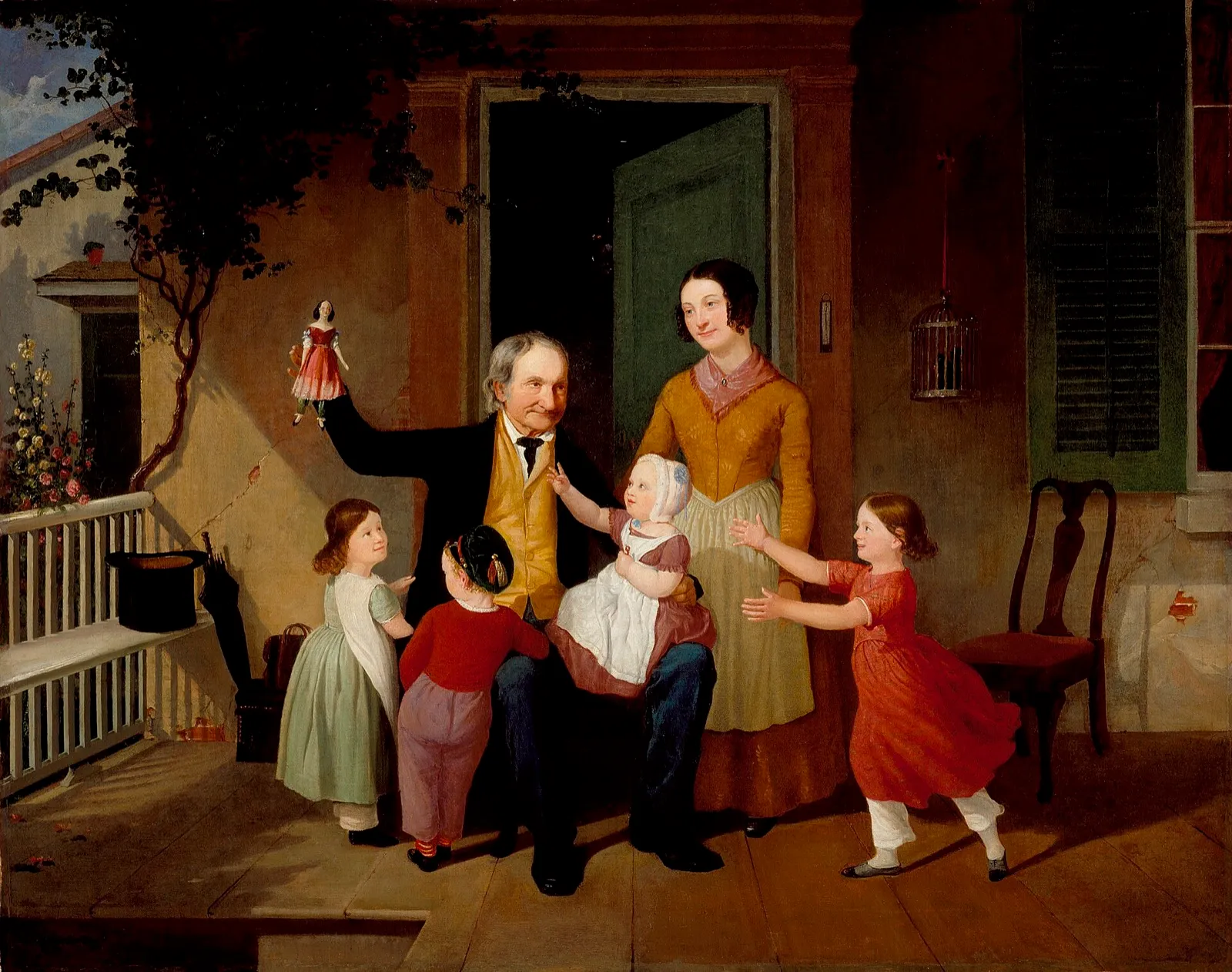
Some decades ago the researcher Bruce Dorval filmed pairs of best friends talking to each other: children in second grade, sixth grade and tenth grade, and adults of about twenty-five. The linguist Deborah Tannen later studied the tapes, and the first thing she noticed was not what anyone said. It was where they looked. At every age, the girls and women turned their chairs towards each other and held each other’s gaze. At every age, the boys and men sat at angles or side by side, looked around the room, and glanced at each other only now and then. The older boys talked about things that mattered to them, but they did it facing the same way, not facing each other.
Tannen published the analysis in 1990, and it has an obvious application that she did not write about. If you want to know what questions to ask your grandpa about his life, the questions are only half of it. The other half is where you sit when you ask them.
This post gives you the best questions to ask your grandpa, grouped by the parts of a life he is most likely to talk about freely. It starts with why the usual approach so often gets a shrug.
Why does Grandpa say so little when you ask about his life?
Most grandfathers alive today were born between about the 1930s and the 1960s. They grew up when a man was expected to provide, endure and say little about either. Many of them were never asked how they felt about anything, and they answer the question the way you answer a question in a language you rarely speak: briefly, and with relief when it is over.
This does not mean they have no stories. It means the door is in a different place. Ask a grandfather “What was your childhood like?” and you may get “Pretty ordinary.” Ask him how his father fixed the car, how the shearing shed worked, or what the foreman at his first job was like, and he may talk for twenty minutes. The feelings are in those stories. They arrive attached to a task, a place or an object, rather than on their own.
There is also a harder reason to start soon. In Australia, a boy born in 2021–23 can expect to live 81.1 years and a girl 85.1, according to the Australian Bureau of Statistics. For older generations the gap was wider. In many families, Grandpa is the grandparent we have the least time with, and the one whose stories are least often recorded. (The questions to ask your grandma post makes the opposite case: she tends to be asked about everyone except herself.)
What questions should you ask your grandpa?
The rule behind every good interview question applies: ask for scenes, not summaries. “Describe the first car you owned” will always beat “Did you like cars?” The groups below follow roughly the order of a life, because one period brings the neighbouring years within reach.
Where he grew up
- Draw me a map of the street you grew up on. Who lived where?
- What did your father do for work, and did you ever go with him?
- What were you allowed to do at ten that a ten-year-old could not do now?
- What did you build, break or get in trouble for?
- Who was the toughest person you knew as a boy, and were they right?
Work and skill
For many men of his generation, work was the main way they knew who they were. These questions tend to unlock the most.
- What was your first job, and how did you get it?
- What did you earn in your first pay packet, and what did you do with it?
- Show me how you used to do it. (A knot, a joint, a sum, a sales pitch.)
- Who taught you your trade, and what did they get right?
- What was the hardest day you ever had at work?
- What part of your work do people in the family not understand?
Places
- Where did you go when you wanted to be alone?
- Take me through a normal Saturday when you were twenty.
- Which place would you go back to for one more day?
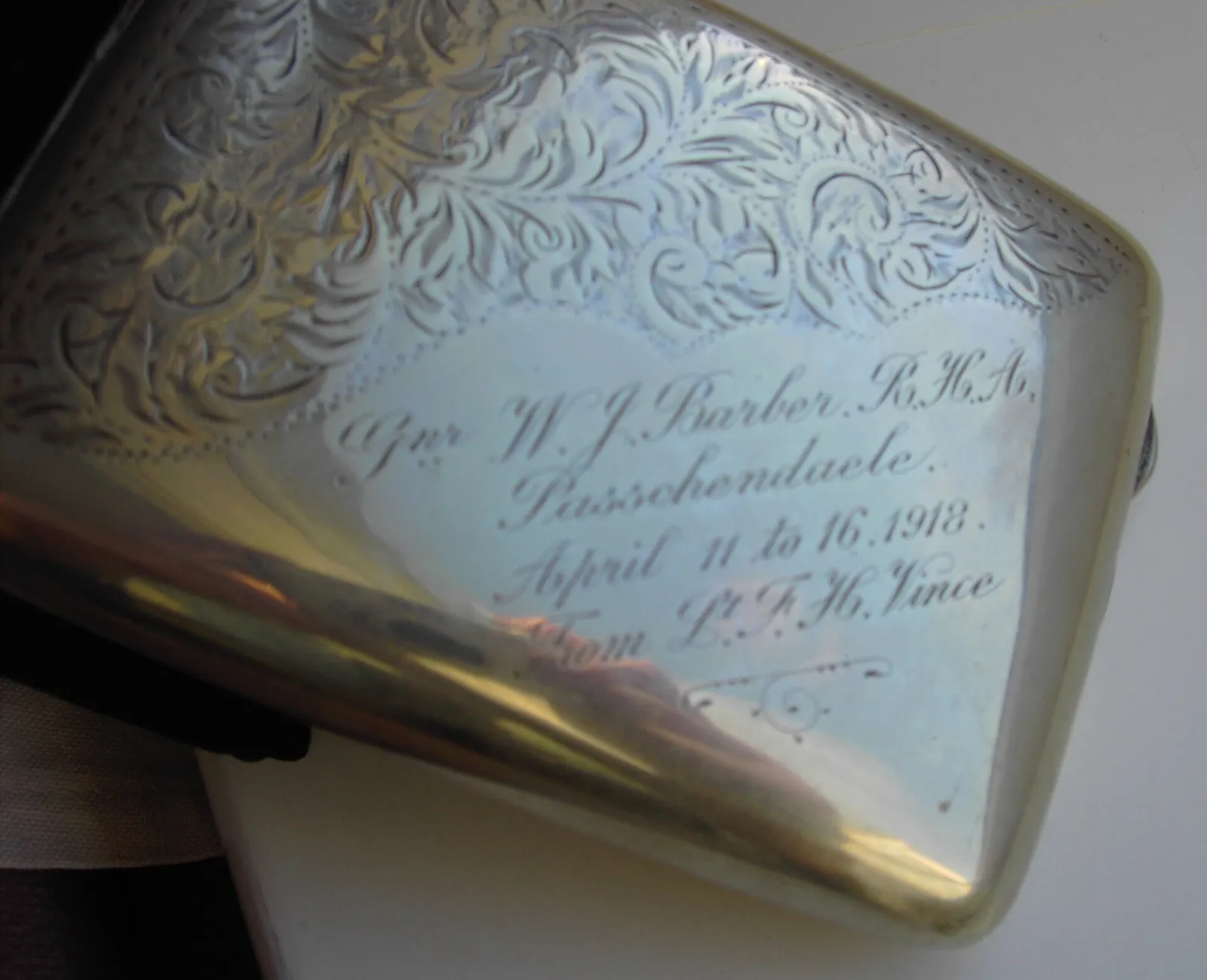 A silver cigarette case engraved to Gunner W. J. Barber, Royal Horse Artillery, “Passchendaele, April 11 to 16, 1918”, from a Lieutenant F. H. Vince, contributed by his grandchild to the Europeana 1914–1918 collection. Photo by a Europeana staff photographer, 2014. Public domain.
Objects
An object is the easiest way to talk side by side. You are both looking at the thing in his hands, not at each other.
- What is the oldest thing you own, and where did it come from?
- Which of your tools would you never lend anyone?
- Is there anything in this house that you would grab in a fire?
- What did your father leave you, and what did you think of it?
The cigarette case above shows why these questions matter. Its engraving records a name, a regiment, a battle, a week and the officer who gave it. It does not say why a lieutenant gave a gunner a silver case after six days at Passchendaele. That is the part of the story that lived only in the man who carried it, and it is the part that disappears unless someone asks.
Service, national and otherwise
Not every grandfather served, and many who did will not want to talk about it. Ask, and accept the answer.
- Did you do national service, or did you ever expect to?
- If he is Australian and was born between 1945 and 1952: Was your birthday drawn in the ballot? Where were you when you found out?
- Who did you serve with, and are any of them still around?
- What did you not tell your family at the time?
The Vietnam-era ballot is a good example of a story hiding in plain sight. Between 1965 and 1972, more than 800,000 young Australian men registered for national service; about 63,000 were called up after their birth dates were drawn, and the Australian War Memorial counts more than 15,000 national servicemen who served in Vietnam. Every man of that age in Australia has a ballot story, even if it is only the story of a birthday that was not drawn. For grandfathers who were children during the Second World War, these questions to ask grandparents about WW2 are a better fit.
Love and family
Do not assume one marriage, a happy one, or any marriage at all.
- How did you meet the people who mattered most to you?
- What did you think being a husband or a father would be like, and how was it different?
- What was my mum or dad like as a kid? What did they get away with?
- What did you do differently from your own father, on purpose?
Looking back
- What are you proudest of that nobody gave you credit for?
- What risk are you glad you took, and which one do you wish you had?
- What did you worry about at forty that turned out not to matter?
- What do you want your great-grandchildren to know about you?
- Is there something nobody has ever asked you about?
For more general questions that suit any grandparent, see questions to ask your grandparents before it’s too late. Many of the questions to ask your dad also work for a grandfather. An aunt or uncle often remembers your parent’s childhood too: see the questions to ask your aunt and the questions to ask your uncle.
How do you get your grandpa to open up?
The Dorval tapes suggest a practical answer: stop sitting across the table from him.
Do something together. Ask your questions in the car, in the shed, while cooking, on a walk around the suburb he grew up in, or while going through a box of photographs. A shared task gives both of you somewhere to look, and it takes away the feeling of being interviewed. The Men’s Shed movement, which began in Australia with a shed at Goolwa in South Australia in 1993, was built on the same insight: many men talk more easily with their hands busy.
Ask for instructions, not feelings. “How did you do it?” is a question most grandfathers are glad to answer. “How did you feel about it?” can come later, as a follow-up, once the story is already moving.
Keep it short and come back. Thirty to forty-five minutes is enough. A second visit tells him the first one mattered. There is more on pace, hearing and tiredness in how to interview older family members, and on persuading someone reluctant in how to get a parent to talk about their past.
Why film the answers?
Since 2020 I have filmed more than a hundred life stories, many of them with men who began by saying they had nothing interesting to tell. Very few of them were right. What the camera keeps, and a notebook loses, is exactly what makes these men themselves: the hands demonstrating how a lathe worked, the pause before a name, the dry joke delivered without a change of expression.
A grandfather who would never write a memoir will often talk for an hour if someone sits beside him and asks about the right things. The setting can stay side by side. Prop the phone at eye level, angled so it sees his face, and sit next to it rather than opposite him. Then ask about the car, the job or the box of photographs, and let the rest follow. The Everyone app can help by offering one question at a time, but any phone and a free afternoon will do.
Start with one question
Pick one question from the list, ideally one about his work or an object he owns, and ask it next time you are doing something together. Then ask, “What happened next?”
Your grandfather’s generation was taught that a man’s life speaks for itself. It does not. Without someone to ask, it speaks for about one generation and then falls silent, leaving an engraved name and a date. Ask while he can still tell you the rest.
If your grandfather served in the military, the post on questions to ask a veteran covers what to ask and what to leave alone.